Overview
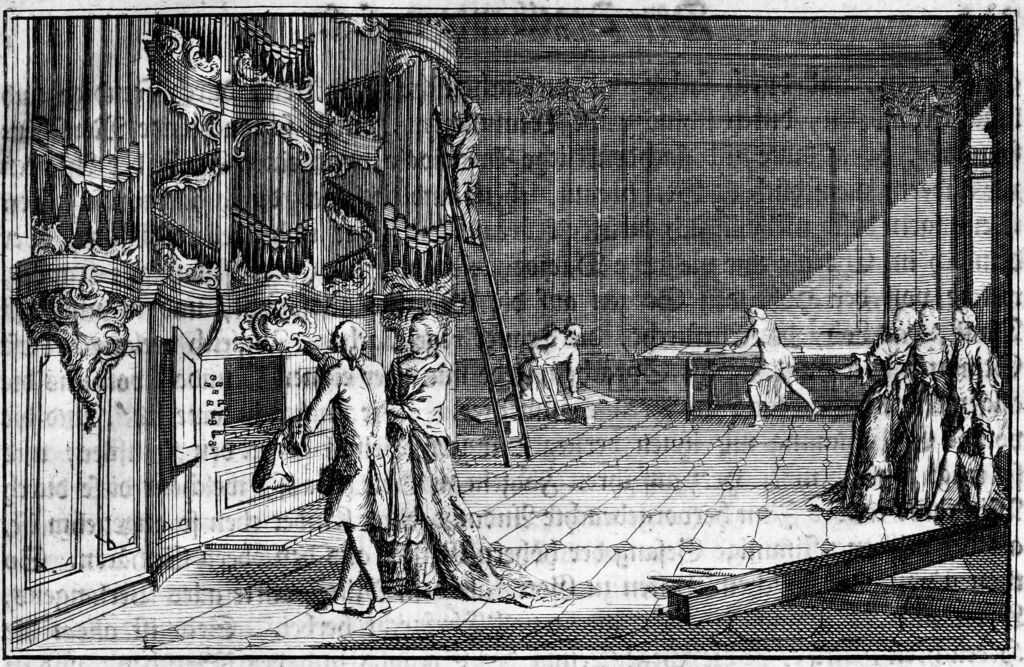
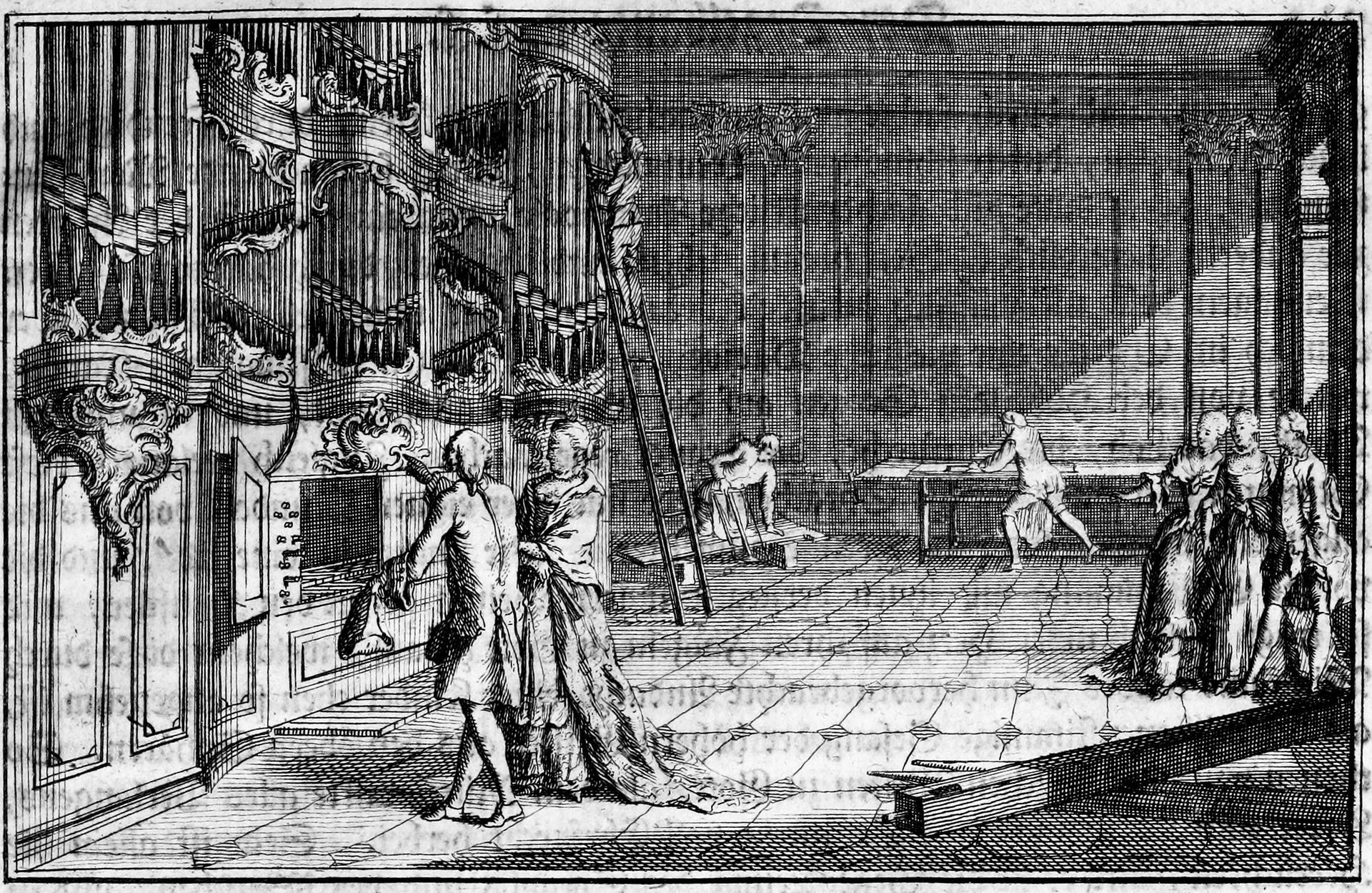
The Art of Organ Building, Described in Theory and Practice is Johann Samuel Halle’s second organ treatise, published in 1779 with eight copperplates. At about three times the length of his 1764 Organ Builder, it expands the account of organ construction and draws heavily on Dom Bédos’s French treatise.
This German–English edition is translated by Jeremy Cox, with philological consultation by Dr. Kira Petersen, and published by Craftsman Technical Companies. Each English page faces the German page it translates. We also offer an English-only reading edition.
Download the German–English PDF · Download the English-only PDF
What Halle covers
Halle divides the work into theory and practice. The first part begins with workshop tools before setting out the scales of flue and reed stops, with tables of diameters, circumferences and lengths.
The second part opens with the windchest, which Halle calls “the foundation of the whole mechanism of the organ.” It goes on to the action, the bellows and wind supply, wooden pipes, casting and soldering metal pipes, voicing and tuning. Later pages give a model contract between a church and an organ builder, the specifications of existing organs, and a survey of earlier writers on the instrument.
The treatise ends with explanations of the eight plates, which show the tools, the pipes and the mechanism.
Contents of the treatise
Halle’s text runs without chapter breaks within its two parts. Our contents list marks where each subject begins, by original page number. Each link opens that passage in the full English text.
- The tools (215)
- The organ stops (223)
- The reed stops (228)
- Scales (Mensur) (230)
- The parts of the organ (233)
- Scale tables for the flue stops (245)
- Scale tables for the reed stops (247)
- Further tools: moulds and gauges (250)
- The windchest (253)
- The keyboards (294)
- The action (301)
- The bellows (304)
- Wooden pipes (313)
- Casting the pipe metal (316)
- Making and soldering the metal pipes (321)
- Setting up the organ (344)
- Voicing (348)
- Tuning (357)
- Repair and enlargement (358)
- Maintenance and costs (362)
- Specifications of existing organs (364)
- A model contract (365)
- Examination and care of the organ (371)
- Combinations of stops (375)
- Dom Bédos’s work (377)
- Earlier writers on the organ (382)
- Explanation of the plates (402)
Skilled work, repeatable methods and lasting instruments
Halle describes an experienced organbuilder testing a spring, selecting the right wire, and then making a bending tool to produce the remaining springs consistently. Elsewhere, he explains how workers form leather purses with wooden tools and leave sufficient slack for the action to move freely.
That relationship between skilled judgment and repeatable production matters to our work at Craftsman Pipe Organs. We use custom tooling and modern manufacturing equipment to produce replacement components, with experienced technicians working alongside apprentices and technicians from related trades. These translations also support the curriculum we are developing for formal education and apprenticeship pathways in pipe organ repair.
Halle makes the economic case for maintenance just as directly: individual parts need attention “before the costs swell considerably.” Preserving an organ means maintaining its working parts and passing on the skills needed to care for them.
Halle and Dom Bédos
Dom Bédos de Celles wrote L’Art du facteur d’orgues for the French Academy’s Description des arts et métiers. Its first three parts were published in 1766 and 1770, and those are the parts Halle used.
On page 377 Halle identifies “the French work in 3 parts, in large folio, on the art of organ building, from which I have hitherto made a very detailed extract.” On page 402 he calls Bédos his principal author and says he has set excerpts from Adlung and Bendeler beside him.
Halle condensed the French and changed details as he went:
- The soldering-iron grip. Bédos joins the two wooden halves with a strip of white leather glued on the outside. Halle joins them with a sheet-metal band.
- The model contract. Bédos prints a specimen agreement between an organ builder and the canons deputized by a cathedral chapter. Halle keeps the agreement and makes the church’s side “Messrs N. N., churchwardens of the church N.” The fee is still stated in French livres.
One work, two titles
In volume VI of Halle’s Werkstäte der heutigen Künste, the treatise is headed Nachtrag zum Orgelbauer, or Supplement to The Organ Builder, with a reference back to volume III, page 313, where the 1764 treatise begins. It was also issued separately in 1779 as Die Kunst des Orgelbaues, theoretisch und praktisch beschrieben. Both titles name the same text.
Inside the edition
The English translation faces facsimiles of the original German pages. Notes explain historical terms and identify differences between Halle’s account and his French source. We translate Halle’s German, not Bédos’s French, and include the organ-building treatise from volume VI rather than the whole volume.
Edition and reuse
Original: Johann Samuel Halle, Nachtrag zum Orgelbauer, in Werkstäte der heutigen Künste, volume VI, 1779, pages 215–412 and Tab. I–VIII. Also issued separately as Die Kunst des Orgelbaues, theoretisch und praktisch beschrieben, Brandenburg, 1779.
The separate issues were printed from the same setting of type as the supplement, though their page numbers can differ. Our edition retains the volume VI pagination for reference alongside the German.
English edition: Translated by Jeremy Cox, with philological consultation by Dr. Kira Petersen. Published by Craftsman Technical Companies, 2026.
The original text and plates are in the public domain. The English translation and notes are licensed under Creative Commons Attribution–NonCommercial 4.0.
Download the German–English PDF · Download the English-only PDF
For Halle’s life, his other writing and why Craftsman publishes these translations, see Johann Samuel Halle and his organ-building treatises.