The Art of Organ Building
Described in Theory and Practice
Translated from the German edition of 1779
Translated by
Jeremy Cox
With philological consultation by
Dr. Kira Petersen
Published by
Craftsman Technical Companies · 2026
English translation and notes copyright 2026 Craftsman Technical Companies, licensed under Creative Commons Attribution-NonCommercial 4.0 International (CC BY-NC 4.0). The original text and plates (1779) are in the public domain.
Halle’s Title Page
The Art of Organ Building,
Described in Theory and Practice
Die Kunst des Orgelbaues, theoretisch und praktisch beschrieben
by
Johann Samuel Halle,
Professor of History at the Royal Prussian Corps of Cadets in Berlin.
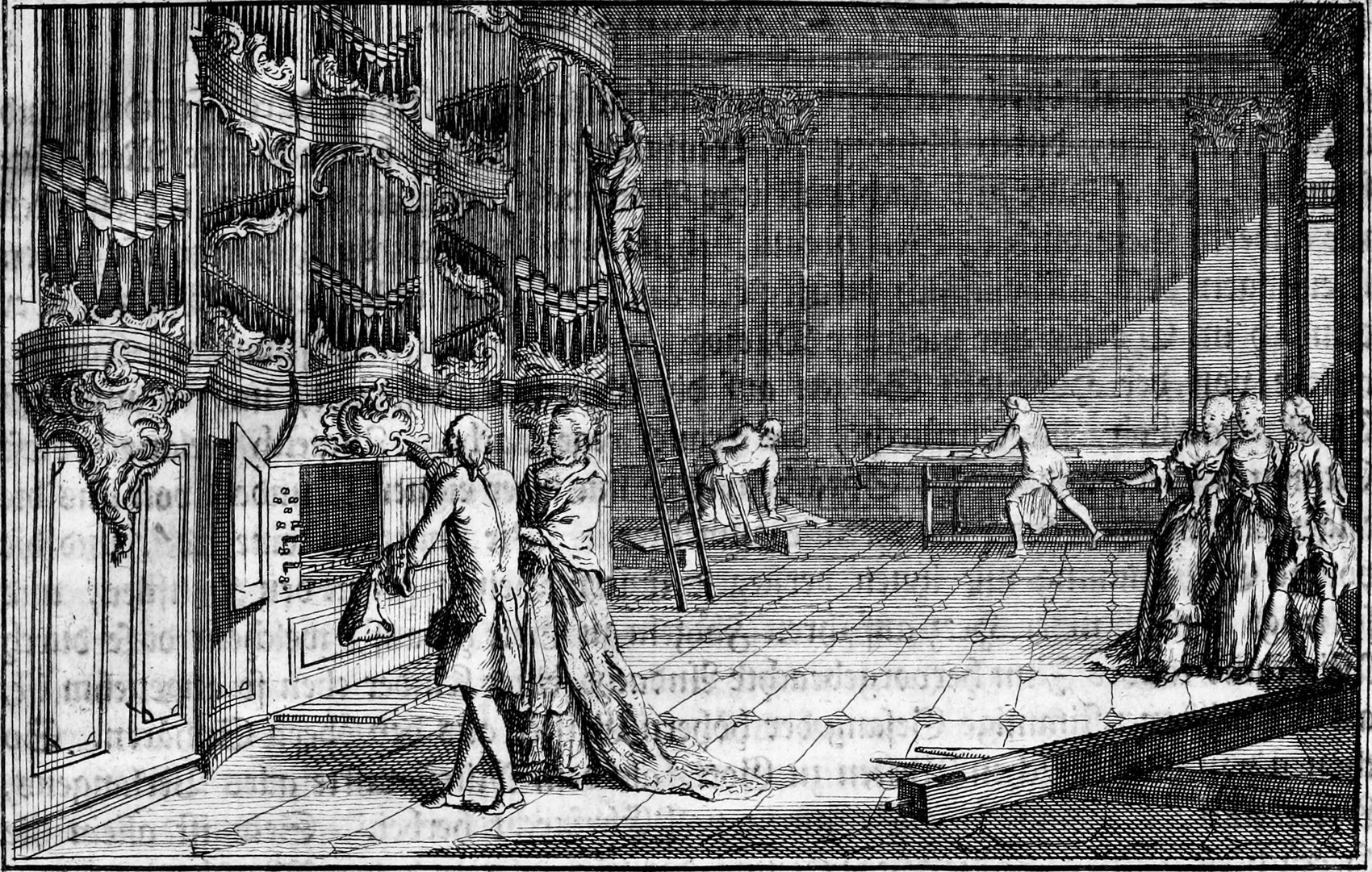
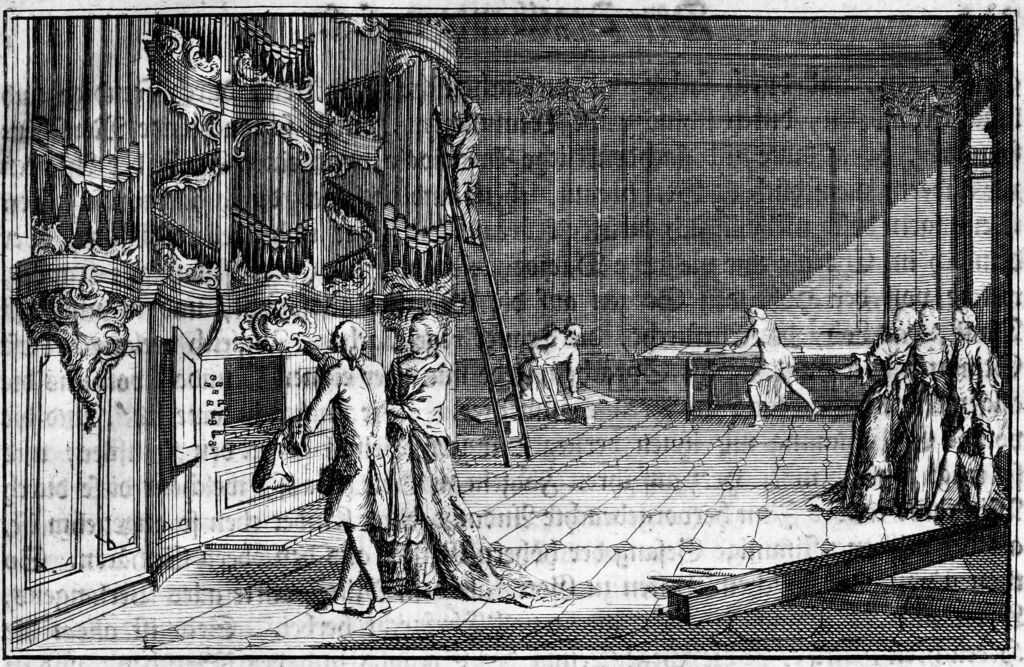
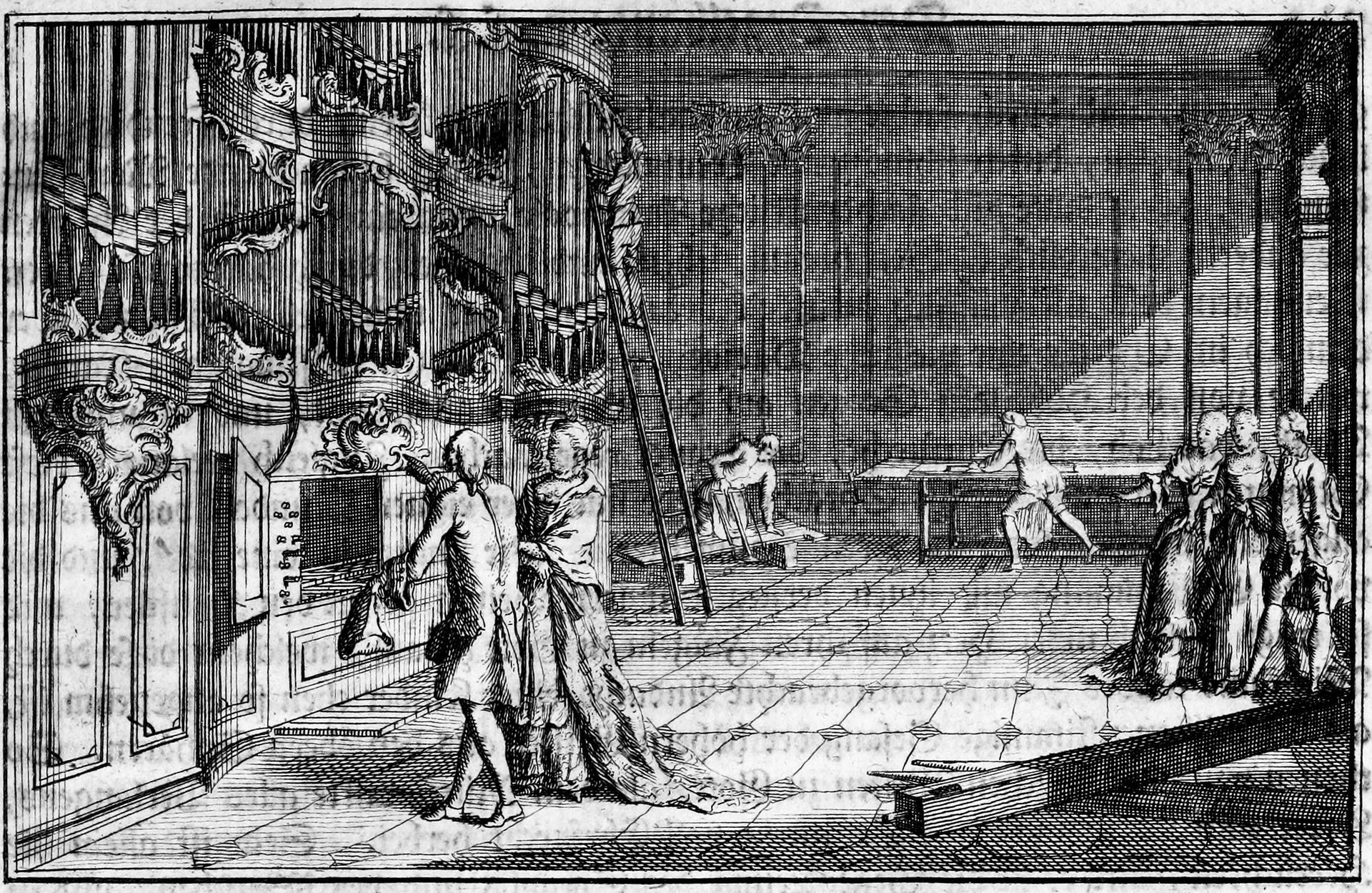
[Engraving: title vignette – workshop or hall with organ case and ladder on the left, workers at a workbench, and visitors]
With VIII copperplates.
Brandenburg,
published by Johann Wendelin Halle and Johann Samuel Halle,
1779.
I. The Theory of Organ Building.
The tools of the organ builders consist of an anvil, which is about 18 Zoll long, 5 to 6 Zoll wide, and at least 2 Zoll thick. It must be steel-faced, hardened and polished on top; its four edges appear rounded. It sits in a wooden stock by means of four strips, which are nailed fast to the block after the anvil has been set on a rag folded many times, so that it may stand all the more firmly. Commonly the block is dug into the ground, in order to stand more firmly, and then its height above the ground, including the anvil, is 22 to 24 Zoll.
The forging hammer weighs 4½ Pfund; its head is round, very slightly convex, well steel-faced, hardened and polished. The body of this hammer is four- or eight-sided. The handle hole is large and strong, so that the handle may hold out well. One also has a smaller forging hammer, for beating with one hand when necessary. This hammer often breaks, either because the handle hole breaks out, or because the steel comes away from the face.
A large hand saw, for cutting through the large tin sheets when they are too thick for the knife. This saw consists of a large, finely toothed blade. It is strengthened along the back of the blade by a thin overlay. Instead of the grip it has a flat piece of wood, one Zoll thick, into which a slit is sawn to receive the blade, which is fastened in the grip by means of two screws. In the handle there is a fairly large hole, to put the 4 fingers through when sawing. The saw blade is commonly 18 Zoll broad.
A small hand saw, all of iron except the grip, which is wood. The blade is about 10 Zoll long, and is a clock spring with still finer teeth. This bow saw is tensioned by means of a screw that is at its upper part.
The keyhole saw is 10 Zoll long, about 20 Linien wide, and sits in a wooden grip; the free end or point of the saw is bent upwards, so that one can take hold of it with the left hand when one guides it with the right. The worn teeth are freshened, as on all saws, by means of the file, since it is made only like a saw.
[216]The burnisher is curved like a cradle rocker, of steel, rounded, hardened very hard, and polished on the back to a mirror finish. From above, in order to hold it conveniently in the hand, it is set in a wooden saddle, and when one has large pieces to polish, a grip is fixed to it, by means of a joint or a notch, on top of the saddle by a peg pushed through. The grip may be 2 Fuß in length. In order to polish the burnisher, it must have the same hardness as a file. The back of the burnisher is whetted on a small oilstone, with the stroke always lengthwise. Then, when one has continued with the oil and whetting so that neither a file stroke nor any traces of the hardening in the fire are to be seen on it any more, one removes all the strokes of the whetstone by rubbing the burnisher hard, but always with the stroke lengthwise, in a not very deep groove or round hollow in a piece of walnut wood, and strewing in fine haematite, which, however, one takes no more than once; only a little oil is given from time to time, until in this rubbing one finds the surface smoother. Then it is rubbed in a similar groove with tin ash and oil, to give it the polish. Besides these, one also has small burnishers of any shape desired.
A strong four-sided piece of wood with a four-sided cut-out serves to hold the sheets of tin or lead fast during work by means of a wedge. For this one seeks a piece of burr wood, or one from the root, which is knotty and tough, so that it may not easily break when it is forced by the wedge.
A plane with a tail bent downwards for gripping. At the front a peg or stick passes through its wood. The edge of the plane iron is straight. Commonly, for better durability, it is shod on its lower face with an iron plate; without this precaution it would soon wear out. All edges are made blunt, especially on the tail, which stands high enough not to cause injury in planing.
The double-mouthed plane is convenient for planing a piece of tin by itself and for finishing the sheet, because it can cut forwards and backwards: when one has worked with it for a time in one direction and the steel-faced iron is worn, one then turns the plane round. Blade and wedge run in one slot. The two openings form a Latin V towards the top. Its wood is put together from two halves glued and bound with iron, and the face is likewise soled with iron, for durability.
The iron plane is of manifold use, and serves to plane the lead sheets, or tin alloyed with lead, as well as to put in order the lip and the edges of the sheets from which the pipes are cut, and to true the pipe foot [217]with the body of the pipes. It is commonly given 7 Zoll of length, 20 Linien of breadth, and 18 Linien of outside depth. It is entirely hollow. The iron lies reversed on a wedge or cushion of hard wood, which is fitted exactly into the plane. A further small iron is fastened at the edge of the mouth of the plane, on which the end of the plane iron rests, so that the force of the wedge may not bend the iron sole at the place of the opening. This small bed iron must be soldered1, and take up the whole inner breadth of the plane. At the back of the wood a strong wire is riveted2, to keep the wooden handle in a horizontal position. In the same way another piece of iron is riveted at the front end of the plane, to serve there as a handle. All edges are made blunt. The whole body of the plane is soldered. The iron lies as obliquely to the cut as possible, and in particular the mouth of the plane must be so narrow that a shaving can scarcely pass through. If one did not wish to observe this precaution, one would tear the tin or metal sheets in planing.
The carving knife is a strong but quite small knife blade, well fastened in a handle that is 18 Zoll long. It is rested against the shoulder.
The hand knife is smaller and weaker than the preceding. The handle has a length of only 5 Zoll.
The square with a raised edge is commonly of copper, or better still of iron. The edge must project below and above by at most one Linie. Its long arm is 7 or 8 Zoll long, and the whole square is nowhere fully one Linie thick.
Dividers of various sizes, with legs ranging from one and a half Fuß down to 6 Zoll. They are also made strong in proportion to their size. The largest look like the dividers of stonecutters or carpenters, and the smallest like those of joiners.
The pipe mandrels are cylinders of wood, round and quite straight. One must keep a considerable number of them, of all sizes and lengths, in stock. Commonly the smallest are made of iron, from 2 to 4 Linien in diameter and up to 8 Zoll in length. Everything above this size is made of wood, and trued in proportion to the organ pipes. The large mandrels must be made some Fuß longer than the pipes, just as the others are made a good deal longer than their pipes. They are planed with the smoothing plane and finished with the hollow plane; but they are never turned.
The foot mandrels of the pipes likewise come in all sizes, but the smallest are of iron. The foot mandrels for the interior pipes of the organ [218]are all of one and the same length, from their point to the body; the body, however, is given an arbitrary measure. Those intended for the Principal3 or the organ front have their particular measures, varying as the pipe feet decrease and grow.
The Trompete4 or Posaune5 mandrels are pointed cones, round, quite straight. Some of 10 Fuß length are needed. For the small Trompete pipes one can make use of the foot mandrels mentioned before.
The foot mandrels of the reedwork, or wherever shallots with tongues and tuning wires occur, are cylinders of hard wood, quite round, and a little thinner at the point than at the body. The point is only short. One has them of all sizes, according to the various Krükkenkeile6. They may be up to 14 Zoll long.
The soldering irons, whose stem is 15 Zoll long and ends in a point. They are a little curved at the bottom and slanting at the point, and it is with this sharp point that one solders. These soldering irons are made of good, well soldered iron, without any flaky seams. One needs three fairly large ones for the largest pipes, three other similar ones, and three still smaller ones for the smallest pipes. The stems are not round but eight-sided. The grip consists of two pieces of oak, which are joined into a hinge by means of a sheet-metal band on the outside7. On each side, on the inside, a notch is made from top to bottom to hold the stem of the iron. These grips are up to 6 Zoll long. One has three of them, to change about when one has become hot. In soldering, this grip is pushed onto the middle of the stem.
The scraping knife. Into a wooden grip one drives a piece of a rapier or of a strong shear blade, in order to grind the point on both sides. The lower surface remains flat.
The solder board is an oak board, 2 to 3 Fuß long and 1½ Zoll thick. In it one hollows out 3 or 4 channels, 6 Linien square and parallel to one another, observing in doing so that the bottom of the channels is somewhat narrower than the top, so that the solder, once poured in, may easily be taken out of these grooves. One of these channels can be one Zoll wide, for casting thicker solder strips. At each end of the channel a piece of wood closes it.
The soldering tile is a fired brick or fired flagstone, flat, and as large as one can get it; one must have several of them at hand in case of need.
The languid mould is entirely of wood and put together from two boards, which are 4 Fuß long8, 4 Zoll wide and about 16 Linien thick. The one board is planed quite smooth and straight in its length and breadth, and the other of these two side boards is thicker at the edge, namely by one Linie. These two side boards [219]are set against each other into an oblong four-sided form, and the wedge which separates their two ends produces an empty space for the molten lead. So that these boards stay properly together or fast, three notches are cut into them, in order to force the mould together by three wedges, so that the lead may not penetrate. For greater security one could fit one more peg at each end9. The two wedges at each end of the mould determine the thickness of the lead sheet. The upper edge of the two boards runs sloping down towards the inside of the mould. It is customary to coat all inner surfaces of the mould with two good layers of chalk and glue, so that it may resist the heat of the lead longer. It is better still to line the whole inside of the mould with sheet iron.
Of shears one needs some of all sizes. These kinds of plate shears serve for cutting through: the smallest, the tongues on the reedworks; the larger, the pipes and the lead lip; and the strongest, a piece of fairly thick copper.
A piece of brass in the form of an isosceles triangle for the cut-up of the front pipes, 4 Zoll10 wide at the base, 10 Zoll high, one Linie11 thick, with a rim projecting on one side along the base, as a gauge for the flute-work.
The scraper for the front pipes is a plate of well-hardened and blued steel, up to 7 Zoll long, 2 Zoll wide and a quarter of a Linie thick. It must be quite smooth and polished on both flat faces. One grinds the two edges of this oval plate square on an oilstone, and always lengthwise, and never crosswise12. This plate must be well protected from rust, and, like the burnisher, kept in soft linen and often rubbed over again with haematite.
The voicing knife. The handle and blade are of one piece and flat. One covers the tang on both sides with horn, as on ordinary knives, by riveting these scales on. It must be strong, one Linie thick at the back, its edge straight and the point short, so that it does not become notched or chip when one cuts thick tin.
The test mould for tin is a rectangular block of brick or fine sandstone, 4½ Zoll long, 3 Zoll wide and 12 Linien thick, in which a semicircular, somewhat conical hollow is cut, 10 Linien in diameter and 6 Linien deep. At one and a half Zoll from the hollow one makes another channel, of 4 Linien in diameter, which ends in a small pit. In short, it looks like a spoon mould.
[220]The form for the shallots of the reedworks. One makes it of beaten copper, but it is better if one forges it of iron. Some cast it of iron, but this is no good, because one would have much trouble if one wished to repair it, since this material is much too hard and brittle. Externally it is oblong. To forge it, one first makes a pattern of wood, which the locksmith copies in iron, digging out each channel of this shallot die with gravers or graving irons and finishing it with the file. The bottom of this die is straight and flat: the largest channel is about 6 Zoll long in the form, which is about 8 Zoll long. For really large organs, however, one makes another die of tin with larger channels, because one makes only few such large shallots. There are as many channels as a whole stop requires, i.e. through the whole manual or pedal.
The tongue formers are oblong iron plates, rounded at the back and at one end.13 One must have as many tongue formers as there are rounded channels hollowed out in the preceding die; and each tongue former must have a thickness and length proportionate to each channel, so that the largest of these iron plates becomes 2 Linien less thick than the largest channel of the die, and at least 4 to 5 Zoll longer. The tongue former for the second channel is 1¾ Linie less thick than its channel is wide. The smallest becomes ¼ Linie thinner than its channel is wide14, and 3 or 4 Zoll longer. The widths of the tongue formers are arbitrary. The largest receives at least one Zoll of width, and the smallest half as much.
The tuning wires (Krükken, or Stimmdrat) are iron cylinders of all sizes, somewhat rounded at one end. The four or five smallest wires are of steel. Their length is governed by their thickness. The lengths are arbitrary, but the thicknesses essential.
A large file for truing the shallots is 2½ Zoll wide and 14 Zoll long. Its thickness remains arbitrary, about 6 to 8 Linien. One of its faces is cut coarse, the other fine. Since it is not good when bought from the ironmongers, it is made by the file-cutter. In its shape it is oblong, and has a ring at each of its two ends.
The pointed pliers with closing points; of these the largest are the most convenient.
The long beak pliers with very long, tightly closing points. They are 15 Zoll long overall.
There follow bits of all sizes, and wood rasps of various kinds.
[221]A brace and bit, which is of steel, because in organ building it has much to bear. Its hollow socket, by which it sits in the bow, is commonly square, and fastened in it by a well-hardened steel screw so as not to wobble; therefore it is better if the socket hole is triangular. One must have some fifty bits of all sizes, among them some flat, others conical at the point, with cutting channels filed in from the point to the base, as in a file. The base is one and a half Zoll, and the length of this bit is 1 Zoll 9 Linien; the tail has 8 Zoll. Sometimes one sets into this brace bit, whose bow one turns round by the handle during the work, such needles as the bag-makers use, which are up to 4 Zoll long. One pours molten tin into a hole in a piece of wood; while the tin is still liquid one inserts the eye of the needle, and when the tin has become cold one files it until it fits into the hole of the brace bit, taking care only that the needle stands quite straight. Before one puts the tin head on the needle, one first softens it on coals, to take from it the hardening that makes it brittle.
The lathe for boring out the pipe feet, or making them wider, consists of two short uprights with two poppets, and a copper spindle whose projecting end is hollow, into which one solders another cone of brass with tin solder.
A scraper of well-hardened steel, triangular at both ends like a lance.
A stroking iron, for stroking the tongues, is an iron straightedge, 8 Zoll long, 10 Linien thick15, well filed, flat and smooth.
In addition, flat files 8 Zoll long of all kinds of cut also belong here, for the tongues of brass, half-round ones, etc. The English ones are the best.
Burning irons are little iron rods, 18 Zoll long, with a conical head at both ends, one of which is 15 Linien in diameter and the other 8.
The wind gauge, for measuring the strength of the wind. It is a copper box, 2 Zoll high, 2 Zoll 6 Linien in diameter. Its top surface has three holes; the largest hole is 10 Linien, the second 8, the third 6 Linien wide. On the two smaller ones one solders a collar 6 Linien high. A tube 10 Linien wide is 5 Zoll 6 Linien long where it bends round at a right angle, in order to go down 2 Zoll 6 Linien long along the box and reach its bottom, this end being filed out like a saw. The tube is soldered into the largest hole in the top surface of the box, just as its long end, which touches the box on the outside, is also soldered on there. All these solderings are done with zinc or silver, and are carried out with all precision [222]. Into the middle hole, in the shoulder ring, a good cork stopper is inserted, and another into the small hole, where the scale goes. In this last stopper one bores a hole, in order to insert a thick piece of a barometer tube whose inner bore is at most one Linie wide. This glass tube is 5 Zoll long and sits one Zoll in the stopper. Consequently it projects 4 Zoll out of the box. Along it one glues a strip of paper, which one divides into graduations from one half Linie to the next, and these one numbers by fives, beginning from the bottom, so that here 5, 10, 15 and so on go upwards. On the outside this tube must have at least three and a half Linien in diameter.
The tuning flute is a small flute for giving the correct pitch of the organ and other instruments; made of ebony, boxwood, ivory or other hard wood, on the lathe, so that the inner bore is six and a half Linien wide, and the cylinder or flute body 5 Zoll 8 Linien long. The inner bore must be perfectly even, smooth and straight. The cut-up is four and a half Linien wide, and as on an ordinary flute that one takes into the mouth. The head of the flute, or the mouthpiece, is almost entirely pointed, and the blowing hole in it is one Linie wide, and round, like this beak. It is screwed onto the head.16 In the flute tube there is a piston, whose outer diameter is a quarter of a Linie smaller than the hollow width of the flute. Its end is hollowed out 2 Zoll deep and pared down on the outside, so that a soft leather spread with soap can be glued round it. In this way the piston goes snugly in the flute. Along the piston one marks the notes from a well-tuned organ.
The tuning horn, of which one has large and small ones, is a brass cone soldered with strong solder and hammered hard under the hammer. One must not turn them, for otherwise they would come out too round and serve badly. But they may be polished on the lathe, and they become round enough if one hammers them hard. The height of these hollow cones is one and a half diameters of the base.
The double tuning horns are narrower cones of brass, half a Linie thick, soldered with hard solder, hammered hard, but not turned. The handles and the hollow end may be turned. For the sake of lightness everything is made hollow. Some six are enough for all kinds of organs, and they must, especially the single tuning horns, be strong enough not to get dents easily from falling and knocks. The upper end of the double ones is thus a cone, to put into the pipe in order to make the tone lower; whereas the lower end has within it a hollow cone of brass, which one sets onto the pipe from outside in order to make the tin narrower. The lower or hollow cone end has somewhat more width inside than the upper end has outside.
[223]The silk swab is, as it were, a brush of silk threads on an iron wire. For this purpose one takes a silk fringe, whose end one winds round a wire. One glues it to the wire. Of these brushes one needs a quantity, large and small.
The voicing iron is about 10 Zoll long, round, and of unhardened steel at least at both ends. The one end is quite thin, long and pointed, and the large end flat, cut off straight, filed to an edge on one side, almost like a chisel, and pressed down for more than a Zoll.
The screwdriver is entirely of iron, forged with all care, 14 Zoll long, 6 Linien square, with chamfered edges towards the middle. At the front is a hook; at the other end there are two short, parallel grips standing upright, which are round, have 6 Linien in diameter and 14 Linien of length, and stand 6 Linien apart.
The pallet scraper is a brass wire, one Fuß17 long, strong, hammered, with a turned-up end that is broad, flat and almost cutting, shaped like a crutch18.
Two small hand vices, one pointed, the other with ordinary jaws; as also large ones, 30 Pfund19 in weight. A couple of stone chisels, an iron ladle, and a larger one for 5 Pfund of tin;20 hand hammers, tongs and so on. Besides these, each man devises tools according to his needs, and the casting equipment will come below with the cast tin sheets.
The organ stops. These are a row of pipes of the same kind, which commonly stand on one and the same slider and give a sequence of tones in chromatic progression. For the most part they run through four octaves, although some stops have only three, or two octaves, etc.; since some are suited only to imitate the bass, others only the treble. All organ stops can be divided into flue works and reedworks.
The flue stops (Flötenstimmen) are so called because the wind sounds them as one sounds an ordinary flute with the mouth. Such a pipe, if it is of tin, consists of at least three pieces. Its cylindrical or conical upper part is called the body. Its conical foot is the part with which it is inserted and stands in the pipe board. The mouth is called the cut-up. The pressed-in hollow above the mouth slit is called the upper lip, and the smaller flat depression below the slit the lower lip. The flat plate that passes crosswise through the pipe at the slit, cut straight at the front, is the languid. The wind enters the pipe through the lower wind hole of the pipe foot. Between the round languid, cut away at the front, and the edge of the lower lip a small opening arises, through which the wind goes according to the form of this plate, and reaches the edge of the upper lip. [224]The front side of the languid is thus flat, but cut somewhat obliquely. The remaining round side of it is given a blunt projection, so that it can be soldered in more conveniently. It is soldered to the foot of the pipe, however, and so the wind from the pipe foot can come out nowhere except at the front, at the segment of the languid, because the whole languid, except for this segment, is soldered to the pipe all round. Finally the body of the pipe is also soldered to this languid. At the bottom the foot of the pipe is beaten narrower, so that with this shoulder it sits snugly in the toeboard. This, and the foot hole of the pipe, must therefore receive its proper Windmaaß21. The length of the feet contributes nothing to the tone, except that they admit too much or too little wind. The feet of all the inner stops of an organ that do not come into view are commonly 8 or 9 Zoll high.
The flue works can be divided into the Oktavstimmen22 or foundation stops and the Veränderungsstimmen23. The latter are divided again into the simple and the compound. All these stops are made of tin, wood or metal, i.e. lead, to which a very little tin is added for stiffness and a sharper sound.
Most Oktavstimmen are either open or stopped, i.e. closed at the top with a cap. When they are open, they are commonly named after their first and largest pipe. So one says a stop of 8, of 16 Fuß, because in this row of pipes the first or largest really has 8 Fuß, etc. In France, however, a 4-foot stop is called Prestant24, and a 2-foot one Doublette25. A stop that is twice as large as another sounds an octave lower. So an 8-foot work sounds an octave lower than a 4-foot one.
The Prestant (Principal) bears this fine name not because of its excellent harmony, but because all other stops are tuned to it, since it holds the mean between the bass tones of the largest and the high treble tones of the rest. It can therefore best be brought to a fixed degree, and falls most comfortably on the ear.
However, an 8-foot work is taken as the foundation and proper pitch of an organ. It accords with the natural human voice and with almost all instruments: with the harpsichord, violoncello, with the bass viol, trombone, oboe and the flute.26 All the remaining organ stops have been devised merely to support the eight-foot tone, and to imitate all musical instruments, so as to make one whole. These four principal stops, namely 32, 16, 8 and 4 Fuß or Prestant, give a whole organ its name, and one says of an organ: it is a 32-foot work in the façade, or a 16-, 8- or 4-foot work. These stops come to be seen at the front of the organ, if one has [225]room for it and can meet the costs. Sometimes, however, for lack of room, one hides the bass pipes, e.g. of a 16-foot, behind the façade, and brings them into the façade only from 8 Fuß onwards, and then one says: an 8-foot work in the façade, with a 16-foot open inside, although it always and in fact remains a 16-foot work.
Of closed pipes there are two kinds: the entirely stopped-up (gedakkt27) ones and the Rohrflöten28. The latter are an intermediate kind between the stopped and the open. The stopped ones always speak an octave, i.e. by 8 keyboard keys, lower than the open ones, although they have the same height. So a closed or stopped 16 Fuß pipe sounds just like an open 32-foot one; or stopped 4 Fuß like 8 Fuß open.
All stopped stops are called Bourdons29 when they belong to the foundation of the organ, and even the Rohrpfeifen30. Bourdon means the same as a humming pipe. All these pipes sound an octave lower than they would sound open, because the wind passes through their height, but because of the cap it is forced to return to the cut-up, and so must run through the height of the pipe twice. Since the Rohrpfeife is partly open, partly closed, one must give them almost the same height, the height of the tube included, as if they were open, because part of the wind goes away through the tube and the other part goes back to the cut-up. This return of the air stream means that the stopped pipes and the Rohrpfeifen are given a larger cut-up (ausgekehlet)31 than the open ones receive. Their slit is therefore wider. The Gedakkten (Bourdons) commonly receive their name from their pitch. So 16 Fuß Gedakkt is called Bourdon of 32 Fuß, because it speaks just like 32 Fuß open. The smallest Bourdon is Gedakkt 4 Fuß, which nevertheless sounds like 8 Fuß open.
These foundation stops or Oktavstimmen of the organ sometimes cannot be complete. So it is something rare that C is 32 Fuß, because in this stop one always leaves out at least the first four or lowest pipes, and often up to nine. This is partly because such large bodies cost a great deal, partly because there is not always room for them in a small organ case, but most of all because they consume a great quantity of wind, which would at once empty the Windlade32. They are therefore placed on the pedal Windlade, which is much larger. In the same way, with the remaining stops, one is guided by the room, and the finest must often stand behind the façade.
The Veränderungsstimmen or Hülfsstimmen33 are so called because they commonly do not sound in unison with the octave or fundamental pitch of the organ, but give its fifth or third. They are also called compound or multiple stops, or Mixturen34, because several rows of pipes stand on one and the same slider, and one key of the keyboard sounds several of them together at once [226]. So the Mixtur (fourniture35) consists of three to seven rows of pipes through the whole keyboard, as if they were seven separate stops. The Cornets36 always have five rows of pipes.
All stops of the organ are divided according to the cut into the narrow, middle and wide cut, according to whether the tone is to become grave or not. I will take as a basis a pipe of each stop whose body is to be 6 Zoll high. If this pipe is to be made according to the narrow cut, e.g. in Positive37, it receives 6 Linien in width (diameter). If it is to have a medium Mensur38 and be open, it is made 9 wide. Open and according to the wide cut, it is given 12 Linien in width. If it is stopped, it receives 14 Linien width. Large organs follow the wide Mensur.
Conical pipes that are narrow at the tip and become broader below at the cut-up (Spillpfeifen39) sound almost like Rohrpfeifen. They are commonly used in the treble of the Nasard40 when the bass has Rohrpfeifen, as is now customary in the Positive. Yet in good organs the Nasard also consists entirely of such Spillpfeifen. The Nasard, however, is a tin stop that speaks, as it were, through the nose. Conical pipes that are wide at the top like a trumpet, and half as wide at the bottom at the lip, are good only for the treble of open eight-foot, to mix with the Flöten41, for which they are exceptionally well suited.
In France the following flue pipes (jeu à bouche42) are usual: 32 Fuß open, Bourdon of 32 Fuß; 16 Fuß open, Bourdon of 16 Fuß; 8 Fuß open, Bourdon of 8 Fuß; Grobnasard43, Prestant, grosse Terz44, Larigot45 (wide Flöte), Nasard, Doublette, Quarte von Nasard46, the Terz47, Mixtur, Cimbel48, Cornet, Basse de Viole49. All other organ stops are only a repetition of these under new names and Mensuren.
Throughout all stops pure tin has a great advantage over all lead and tin-lead, because tin makes a sharper tone, more harmony and no rust, although inside the organ almost all the feet are made of lead. All lead puts on a white rust (white lead) like a white salt, partly from the moisture of the mouth, partly from the mere damp air that the bellows press in, so that lead pipes, even within a year, appear eaten away, white and rough at the feet, and even in dry rooms. They therefore take in or let through more wind and consequently spoil the harmony. Lead also spreads a creeping poison in the mouth of anyone who takes a pipe into the mouth to sound a note. In particular this delicate rust gnaws away the delicate edges of the lips and of the languid, though it is this delicacy alone that makes the tone. Finally, a pipe of lead, or of lead-tin (I shall call this adulteration, [227]which brings organ builders so much profit, by that name, although they give it the name metal [étoffe50]), bends very easily in tuning and handling, whereby its tone and roundness are lost. That is why many defrauded organs must be tuned so often.
Großnasard is a Hülfsstimme of large cut51, entirely open, and the fifth to eight-foot. Its largest pipe is 5 Fuß, 4 Zoll long. It runs through the whole keyboard. Some pipes are made of wood, the rest of lead-tin. It gives weight to large organs. The grosse Terz is open and of wide cut, of lead-tin, runs through the whole keyboard and gives the third of the Prestant. A Bourdon of 16 Fuß goes well with it. Its largest pipe is 3 Fuß, 2 Zoll. The Nasard is open, of wide Mensur, lead-tin, and runs right through the keyboard. It gives the fifth of the Prestant, or the octave of the Großnasard. This stop occurs in large and small organs, especially in Positive, where it has a tube and narrow cut. Its treble can have Spillpfeifen. The largest pipe is 2 Fuß 8 Zoll. The Quarte von Nasard is open, of lead-tin, throughout, of wide Mensur, and is drawn with the Nasards and Terzen. It gives the fourth of the Nasard from above. The first pipe is 2 Fuß. The Terz is open, of wide Mensur, of tin or tin-lead, throughout, and gives the third of two-foot, or the octave of the grosse Terz. Its largest pipe amounts to 19 Zoll. The Larigot is open, a Hülfsstimme of wide cut, throughout, of tin-lead, and speaks the octave of the Nasard, or the fifth of two-foot. This stop is the highest and is suited only to Positive. The largest pipe is 16 Zoll. The Mixtur is of narrow Mensur, of the finest tin, throughout, three- or sevenfold. Its second row is the fifth of the first; the third the octave of the first; the fourth the fifth of the third, or octave of the second, etc. The Cimbel is of narrow Mensur, open, of the finest tin, throughout, smaller in pipes than the Mixtur, but also of many rows, so that in each row the pipes are taken again seven times, whereas in the Mixtur (fourniture) this happens only three times. The second Cimbel row is the fifth of the first, and partly the fourth; the third is an octave higher than the first; the fourth like the second, but an octave higher, and so on up to the ninth row. The Cimbel is always played together with the Mixtur, and the foundation stops of the organ must give harmony and correctness to these many-rowed stops, which are called plein jeu52, since on their own they shriek confusedly. The Cornet is of wide cut, of lead-tin, of five rows: the first row sounds like a Bourdon of 8 Fuß; the second like the treble of the Prestant; the third as the treble of Nasard, or as the Prestant fifth from above; the fourth as the Quarte von Nasard; the fifth as [228]the Terz treble. The Cornet, however, beautifies only the treble. Let many Cornets be placed together in a large organ. The Baßgeige53 (basse de viole), of tin, throughout, eight-foot in the length Mensur, but cut according to the Prestant in width. It sounds in unison with the Prestant.
The reedworks (jeux d’anche54) sound by means of a shallot, or tongue. These give the organ stops the greatest strength and the most brilliance. They may be compared with the other instruments of music, such as the bassoon or oboe, which are likewise played through a mouthpiece, which is taken between the lips, and is a reed with a tongue, which plays freely and is put wholly into the mouth. The bass trombone, the hunting horn, the trumpet etc. also have their mouthpieces, or a round top-piece with a hollow, instead of the tongue, in order to set the lips to it. Here are the Trompete, the Clairon55, the Cromorne56 (changed by the German organ builders into Krummhorn) and the Menschenstimme57. Newer reedworks are the Hautbois58 and the Sakkpfeife59 (musette60). The Regal61 is no longer the fashion in church organs, but is still found only in the portable cases (Leiern62), because it is very small. All reedworks are of brass and of one and the same construction, and differ only in size.63 To a reedwork belongs the following, e.g. a large Trompete pipe, whose lower part sits in another tube, which is called the box (boite64). This box is soldered together with the cylindrical block, in which the shallot with the tongue is fastened by a wooden wedge; the tongue is pressed more or less against the channel by a tuning wire; block, tuning wire, wedge, tongue and channel belong to the pipe foot, and are enclosed in it, invisible as it were; the lowest end of the pipe foot is conically thinner, in order to fit better into the toeboard. The shallot is a roundish stamped channel of brass, open at one end, thick in metal. This channel is covered from above with a flat brass plate, whose thickness is great when the channel is thick, long and broad, exactly like a sliding lid on a little box. This tongue must be thicker if it has not been hammered very hard with the hammer, and so conversely. The tongue is not, however, entirely straight-flat, for otherwise it would close the channel exactly, like a flap, and the wind would press it exactly against it; it is therefore made a little raised, or bellied-flat, and so the wind finds at the front between the channel and tongue an opening or slit by which to penetrate into the channel, to shake the tongue. These rapid vibrations of the tongue give a high, and the slow ones a low, buzzing tone. Everything sits fast in the cast block in the pipe foot. The tuning wire is an iron wire, well hammered, or a brass wire; it serves for tuning the shallot, has for this purpose a notch at the top, and at the bottom is bent round on the [229]tongue like a small pressing spring, in order to press it there against the shallot; it sits fast in the core, so as not to sink or put the pipe out of tune; and one knocks it further down on the tongue if this is to sound higher, and upwards if it is to sound lower. The tongue is thus as it were made shorter by this and springs faster, or longer, and vibrates slowly, or lower. The tuning wire is thick in large pipes, thinner in small ones. Now if the pipe which stands above the shallot is like a cone, broad at the top, narrow at the bottom, the tone of the shallot becomes louder, as in speaking trumpets. If it is cylindrical, the tone does not become so strong; if the cone is narrower at the top than at the bottom, the shallot sounds more softly. At the same time the tone becomes trumpet-like or otherwise. These pipes are conical in the Posaune, Trompete and the Clairon, and therefore the loudest of the organ, but of one and the same construction, except that the large pipes have a square block and box, the middle ones round blocks and a ring, and the small ones a round block without a ring. The ring is of lead, and prevents, at the upper part of the pipe foot, the block and the pipe from sinking too deep down into the foot. The ring is split from the top downwards for the path of the tuning wire, and occurs in the second octave of the Trompete, and the first of the Clairon. The pipe of the Cromorne is narrow and cylindrical; at its lower end is a cone, and at its point the round block is soldered on. The Menschenstimme is built like the Cromorne, but half open at the top, so as not to shriek so. Its pipes are small; the first is 6 Zoll, and often not even so long. The Hautbois is conical, wider at the top, sits in a still narrower cone, and the two are soldered together. A thick ring fills out the foot. The Dudelsakk (musette)65 is a cone thin at the top, which is otherwise quite narrow.
The Posaune is a 16-foot reedwork, which agrees with 16 Fuß open. All the pipes are conical, wider at the top, of fine tin, and sound the loudest; they go through the whole keyboard, and in large organs are often played from a third keyboard; or they are taken into the pedal. The Trompete is of 8 Fuß, conical, of fine tin, sounds an octave higher than the Posaune, and like 8 Fuß open; it is splendid, and runs throughout. Large organs even receive three Trompete stops on one and the same keyboard, or in the pedal. The Clairon is 4 Fuß, of fine tin, built entirely like the Trompete, but an octave higher, throughout, in the manual or pedal. The Cromorne is cylindrical, of 4 Fuß, and sounds 8-foot like the Trompete; it is made of fine tin, throughout, mostly in Positive and rooms. The Menschenstimme is of tin, throughout, with short pipes, of 8 Fuß Thon, and everyone tinkers with it according to their own taste, although the Menschenstimme is seldom hit off well. The Hautbois, conical, of fine tin, sounds in unison with the Trompete treble, and [230]makes a good harmony. The Musette has inverted cones, is made of fine tin, and goes through the whole keyboard in organs or Positive; it sounds 8-foot, and is only 4 Fuß. The tone is weaker than in the Cromorne, and this stop is still little known in France. The Regal was the first invention of reedworks, but on account of its bleating (as of wethers), although for joy it was called the King’s Voice, it has been done away with now that there are better reedworks. Sheet iron serves for no reedwork, because the rust spoils everything.
By the word Mensur, or Diapason66, which signifies a succession of tones in Greek, one understands the progression or succession of the tones of an octave, or the measure of the octave tones (la gamme67), that is, of the Ut, Re, Mi, Fa, Sol, La invented by Aretin, among those who use solmisation. By this Mensur the organ builders understand the measures for each pipe, or its cutting-out, since each stop requires its essential Mensur, according to which its pipes are proportioned. It is hardly possible to find, by the help of geometry, the gradation in the decrease of the thickness of the pipe materials, because all pipes must be perfectly round, exactly cylindrical, since the only means of giving a pipe its right tone rests on one’s making its top opening narrower or wider, the foot hole narrower or wider for the wind, the upper lip larger or smaller, pressing it in or out, setting the languid lower or higher, etc. All this, however, alters the proper measure in the geometrical gradation and spoils the harmony; even if one wished to make a pipe which is to become an octave higher shorter and narrower by half. Consequently one must hold to the experience of the best organ builders.
The double Hauptmaaß68 of every stop of tin or of mixed tin rests on the length and breadth of a tin sheet, which is rounded on its wooden mandrel. The chromatic scale consists of 12 semitones, namely C, Cis, D, Dis, E, F, Fis, G, Gis, A, Ais, (B) H, C; or Ut, Ut x, Re, Mi b, Mi, Fa, Fa x, Sol, Sol x, La, Si b, Si, Ut. And so too are named all the keys or the claves of the organ keyboard, both in the manual and in the pedal, as on every clavichord or harpsichord. The keyboard consists of four octaves (gammes69). The one which begins from the left hand is called the first; the following one is called the second, and there follow the third and fourth octave, which determines the end of the keyboard at the right hand. In order, then, to distinguish the keys, one says the first C, the second C, the third C etc., since each octave consists of 7 keys, and each set of octave keys always gives the same names to the keys, since in the diatonic scale 5 whole and 2 half tones follow one upon another. The white half-split (feintes70) keys which lie between these bear the ending -is by virtue of the added sharp sign, or the ending -es, or flat sign, [231]e.g. Cis, Dis etc. or B, Fes, Ces. The pipes bear these same names as the keys, e.g. the first C in the Gedakkt 8 Fuß.
In order to cut out the pipes of a stop according to their proper Mensur, one must know three things, namely the length and breadth of the first or largest pipe in this stop; merely the breadth of the smallest or last; the ratios of its octave, fourth and fifth. As concerns these ratios of the octave, fourth and fifth, the following is to be observed. The octave is in the ratio of 1 to 2, that is, if a pipe is shorter by half than another, it sounds an octave higher, that is, higher in pitch. E.g. in the Doublette of 2 Fuß the first C is 2 Fuß long; consequently its second C pipe in the second octave receives only one Fuß of length. The ratio of the fourth is as 3 to 4, that is, if a pipe has three-quarters of the length of another, it sounds the fourth above, or higher. Thus in the Doublette the first or lowest C is 2 Fuß, but its fourth F only three-quarters of 2 Fuß, that is, 18 Zoll long. The ratio of the fifth is as 2 to 3, that is, if the first pipe has 2 Fuß of height, its fifth, namely G, must become two-thirds of 2 Fuß, that is, 16 Zoll long. Here follows a table of the length of an octave, to serve for the Mensur.
C is known.
F, or the fourth, receives three-quarters of C.
G, or the fifth, is two-thirds of C.
D, or the descending fourth, is four-thirds of G.
A, or the fifth, is two-thirds of D.
E, or the descending fourth, is four-thirds of A.
B, or the fifth, is two-thirds of E.71
B b, or the fourth, is three-quarters of F.
E b, or the downward-stepping fifth, is three-quarters of B b.
G x, or the fourth, is three-quarters of E b.
C x, or the descending fifth, is three-quarters of G x.
F x, or the fourth, is three-quarters of C x.
According to this prescription one draws a line, which one divides in just the same way with the dividers, and marks off through all four octaves. Now if one wants to have a stop of 4 Fuß, one takes the total lengths of the Doublette, or of the two-foot, doubled. If one wants to have an 8 Fuß work, one takes the whole first octave of 4 Fuß double, and so on up to 32 Fuß. This is a general rule for all the Mensuren of stops. One need therefore only divide one octave, whichever one wishes, and that according to the three ratios mentioned. Afterwards one divides each length of this octave into two equal parts, in order to obtain the following ascending or higher octave. This one divides again, in order to have the still higher one. To find the descending [232]octaves, one takes all the lengths doubled. But one must always first begin with a chosen largest pipe.
A single line also gives the width of the pipes, and for this one need only have the width of the first and last pipe. The first pipe or C of the Doublette is 2 Zoll 1½ Linien in diameter, that is, it is 2 Zoll 1½ Linien wide; the fifth C or the highest pipe must measure 3¾ Linien in diameter. Here everything depends only on finding the circumferences of these two pipes. Every diameter of the circle is to its periphery or circumference as 100 to 314, that is, if the diameter has 100 Linien, the circuit has 314 Linien. And now one concludes according to the rule of three: as 100 to 314, so 2 Zoll and 1½ Linien, that is, the width of the first C of the Doublette, to the as yet unknown periphery. One therefore converts the 2 Zoll 1½ Linien into 51 half Linien, which one multiplies by 314, and so one obtains 16014, from which one cuts off the last two figures, namely 14; thus there remain 160 half Linien, or 80 Linien, or 6 Zoll 8 Linien for the periphery of the C pipe. In order to have the width of the fifth or last C, one at once converts (in order to avoid fractions) its diameter, that is, 3¾ Linien, into quarters of a Linie, that is, into 15 quarters of a Linie. Now one says: as 100 to 314, so these 15. 314 multiplied by 15 gives 4710, from which, the last two figures 10 being cut off, 47 quarters of a Linie remain. 47 quarters of a Linie make 11¾ Linien for the circuit of the pipe. Both widths are set together as a right angle.
In the Nasardquarte the first C is 2 Zoll 8 Linien in diameter, and 22 Zoll 10 Linien long, as a 2-foot work, but of wide cut: the last pipe C is 5 Linien wide. In the 32-foot, open and of tin, F, for example, is 24 Fuß72 long and 3 Fuß 11 Zoll wide. In the Prestant the diameter of the first C is 3 Zoll 6 Linien, the diameter of the last C 5 Linien. In the square open wooden pipes the first C of the 32-foot is 16 Zoll 4 Linien inside73, its last F 1 Zoll 11½ Linien. The first C of the 16-foot is 10 Zoll 7 Linien inside, the last F 1 Zoll 10½ Linien. The first C of the 8-foot is 6 Zoll 3 Linien inside, the last F 1 Zoll 10½ Linien. The first C of the 4-foot is 3 Zoll 6½ Linien inside, its last F 1 Zoll 10½ Linien. Among the reed pipes the organ builders speak of a Trompete of 6 or 4 Zoll. By this they mean a Trompete whose first C has a diameter of 6 or 4 Zoll at its wide end. However, the correct proportioning of the lower end, of the block, etc., also belongs to it. In the reed stops one always casts the block of lead, or so-called Probezinn74, and the rings of tin; the lead, however, wears away, and so the shallot easily shifts in the block, since lead yields. Consequently blocks of tin would be better.
[233]On an organ, from the outside, one sees the organ case of elegant joinery, ornaments or carvings, and large polished tin façade pipes (montre75). Inside, the Windlade is the principal part. On this Windlade (sommier76) the pipes stand, and from it the wind is distributed to the pipes. The chief parts of the Windlade are the wind box (la laye77), the Cancellen78 (gravures79) and the sliders. The wind box is the container of the wind, and this wind box contains the pallets (soupappes80, Hauptventile81) with their springs. The Cancellen are hollow channels, or hollow grooves in the wood, running across the breadth of the Windlade, whose front end in the wind box is closed by one of the pallets. There are as many pallets as channels (Cancellen). The sliders are movable slides or rules; they run along the length of the Lade82, and when one pushes them open they let the wind through their holes into the pipes. This is done by means of square pegs, which are called drawstops, and which come out with their knobs at both sides of the keyboard. These drawstops pass their motion on to the pilotes tournants83, these to the balanciers84, and these to the sliders to which they are attached. In this way the organist opens his stops. When he wants to play the organ, he draws out whichever stops he pleases and strikes the key with his finger; these keys pull down the pallets in the Windlade by means of the rollerboard (abrégé85), which carries the motion of the keys on to the pallet; the wind enters the opened Cancelle and makes the pipe speak.
Not far from the organ, but as near to it as possible, is the bellows chamber with several large bellows. There are 2 to 14 of these according to the size of the organ, and one or two bellows treaders tread them down for the whole time the organ is played, in order to supply the Windladen with sufficient wind. On some organs there is also, behind the organist’s back, a Rükkpositiv86 with its own Windlade and its own pipes, and it receives its own keyboard.
There are from one to five keyboards, each with its own particular purpose. The pedal keyboard is called the pedal, and it receives its own Windladen and pipes. Each keyboard has its Windladen, or at least its own pallets. The keyboards can each be played on their own, but also two or three at once.
At the bottom of the organ case is the panelling or ornamented wall (le massif87), into which one sets the window for the keyboards; the rest of the panelling consists of board infillings with panels and other ornaments. Above this panelling there appears on the organ case (le buffet88) a cornice, and beneath it a frieze and architrave running across the whole façade, or else broken. The frieze boards are usually movable, so that one can get to the wind boxes of the Windladen. [234]Above this entablature one erects another work of joinery, whose façade one can see right through. The rows of upright pipes standing on it in the façade are called Tourelles89 when they project in the form of semicircular columns like small pipe towers and consist of the tallest pipes. The flat rows of pipes standing between them are called Platesfaces90. All the pierced pieces of carving, or also the solid ones, which serve to support the left side of the front pipes, are called Clairs-voirs91. Beneath the pipe towers all kinds of statues or other ornaments are placed as apparent supports for them. Over each tower or pipe superstructure there usually lies an entablature of architrave and cyma, bent to the same roundness, together with carvings. The flat intermediate fields or flat rows of pipes are covered at the top with ornamented and curved foliage work. At the back and the sides the whole organ case is closed with panelling.
The chief pieces of the main Windlade are the four-sided frame (chassis92), which is filled entirely with bars. The two opposite sides of the frame are called its wings (battants93) and are full of mortises (denticules94), into which one tightly fits and glues the bars (barres95). These bars are wooden strips as broad as the wings and cross-pieces are thick, i.e. 2 to 3 Zoll. Their thickness varies as much as their breadth. The frame is fastened at the four corners by double tenons. Each space between the bars is called a Cancelle (gravure96). These spaces or channels are given different breadths. When this grid or grating is finished, one covers it with a board about 4 Zoll thick97 and glues the board on. The board consists of several pieces, and its grain runs along the length of the Lade and across the bars and Cancellen. One glues the board to the bars and further fastens it to them with small headed nails of iron wire, in two rows at the joints. All the pins must engage in the bars; and here everything must fit exactly, because otherwise the wind passes from one Cancelle into another and makes a howling in the next pipe (emprunt98). When the board is properly fastened, one turns the Lade over in order to flood the channels or Cancellen with glue. One fills four or five channels with very hot glue and soon afterwards pours it out again by turning the Lade back over. One does this with all the empty spaces or Cancellen. When the first layer of glue has become quite dry, one gives them a second layer of glue. Finally one planes the whole board with the smoothing plane, and then glues and nails the bearers firmly to it. These are wooden rules about 3 Linien thick and one Zoll broad; the bearers that go on the wings of the frame are broader than the others, [235]and all are as long as the Lade. The little holes in the board, above and opposite the Cancellen between each pair of bearers, are cut out with a small bit of the brace99; one removes all the shavings from the edge of the hole and lays the sliders on.
The toeboard (la chape100) is one Zoll thick and as long as the Lade. Its breadth is such that it reaches from the middle of one bearer to the middle of the next, and one needs as many toeboards as there are sliders. Consequently all the toeboards touch one another. When one lays them on, one sees nothing more of the bearers and sliders than their long projecting ends.101 One fastens the toeboards to the sliders with ordinary nails, which one lines at their heads with a few round leather washers (clous à chape102) and drives in one Fuß apart. The sliders can be moved between the board mentioned above (table board) and the toeboards without the pipe board shifting in the least. Now one turns the Lade over, with the toeboard underneath, and bores the holes of the sliders and toeboards. A fitting peg is at once inserted into each bored hole, and one bores all the slider holes. The peg serves to keep the slider from shifting during boring. Now the Lade is turned over, with the toeboards on top. One bores some holes larger, those that are meant to be so, because large pipes require more wind than small ones, and some holes are made square.
Now the sliders and toeboards are taken off, and one turns the Lade over so that it lies on the workbench with the bearers underneath. Now one glues and notches into the Cancellen the two rows of ledges (flipot103, strip), which carry the bars and the tails of the pallets and are thus a part belonging to the wind box. When all the strips are glued on and dry, one planes all the bars, the frame and the ledges with the smoothing plane. One glues parchment on, especially on the pallet head; one planes it straight and cuts it away over the whole size of the Cancellen that the pallets are to cover, and one leaves the parchment standing only on the bars, on the ledges and on the wings of the frame. It is glued on in this way so that the pallets may close against the Cancellen all the better. The pallet heads face forward towards the wind box, and the pallet tails towards its rear part.
On the face of all the pallets that closes against the opening of the Cancellen, i.e. under all the pallets, one glues a double white leather, longer than one Zoll, at the tail end.104 Another piece goes over the tail to make it firmer. When bedding the pallets in their place one glues this excess leather to the strips. The pallets are always somewhat longer and broader than the openings of the Cancellen, so that they close them exactly.
[236]Between each pair of pallets one sees the pallet guides (les guides105), or headless pins of hard brass wire, which stop the pallets from shifting from one side to the other without hindering them in opening and closing. In addition, some pins of iron wire, which have at the bottom a knee with a wedge, must secure the accesses or bungs of the wind box, and this is done both at the front and at the back of the wind box. Some, on the other hand, use iron hooks to hold the bungs of the wind box fast.
The little purses (boursettes106, Pulpeten107) are made of good white leather and end in small rings of brass wire. One sees a rod coming out through the middle of the little purse. This cylinder or rod, which goes through the little purse, is called Osier108, and through it in turn goes a wire with the ring, which holds the cylinder fast in the little purse. Both projecting ends of the little cylinder are coated with glue. Under each little purse there is a hole in the board, which serves it as a form when one makes it. One pushes the leather into this hollow with a little piece of wood and glues the rest of the leather down all round. When this is dry, one draws the purse upward, and it is now finished. Underneath, one makes the hole wider because of the rubbing.
The rod therefore goes through the middle of the leather of the purse or of each Pulpete, and the brass wire through the middle of the rod. The head of the pallet can go down when one wishes, and under it lies, instead of a hinge, a spring of brass wire wound into two legs. One leg is fixed fast below in the pallet, while the other leg is fixed on the ledge in a sawn-in groove. Towards the head of the pallet there appears an S of hammered brass wire109, which is hooked into the ring at the top and into the ring of the Ruthenhaube110 at the bottom. When, therefore, the rod is pulled down two or three Linien by striking the keyboard, the purse bends and becomes flat on its upper surface. Because it is hooked by means of the S-hook to the cap of the rod and to the pallet ring, the pallet in sinking down makes a considerable opening. The wind enters the Cancelle, fills its whole capacity, changes the sleeping air in the Cancelle into wind and, provided a hole above the Cancelle is open, blows the pipe whose slider hole has been drawn open.
Each pallet111 is a triangular piece of wood with a sharp back, cut away obliquely at the rear at the tail, and in the back a small groove is driven in to receive one leg of the spring. On all the sliders there are wedges to limit how far one can open them. If one has no room to place large pipes on the toeboard or the Lade, which the French call placing them on their wind, then one brings them some distance away from the Lade on to a board which carries them, while one conveys the wind to them from the Windlade [237]through conveyances or wind conduits (porte vents), which are twice-bent, closed wooden channels, and fastens them with tow and glue at the front on the hole of the toeboard, and at the rear on the offset board (piece gravée). And here the displaced large pipes sound their tone as well as if they stood vertically on their Lade.
From the foregoing detailing of the individual parts of a Windlade one sees that the Cancellen run across the Lade from front to back, and that they are hollow wind conduits whose front end is closed by the pallets, and the remaining part from above by the table of the Lade and below by a glued-on parchment. The sliders and toeboards, on the other hand, run from the left towards the right hand along the Lade and across over the Cancellen. And so too the rows of pipes stand on the toeboards, since each toeboard, although like the Lade it often receives four sections, carries an entire stop. All the holes fit over the Cancellen, and e.g. every first C of every stop fits over one and the same Cancelle, all the first Ds over another Cancelle, etc. Thus the first C of the Bourdon, Prestant, Nasard, Doublette, Terz stands on one and the same Cancelle, etc. Now when all the sliders are pushed in, the corresponding holes of the sliders no longer stand directly over the holes of the toeboard and of the table of the Lade, but cover them, and so the wind must remain merely in the wind chamber. But if one strikes a key of the keyboard, one pulls down the rod112 of a purse (Pulpete) and so also a pallet, and now the wind goes into the opened Cancelle; but it can find no hole to the pipe open above the Cancelle, and so it dwells in it in vain, until one draws a slider and so opens the holes to the pipe. To take out the springs in the wind chamber, with low Laden, where one cannot get at them with the hand, one makes use of a stiff iron wire, one end of which is bent round like a ring and the other like a crutch.
The Windlade of the Positive has the wind chamber above the bars (barres), whereas on the large Windladen of the organs the wind chamber lies beneath the bars. The organ keyboard consists of its keys, which one presses down with the fingers in playing, and one sometimes has five keyboards one above another. The keys (touches) are whole (long) or short (feintes) for the sharp signs (dieses) and flat signs. The iron pins are better of copper, and are set as hinges (key guides, guides) in a cross-piece of wood beneath the keys. This cross-piece carries the pins and does not let the keys sink too deep; so that they do not rattle in playing, one glues a strip of woollen cloth on this bar. The two sides of the keyboard frame are called frame arms, or wings, and into these the back wall is rebated, in which a channel allows the tails of the keys free play. [238]Some tacks hold the shanks of the keys in their groove track. In the middle of the length of the keys appear the riveted rings, to which one hooks the tracker action. The half keys are covered with ivory, and the whole ones with black ebony, sugar-chest wood, plum wood, etc., and at the sides of the keys the wood is pared a little obliquely. The lowest, longest keyboard is called the Positiv keyboard; above it lies the great organ keyboard, the third is for the Solo113 (le recit), the fourth is called the Echo keyboard; each lies in its own particular frame. The coupling of the many keyboards requires a particular underlay of slides, which I omit here. The pedal keyboard (pedal) is trodden with the feet in order to open the pallets of the pedal Lade, and receives almost the same arrangement as the manual.
The roller board with its turning rollers is called in French l’abrégé, because it shortens, as it were, or reduces the length of the Windlade to the shorter length of the keyboard, since the keyboard is commonly only 2 Fuß, and a large fourfold Lade up to 25 Fuß long and more; notwithstanding this, the tracker action or the trackers nevertheless go up vertically to the pallets of one and the same Windlade. The lower trackers (vergettes inferieures) go up to the keyboard. These trackers are narrow strips of wood, up to 4 Linien broad and 1 Linie thick, provided at both ends with a little piece of brass wire, so that they can be hung by it. The upper trackers are connected with the lower by means of movable rollers. These rollers are octagonal wooden cylinders, one Zoll thick, and have at each end a pivot of brass wire, about which the rollers turn. These turning rollers further have two small arms of thick iron wire, which are up to 3 Zoll long (fers d’abrégé), and a small hole at the end, in order to hook into the brass wire which is at the end of the trackers. One end of the iron is flat and pierced. The rollers are set with their pivots in the studs, which on the roller board are of wood and glued in. Some prefer copper studs to wooden ones. When, therefore, a key of the keyboard is pressed down, its lower tracker likewise sinks, and the iron of the rollers with the roller and the upper tracker, and the Pulpete and pallet sink down, and the pipe sounds.
The roller action (abrégé) does not always consist of wooden rollers; in very small organs one makes it of iron, and even in large organs if one has not room enough for the wooden rollers. The iron ones are made from a wire of iron proportionately thick according to their length, and this wire is from 2 to 4 or 6 Linien thick114. Either one bends the wire at a right angle, to give it two arms, and these one fastens to the roller board in such a way that one lets them pass through two eyes without wobbling in them, although they play freely; or one makes the wire rollers in the following and better [239]way, such that the bend of the wire at a right angle does not remain the same, but at the two ends of the straight rollers one puts through two wire arms, whose end is bent round into a ring, and the roller itself ends at both ends in pointed pivots. One fastens the arms to the roller board in copper studs or eyes. They are made large or small according to the size of the rollers. The rollerboard or the tracker action (Zugwerk115) is made in various ways, according to the disposition of the stop on the Lade. If it is to be placed far away from the keyboard, one divides the tracker action into two or three parts, i.e. one tracker action pulls another, because rollers that are all too long would warp, and would touch and rub against one another.
The pedal action is again differently constituted. Many organ builders give it rollers; but this has great inconveniences, because one commonly places the pedal windchests at the outermost ends of the organ case, and so the keyboard has a long way to them. I shall therefore explain the best and most usual pedal action. When one treads down a pedal key, the tracker sinks, which turns the square round a little. This square has two arms or roller arms; to one the previous tracker was fixed, and the other, horizontal tracker is fastened to the other; but this also has at its other end its square, which pulls a new upward-going tracker, and since this is hooked to one arm of the tracker-action roller, the other arm of this roller, which carries a tracker, pulls the pallet open. All squares have right-angled arms, except the one going up at the top, where they make an acute angle; so that the whole tracker action is performed at right angles. Every key of the pedal keyboard has such a tracker action, and along the way the squares are fixed on three boards, on which they can turn freely about their pivots, namely on each board one at the front and one at the back (double échelle116), or, if the boards lie horizontally, only one on top (échelle simple). On the doubled boards a piece of wood is set upright at both ends, to hold another similar board.
The Positive keyboard opens the pallets of the Lade in another way; it presses the pallet down, whereas the other keyboards pull it. When a key is pressed down, there sinks beneath the key the key guide (guide), i.e. a transverse rule of wood which has as many holes as there are keys. Along it a tracker wire (pilote) goes down, whose upper end passes across through the key guide and supports the key; its lower end is provided with a small brass pin, by which it is fastened to the end of a horizontal backfall. This backfall (bascule) is a rule of wood, 6 Linien thick and up to 18 Linien broad. Beneath its middle a backfall rail or cross-piece of wood (chevalet) supports it with a pin, on which the backfall goes up and down as a supported lever. When, therefore, the [240]depressed key sinks, the wire and one end of the backfall sink with it at the same time; whereas the other half of this lever rises and pushes the pallet open. These backfalls lie beneath the organist’s seat in the form of a woman’s fan, i.e. close together with their ends towards the keyboard, and they run apart towards the Lade. Commonly one fits some tracker-action rollers with them.
The drawstops (tirants) are rods of wood, 10 Linien square, provided at the ends with heads, which are to be seen on both sides of the keyboard, in order to draw them out when the organ is to be played. These drawstops are fixed to the sliders, and are sometimes themselves called Register117. Some drawstops belong to the main windchest, others to the pedals, others to the Echo, to the Recit118, to the Positive, etc. A drawstop goes with its rod through the middle of the board of the panelling; the rear end of this rod is set in the cross arm of the wooden trundle (pilote tournant), which stands vertically and in two studs, with pivots above and below, and is enclosed between two strong cross-pieces of wood. This trundle takes into itself another horizontal arm, which is half again as long as the previous arm. From the long arm an iron bar (balancier), narrow below and broader above, goes upwards; this is hung above and across through a mortise of a board between two Windladen. The upper end of the balancier ends in a stud on the two sliders of both Windladen.119 When, therefore, one draws out the drawstop, the standing trundle turns round, and the cut-out turns from the left towards the right. The lower narrow end of the balancier follows this movement, its upper end swings from the right to the left, and so pulls the slider likewise towards the left. If the Laden are divided into only two parts, one places the balanciers not between the Windladen but at the outermost ends of the one and of the other, half on the one, half on the other side. The two arms of the wooden trundle are of iron and are set in a groove or slit.
The bellows work (soufflerie) comprises everything that concerns the bellows of an organ. One places the bellows chamber as near as possible to the organ; and it must be secured against the influence of the weather, against severe cold, wet and great heat. Organ bellows would perform very imperfect service if they were built like smiths’ bellows. Here the wind must blow much more strongly and uniformly. One makes them with wooden folds. They receive a top board and a bottom board. The four projecting folds make five inward-going folds. One makes them of thin boards, which are joined by white sheepskin, strips of which are glued on. At the tail of the bellows the pull is fixed, in order to raise the top board, and on this lies a dressed stone [241](squared stone), to make the wind stronger. Two strong cross-pieces of wood hold it fast in its bed. At the other or head end of the bellows a small strip is nailed to the edge, to protect the leather which one must glue on there. The tail or treading end of the bellows rests with the bottom board on a strong bellows bearer. Beneath the head of the bellows opens the great wind trunk with all its upward-going four-sided throats or necks. From below, the bellows has three cross-bars glued and nailed on, so that its bottom board may not warp; two large holes to take in the wind, and a large four-sided opening, which is covered with a frame of four leathered flaps, in order to give the wind, or rather the outer air, free entrance into the bellows, to shut it in there, and to force it to come only to the Windlade, after it has been changed into wind by the pressure of the bellows treader and of the weight lying on top. The whole mounting of the four flaps looks like a cross with four openings, which are covered with four flaps. All four are closed when the bellows goes or blows, and open when they draw in air, as soon as one pushes up the top board. Between the flaps lies a piece of wood or crutch, so that they do not turn over backwards. It is broad above, narrow below, like a Latin V. Each flap has two round holes in it, in order to cut through the wood fibres and take from these their strength, so that the flaps may not bend crooked (warp). These holes are conical, i.e. wider above than below, round, and covered and stopped by the white leather with which the flap is lined. Other such frames have only one cross-piece of wood, and so only two flaps with their holes and crutch holes. Inside, the bellows are lined with frieze, with parchment and joiner’s glue, both on the folds and on the top and bottom boards.120 Everywhere the leather must be doubled, in order to close exactly all the pores in the wood and in the leather, so that no wind may creep through.
The wind trunks or hose pipes, Kröpfe121 (gosiers), have been invented in order to remedy a great defect. For the bellows can draw in no other air than through the large flaps which lie beneath their bottom board. One must therefore prevent a bellows (soufflet) which is at that moment blowing its wind into the large wind trunk (porte-vent) from being able to swallow it back when the top board is raised, and from pumping back the other wind of the remaining blowing bellows. Since the flap of the wind trunks naturally closes as soon as the bellows falls, the air already contained and compressed in the wind trunk absolutely cannot flow back into the bellows. If, therefore, there were no wind trunks, then as soon as one treads a bellows while one or another bellows is at the same time in the act of blowing, the wind compressed in the wind trunk [242]would rather run back into the bellows to fill it than the outer, uncompressed and sleeping air. Thus, instead of obtaining wind from the outer air, it would give only that which it had received from the organ. The bellows lies on two of these wind trunks, and each trunk has at the bottom a narrower foot, with which it stands vertically in the main wind trunk, and at the top, on one side, a square hole, through which the bellows delivers the wind to the trunk. In this hole there is on the inside a flap, and below the hole a solid piece of wood, as a closure or Kropf, to be inserted into the bellows, which rests on this Kropf. The main wind trunk rests on bearers and not on the ground. On the outside one finds the large trestle (treteau), to carry the obliquely lying levers, which swing in bearings, and there are cords with many knots there, to pull these levers up and down. Iron straps with a hole at each end hang these levers to the tail of the bellows, and a large nail holds the thick end of the lever fast. The tail of the lever is set between two posts standing side by side, and goes down between them with the cords running down. These pairs of posts stand at the bottom on the foot. The bellows-treader presses the tail of the bellows down as far as this foot.
All the wind trunks stand on the long main wind trunk, and this joins onto a trunk lying likewise horizontal, in which the tremulant is, and from there the wind goes into an upright trunk to the great organ. Here one commonly fits the strong tremulant122, just as in the preceding horizontal trunk the gentle tremulant (Schluchser123). Organ builders commonly set only one Kanalkropf (gosier) under each bellows; but then the Kropf and the flap become larger, and the latter easily warps. It is therefore better to place two Kröpfe with flaps half as small under one bellows, and moreover two Kröpfe carry the bellows better than one.
A large organ commonly has a gentle tremulant and a strong tremulant (tremblant fort & doux). The gentle one consists of a flap which has a weight that is fixed at the end of a spring, and hovers in the large wind trunk. The wind which blows through rocks it, and makes it, pressed down by the weight, float in the trunk, and impart to the tones, as it were, a plaintive sobbing. The gentle tremulant consists of a case or little box, which is merely an extension of the trunk or an inner partition of it. In the middle of this box an oblique frame hangs down, on which the flap of the tremulant is hung, with its spring and the lead weight at the lower end. At the top an iron pull, like a scythe, goes up out of the box, to draw the flap in the trunk up again when it is no longer to beat gently. The incoming wind thus pushes it open, and the flap in turn fans the wind like a [243]fan. The spring looks like two hooks, on which a little lead cylinder is fixed at the bottom. The shorter this spring of brass wire is, the faster the flap pulsates; the longer or thinner it is, the more slowly the vibrations of the flap take place. The spring is hooked onto the flap with four small eyes. Others, by contrast, make a spring of thin sheet brass with two vertical arms at the ends. At the pull-iron of the flap a little leather bag holds back the wind, so that it may not escape along with it at the pull.
The strong tremulant consists of two flaps which lie reversed against each other, and thus produce a trembling in the tones. On the outside of the trunk one sees a sloping piece of wood, as the tremulant body, in which there is a rectangular opening 5 Zoll high and 4 Zoll wide, and which is closed by a flap from outside and a flap from inside, the latter pressed by a spring that stands vertically. Both flaps are drawn open, as on the gentle one. In the trunk a brass wire spring, wound like a corkscrew, serves for this. The wire holes get their little leather bags. Both flaps likewise get lead plates. To play, one draws the tremulant drawstop, and with it at the same time the wound spring, from the right towards the left; the inner flap, which is in the trunk, opens, and the wind drives it against the outer tremulant body. But since the spring, stretched by the pull and otherwise wound like a corkscrew, is then half straightened, the flap is thereby lifted with it, but at once pressed shut again by the wind; so that in this alternating struggle between the spring and the wind, the wind nevertheless partly creeps through, and the outer flap is pushed open by the inner. Consequently the outer one knocks, falls shut again, and now the inner one knocks, since the outer one also has a lead weight, in order to whip the wind more forcefully. Both tremulants move the heart by their plaintiveness, if they do not beat too fast.
To lay out the Mensur (diapason) for an open stop of 2 Fuß (doublette), one draws the straight line X, 1. This is here, on a small scale, to represent 2 Fuß in length, and consequently one can copy this whole Mensur on a large scale onto a board, if one marks everything off on it in natural Fuß, Zoll, etc., whereas here everything in the figure is reduced, and X, 1 represents two Fuß in length. One divides X, 1 into two halves at 13; then 13, X gives an octave higher. If one divides the space 13, X into 4 equal parts, one carries 3 of these parts from X to 18, and this is the fourth F above C 13. Divide 13, X into 3 parts, and set 2 of them from X to 20; then one has the fifth G 20 above the C 13. Divide 20, X into 3 parts; of these set one part from 20 towards 15, and this is D 15; or the fourth lower than G 20. Divide 15, X into 3 parts, and set 2 of them from X to 22; then this is the fifth A 22 above D 15. Divide X [244]22 into 3, and set one from 22 to 17; then it is the descending fourth E 17. Divide 17 X into 3 parts, and set 2 of them from X to 24; then it is the fifth H 24. Thus one has the diatonic scale c, d, e, f, g, a, h, c. Now in order to obtain also the 5 sections, so as to have the chromatic scale complete, divide X 18 into 4 parts, and set 3 of them from X to 23, i.e. the fourth B 23. Divide X 23 into 2, and set one from 23 towards 16, i.e. the low fifth Es 16. Divide X 16 into 4, and set 3 of them from X to 21, i.e. the upper fourth Gis 21. Divide X 21 into 2, and set one from 21 to 14, i.e. the lower fifth Cis 14. Divide X 14 into 4, and set 3 of them from X to 19, i.e. the upper fourth Fis 19. Thus the whole second octave of the Doublette is divided into its 12 semitones. From it one can make all the other octaves. Namely
For the third octave, set the middle between X and 14; then it is Cis 26. The middle between X 15 gives D 27. The middle between X 16 gives Es 28. The middle of X 17 is E 29. The middle of X 18 is F 30. The middle of X 19 is Fis 31. The middle of X 20 gives G 32. The middle of X 21 is Gis 33. The middle of X 22 is A 34. The middle of X 23 gives B 35. The middle of X 24 is H 36. The middle of X 25 is C 37.
The measure of the fourth octave. The middle of X 26 is Cis 38. Of X 17 it is D 39.124 Of X 28 it is Es 40. Of X 29 it is E 41. Of X 30 it is F 42. Of X 31 it is Fis 43. Of X 32 it is G 44. Of X 33 it is Gis 45. Of X 34 it is A 46. Of X 35 it is B 47. Of X 36 it is H 48. Of X 37 it is C 49. Of X 38 it is Cis 50. Of X 39 it is D 51. Each point of the fifth octave divided into 2 parts would give the sixth octave. The middle between X and each point of the fourth gives the fifth octave.
The first octave of this Doublette. One need only take the lengths of the second octave double. Take the length from 14 to X, and set it from 14 to 2, i.e. Cis 2. Carry the length 15 X from 15 to 3, i.e. D. From 16 to X one sets from 16 to 4, i.e. Dis. From 17 to X, carried from 17 to 5, gives E. From 18 to X, carried from 18 to 6, gives F. From 19 to X, carried from 19 to 7, is Fis. From 20 to X, carried from 20 to 8, gives G. From 21 to X, carried from 21 to 9, gives Gis. From 22 to X, carried from 22 to 10, gives A. From 23 to X, carried from 23 to 11, is B. From 24 to X, carried from 24 to 12, is H.
To cut out a work of 4 Fuß, one takes the total lengths of the Doublette, or of 2 Fuß, doubled, etc., up to 8, 16, 32 Fuß. To find the width of the pipes, only one single line is necessary, provided one knows the width of the first and the last pipe. Now the first C of the Doublette is 2 Zoll, 1½ Linien in diameter, and the fifth C, or the last pipe of the fourth octave, [245]3½ Linien in diameter.125 One therefore draws in our previous Mensur figure the right angle C, 1, Z, which represents the width of the first pipe C of 6 Zoll, 8 Linien. Likewise draw at C 49, as the highest pipe at the beginning of the fifth octave, a right angle C, 49, Y. This line Y is as long as the highest C is wide, i.e. 11½ Linien.126 Extend the line from Z to Y and V, where one sets the perpendicular X V at the end. And now one drops perpendiculars from each point of the pipe lengths. One draws the line S T, whose distance S, 1 is the diameter of the first C, i.e. 2 Zoll, 1½ Linie, and C, 49, T is the diameter of the smallest C.
According to the Königsfuß127, which has 12 Zoll, the Zoll 12 Linien, the Linie 12 Punkte128, there follows the length of an octave of 4 Fuß. It is
| Fuß. | Zoll. | Lin. | Punkte. | Fuß. | Zoll. | Lin. | Punkte. | ||
|---|---|---|---|---|---|---|---|---|---|
| C | 4 | 0 | 0 | 0 | G | 2 | 8 | 0 | 0 |
| Cis | 3 | 9 | 6 | 9 | Gis | 2 | 6 | 4 | 6 |
| D | 3 | 6 | 8 | 0 | A | 2 | 4 | 5 | 4 |
| Dis | 3 | 4 | 6 | 0 | B | 2 | 3 | 0 | 0 |
| E | 3 | 1 | 11 | 1 | H | 2 | 1 | 3 | 4 |
| F | 3 | 0 | 0 | 0 | C | 2 | 0 | 0 | 0 |
| Fis | 2 | 10 | 2 | 0 |
Mensur (le diapason129) for the flue stops (jeux à bouche130), in each the largest and smallest C pipe with the diameter and circumference.
| In diameter. | In circumference. | ||||||
|---|---|---|---|---|---|---|---|
| Zoll. | Lin. | Fuß. | Zoll. | Lin. | |||
| 32 Fuß open | First C | 18 | 7⅓ | 4 | 10 | 6 | |
| fifth or highest C | 1 | 10 | 0 | 5 | 9 | ||
| 16 Fuß open | first C | 11 | 4 | 2 | 11 | 8 | |
| highest C | 1 | 1⅓ | 0 | 3 | 7 | ||
| Bourdon. 32 Fuß of wood | first C | 14 | 4 | 0 | 0 | 0 | |
| fourth C | 2 | 7 | 0 | 0 | 0 | ||
| Bourdon of 16 Fuß in wood | first C | 7 | 4 | 0 | 0 | 0 | |
| third C | 2 | 7½ | 0 | 0 | 0 | ||
| Eight-foot open | first C | 5 | 9 | 1 | 6 | 0 | |
| fifth C | 0 | 9½ | 0 | 2 | 6 | ||
| Bourdon. 4 Fuß wood | first C | 4 | 7 | 0 | 0 | 0 | |
| second C | 2 | 8 | 0 | 0 | 0 | ||
| Length 2 Fuß. | Treble of the Bourdon with Rohrpfeifen, large cut, in Probezinn. | second C | 3 | 1½ | 0 | 9 | 10 |
| fifth C | 0 | 9¾ | 0 | 1 | 6½ | ||
| Length 2 Fuß. | Small cut. | second C | 2 | 8½ | 0 | 8 | 8 |
| fifth C | 0 | 8¼ | 0 | 2 | 3½ | ||
| In diameter. | In circumference. | ||||||
|---|---|---|---|---|---|---|---|
| Zoll. | Lin. | Fuß. | Zoll. | Lin. | |||
| Length 22 Zoll, 10 Linien. | Treble of the stopped Bourd.131 large cut in Probezinn. | second C | 3 | 1½ | 0 | 9 | 10 |
| fifth C | 0 | 9½ | 0 | 1 | 6½ | ||
| Small cutting-out. | second C | 2 | 8½ | 0 | 8 | 8 | |
| fifth C | 0 | 8¼ | 0 | 2 | 3½ | ||
| Prestant. | first C | 3 | 6 | 0 | 11 | 0 | |
| fifth C | 0 | 5 | 0 | 1 | 3½ | ||
| Length 3 Fuß. | Large open Terz. | first C | 3 | 6 | 0 | 11 | 0 |
| fifth C | 0 | 5 | 0 | 1 | 3½ | ||
| Length 2 Fuß, 7 Zoll. | Open Nasard, large cut. | first C | 3 | 2 | 0 | 9 | 11½ |
| fifth C | 0 | 5½ | 0 | 1 | 6½ | ||
| Small cut. | first C | 2 | 7½ | 0 | 8 | 3½ | |
| fifth C | 0 | 5½ | 0 | 1 | 4½ | ||
| Length 2 Fuß, 4 Zoll, 8 Lin. | Nasard with Spillpfeifen, large cut, lower part of the pipe. | first C | 3 | 5½ | 0 | 10 | 10 |
| fifth C | 0 | 6 | 0 | 1 | 7 | ||
| At the top of the pipe. | first C | 0 | 0 | 0 | 7 | 3 | |
| fifth C | 0 | 0 | 0 | 0 | 3½ | ||
| Narrow cut at the bottom of the pipe. | first C | 2 | 7½ | 0 | 8 | 3½ | |
| fifth C | 0 | 5 | 0 | 1 | 3½ | ||
| At the top of the pipe. | first C | 0 | 0 | 0 | 5 | 7 | |
| fifth C | 0 | 0 | 0 | 0 | 7½ | ||
| Doublette. | first C | 2 | 1½ | 0 | 6 | 8 | |
| fifth C | 0 | 3¾ | 0 | 0 | 11½ | ||
| Length 22 Zoll, 10 Lin. | Quarte132, wide cut. | first C | 2 | 8 | 0 | 8 | 4½ |
| fifth C | 0 | 5 | 0 | 1 | 4 | ||
| Narrow cut. | first C | 2 | 5¼ | 0 | 7 | 8 | |
| fifth C | 0 | 6 | 0 | 1 | 7 | ||
| Length 18 Zoll. | Terz, wide cut. | first C | 2 | 2½ | 0 | 6 | 10½ |
| fifth C | 0 | 4½ | 0 | 1 | 2 | ||
| Narrow cut. | first C | 2 | 0 | 0 | 6 | 3½ | |
| fifth C | 0 | 3¾ | 0 | 1 | 0 | ||
| Larigot, length 15 Zoll, 3 Linien. | first C | 1 | 9 | 0 | 5 | 6 | |
| fifth C | 0 | 4½ | 0 | 1 | 1½ | ||
| Large Cornet. | Bourdon, length 11 Zoll, 8 Lin. | first C | 1 | 8½ | 0 | 5 | 5 |
| third C | 0 | 9½ | 0 | 2 | 6 | ||
| Prestant, length 11 Zoll, 8 Lin. | first C | 1 | 5½ | 0 | 4 | 7 | |
| third C | 0 | 8 | 0 | 2 | 1 | ||
| Nasard, length 7 Zoll, 6 Linien. | first C | 1 | 3 | 0 | 3 | 11 | |
| third C | 0 | 7¾ | 0 | 2 | 0 | ||
| Quarte, length 5 Zoll, 6 Linien. | first C | 1 | 0¾ | 0 | 3 | 4 | |
| third C | 0 | 6½ | 0 | 1 | 8½ | ||
| Terz, length 4 Zoll, 5 Linien. | first C | 0 | 10¾ | 0 | 2 | 10 | |
| third C | 0 | 5¼ | 0 | 1 | 4½ | ||
| Cornet du Recit133. | Bourdon, length 17 Zoll, 5 Lin. | first F | 2 | 6 | 0 | 7 | 11 |
| fourth C | 0 | 9¼ | 0 | 2 | 5 | ||
| In diameter. | In circumference. | |||||||
|---|---|---|---|---|---|---|---|---|
| Zoll. | Lin. | Fuß. | Zoll. | Lin. | ||||
| Cornet du Recit. | { | Prestant, length 17 Zoll, 5 Lin. | first F | 2 | 2 | 0 | 6 | 10 |
| fourth C | 0 | 7½ | 0 | 1 | 11½ | |||
| Nasard, length 11 Zoll, 3 Lin. | first F | 1 | 9½ | 0 | 5 | 7 | ||
| fourth C | 0 | 7 | 0 | 1 | 10 | |||
| Quarte, length 8 Zoll, 4½ Lin. | first F | 1 | 7 | 0 | 4 | 11½ | ||
| fourth C | 0 | 6 | 0 | 1 | 7 | |||
| Terz, length 6 Zoll, 8½ Lin. | first F | 1 | 4½ | 0 | 4 | 4 | ||
| fourth C | 0 | 5 | 0 | 1 | 3½ } | |||
| Vollstimmig134 (plein jeu) | { | Length 4 Fuß, 6 Linien. | first C | 2 | 11⅓ | 0 | 9 | 3 |
| second C | 1 | 8⅓ | 0 | 5 | 4 | |||
| Length 26 Linien. | sixth C | 0 | 3 | 0 | 0 | 9⅔ } | ||
| Diameter. | Circumference. | |||||||
|---|---|---|---|---|---|---|---|---|
| Zoll. | Lin. | Fuß. | Zoll. | Lin. | ||||
| Open Flötenpedal135. The pipes square, of wood. | { | 32 Fuß, | first C | 16 | 4 | 0 | 0 | 0 |
| fifth F | 1 | 10½ | 0 | 0 | 0 | |||
| 16 Fuß, | first C | 10 | 7 | 0 | 0 | 0 | ||
| fourth F | 1 | 10⅔ | 0 | 0 | 0 | |||
| 8 Fuß, | first C | 6 | 3 | 0 | 0 | 0 | ||
| third F | 1 | 10⅓ | 0 | 0 | 0 | |||
| 4 Fuß, | first C | 3 | 6½ | 0 | 0 | 0 | ||
| second F | 1 | 10½ | 0 | 0 | 0 } | |||
Mensur of the reedworks, namely of the length.
The Posaune.
| Fuß. | Zoll. | Lin. | Punkt. | Fuß. | Zoll. | Lin. | Punkt. | ||||||
|---|---|---|---|---|---|---|---|---|---|---|---|---|---|
| D | 51 | 0 | 9 | 7 | 0 | } without ring. | C | 37 | 1 | 9 | 7 | 3 | } with the ring. |
| Cis | 50 | 0 | 10 | 4 | 0 | H | 36 | 1 | 10 | 11 | 3 | ||
| C | 49 | 0 | 10 | 9 | 6 | B | 35 | 2 | 0 | 6 | 0 | ||
| H | 48 | 0 | 11 | 7 | 0 | A | 34 | 2 | 2 | 3 | 9 | ||
| B | 47 | 1 | 0 | 3 | 3 | Gis | 33 | 2 | 3 | 8 | 3 | ||
| A | 46 | 1 | 0 | 10 | 0 | G | 32 | 2 | 5 | 4 | 6 | ||
| Gis | 45 | 1 | 1 | 9 | 0 | Fis | 31 | 2 | 7 | 1 | 9 | ||
| G | 44 | 1 | 2 | 5 | 6 | F | 30 | 2 | 9 | 0 | 6 | ||
| Fis | 43 | 1 | 3 | 4 | 0 | E | 29 | 2 | 11 | 4 | 0 | ||
| F | 42 | 1 | 4 | 2 | 6 | Dis | 28 | 3 | 1 | 5 | 0 | ||
| E | 41 | 1 | 5 | 2 | 6 | D | 27 | 3 | 4 | 4 | 3 | ||
| Dis | 40 | 1 | 6 | 1 | 6 | Cis | 26 | 3 | 6 | 6 | 9 | ||
| D | 39 | 1 | 7 | 4 | 0 | C | 25 | 3 | 8 | 5 | 3 | ||
| Cis | 38 | 1 | 8 | 6 | 6 | H | 24 | 4 | 0 | 1 | 9 | ||
| B | 23 | 4 | 4 | 3 | 0 | ||||||||
| Fuß. | Zoll. | Lin. | Punkt. | Fuß. | Zoll. | Lin. | Punkt. | ||||||
|---|---|---|---|---|---|---|---|---|---|---|---|---|---|
| A | 22 | 4 | 2 | 11 | 0 | with the box. | Fis | 7 | 10 | 7 | 8 | 3 | with the box. |
| Gis | 21 | 4 | 7 | 8 | 0 | F | 6 | 11 | 6 | 1 | 0 | ||
| G | 20 | 4 | 10 | 1 | 3 | E | 5 | 12 | 3 | 6 | 0 | ||
| Fis | 19 | 5 | 1 | 8 | 3 | Dis | 4 | 13 | 1 | 11 | 0 | ||
| F | 18 | 5 | 5 | 1 | 6 | D | 3 | 14 | 0 | 5 | 0 | ||
| E | 17 | 5 | 8 | 10 | 6 | Cis | 2 | 14 | 8 | 10 | 0 | ||
| Dis | 16 | 6 | 0 | 11 | 9 | C | 1 | 15 | 4 | 1 | 0 | ||
| D | 15 | 6 | 6 | 8 | 3 | H | 15 | 11 | 0 | 6 | ravalement136. | ||
| Cis | 14 | 7 | 0 | 4 | 6 | B | 16 | 9 | 11 | 6 | |||
| C | 13 | 7 | 4 | 1 | 0 | A | 17 | 9 | 1 | 6 | |||
| H | 12 | 7 | 11 | 6 | 3 | Gis | 18 | 10 | 3 | 6 | |||
| B | 11 | 8 | 4 | 11 | 9 | G | 20 | 0 | 8 | 6 | |||
| A | 10 | 8 | 10 | 6 | 9 | Fis | 21 | 3 | 4 | 6 | |||
| Gis | 9 | 9 | 5 | 6 | 9 | F | 23 | 0 | 3 | 0 | |||
| G | 8 | 10 | 0 | 4 | 3 |
Length of all Posaune pipes over 4 octaves.
The Trompete.
| Fuß. | Zoll. | Lin. | Punkt. | Fuß. | Zoll. | Lin. | Punkt. | ||||||
|---|---|---|---|---|---|---|---|---|---|---|---|---|---|
| D | 51 | 0 | 4 | 1 | 9 | without ring. | C | 25 | 1 | 9 | 7 | 3 | with the ring. |
| Cis | 50 | 0 | 4 | 5 | 3 | H | 24 | 1 | 10 | 11 | 3 | ||
| C | 49 | 0 | 4 | 8 | 3 | B | 23 | 2 | 0 | 6 | 0 | ||
| H | 48 | 0 | 4 | 8 | 3 | A | 22 | 2 | 2 | 3 | 9 | ||
| B | 47 | 0 | 5 | 5 | 6 | Gis | 21 | 2 | 3 | 8 | 3 | ||
| A | 46 | 0 | 5 | 11 | 3 | G | 20 | 2 | 5 | 4 | 6 | ||
| Gis | 45 | 0 | 6 | 4 | 6 | Fis | 19 | 2 | 7 | 1 | 9 | ||
| G | 44 | 0 | 6 | 10 | 0 | F | 18 | 2 | 9 | 0 | 6 | ||
| Fis | 43 | 0 | 7 | 3 | 9 | E | 17 | 2 | 11 | 4 | 0 | ||
| F | 42 | 0 | 7 | 8 | 6 | Dis | 16 | 3 | 1 | 5 | 0 | ||
| E | 41 | 0 | 8 | 3 | 3 | D | 15 | 3 | 4 | 4 | 3 | ||
| Dis | 40 | 0 | 8 | 10 | 3 | Cis | 14 | 3 | 6 | 6 | 9 | ||
| D | 39 | 0 | 9 | 7 | 0 | C | 13 | 3 | 8 | 5 | 3 | ||
| Cis | 38 | 0 | 10 | 4 | 0 | H | 12 | 4 | 0 | 1 | 9 | ||
| C | 37 | 0 | 10 | 9 | 6 | B | 11 | 4 | 4 | 3 | 0 | ||
| H | 36 | 0 | 11 | 7 | 0 | A | 10 | 4 | 2 | 11 | 0 | with the box. | |
| B | 35 | 1 | 0 | 3 | 3 | Gis | 9 | 4 | 7 | 8 | 0 | ||
| A | 34 | 1 | 1 | 9 | 0 | G | 8 | 4 | 10 | 11 | 3 | ||
| Gis | 33 | 1 | 2 | 1 | 3 | Fis | 7 | 5 | 1 | 8 | 3 | ||
| G | 32 | 1 | 2 | 5 | 6 | F | 6 | 5 | 5 | 1 | 6 | ||
| Fis | 31 | 1 | 3 | 4 | 0 | E | 5 | 5 | 8 | 10 | 6 | ||
| F | 30 | 1 | 3 | 2 | 6 | Dis | 4 | 6 | 0 | 11 | 9 | ||
| E | 29 | 1 | 5 | 2 | 6 | D | 3 | 6 | 6 | 8 | 3 | ||
| Dis | 28 | 1 | 6 | 1 | 6 | Cis | 2 | 7 | 0 | 4 | 6 | ||
| D | 27 | 1 | 7 | 4 | 0 | C | 1 | 7 | 4 | 1 | 0 | ||
| Cis | 26 | 1 | 8 | 6 | 6 |
Lengths of all the Trompete pipes over 4 octaves.
Lengths of the Clairon.
| Fuß. | Zoll. | Lin. | Punkt. | Fuß. | Zoll. | Lin. | Punkt. | ||||||||
|---|---|---|---|---|---|---|---|---|---|---|---|---|---|---|---|
| D | 51 | 51 | 0 | 4 | 1 | 9 | without ring. | C | 13 | 25 | 1 | 9 | 7 | 3 | with the ring. |
| Cis | 50 | 50 | 0 | 4 | 5 | 3 | H | 12 | 24 | 1 | 10 | 11 | 3 | ||
| C | 49 | 49 | 0 | 4 | 8 | 3 | B | 11 | 23 | 2 | 0 | 6 | 0 | ||
| H | 48 | 48 | 0 | 5 | 0 | 6 | A | 10 | 22 | 2 | 2 | 3 | 9 | ||
| B | 47 | 47 | 0 | 5 | 5 | 6 | Gis | 9 | 21 | 2 | 3 | 8 | 3 | ||
| A | 46 | 46 | 0 | 5 | 11 | 3 | G | 8 | 20 | 2 | 5 | 4 | 6 | ||
| Gis | 45 | 45 | 0 | 6 | 4 | 6 | Fis | 7 | 19 | 2 | 7 | 1 | 9 | ||
| G | 44 | 44 | 0 | 6 | 10 | 0 | F | 6 | 18 | 2 | 9 | 0 | 6 | ||
| Fis | 43 | 43 | 0 | 7 | 3 | 9 | E | 5 | 17 | 2 | 11 | 4 | 0 | ||
| F | 42 | 42 | 0 | 7 | 8 | 6 | Dis | 4 | 16 | 3 | 1 | 5 | 0 | ||
| E | 41 | 41 | 0 | 8 | 3 | 3 | D | 3 | 15 | 3 | 4 | 4 | 3 | ||
| Dis | 40 | 40 | 0 | 8 | 10 | 3 | Cis | 2 | 14 | 3 | 6 | 6 | 9 | ||
| D | 39 | 39 | 0 | 9 | 7 | 0 | C | 1 | 13 | 3 | 8 | 5 | 3 | ||
| Cis | 38 | 38 | 0 | 10 | 4 | 0 | |||||||||
| C | 37 | 37 | 0 | 10 | 9 | 6 | |||||||||
| H | 36 | 36 | 0 | 11 | 7 | 0 | |||||||||
| B | 35 | 35 | 1 | 0 | 3 | 0 | |||||||||
| A | 34 | 34 | 1 | 0 | 10 | 0 | |||||||||
| Gis | 33 | 33 | 1 | 1 | 9 | 0 | |||||||||
| G | 32 | 32 | 1 | 2 | 5 | 6 | |||||||||
| Fis | 31 | 31 | 1 | 3 | 4 | 0 | |||||||||
| F | 30 | 30 | 1 | 4 | 2 | 6 | |||||||||
| E | 29 | 41 | 0 | 8 | 3 | 3 | |||||||||
| Dis | 28 | 40 | 0 | 8 | 10 | 3 | |||||||||
| D | 27 | 39 | 0 | 9 | 7 | 0 | |||||||||
| Cis | 26 | 38 | 0 | 10 | 4 | 0 | |||||||||
| C | 25 | 37 | 0 | 10 | 9 | 6 | |||||||||
| H | 24 | 36 | 0 | 11 | 7 | 0 | |||||||||
| B | 23 | 35 | 1 | 0 | 3 | 3 | |||||||||
| A | 22 | 34 | 1 | 0 | 10 | 0 | |||||||||
| Gis | 21 | 33 | 1 | 1 | 9 | 0 | |||||||||
| G | 20 | 32 | 1 | 2 | 5 | 6 | |||||||||
| Fis | 19 | 31 | 1 | 3 | 4 | 0 | |||||||||
| F | 18 | 30 | 1 | 4 | 2 | 6 | |||||||||
| E | 17 | 29 | 1 | 5 | 2 | 6 | |||||||||
| Dis | 16 | 28 | 1 | 6 | 1 | 6 | |||||||||
| D | 15 | 27 | 1 | 7 | 4 | 0 | |||||||||
| Cis | 14 | 26 | 1 | 8 | 6 | 6 | |||||||||
Diameter and circumference of the lower Contratöne137 of the Posaune, below the first or lowest C.
| Diameter. | Circumference. | |||
|---|---|---|---|---|
| Zoll. | Lin. | Zoll. | Lin. | |
| H | 10 | 1 | 31 | 8 |
| B | 10 | 6⅔ | 33 | 2 |
| A | 11 | 0⅓ | 34 | 9 |
| Gis | 11 | 7 | 36 | 5 |
| G | 12 | 1¾ | 38 | 2 |
| Fis | 12 | 10½ | 40 | 0 |
| F | 13 | 4⅓ | 42 | 0 |
The first Mensur table, of the length of the Posaune pipes, contains six columns. The first designates the name of each pipe according to the keyboard, from the bottom upwards. The second its number in the series of keys; the third its measure [250]in Fuß etc. The Punkte 3 or 6 or 9 indicate a quarter, or a half, or three-quarters of a Linie. Below the first C follow the Contratöne. The table of the Trompete and the Clairon is of just the same nature, except that in the Clairon table the third column indicates how the pipes are repeated in some octaves. These figures refer to the Trompete, and show that all the pipes of the Clairon are nothing but Trompete pipes, whose first C is the thirteenth, or the second C of the Trompete.
One must reckon the lengths of all pipes with boxes from the upper end to the lower end which goes into the boxes. The lengths of pipes without boxes but with a ring, or also of those which have neither box nor ring, are reckoned from the upper end to the block (ball). The Posaune begins with the first C and ends in the fifth D. The Trompete begins with the second C and ends in the sixth D. The Clairon begins at the third C and ends at the sixth D, like the Trompete.
The Menschenstimme consists of a narrow cylindrical tube of tin, in which, at the top, a thin tin cone is fixed. This reedwork sounds 8 Fuß. Its scale contains the heights of the little cylinder, and the subsidiary figure its width. The third measure concerns the heights and breadths of the small cone end, or of the points. The greatest heights go from S to X, and the breadth of the small end is the length of the line S. One needs six of this size, which are soldered onto six round pipes of number 2138. There are six others, whose height is from T to X, and the breadth of the small end is the breadth of the line T139; to these belong six round blocks of number 2. One needs 12 other Kugelspizzen140 from V to X; 12 others from Y to X, and 15 from Z to X. This makes 39 of three different lengths, whose lower width, however, is the same, that is, like the length of the line V, equal to Y or Z. These 39 cones are soldered onto 39 round blocks number 3.141 The breadth of the large cone ends is taken according to the width of the cylindrical pipe piece. The upper hole is half-stopped.
Here follow some further instruments of the organ builders that were passed over, namely the block mould etc., before I analyse the practical part of this art.
The block mould (for the ball) of the reedwork, of cast brass, in two halves, at whose end is the hinge. When it is closed, one sees on it at the top the round pouring holes, and the little holes for the tails go down beneath the mould, and serve to set the iron Spiesse142, which are not perfectly cylindrical. The other little holes between the larger ones serve to set the small iron Spiesse, which are better of steel, are made as little conical as possible, and pass through the mould at the bottom like the large Spiesse. In the mould half shown here one sees five roundish spindle-shaped cavities, [251]which in casting give the five blocks, together with the recesses, so that the large and small Spiesse can be fixed in them. The two largest blocks are called ‘square’, although they are mostly round, and the three small ones are called round blocks. Seven kinds of these blocks are sufficient for all organs. Through the middle of each of the five blocks goes a thicker Spieß, and through their shorter side a thinner one; thereby there arises in the block a larger middle hole, to let the shallot through, and a small one, to let the tuning wire through. At the handle of the mould a peg holds both mould halves together. Since the casters do not insert the Spiesse properly and do not get this mould right, an exact description follows.
Everything depends on first making oneself a pattern for the mould. One therefore first turns the blocks from hard wood, as they are indicated in the figure, roundish or cylindrical; one pushes the large central Spieß and the small side Spieß through, so that they sit fast, and now one makes a half-mould of plaster, into which, while the plaster is still soft, one sets the five pierced blocks in the middle and with care, after they have been coated with oil. When the plaster is firm, one draws the five blocks out gently, and one dresses the whole surface of the mould; one sets the blocks in again, so that they occupy the middle exactly; if not, the plaster is hollowed out somewhat more for those which do not lie deep enough, down to the middle. The broken-out corners of plaster are repaired with new plaster. When the one half-mould is finished and the blocks are properly bedded, one coats this whole face of the mould and the blocks with oil, and one covers the other half with plaster. When this has become hard, one separates the two halves of the mould with caution, one takes the blocks out, and repairs everything. This pattern must be thicker and must not receive a hinge.
When the plaster mould is quite dry, one moulds each half separately in sand (which the caster does), in order to cast it in lead; one makes the pieces of the hinge of lead and solders them on at the ends of the mould. In the same way one also solders the tails in their place; one makes the pin hole and inserts the iron pin. All the inner edges must remain quite sharp. In order to be certain of the inner soundness of the mould, one inserts the Spiesse and pours in molten tin, so as to make blocks of tin, which neither makes the lead run nor sticks to it, provided only that one smokes the inside of the mould well with resinous pine and the tin is not too hot. If the blocks are properly roundish and come out of the mould well, then all is correct. When, therefore, the mould has been found correct, one draws the nail out of the hinge and gives the mould to the caster, who casts it in pure and soft brass. This brass mould is filed, dressed and cleaned, and must keep all its edges sharp on the inside; one casts several blocks in it, until they come easily out of the mould. The mould must be thick enough, [252]so that it does not warp. All cast objects become narrower than their mould is.
The mouth gauge (trace-bouche143) is a board of straight wood, of arbitrary size, about 1½ Fuß long, up to 10 Zoll wide, up to 12 Linien thick. To make this gauge, one draws with a T-square, 8 Linien from the edge A B Fig. 61., a line, and yet another from the lower corner of the board up to D, so that at the ends B and D there are three or four Linien from one line to the other. From A to C runs a perpendicular line, and one Linie distant from C D and B A. The space between the two large lines one divides at A C into 8 equal parts, and likewise the space between the two large lines E F. From C to H are 3 of these 8 parts, and from A to G 3 others of these 8 parts, so that between G and H two remain, i.e. the fourth part of the length A C, i.e. the middle of A C. This same is done also with the lines E F between the two large lines A B and C D; thus one finds the quarter, which one marks off, in order to draw out the two middle lines in ink. Finally one sets on two rules, 8 Linien wide, 4 Linien thick, made fast against the two large lines A B and C D.
The foot gauge (trace-pieds). Tab. I. It can be laid out on the left side of the preceding one. One fastens at the edge a rule L K, which is not quite as long as the board. Towards the end of the board one inserts a copper pin, so that the small hole which it is to make at its centre grazes the front side of the rule I K. In order now to make a movable rule, one attaches another rule B, under which, towards the end L, the small piece of copper is inserted, whose hole is large enough to take the pin L into itself, so as to move the lower rule about this hinge. The instrument is correct when the lower rule, in being moved, touches the upper one everywhere.
The mouth rule, Tab. I. Fig. B., is a copper rule, one Linie thick, one Zoll wide and at most 5 Zoll long. The two ends stand turned up almost at right angles and are rounded. After the bending of the two ends the copper must be hammered until it is quite hard.
The slider plane (filiere), for making all rules of wood equally thick. Tab. II. Fig. 31. The iron and the wedge have a rim. Below, two iron rules are inserted, in order to fasten the plane on the workbench when one is working. The large screw, which projects at the top of the plane as a handle or nose, serves to set the plane high or low. Tab. IIII. Fig. 107. the plane is represented as transparent. Fig. 108. in section. Fig. 109. is one of the large screws. Fig. 110. the body of the plane outside its box. Fig. 111. the outer box. 112. the iron for the mortise. 113. board of the bottom of the box. [253]114. one of the sides of the box, from inside. 115. nut. 116. slotted cotter. 117. front end of the thicknessing plane; below is the hole for drawing the sliders through. 118. the adjusting screw. 119. the same. 120. iron screw. 121. the tang. 122. cross-piece. 123. the round bolster, faced with sheet iron. This plane, whose parts are here taken apart, serves not to make sliders of all sorts of thicknesses, but only of two and a half Linien, for thus they are thick enough; one can, however, still make them half a Linie more or less with this plane. In working, two persons draw the slider through this plane, which is fastened to the table. The full size of this useful plane is as follows, by Rhineland working measure of 12 to 12144. Its box is four-sided; the height of the box from outside is 2 Zoll, 10 Lin., its length 4 Zoll, 9 Lin., the width 1 Zoll, 11 Lin.
2. The Practical Part of Organ Building.
The Windlade (le sommier) is the foundation of the whole mechanism of the organ; it therefore deserves the very greatest attention, the most exact measure and the proper size. Its placing must be convenient, so that one can easily get at its defective parts. Most organs have more than one Windlade, namely a main windchest, a pedal windchest, one in the Echo, one in the Positiv. From experience one knows that the wind in channels that are all too large does not retain enough liveliness, and that their length of 6 Fuß gives good service. With the length of the Windladen it is not quite the same; one can make them as long as one wishes, but if too large they are not tight and firm enough in their joints, their wood warps, and they are difficult to build. Consequently one must make them as short as possible, provided only that the stops on them do not stand too close, because their tone would be stifled. It is customary to divide the main Laden into two, three and often into four parts, because one thereby makes the Lade shorter, firmer and more convenient to build, because one gains room to get easily with the hand to the pipes which stand on the Lade (which is a principal point that large Laden do not have), because one can easily get to the pipes of the façade. However, these passages between the Laden must be as narrow as possible, and not made a whole Fuß wide.
The simplest arrangement of the pipes is the best, when one places the bass pipes at the ends, and the other pipes according to their order, always alternating on each side, the treble in the middle of the organ, provided there is room enough for the long pipes. The larger and more numerous the stops are, the deeper the channels must be, so that the pallets can give more wind. The greatest [254]length for the pallets of a large Windlade, in order to have wind enough for the Cancellen, is 12 Zoll, and the greatest width for the channel of the basses 9 Linien for the strongest stops. If one exceeds this measure, the keyboard becomes too hard to press down or to play. A bass key (Klavis145) can be pressed down no more than 5 Linien, and a treble key one Linie less. The pallet must be 12 Linien wide, in order to close the channel, overlapping it by one and a half Linien on each side.
The best measure is to make the channels 9 Linien wide if the stops are large, so that the largest holes become 9 Linien wide, like the channels; one gives them 16 Linien of length across the slider, and the slider becomes 30 Linien wide in the main Laden. Not every channel in the Windlade can have the same width; many a one is 9, 8, 7, 6, 5, 4 Linien wide and less, according to how the stops are constituted. The smallest channels of a Windlade heavily laden with stops must receive 6 Linien of width. With really large pipes, such as 32 and 16 Fuß, one puts two channels and two pallets on a single key, and this is called a double pallet, in order to obtain wind enough and to be able to press down the key of the manual. And this is done with one and a half octaves where there are many stops, and with one octave where there are fewer. They receive twice as much wind; and since a channel 9 Linien wide and 42 Linien deep gives 378 square Linien of opening for the wind, two channels now give twice as much, or 756 square Linien, i.e. an opening of 27½ Linie square. Most organ builders let each channel by itself, and without communication among them, distribute its wind into the pipes standing above it.
The construction of the Windlade, namely of a large one. I assume the keyboard of 50 keys. The Windlade is to have 30 sliders and to belong to a complete organ of 32 Fuß, which receives 5 keyboards. The stops chosen for it are groß Posaunencornet146, groß Cornet147, Principal of 32 Fuß in the façade, of which the first four pipes are omitted; Principal 16, Principal 8, Bourdon 32 for the Posaune, Bourdon 16, the same of 8 Fuß; Posaunenbourdon148 16, Posaunenbourdon 8, groß Nasard (Schnüffler149), Bourdon 8 Fuß, Prestant, grosse Terz, Posaunenprestant150, grosse Posaunenmixtur (Fourniture) of four rows of pipes; Nasardsquarte, Doublette (two-foot), Nasard, Terz, grosse Mixtur151 of three rows of pipes, Mixtur of four pipes, grosse Cimbel152 of four pipes, Cimbel of five pipes, Posaune, Posaunentrompete153, Posaunenclairon154, first Trompete, second Trompete, Clairon. This amounts to 28 stops in 30 sliders. Posaunencornet155, Posaunentrompete, etc. are so called here because one sets them on one and the very same Cancellen, pallets and keyboard as the Posaune.
[255]This Windlade receives four sections, two for the basses, two for the trebles. The two bass chests156, each of which contains 10 keys, receive on each key a triple Cancelle (channel, gravure). The two treble chests each receive 15 keys (Klavis), and each key a double Cancelle. Everything together makes 50 keys. Each key receives one of the triple bass Cancellen, and one of the double treble Cancellen, in order to play the Posaunenstimmen157 and the stops set above on this Cancelle. All other stops take their wind from the double Cancellen remaining in the two bass chests, as well as from the single ones of the two treble chests. One part of the stops is distributed on the one of the double Cancellen of the two bass chests, the other on the other, because these double Cancellen on each key of the bass chests have no communication of wind among themselves.
On the first Cancelle of each double Cancelle one sets the Principal 32, Principal 8, groß Nasard, Prestant, Nasardsquarte, Doublette, grosse Mixtur of three pipes to the key, grosse Cimbel of four pipes to the key, first Trompete, Clairon.
On the second Cancelle of each double channel, Principal 16, Bourdon 16, second Gedakkt 8, Bourdon 8, grosse Terz, Nasard, Terz, Mixtur of four pipes to the key, Cimbel of five pipes to the key, second Trompete.
On the single Cancelle of the Posaune, both on the two bass chests and on the two treble chests: groß Cornet, Bourdon 32, Bourdon 16, Bourdon 8 Fuß, Prestant, grosse Mixtur of four pipes to the key, Posaune, Trompete, Clairon.
These are 20 sliders, or 20 stops, whose basses go onto the double channels of the two bass chests.
Once one has come to agreement on the distribution and number of the stops that are to go onto the large Windlade, one inspects the space in the organ case where one intends to bring these four parts, how long and wide one must make the Laden (for if the sliders become wider, the Lade becomes wider with them), how much passage can remain between the separate Laden, how one can place the pipes, where the pedal windchests will go, how high the long pipes reach up, etc.
The length of the two bass chests comes to 41 Zoll, 7 Linien on the outside; the length of the two treble chests 48 Zoll, 2 Linien on the outside; the width of the four Windladen on the outside 75 Zoll, 3 Linien, the two wings of the frame included therein. One writes down on paper the measurements of the cross-pieces of the frame (chassis) of the Cancelle, and of the bars of the four chest sections, of the width of the Cancellen, the thicknesses of the bars, and the cross-pieces of the frame. These measurements, set down in figures or lines, are drawn onto two boards, [256]which are called the chest rule, or rules of dry walnut wood. One rule is 6 Fuß, 4 Zoll long, the other 3 Fuß, 6 Zoll; both are 4 Linien thick, and about 2 Zoll or somewhat more wide. The thickness and width are arbitrary here, only they must be planed straight, and not scraped, so that one can write on them cleanly. On the rule of 6 Fuß, 4 Zoll one draws with a fine point two parallel lines along its length, each 22 Linien distant from the other, and onto these one carries the widths of the sliders and bearers, toeboards and other measurements. These strokes are traced over with pen and ink, and the name of each stop is written beside them. On the left side of this same rule go the Cancellen, pallets of the two bass chests; on the second rule, of 3 Fuß, 6 Zoll, go the cross-pieces, Cancellen and bars; as also, on the longer rule, for the bass chests, the measurements of the depth of the Geleise158, the length of the pallets, and of the opening which they must close, the width of all the pallets, their heights, etc.
In the four Laden the pallets are 12 Zoll long, the opening of the Cancellen from the inner edge of the frame 11 Zoll, 4 Linien, etc. Now one gives thought to good oak with which to build the Windlade. In France the Norwegian, which arrives by way of Holland, is preferred to all others. It must be dry, without cracks, knots, without sapwood; the densest is picked out for the pallets, frames and sliders.159 In general every wood that one uses according to its naturally grown measure is less inclined to warp or bend, because, when it is sawn green, it has time to become firmer in slow drying. Old wood that has lain long has already let its glue, which should give it strength, evaporate; its fibres or strength are brittle, and it bends even more than thoroughly dry fresh wood. Mild oak of straight grain suits better here than walnut. One may have oaks felled in the forest in December or January, have them at once cut green into planks of suitable thickness, lay all these planks under water for two months, then stand them upright lengthwise against a wall under a shed, so that neither sun nor rain gets at them, and no plank touches another. Thus they remain leaning there through the whole summer, and so one can plane them in the following spring. With boards 3 or 4 Zoll thick one must wait longer. Wood laid in water dries more quickly, and some afterwards bring it to the oven. Thus one buys in all the pieces of wood for the Windlade, namely the 4 frames, each of 4 pieces; 120 sliders of firm straight grain; the 4 tables, each put together from several pieces; 120 toeboards; 116 bars; the 4 boards for the purses; 120 pallets of selected wood, not too hard, but straight-grained. The brownest oak is commonly the hardest and [257]heaviest, and warps sooner than the whitish wood that is soft to work. The latter serves for the pallets.
One makes all pieces wider, thicker and longer than the given measurements, so as to be able to plane them. The purchased wood must lie through the summer in a dry place; then it is planed, trued to the measurement, and everything unfit is set aside, since the Windlade is the principal part of an organ, and the slightest weak fibre can produce a howling of the pipes if, with the weather, it now swells, now dries out and becomes shorter.
When the eight frame sides (wings, battants) of the channel frame of the four Windladen have been trued, and set at 3½ Zoll for the height, and to the thickness on the chest rule, one takes a wing of the bass channel frame, lays against it the Mensur of the channel openings of the bass chests, and marks with precision all the openings, in order to make the notches in the frame, which one marks out 4 Linien deep. Afterwards one lays the three other wings, which must be of equal size, against this wing; by means of a set square one marks the notches on the four wings at once, as also the doubled mortises at the ends and at some bars (Cancellen) which come to lie in the frame, because these Laden are large enough for three frames. I shall sometimes use the word Cancelle for the bars (barres, grid) and sometimes for the empty spaces or openings between two such bars, as the organ builders themselves do. Now one lays the notching rule of the treble chests against one of the wings of the treble frame, and after taking off all the points from it, one draws the notches and mortises on the four wings at once. Afterwards one takes one of the cross sides of the bass frame, lays the slider rule against it, in order to mark on it the uppermost field of the doubled tenon pieces at both ends, and these one scribes off onto all eight cross-pieces of the frame together, for they must all be equal. At the same time the four dovetail joints (mortaises160) of the cross side of the frame are marked.
When all the dovetail joints, notches and tenon ends are finished, together with the rebate at the front end of one of the wings of each Windlade, on the side where the wind chamber goes, one furnishes the four channel frames with the three Cancellen bars. One gives each joined place abundant glue, without using clamp hooks or clamps for help, and yet everything must close exactly. In all accurate woodwork one must never press the pieces together by force, but use only the hand and a few small hammer blows, because otherwise the tenon ends and holes suffer. After everything is quite dry, one fastens all the joints together with glue.
[258]When all the Cancellen have been cut exactly to their length and square at each end, one observes the thread of the wood or the stroke, i.e. how the smoothing plane was guided over it; and so one sets them according to the grain, or, because the Windladen are large here, one places half of them in such a way that their grain runs one way, and that of the other half directly opposite, in order to make everything even and without chips. The Cancellen must fit exactly into the notches, but without being forced in. In fitting them one gives the notches glue, and dips both ends of the Cancellen into the glue pot. They must project a little below and above the frame, i.e. they must be somewhat wider than the frame is high. Often such long Cancellen of 71 Zoll, 7 Linien will not stay quite straight, since they are held in the frame only at the two ends, and then irregular spaces between the Cancellen arise. To prevent this, one makes two rules, about 3 Zoll thick and 1 to 2 Zoll wide, on which one marks the Cancellen and their intervals according to the chest rod. These two rules one nails, in such a way that the nails can easily be taken out again, across the Cancellen bars onto the two cross sides of the chest frame, so that they divide it into three equally large parts. Under each end of these rules one lays a small piece of pasteboard before nailing them on, in order to raise them, so that the Cancellen may project beyond the frame on the two faces of the Lade. The rules lie on the opposite side, where the board or the table will not go. The Cancellen are inserted from above at the frame into their notches. When now many are in their bed, and have been glued in at the ends, one turns the Lade over again, and holds them firm along their length by means of the tacks, which one drives into the rules, so that the Cancellen come to lie exactly on the setting-out lines that are marked on the rules. Then the rules remain lying there until the table board (Tafel161) is laid on.
The Cancellen thus laid are, when the glue is dry, trued flush with the frame everywhere the table board is to go, so that a true straightedge laid anywhere touches all the Cancellen and the frame at every point. Then the windchest grid is in a state to take the table upon itself.
For the table board an oak board is required, without knots, cracks, and of straight fibres. One procures all the pieces of which it consists, so that all its joints always remain covered by the bearers. These pieces must not be very wide, but only from 3 or 4 to 7 or 8 Zoll at the most. One splits these boards lengthwise 5 to 6 Linien thick, if the wood is thicker than necessary. One dresses them carefully across the width, and makes them at most 5 Linien thick. One joins them perfectly on one side, one [259]lays them in their place on the chest grid, where one tacks them lightly. In all the pieces the grain must have one and the same direction. One examines with the straightedge whether all the joints are covered by the bearers. Over this one marks, by means of the notching rule, a line in pencil opposite the middle of each Cancellen bar, and also all the bearers, merely to indicate the place where each tack is to be driven when one lays on the table board. Before one takes away all these pieces of the table, one inserts all the tacks, but none must go through the whole thickness. These iron tacks must be headed, 1 Zoll long, and of proportionate thickness. Now all the pieces of the table board are laid together, and glued as soon as possible, before they warp.
English joiner’s glue is the most serviceable, although it is dearer; one can do the cleanest work with it, and the organ builder uses much glue. The Flemish is unsuitable here, because it does not hold so well. All glue must be kept dry and therefore bought in good time, because damp spoils it. To melt it, it is crushed into small pieces in a box which is somewhat hollow at the bottom, with a somewhat bulging, fitting lid, so that it does not fly off when one strikes the pressing lid with the hammer. This crushed glue is covered in the glue pot with 2 Zoll of water above it and set by the fire. Those who let it soften beforehand spoil it. One sets the glue pot in another vessel with water (water bath) and stirs it; others set it straight by the fire, and use the bath only when they want to spread the glue. One stirs it constantly with a wooden spatula of white wood, e.g. lime, poplar, but never of oak. When it has melted at the bottom, it is set on the coals, skimmed, and it must flow clean and be strained through linen. Take care that it does not settle on the bottom. Were the glue too thick, one would add hot and clean water. Some prefer river water to well water. Otherwise the glue turns, and it must therefore be cooked and made only by men. One cooks no more than will last 8 days. If it goes mouldy, it is no good. Some pour in brandy to make it last longer. If one gently remelts it from time to time, even though one is not using it, it also lasts longer.
Once all is ready, the two ends of the grid of the Windlade are laid on the edges of two workbenches. Under the Lade a few charcoal pans stand on the floor, so that the glue does not set too quickly. And now, with a large brush, one coats with glue the underside of the first piece of the table board, and the part of the Cancellen that this piece of the table is to cover. This is quickly laid in its proper place, being shifted to and fro in all directions, [260]in order to get rid of the superfluous glue and to let the air out. All the pins are driven in carefully; one piece after another is quickly, and as accurately as possible, glued on and tacked. For this 3 to 5 persons must help; each has a hammer for the pins and a pair of pincers to pull out bent tacks quickly and drive in others. Before the second piece of board is glued on, all glue on the Cancellen at the first board and at the adjacent joint must be wiped away, so that the second piece may fit and lie perfectly on the Cancellen and against the first board. To obtain this precision, one prepares a board as long as the Lade, 7 to 8 Zoll wide, and as thick as the table board. One fits the second piece to the first, without glue, and now lays the newly made board against this piece of table so that it presses it against the first, and one tacks the auxiliary board at each end with tacks. The second piece of table is taken away and, once it, together with the Cancellen and also the joint of the first piece, has been provided with glue, it is brought to its place, slid, held in its position by the board, and quickly tacked like the first. One takes off the auxiliary board and proceeds with all the remaining pieces in the same way. On both sides of each joint the pins come to stand in two lines, so that the joins may never shift. Should one of these pieces be wide enough to contain 2 to 4 sliders, one sets a row of pins under each bearer, and on the middle of the place of a slider, if this is very wide. On each Cancelle there comes one pin in each row of pins, and two rows on that piece of table board which covers the frame. As the little nails are driven in, a journeyman drives all the heads back one Linie deep with a nail punch slightly hollow at its lower end, of the thickness of the heads, so that the glue, not yet dry, may find places where it can join the table to the Cancellen all the better.
Some craftsmen begin the Lade by gluing all the table pieces to one another, making them flat on one side, and gluing and nailing them onto the four pieces of the frame and the 2 or 3 Cancellen that are already set there, and then setting in one Cancelle after another. For this they use a straight rule, 6 Linien thick, somewhat less wide, and a little shorter than the Cancellen. This is glued and nailed fast onto a board 3 Zoll wide and longer than the whole Lade is long.162 This tool is made fast at each end of the workbench by a clamp hook. Now one applies glue to the table on the inside of the Lade where the Cancelle is to lie, as also to the two tooth notches, and along the Cancelle and at both ends; one lays the Cancelle in its place and turns the Lade over, so that the Cancelle lies squarely on the board and this in turn closes against the straightedge, whereby the Cancelle is held straight when one [261]nails it. Everything is nailed all along at the marked places, so that the pins are covered by the bearers. Once a Cancelle is fast, one turns the Lade over and wipes all glue away from the next new place for a Cancelle. And so the second, the third Cancelle, etc., follow. For each one turns the Lade over twice: once to glue and set it in, the other time to nail it. Both methods are good, but the first is to be preferred.
When all the pins have been driven back, one stands the Lade on its narrow edge against a wall, the channels (spaces of the Cancellen) facing outwards, and keeps it safe from sun and wet until the glue is thoroughly dry. And now follows the flooding with glue. One lays the Lade with the table underneath and horizontal, and takes away the two straightedges, which now no longer need to hold the Cancellen. One fills 4 to 6 channels (spaces of the Cancellen) with hot glue, lets it stand thus for a quarter of a minute, moves the glue about in each of the 4 to 6 channels, spreading it, and empties the glue out into a pot by turning the Lade over and tilting it and letting everything drain; and fresh new glue is poured into the other spaces in the same way and emptied out in the same way, after which the Lade is leaned against the wall. When the glue is thoroughly dry and hard, all the spaces of the Cancellen are flooded a second time in the same way. Each time the Lade stands upright, but on the opposite edge, because otherwise the glue running down afterwards makes a small channel at the end of the spaces. The flooding is to stop up the pores of the wood, so that the wind may not in future howl through. The draining is necessary, for places where the glue is too thick rot in damp air and never dry.
Once the glue in the spaces of the Cancellen is thoroughly dry, the Lade is laid on the workbench with the Cancellen underneath; one trues the table board with the large smoothing plane with a small iron, so as to make no shavings, and the board must be perfectly smooth, uniform and well trued. Plane and scraper would spoil everything, because they hollow out; therefore all the boards of this table are put together so that the grain of the wood runs in one and the same direction; without this precaution it would be difficult to make the table board properly flat and to join it. To examine this straight smoothness, one holds the Lade towards the sun, so that the sun strikes across the surface of the board and not along its length. And so one can see the smallest faults; one sees every pass of the smoothing plane (varlope), if its iron has projected too far or is not honed flat enough. These strokes are planed away again with the smallest, properly honed smoothing-plane iron.
Next come the necessary holes. One first determines what position each of the four sections of the Lade is to have, in order to know where the front side, the back side, and the end of the Lade that will carry the first pipes are to go.
[262]Front here means the part of the Lade where one bores the wind chamber,163 that is, on the front side of the organ; back is the opposite side. The bass side of the Lade is the end with the largest pipes; the treble side belongs to the treble pipes.
Now one lays the setting-out rule for the sliders and bearers at each end, where the cross-pieces of the frame are, and on top against the table. One pricks off the points and, with a fine point, draws the places of the sliders and bearers. With a pencil other lines are marked between the bearers, in order to know the place of the holes that are made in the table to give the pipes of each stop their wind. If a stop comes on a straight line, one draws only one line between 2 bearers; if it is to run as a zigzag, one draws 2 lines, except that one must not make the large holes too near the edge of the slider; for at least 5 Linien must always remain at the edge of the slider when the hole is finished at its full size. One fits the gauge of the bass channels to the bass chests, and the treble gauge when one is working on a treble chest. That is, one lays these gauges against the edges of the front of the Lade and against the edge of the back; one pricks off the middle of each channel opening with points, and draws lines in pencil from one point to the other along the whole length of the Lade. Since these lines intersect those that were made between the bearers, they give at each point of intersection the true place for each hole.
Since the bass chest has triple channel openings, one must distinguish those that are to give the wind to the Posaunenstimmen from those over which one intends to place the channels of the other stops, which receive double channels, etc. Here one must proceed as follows. One makes the lines that indicate the middle of the Posaune channels, if one wishes, with black chalk; the lines that mark the middle of each of the first double channels with red chalk; and finally the second of each of the double spaces with white chalk. One marks with an O of black chalk all the points where the black lines intersect the lines of the sliders of the Posaunenstimmen, and these noughts give the places for each hole of these stops. Likewise one makes noughts with red chalk at all the points where the red lines intersect the sliders of the stops that one intends to set on the first of the double channels. Likewise, further, the white noughts mark all the points where the white lines intersect the lines of the stop sliders that are to play on the second of the double channels. On each slider place one writes in pencil the name of its stop. Since the treble chests have only double channels, one marks the one channel black for the Posaune, and the other red for all other stops.
[263]Now on each nought one strikes a blow with a thick awl and hammer, to mark the place of the hole one Linie deep, so that the brace and bit may bite right in the middle and not further. Before boring the table board one must know that the Cornets164 are given only two octaves, and that they begin only from the middle C of the keyboard. In our present windchest, which we are describing here, there are 50 keys. If, then, one numbers each channel, the middle C of the keyboard falls on the 24th channel on one of the two treble chests, the one which has all these figures even. Here one makes 14 holes, and one leaves out the first channel, where no holes are made for the Cornet. On the other treble chest, whose numbers are odd, there come only 13 holes for the Cornets, and the first hole falls on the 25th channel; consequently one leaves out the first two channels, on which no hole for the Cornets comes. Had we not left out the first Cis in our description, we should have 51 keys, the middle C would be found on the 25th channel, and one would have 14 holes on the Lade of the odd figures, and 13 on the Lade of the even ones.
When all the holes have now been pricked, one bores them with the small iron of the brace and bit, namely of the thickness of number 2 of the boring plate. I shall set down the diameters of these holes of the boring plate in Rhineland Linien, in order to save the copperplates. The diameter of the largest hole, or No. 14, is therefore seven Linien Rhineland measure (the Zoll at 12 Lin., the Linie at 12 Skrupel165) 8 Linien, 2 Skrupel166; No. 13. 7 Lin. 6 Skr. No. 12. 6 Lin. 7 Skr. No. 11. 6 Lin. No. 10. 5 Lin. 9 Skr. No. 9. 5 Lin. 5 Skr. No. 8. 5 Lin. No. 7. 4 Lin. 7 Skr. No. 6. 4 Lin. No. 5. 3 Lin. 3 Skr. No. 4. 3 Lin. No. 3. 2 Lin. 8 Skr. No. 2. 2 Lin. No. 1. 1 Lin. 4 Skr. This boring plate contains all the sizes of holes for the Windladen, which we shall often need again. When this has been done, one runs the large smoothing plane, with its iron set short, over the table in two directions, in order to remove all splinters left by the bit, but no shaving.167
The sliders are wooden strips, not fully 3 Linien thick, and conduct the wind to the pipes. They are laid between the bearers. They must close perfectly over the table. Almost all organ builders line them underneath with white leather, so that the wind may not creep through between the table of the Lade and the slider. But the constant pushing to and fro of the sliders causes a rubbing on the table board, by which the leather is rubbed away and makes, as it were, a cloud of leather fluff, which the wind drives into the pipes, and which stops up the sliders, etc. It is better, therefore, to leave the leather out, and rather to make the sliders quite straight, and to hone the plane iron quite straight against the straightedge. To true the sliders quite straight and everywhere of equal [264]thickness, the plane mentioned above (filiere) serves. Tab. II. Fig. 31. One draws the sliders very exactly to their width, which is marked on the Lade measure, and a good three Linien thick. Then one fastens the plane to the workbench with two holdfasts, rubs the sliders a little with soap, pushes them through the plane, knocks the plane iron in so far that it bites a little into the sliders, and draws the plane gently to and fro168 until it no longer takes hold, whereupon one turns the screw somewhat in order to set it low. The best slider thickness is 2½ Linie; and in short, the thinner the sliders are, the better they are, yet without becoming fragile. They are brought into the plane with the grain of the wood, and are, as it were, rubbed in it.
The bearers are made a good three Linien thick, and exactly to the width given by the Lade measure. One glues and nails on the first; against it one fits the first slider. Against this one glues and nails the second bearer, to this one joins the second slider, etc., until all bearers are fast, first examining each with the Lade measure. No tacks must come where the nails of the toeboard will strike; all tacks must penetrate into the bars, and not into the cuts, every 3 bars, and one must not let any glue run through under the sliders. Finally the bearers are planed level with the sliders. The sliders proper project 4 to 5 Zoll beyond the length of the Lade; the bearers, however, remain only as long as the Lade. At each end one fixes the slider with a thin pin, and now one nails on the toeboards. These are boards one Zoll thick, and their width reaches from the middle of one bearer to the middle of the next bearer. The wood of the toeboards must be without knots, etc. When all are finished, each is one Zoll thick. One fits and adjusts them exactly according to the Lade measure, in order to nail them fast next to one another. The nails for this are of iron, 2 Zoll long, with a rather small but well-made head. One lines their heads with several discs of such leather as is taken for the uppers of shoes. To make this lining easily and exactly, one makes at the end of a piece of board many holes into which one of these nails fits easily, and one cuts the leather into pieces somewhat larger than the nail heads are. These leathers are pierced with an awl, one pushes the nail through, and when one has furnished it with 3 or 4 pieces of leather, one puts this nail into one of the holes of the board, which is made fast on the workbench; one gives a couple of blows with the hammer to drive the leathers close together under the head, and one cuts them all off round the head with a knife, and this before one takes the nail out of its hole again. One has therefore made many holes in the piece of board, because the passage of the hole wears out, since one [265]applies force to cut the leathers; then one leaves it and takes another.
Since the two treble chests are 48 Zoll, 2 Lin. long, six pairs of nails are put on each toeboard; for they stand 2 and 2, i.e. there come 2 nails every 9 Zoll, and since one has 30 toeboards, one uses 360 nails. On the bass chest, which is almost just as long, one needs as many again, i.e. 720 nails, which one takes doubled, because there are four Laden. Consequently one must leather 1440 nails in all.
When all the toeboards have been laid on the Lade, one draws from the two extreme ends two cross lines, parallel to each other, and opposite the extreme end of the cross-pieces of the frame. This amounts exactly to the length of the Lade, and this gives exactly the length for the toeboards. Between the former, six other parallel lines are drawn for the place of each nail. One bores the holes for the nails of the toeboard with the brace and bit, whose bit must be as thick as the nails. One makes the beginning with the first and the last toeboard, in order to keep all the rest in their position. The holes are bored somewhat obliquely, so as not to damage the slider, and so the nails do indeed always stand 2 and 2 together, but further apart above at the head, closer together below. They must pierce the bars, but not the channels, i.e. their empty interspaces. As soon as one has bored a hole at the end of the toeboard, one must at once put a nail into this hole and drive it in; only then does one make the hole at the other end and drive in the nail, because otherwise the toeboard would be displaced. All nails are smeared with grease before being sunk into their holes; for the custom of annealing the nails beforehand is no good, because they get scale in the fire. To prevent this, one makes them up into packets of 100 to 300, one wraps a linen cloth round, which one ties with coarse thread; everything is wrapped in well-kneaded loam, which one dries slowly at the fire. The cracks one smears over again with loam; and the dried lump is laid in glowing coals until it is red-hot throughout, in which it must become cold of itself. In this way the nails become softer and do not break so easily. One commonly gives the nailsmith a pattern when one orders these nails from him.
When all the toeboards have been nailed on, one turns the Lade right over, i.e. the channels upwards, and one sees at their bottom the holes of the table. One sets in the brace and bit the former bit with which they were made; one puts it into these holes and bores through the sliders and toeboards, yet not straight, especially along the length of the channels, where, when one bores the table, one can bore the holes of the toeboards somewhat in zigzag form. [266]This zigzag serves only to set the pipes a little further apart. Yet this case does not exactly arise here, because one stop stands close by the other. Chiselled-out toeboards, e.g. for the Mixturen and Cimbeln, are bored only to half their thickness, the much thicker bit being guarded with a little piece of wood, so that it does not bite in too deep. This wood, fitted on the middle of the bit, is here thick and cylindrical, so as not to get into the channels, whereas otherwise the other woods for the toeboard bits are more convenient if one cuts them conical, because they do not hide the work.
Now the Lade is turned over, the toeboards upwards, and one bores out to a larger size some holes that need it. To do this properly, one draws across and over the toeboards the same lines with three kinds of chalk, as I said with the bass chests. One uses the same chalks here. These lines go over all the holes, and distinguish the channels of the Posaunenstimmen, as well as the first and second of each double channel. The holes which have to be made larger are of two kinds; some become square, in order to let more wind through, the others remain round. First one puts a bit into the hole whose thickness suits the smallest square hole. This is No. 10 on the plate, which is to be seen reduced at Tab. III. Fig. 66. This number 10 has in diameter 6 Rhineland Linien (since No. 14 has 8 Lin.), the second 7 Lin., the third 6 Lin. 10 Skr., the fourth 6 Lin. 4 Skr., the fifth or the one now used 6 Lin. (counted from the largest hole or No. 14); No. 9 is 5 Lin. 4 Skr.; No. 8 is 4 Lin. 9 Skr.; No. 7 is 4 Lin. 2 Skr.; No. 6 is 3 Lin. 9 Skr.; No. 5 is 3 Lin. 7 Skr.; No. 4 is 3 Lin.; No. 3 is 2 Lin. 8 Skr.; No. 2 is 2 Lin.; No. 1 is 1 Lin. 7 Skr., or as the preceding boring plate.
When, therefore, I speak of the numbers of the hole sizes, one must always understand by them such round holes as I have just measured in the iron or copper plate. In the bass chests there must be no hole for the Cornets. The third stop, namely Principal (la montre169) of 32 Fuß, receives all these holes of No. 10; afterwards one makes them square. This same No. 10 belongs to the seven following stops. A great part of these holes are made square. The eleventh, or Großnasard, receives the first four holes of No. 10, the four following of No. 9, the two others of No. 8; some are squared. The twelfth stop, Bourdon, 8 Fuß, has all holes of No. 10, and some square. The 13th, or the Prestant, receives the first two holes of No. 10, two of 9, two of 8, two of 7, two of 6, and all remain round. The 14th stop, namely the große Terz170, like the preceding. The 15th, or the Prestant of the Posaune, likewise. The 16th, or grosse Posaunenmixtur, receives no hole, because the toeboard is cut out beforehand. The 17th, or [267]Nasardsquarte, eight holes of No. 6 and two of 5, all round. The 18th, or Nasard, first four holes of No. 7, four of 6, two of 5, all round. The 19th and 20th stop, namely Doublette (Oktav171 2 Fuß) and Terz, like the preceding Quarte. The stops 21, 22, 23, 24, or the two Mixturen (fournitures) and the two Cimbeln, receive no hole, because one must first cut out their toeboards. Stop 25, or Posaune (bombarde172), has all holes of No. 12, and many square. The 26th, or Trompete of the Posaune, has all holes of No. 12, all round. The 27th, the Posaunenclairon, has all holes of No. 10, and round. The 28th, or first Trompete, like the preceding. The 29th, or second Trompete, likewise. The 30th stop, the Clairon, likewise. When all these holes have thus been enlarged, one proceeds in the same way with the other bass chest, which is entirely the same as this one.
Next one takes in hand one of the two treble chests, which one has already bored with No. 2 in the table for the sliders and toeboards. These holes one enlarges in the following manner. Stops 1 and 2, namely the two Cornets, receive all holes of No. 10, and are afterwards made square. Stop 3, or continuation of the Principal 32 Fuß, has the first eight holes of No. 10, these become square, finally two of No. 8, two of No. 7, two of 6, two of 5, and one of 4. The 5th stop, or Principal 8 Fuß, has three holes of No. 5, six of 4, six of 3, all round. Stop 6, or Bourdon 32 Fuß, receives the first nine holes of No. 10, and they are cut square; the tenth hole is No. 8, the eleventh of 7, two of 6, two of 5, these remain round. Stop 7, or Bourdon (Holzgedakkt173) 16 Fuß, has the first three holes of No. 10, they are made square; three of No. 7, three of 6, three of 5, three of 4, remain round. The 8th stop, or the second eight-foot (presupposing that the whole first octave stands in the organ front, and that all 30 pipes are placed on the Lade), receives the first three holes of No. 7, three of 6, three of 5, three of 4, three of 3, all round. Stop 9, Bourdon 8 Fuß for the Posaune174, the first two holes No. 8, two of 7, two of 6, three of 5, three of 4, three of 3, all round. Stop 11, or Großnasard, like the Bourdon 8 Fuß. Stop 12, or Bourdon 8 Fuß, like the Posaunenbourdon 8 Fuß. Stop 13, or Prestant, if it stands entirely on the Lade, four holes No. 6, four of 5, four of 4, three of 3, all round. Stop 14, or grosse Terz, like the Prestant. Stop 15, or Posaunenprestant, like the preceding Prestant. Stop 16, or grosse Posaunenmixtur, does not yet receive a hole, because one must first cut out the toeboard. Stop 17, or Nasardsquarte, the first hole No. 5, four of 4, four of 3, five of No. 2, as they were already bored before, all round. Stop 18, or Nasard, two holes [268]No. 5, four of 4, nine of 3, all round. Stops 19 and 20, or the Doublette and Terz, like the Nasardquarte. Stops 21, 22, 23, 24, or two Mixturen and two Cimbeln, without a hole, are cut out beforehand. Stop 25, or Posaune, six holes of No. 11, nine of 10, six of 9, all round. Stop 26, Posaunentrompete, nine holes No. 10, six of 9, all round. Stop 27, or Posaunenclairon, like the Trompete. Stops 28, 29, 30, or first Trompete, second Trompete, Clairon, bored like the Posaunentrompete.
When all the holes in the four Windladen have been bored out, some of them that require it are made square. For this purpose one unnails all the toeboards, cuts them along the length, and lays them in order. The sliders remain fixed by the two pins at each end, and over them one marks the squares for the holes, which one makes square according to the following measure. To make the holes square, one uses a cutting chisel of suitable width, and one chisels the holes out so cleanly that the square hole shows at once in the slider and the table, right into the channels, whereby the hole must be as large underneath as on top.
To begin the chiselling out on the bass chest, one marks and cuts out at the same time the holes of the slider and of the foundation board for the third stop, i.e. Principal 32 Fuß: for we leave out the first four pipes and begin with F of 24 Fuß. Thus one need only set to work on the first channel of the third pair of the double channels, which I shall call the third hole. One makes it 9 Linien in one direction and 16 in the other. The fourth hole has 9 and 15 Lin., the fifth 8 and 15 Lin., the sixth 8 and 13 Lin., the seventh 8 and 12 Lin., the eighth 8 and 11 Lin., the ninth 8 and 10 Lin., the tenth 8 and 9 Lin. It is to be observed that one reckons the 9 Linien of width along the width of the channel, and the 16 Lin. along the length of the channel, i.e. taken across the slider, so that the slider of the Principal 32 has 30 Linien of width, and 7 Linien of breadth of wood still remain on each side of the hole; and so the slider still remains strong enough. Stop 4, or Principal 16 Fuß, for the first hole 9 and 12 Lin., one of 9 and 11, two of 9 and 10, two of 8 and 9, two of 8 and 8, two of 7 and 8 Lin. Stop 5, or Principal 8 Fuß, one hole of 8 and 8, one of 7 and 8, two of 7 and 7, two of 6 and 7, two of 6 and 6; two holes remain round according to No. 10. Stop 6, or Bourdon 32 Fuß, which lacks the first 4 pipes, has for the third hole 8 and 18, for the fourth 8 and 17, for the fifth 8 and 15, for the sixth 8 and 13, for the seventh 8 and 12, for the eighth 8 and 11, for the ninth 8 and 10, for the tenth 8 and 9 Lin. Stop 7, or Bourdon 16 Fuß, one hole of 9 [269]and 12, one of 9 and 11, two of 9 and 10, two of 8 and 9, two of 8 and 8, two of 7 and 8 Lin. Stop 8, or the second eight-foot, one hole of 8 and 8, two of 7 and 8, two of 7 and 7, two of 6 and 7, three of 6 and 6 Lin. Stop 9, or Posaunengedakkt175 16 Fuß, one hole of 8 and 13, one of 8 and 12, two of 8 and 11, two of 8 and 9, two of 8 and 8, two of 7 and 8 Lin. Stop 10, or Posaunengedakkt 8 Fuß, one hole of 8 and 8, one of 7 and 8, two of 7 and 7, two of 6 and 7, two of 6 and 6, two remain round of No. 10. Eleventh stop, or Großnasard, two holes of 7 and 7, two of 6 and 7, one of No. 10, one of No. 9, two of No. 8, two of No. 7. Thus the first 4 holes are square, and the other 6 round. Stop 12, or Bourdon 8 Fuß, like the Posaunenbourdon 8 Fuß before. Stop 13, or Prestant, has no square hole. Stop 14, or grosse Terz, without a square hole. Stop 15, or Posaunenprestant, without a square hole. Stop 16, or grosse Posaunenmixtur, the first 4 holes of 8 and 13, the 6 others of 8 and 12. Stops 17, 18, 19, 20, or Nasardquarte, Nasard, Doublette and Terz, without square holes. Stop 21, 22, 23, 24, or two Mixturen and two Cimbeln; each has the first 4 holes of 9 and 12, and the 6 others of 8 and 12 Lin. Stop 25, or Posaune, has 2 holes of 8 and 10, two of 8 and 9, two of 8 and 8, two of 7 and 8, two round No. 14. Stop 26, 28, 29, or three Trompeten, all 10 holes round No. 12. Stop 27 and 30, or two Clairons, have all 10 holes round of No. 10.
When all the holes of the sliders and of the foundation board of the two bass chests are finished, one must also chisel out the holes needed on the two treble chests. I shall describe only the one, because one does exactly the same on the other. The first two stops, or two Cornets, have the first three holes of 8 and 8, three of 7 and 8, three of 7 and 7, four others of 6 and 7 Linien. For these two Cornets one needs only 13 holes on one Lade, and 14 on the other, because these two stops receive only 27 keys, and begin only with the third C in the middle of the keyboard. Stop 3, or Suite176 of Principal 32 Fuß, two holes of 8 and 8, two of 7 and 8, two of 7 and 7, two of 6 and 7 Lin. The seven others round according to the numbers, as I gave above for the treble chests. Stop 4, or Principal 16 Fuß, one hole of 7 and 7, two of 6 and 7, one of 6 and 6 Lin. The other holes No. 11, as above for the treble chests.177 Stop 5, or Principal 8 Fuß, all holes round, as said above. Stop 6, or Bourdon 32 Fuß, two holes of 8 and 8, two of 7 and 8, two of 7 and 7, two of 6 and 7, one of 6 and 6 Lin., the other 6 round, see above. Stop 7, or Bourdon 16 Fuß, one [270]hole of 7 and 7, two of 6 and 7, one of 6 and 6 Lin., the 11 others round, as said above. Stop 8, or second eight-foot, all holes round, as said above. Stop 9, or Posaunenbourdon 16 Fuß, like the preceding Bourdon 16 Fuß. Stop 10, or Posaunenbourdon 8 Fuß; see the previous treble chests. Stops 11, 12, 13, 14, 15, or Großnasard, Bourdon 8 Fuß, Prestant, great Terz and Posaunenprestant; see above. Stop 16, or great Posaunenmixtur, has all 15 holes square, 8 and 12 Linien. Stops 17, 18, 19, 20, or Nasardquarte, Nasard, Doublette and Terz; see above. Stops 21, 22, 23, 24, or two Mixturen and two Cimbals, have all their 15 holes square, of 8 and 12 Lin. Stop 25, or Posaune, four holes of No. 13, five of No. 12, six of No. 11, all round. Stops 26, 27, 28, 29, 30, or three Trompeten and two Clairons; see above.
When all the holes are finished, one takes the sliders away; one lays them on the toeboards, and all the holes must match one another. If all the holes of a slider are square, it is difficult to lay it correctly on the toeboard; therefore one does not cut the first and last holes of the slider out square until one has carried out this fitting. In this case, i.e. while the first and last holes are still round, one fits the slider on the toeboard and puts a peg snugly through the first and last hole, in order to mark on the toeboard all the holes of the slider with a fine point along the four inner sides of each square hole. Now one fastens the slider on the toeboard with two hooks at both ends, one draws the two first round pegs out of the first and second hole again178, and cuts the holes out with the chisel, which at the same time squares the hole in the toeboard. Finally one squares, by means of the slider, the two holes of the foundation board which had not yet been squared. It is to be observed here that the square of the holes in the toeboard must be just as large on top as underneath, and so must go right through.
When all the toeboard holes on the four Laden have been squared, one widens all the holes at the top of the toeboard at their rim with the reamer in the brace, especially the squared ones. Finally one goes over the toeboard lengthwise and breadthwise with a small plane in order to remove all splinters. Likewise one also removes from underneath all saw-cuts and edges on it with the rasp. So that in future, should the wood warp, the wind may not escape between the slider and the toeboard, some chisel out on the foundation board of the Lade just such small, fine, shallow, neat grooves as are underneath the toeboards, only that they are smaller. And this is a good precaution.
[271]Most organ builders never use this reaming bit (la fraise179), which is conical and cut lengthwise like a file; in its place, however, they prefer to use the burning irons, two of which one makes red-hot at once at the conical, suitable end, and turns in the hole until the belly of the hole is as large as it ought to be, although the wood warps from the burning, is charred and becomes brittle.
Some organ builders make the holes of the toeboards differently where the wind is to be led in through conveyances. When one has bored the table, slider and toeboard with the small bit, and before one widens the hole with another bit, they apply another bit, which is called the square one, one end of which is round and properly fills the hole of the toeboard; with it they make a cylindrical opening as large as the wind conduit is to have, afterwards use a round bit to enlarge the hole, square it underneath, etc. This wind conduit is evidently better than one in a conical hole, such as one makes with the toothed reamer (fraise); for sometimes one is obliged to break away these wind conduits (porte-vents180), and then they all break in their holes, whereas otherwise one removes them by means of the chisel without damage to the holes.
There still remain the toeboards of the Mixturen and Zimbeln181 to be chiselled. But the simple method of cutting out toeboards, and the double method, have already been mentioned. The simple method of cutting out toeboards is that in which one has to make neither grooves with the jointer plane nor strips, which is the double method. In order, then, to cut out the toeboard of the great Posaunenmixtur, one lays the treble of its slider182 against the lower part of its toeboard, and fastens both with 2 pegs in the first and last hole; one squares the holes to the size given above, i.e. of 8 and 12 Linien, draws out the two round pegs, puts two other square ones into two squared holes, and squares those from which one drew the round pegs. Finally one squares the first and last hole, which still remained on the table, in such a way that the square holes of the toeboard become no deeper than to the middle of their thickness.
Once all this has been done, one sets on the toeboard the four pipes, the first of each of the four rows that one key sounds. The first from the first row is a pipe of 4 Fuß, which has a diameter of 3 Zoll. The first of the second row is 2 Zoll, 1½ Linie in diameter. The first of the third row 1 Zoll, 8½ Linie. One holds them upside down on the toeboard by their upper end, with the foot upwards. One marks on the toeboard the place of these four pipes, and the centre of each, and one draws lines along the toeboard over these centres with a ruling straightedge, and these lines [272]give the position for each pipe. Here, then, the largest pipe does not stand in its natural position, and one moves it a little to the left on account of its size; one sets it on a small bridge; it is better, however, to make a little piece of channel, in order to move this pipe sufficiently far away. Opposite the middle of each large square hole one also draws lines at right angles; one makes holes of No. 8 crosswise through the thickness of the toeboard, opposite the large square holes and the right-angled strokes; but they must not go too deep, nor right through.
In order to give each hole of the toeboard for the Mixtur its proper size, or each pipe its proper wind, one must know that in the description I shall not confine myself merely to the toeboard of the bass chests, but shall at the same time take along with it the corresponding toeboard of the treble chest on the same side, as if the great windchest, instead of being divided into four parts, were divided into only two; thus the two toeboards will make up only one, which would be in one piece. This, however, is to serve only for the description of the toeboards for the Mixturen and Cimbeln; and I further take as my basis that I am describing the holes of these two kinds of stop on two Windladen which are numbered with odd figures, which stand on the left-hand side of the organ, that is, on the side of the first C of the keyboard.
One makes the holes over the toeboard, namely for the largest first pipe of No. 7, for the smallest No. 4, for the two others No. 5; for the two other keys likewise. For the fourth key, for the largest pipe No. 6, for the smallest No. 3, the other two No. 4, and so also for two following keys. For the seventh key, of the largest pipe No. 5, of the smallest No. 3, of the two others No. 4; the same for the following key. For the ninth key as for the fourth, because the break begins here. Likewise for the two following keys. The twelfth key, for the largest pipe No. 5, for the smallest No. 3, also for two others No. 4; so also for the two following. Fifteenth key, as the fourth, for here the second Reprise183 begins; likewise for two following keys. Eighteenth key, largest pipe No. 5, smallest No. 3, and the two following No. 4. So also for two following keys. Twenty-first key, largest pipe No. 4, smallest No. 2, the two others No. 3. The same holds for the four following keys.
When all these holes have been bored over the two toeboards, one makes just as many on the two other corresponding ones; one makes the grooves from below, one furnishes them with strips, and with the saw gives cuts that are half a Linie deep, and one widens the holes where the pipes are to stand, etc.
One must also chisel out the toeboards of the large, or first, Mixtur of 3 and of 4 pipes to a key, as well as those of the Zimbeln, whose first key has 4, [273]and the last 5 pipes on one key. In order to cut out the toeboard of the first Mixtur, of 3 pipes to the key, one sets on the toeboard the first pipe of each of the three rows of pipes, as described before. And now follow the sizes of the holes that one must make over the toeboards in order to set the pipes.
In the first row of the large Mixtur, which consists of the largest pipes, one bores for the first three with No. 7, for the three following with No. 6, for the two others with No. 5, for the three following again with 6; for here the first Reprise begins. The following three with No. 5, the following three again with No. 6, because here the second break begins. The three following with No. 5, the three following are of No. 4, and the two remaining of No. 3.
In the second row, the first three pipes No. 5, the eighteen following No. 4, the four others receive No. 3.
In the third row, the four first pipes No. 5, the eighteen following No. 4, the three others No. 3.
The second Mixtur is only a continuation of the first, and these two Mixturen in fact make up only one single Mixtur stop, which one divides, and places on two toeboards and two sliders, in order to avoid the all too great width of the one and of the other. The largest pipe of this second Mixtur is only 16 Zoll high, whereas the largest of the Posaunenmixtur is 4 Fuß long.
In the first row all the holes are No. 3, in the second and third row of No. 2, in the fourth row No. 1.
The holes on the toeboards for the four rows of pipes of the first row or of the great Cimbel are as follows. First row, its 3 first pipes one bores with No. 7, the 18 following with No. 6, the remainder with No. 5. In the second row, the 3 first with No. 5, the 18 following No. 4, the 4 remaining No. 3. In the third row, the 3 first No. 4, the 22 following No. 3. In the fourth row, the 3 first holes No. 3, the 22 following No. 2. For the second Cimbal of 5 pipes, which is one side of the first Cimbal, in the first row the 3 first receive No. 3 and the 22 following No. 2. The same holds also for the second row. The third has No. 2. The fourth No. 1. The fifth No. 1. It is unnecessary to repeat that these toeboards must all be chiselled out, and that in doing so one must apply the above manipulations.
Once everything has been done that has been prescribed to be done to the toeboards, sliders and the foundation board, one gives the sliders, or their Schleifen184, their play, so that they can be moved comfortably, and gives their passage its limits. One chooses whether the slider is to open when one draws it out of the Windlade, or whether one wishes to push it in. It is most customary [274]that one opens it in drawing; however, it also often happens that the movement is so arranged, when one draws a drawstop at the side of the keyboard, that the slider opens as it moves into the Lade. Both manners are equally good. Here I presuppose that the slider opens when it is drawn out of the Lade. In both cases it is essential that the organist always draws the drawstop towards himself in order to open the slider, and pushes the drawstop in when it is to close, whether the draw thereby goes out of the Lade or into it.
The three principal ways of determining the Zuglinie185 or limit of the sliders (les reperes) are the following. The first has been mentioned above. The second consists in a mortise in the middle of the width at the end of the slider, with the square peg which fits into the frame or first Cancellen bar of the Lade and is glued in. This peg lies level with the upper part of the slider, and one understands that the slider can go neither forwards nor backwards except according to the length of the tenon joint, and that in closing it covers the largest hole, just as, when open, it has all the holes of the table directly beneath it open. Some here take, instead of the wooden peg, a piece of thick iron wire, which they drive into the table and let pass through the slider and toeboard, so that it projects a few Linien at the top. This has only the advantage that one can take a slider out entirely without removing pipes and toeboard; for one draws this pin out like a nail, and puts it in again. But since, with frequent and violent drawing of the sliders, the two ends of the mortise in the slider are subjected to a shaking, the hole in which the pin sits is worn out, the tenon joint becomes longer, and rust can also do harm here. According to the third way, one fastens a piece of wood which packs underneath the slider at the two ends that go out of the Lade. That with which one packs the slider at the end towards the stop action forms a check as soon as the slider moves into the Lade, and that with which one packs the opposite end forms the check when one draws the slider. The first two ways, however, are better.
One thus gives the sliders their checks, namely to all of them, that is, each of the four sliders which are intended for one stop and distributed over the four Laden receives its check; and one needs as many as there are stops, because a single check for four sliders does not remain good for long.186 If, on the other hand, there are four for a single stop, one on each of the four sliders, then no disorder can occur in the exact closing and opening of the stops, since each check has to bear only the fourth part of the rubbing force.
When the Lade is finished on the side of the table, one turns it bottom upwards, that is, the Cancellen bars come to stand at the top; one planes [275]this whole upper surface in order to take off the superfluous wood from these bars, and one trues them; but before one makes all the bars dead straight, one sets on the strips mentioned above, by drawing two lines, each 3 Zoll distant from the other and parallel with the frame wing. The first one draws 11 Zoll, 4 Lin. from the inner edge of the wing, all in accordance with the chest measure.
To make these strips, one takes an oak straightedge, 3 Zoll wide, as the distance of one line from the other requires, at most 2 Linien thick, and trued exactly to the width. The length can be divided into several pieces, so as to have enough for all the strips with which one is to furnish the four Windladen. On these straightedges one draws lines crosswise and at right angles, in order to indicate the length of each strip, which must be about 3 Linien longer than the width of the channel opening to which it is to be glued. When one has sawn their proper number, one trues them with the smoothing plane to the marked lines, and then one lays each in its place between the two lines, and with a pointed iron draws a stroke on the two Cancellen bars at each side of the strip. One makes two notches a Linie deep, into which one pushes the strip somewhat snugly, glues it in and drives it in a little with the hammer.
All the strips are laid and cut in such a way that their grain receives a direction counter to the grain of the Cancellen, or runs crosswise; if one were to lay them with the same grain and direction as the Cancellen bars, they could in time lose the glue on one side or the other, because the wood, which in this direction works continually, that is, which now widens and now lengthens187, when it has made this movement for a time, finally lets go of the glue, from which harm would arise. The small strips need only support the Cancellen bars, and so need not be tenoned in, but only properly glued on; one lays them midway between the large strips and the rear end of the chest. They receive almost one and a half Zoll in width.
Since our described Lade is about 6 Fuß wide, and therefore very wide, it is good if one puts two rows of small strips, and these in turn divide the whole distance from the large strips to the back of the Lade into three equal parts. This precaution is all the more useful since it sometimes happens that the bars which do not have this support make a movement sufficient for the parchment to get cracks in many places, since all the lower surfaces of the channels are closed up with it. Besides this, with the uniform direction of the wood grain that one might wish to give the strips, if some bars warp, there arises here and there a place which comes unglued and comes away from the board, from which a ciphering or Durchstechen188 of the wind arises; and this ugly fault of Windladen is nothing rare.
[276]If one wishes the pallets to be narrow, one puts a strip on one side of each channel opening that is over 7 Linien wide. To this end one makes a small neat closing strip of 2 Linien189 on one side of the channel and at each end, and fits and glues on a strip of suitable width, so that this opening does not become wider than 7 Linien.
When all the strips have been glued to the four Laden, then, once the glue is dry, one planes the whole upper surface until the strips and Cancellen lie dead straight with the frame, without leaving splinters. In particular the smoothing plane must true quite straight that part of the Cancellen which is inside the Lade, and against which the pallets are to lie.
One looks for parchment that is not too strong, but yet of equal thickness everywhere; one cuts it so wide that it covers the whole space from the large ledges (cross-battens, flipots) to the frame, so that both the large ledges and the wing sides of the frame are covered. One therefore prepares two, three or four pieces in order to make up the whole length of the wind chamber. The joints of the parchment must meet in the middle of each bar, and one must not lay the one strip of parchment over the other there: one soaks them in water for some hours, until they are thoroughly penetrated by it, and one scrapes them with a knife on the flesh side.
To carry this out, the craftsman puts on, instead of the usual leather apron, one of parchment skin, so as not to dirty his breeches; he holds in his left hand one end of the moistened parchment, he rests it on his thigh over the parchment apron, holds the knife horizontally and, with its edge leaned over the wet parchment, draws the parchment upwards until its lower end comes under the knife, and thus he scrapes the parchment place by place. The purpose is to stroke out all the superfluous water, and also to scrape away some lime or fat; at the same time one opens the pores, so as to take in the glue all the better and hold it more firmly.
One spreads glue on the scraped side of the parchment and on the whole surface that the parchment is to cover, and brings it into its place. One dips a napkin laid fourfold in hot water, wrings it out as hot as possible, and spreads it, folded fourfold, on the parchment, and strokes the hands firmly over it until one notices that the glue has become warm again. Then one rubs the whole surface of the parchment along the bars with the edge of a wooden knife, in order to remove the air bubbles and the superfluous glue. Finally one wipes away all dirt and glue with the damp napkin.
[277]When the parchment is dry, it is trued with the smoothing plane, whose edge is half-upright, i.e. whose oblique position keeps the mean between the usual slope and the right-angled position, or between the degree of the usual obliquity 50 and the degree 90; so that the cut or the obliquity of the plane iron makes 70 degrees, and that along the length of the bars, and with a very short iron, until one has reached all parts of the parchment and trued it quite smooth. Finally one cuts through with a penknife all the parchment which closes the channels. These openings so made are covered by the pallets.
Formerly, instead of the parchment described, one glued on the bars and their interspaces in the wind chamber a leather, with the shaggy side upwards. In this way the pallets closed perfectly; but thereby the keyboards became heavy or hard to press. The delicate leather fluff of the pallet leather and of the leather on the Cancellen stuck, so to speak, into one another, and increased the resistance of the pallets at the keyboard keys; besides this, the dirt from the wind settles on the pallets, and causes a rushing noise in the Lade.
To make the pallets, one selects oak of straight fibres on all sides; it must be dry and easy to work, and as white or light as possible. The fatty, very hard and brown kind is apt to warp. One planes it and squares it, one brings it to the width and thickness according to the measures that stand on the chest scale. With the marking gauge one draws a fairly deep line along and in the middle of the back of the pallet, after one has filed the point of the gauge to a barleycorn, which is narrow and elongated. Finally all the superfluous wood is taken off with the smoothing plane on both sides, and indeed right up to the line made. The two ends are neatly cut to the figure that they are to receive.190 All the pallets are cut in one and the same manner; and therefore one makes use of a wooden pattern for it. This template is a small board of any length, on which another little board of arbitrary width is set.191 By means of this instrument one marks the two ends of all the Windlade pallets easily and of equal size.
When all the pallets are carved, one provides them with an unannealed strong brass wire, which one drives into the back one Zoll from the end of the head. To this end one makes a small hole there, exactly as large as the wire is thick, and bores through the whole pallet. Into this hole one puts the small pin, whose tail one files to a fairly long point, which is bent round into a loop like a common nail, so that the loop sits entirely in the wood and nothing of it may project.192 A few strokes with the file make the [278]loop or bend still horizontal, if necessary. Finally the pallets are leathered. The leather for this must be well selected, full, strong, of equal thickness everywhere. Not a single place may be used which seems to loosen into two layers in its thickness. One scrapes it with a knife on the side opposite the rough one. One spreads it out on the table, the rough trued side underneath, with a few tacks, but without stretching or pulling it out lengthwise or widthwise; and then one draws with pencil, along one edge of the leather, a line against which all the heads of the pallets lie ranged side by side; between each pallet there remains a very small interval, so that one can get through with the point of a knife when one cuts through this leather in order to separate the pallets from one another. All the pallets lie on the leather in such a way that their length runs in the same direction as the wood fibres of the board on which the leather is tacked, because the board is narrower here than crosswise. When one covers a place of the leather with the pallets, one must remove all the glue which generally occupies the whole length of the interval between the pallets, and this is done by means of a wooden knife. When the glue is quite dry, one glues on the rough side a leather strip over the tails of the pallets, and this strip must be wide enough to cover half of the oblique bevel of the tail of the pallet; one lets it project by more than a Zoll; but beforehand one must pare the rough side, i.e. make everything thin along the edge of the leather strip which is to be glued over the bevel of the pallet tail; but this does not apply to the opposite side. When, therefore, this leather strip has been spread out in its place without stretching or pulling it, one lays the linen, wetted in hot water and wrung out, along on it; finally one presses the leather still better with a wooden knife against the outermost ends of the oblique slope.
When the strip has become quite dry, one marks with the dividers two points, one Zoll from the outermost end of the pallet bevels, or 13 Zoll from the head of the pallets.193 At these two points a straightedge is laid, along whose length one cuts through the double leather with a knife. The same is done also along the heads of the pallets, but without a straightedge, which is not necessary here. One separates all the pallets by passing the knife through all the intervals. In this way the pallets come into being with the double leathering at the tail, and such that a considerable part of the oblique slope is covered. The surplus leather at the separation one cuts away exactly and cleanly. In leathering the pallets one sees to it that the back of the leather, or the middle, comes against the middle of the pallets194, because this place of the leather is generally stronger, and the pallets would not [279]fit properly in their place. The leather must therefore have its regular thickness. Concerning the rule that one should never stretch the leather out over the table in order to glue on the pallets, there are two things to remark. For if one pulls the leather, one diminishes its thickness and consequently its essential strength. The main consideration, however, is this: that the leather shortens with time and no longer covers the whole surface under the pallet; but this never happens if one glues the leather on in its natural state. Some organ builders glue two leathers under all the pallets, because they are then less subject to ciphering. But two are not so windtight as one, provided only that the single leather is properly treated.
Before one glues the pallets into the wind chamber, one must assemble the latter. To this end one fastens the two supports or boards of the Lade which are fastened to the frame by tenons or keys; one spreads glue on all the places of these supports that fit against the frame; one glues the keys and fastens them tightly with pegs in the glue. One also fastens the small wing, by gluing its lower tenon into a bar; one glues and fastens with tacks the small ledges which carry a strip of the cross-ledges and bars. Over all these pieces one fits the Pulpetenbrett195.
In order to glue the pallets exactly, one draws with pencil a line 2 Linien from the edge of the end of the Cancellen openings, to indicate the position of the pallet heads. One draws another line, 14 or 15 Linien from the preceding one, to indicate the place for the two guiding side pins of the pallets (les guides), between which a pallet plays, or moves up and down, without shifting; finally one brings the pallet to its place in such a way that one uncovers its channel opening by lifting its tail leather a little. When by this means one has positioned the pallet properly, so that its covering is equal on each side, one drives in, on one side only and lightly, a common pin, which touches the pallet towards this same end; towards the front end (imagine that it is always one and the same pallet, although I describe the continuation of the operations on another) one pushes the pallet back in order to uncover the opening of the channel, and one drives in the two pallet guides or pins, which take the pallet between them without pressing it.
In order to set these pallet guides quite straight and uniform, one makes use of a piece of wood up to 6 Zoll long, 1 Zoll wide, up to 4 Linien thick, oblong; at one end of it one makes a hole going vertically downwards, so that the wire or pallet guide goes in snugly without wobbling. With this instrument one drives in these pallet guides. For this one bores a small hole with an awl where the pin or guide is to stand, one inserts it, lays [280]this piece of wood straight on the Cancelle and hammers the pin in until it stands level with the wood. In this way all the pallet guides will come to stand vertical and of equal height.
When the two pallet guides for each pallet, together with the pin, have been driven in, it is quite easy to lay and glue the pallets in the following manner. One spreads glue under the tail, 5 to 6 Linien below the bevel, and also on the part of the parchment which this part of the pallet is to cover; one lays it in its place, the head exactly on the line drawn with the pencil, and one presses the wooden knife on the tail, so that the glue may take well. One sees that the pallets, by means of their guide wires and the pin, close equally exactly on each side against the channel openings. One draws out the pin. Some organ builders glue a long leather strip over all the pallet tails, so that these may hold all the better. One knows from experience that the pasteboards196 glued in the manner described never come unglued again, except in extraordinary cases, and therefore the first manner is better than the leathering of the tails.
When the pallets are glued, one takes the Pulpetenbrett (planche des boursettes), which is to form the part under the wind chamber; one lays it in such a way that the surface which is to come inside the wind chamber actually comes there, and that its front edge comes to lie opposite the head of the pallets; to that end one moves it sufficiently back. One marks on its edge, by means of a square or set square, the middle of each pallet. When this is done, one takes this board away from its place, and by means of a set square extends all the strokes as far as is necessary. With dividers one takes the distance of the pallet eyes (pitons) to the front edge of the wind chamber, and indicates it on the Pulpetenbrett. With the marking gauge one draws a line along over this point, which cuts through all the strokes drawn across. One marks all these points of intersection with a good prick, and bores a straight hole 3½ Linie thick, or with bit No. 5., in these points.
On the face of the board where the purses (Pulpeten) are to go, one widens all the holes with the gouge at least 6 to 7 Linien deep, and runs a small plane over it in two directions, to take away the splinters. In the same way all the holes on the other side of the board are reamed out somewhat, to lessen the rubbing of the willow rod against them. Finally one bores all the bored holes once more with the previous bit, to keep them neat.
For the Pulpeten one selects white leather which is not too thin, but fleshy enough to let itself be stretched easily in all directions. Commonly [281]one cuts it from the sides of the wether sheepskins; lambskin is not firm enough, and the wind easily penetrates it. The wether sheepskin must have no thin, scuffed places. One cuts out many strips of 3 to 4 Zoll in width, and as long as the whole skin is long. One sets the Pulpetenbrett on the workbench and makes it fast there; the glue pot stands beside it in its water bath, and at hand there are likewise a wooden knife and a bowl of hot water, together with two small turned rods of hard wood.
Then a journeyman spreads (along the length of the board) one end of the leather strip, the rough side underneath, over the first hollow of the Pulpetenbrett, keeping it somewhat stretched between the hands. Another assistant pushes one of the little rods firmly into this first hollow. The first draws the leather out all round, so as not to make the smallest fold. Thereupon the first raises the leather, while the rod remains all the time in the hollow, and with a small brush spreads glue all round on the wood, lays the leather on, and smooths it down everywhere with the wooden knife, which is dipped into the hot water so as never to rub the leather dry. When the first purse is finished, and the first rod has remained in it all the while to hold it fast, the first journeyman spreads the very same little leather strip a little over the second hollow, into which the second journeyman pushes the second rod, without the other having to be loosened or let go. The first draws the leather round about this second rod until there is no fold left. And now the second assistant takes this second rod away; the first raises the leather of which the purse is made, in order to spread glue on the wood round about the hollow, and takes care at all times that no glue runs into it. The first lays the leather back in its place; the second journeyman puts the second rod in again, and the first glues the leather fast as for the first purses, without leaving a fold.
To make the third Pulpete, one takes the first rod out of the first Pulpete, and pushes it over the leather into the third hole, while one holds the second rod fast in the second Pulpete. And so one makes the third in just the same way as the first two, as long as the leather strip suffices. When this is entirely used up, one cuts it off along the straightedge and with the knife along each side of the Pulpeten, to remove the superfluous. One leaves only 6 Linien width of the leather standing at each side of the Pulpeten. This must be done at once, one after the other, before the glue becomes dry; for otherwise one would not be able to detach what one has cut off with the point of the knife. The remaining purses are made with a new leather strip and in the same way. When everything is dry, a wooden wedge is pushed into the holes under the purses, [282]and one draws these upwards. Some use no assistant in making Pulpeten.
When all the Pulpeten are finished, one provides them with their rods. These willow rods must be quite dry, straight, without knots. One does not take their thin end, because this is too delicate and its pith too thick. Just as little does their large end serve here, because its pith is too small. One cuts these rods into pieces at most 3 Zoll long.197 One pushes their pith out with an unannealed iron wire. They must all be equally thick at both ends, and fit freely into the holes of the Pulpetenbrett; one makes them quite smooth, and cuts off from them a small piece, 3 Linien long, for the cap or neck (chaperon), which is to be glued on above over the purses.
One cuts a piece of unannealed brass wire to size, makes at its lower end a loop or ring, and pushes this little spit through the middle of the rod and its neck, and indeed through all the rods. One pierces all the purses from below and right in the middle with a fine point and pushes the rods through. One takes care that all the lower rings of the purses remain turned towards one another, so that one could, if one wished, put them all at once on a spit. The rings which come out above the rod neck are given just the same position as the lower loops. The wedge or peg is a small piece of wood, 8 Linien thick and 18 to 20 Linien wide. Across the greater part of it one makes several saw-cuts crosswise and at right angles, at most 3 Linien deep, and indeed right opposite the middle of the purses and the middle of the pallets, and they must be wide enough that the spring keeps its freedom there. One sets this wedge so close to the purses that it almost touches them from behind, and one fastens it with tacks. The whole inside of the wind chamber is lined with well-glued parchment, i.e. the back, the ends and the Pulpetenbrett are covered with it.
When all this upper work is finished and quite dry, then, and not before, the Pulpetenbrett is fixed on permanently. One fastens it with glue and tacks. On the outside one glues small leather strips over all the joints. One applies the linen rag, dipped in hot water and well wrung out, to all these strips of leather, and trims them neatly along the straightedge.
The loops are of annealed brass wire, and as thick as the rods. They represent a Latin S bent round somewhat more at both ends, or an elongated 8. Both their hooks must be elongated. When one hooks them as hooks onto the peg of the pallets and onto the neck ring, the purse must not be made taut, but a good Linie slack, because in time the purses would draw back a little and tug at the pallets.
[283]All these loops (esses) are, for the sake of ornament, cut to equal length and bent uniformly into an S. Now only the springs are still lacking for one to see the inside of the wind chamber in its perfection and finished.
These pallet springs (ressorts) consist of hard-hammered brass wire. The common kind, which one finds at the ironmongers’ and which is unannealed, is not yet hard enough for this. One therefore does buy such, but it must be thicker than the springs require. One draws it once more through the draw plate, without annealing it, and indeed through many of its drawing holes, to make it thinner and harder. If a keyboard is to play well, the right thickness of the brass wire must be taken for the springs. With springs that are too thick the keyboard always plays badly, and it will never take on that gentle elasticity which one feels under the fingers in striking the keys, which organists call vivacity, which is the chief merit of the manual, and contributes not a little to bringing out the rapid runs of the hand and the cadences pleasantly and cleanly. If the brass wire is too thin, the springs become too weak; though one may try to tension them with all force, the pallets will nevertheless always remain standing half open, not lie close everywhere, and cause ciphering. If a spring is to do its proper service, it must, when one tensions it to the utmost, make the key as little hard to press down as is possible, and when one slackens it a little, the key must rise again gently and with liveliness.198 In this way the keyboard is responsive, provided that the tracker action, the keyboard and the rest are also in their proper condition.
Only long experience brings it about that one does not err in the choice of the thickness of the spring wire; since at times a practised organ builder must take all the springs out again and change them. Hence some put nothing but false springs under the pallets, and wait until the Lade, tracker action and keyboards are brought into place. Then they take away one false spring, and insert another serviceable one as a trial. If they now find the right wire thickness, they make all the others from this wire. False springs is the name given to shapeless springs of iron wire, stronger than it ought to be; they are put underneath to hold the pallets only until the Lade and everything is in its right place. These strong iron springs brace themselves against the pallets, and for the time being press their leather more completely against the channel openings, in order to accustom them to it.
If the kind of brass wire, and the length and thickness of the spring, are now known, one prepares an instrument in order to bend all the springs uniformly and with care. This is the so-called spring-bending board. Towards one end of it one drives in firmly an iron pin, 3 to 4 Linien thick, on which to wind the eye of the spring. Just as firmly one drives another strong [284]iron wire into the board, on which to hang the pointed hook of the one leg of the spring; the third pin shows where the wire must be cut off. Experience on the board must teach the distance between the two legs, so that all the rest may be made on it.
First the wire, which lies on coils, must be straightened. For this one need only drive 6 to 7 nails or strong pins into a piece of board 8 or 9 Zoll long and 6 to 7 Zoll wide, and the wire straightener is ready. The nails are without heads, of soft iron, so that they can be bent somewhat according to the thickness and strength of the wire. One arranges these tacks by trial, driving them in one behind another almost along a straight line, and trying until the wire between them is drawn straight, while the coil of wire sits on a pin, as one unwinds the wire from it between the tacks, and pulls and stretches it out with pincers. The wire thus gradually stretches out straight between the bent tacks, which are driven in along a somewhat less serpentine line. If this wire straightener is good, one can straighten a fair quantity of wire in a quarter of an hour, like the needle-makers.
To make the springs, one files one end of the brass wire to a good sharp point. For three Linien of its length one bends it almost at a right angle with pincers. This right-angled end one hangs on the pin; one lays the wire on the spindle, around which one bends it once completely round, and this is called the eye of the spring; finally one draws it to the other pin, where one cuts it off. This unpointed end is bent over at a right angle for only 2 Linien of its length. The spring-bending board lies fastened on the workbench. Or one unrolls the first spring made completely again, cuts all the remaining wires to the same length by it, files its point onto one of their ends, and gives them all the form described on the spring-bending board. Under the double pallets somewhat weaker pallets must be laid199, so that the keys which have to pull open these double pallets do not become too heavy to press, and harder than those which pull open only single pallets, since all the keys of a manual must be equally light to press.
Usually the springs are set at right angles, or parallel with the pallets, so that their eye turns towards the back of the wind chamber. Their pointed end at the top lies in the little channel on the back of the pallet; for that is properly what this groove serves for. The other end of the spring, which is called its heel (talon), sits in the saw-cut of the bridge, so that the small right-angled bend holds it, so that it cannot give way towards the back. Some do not make the upper end of the spring pointed, but put it into a hole in the back of the pallet. The other end they put into a hole in the bridge at the bottom of its notch. It is true that a spring whose two leg ends are firmly lodged in holes can [285]never be displaced; but it is also constrained thereby, and the manual never responsive; besides, one cannot then repair it so easily, nor set a pallet right by means of it. Therefore the first method is better. Don Bendos de Celles, a Benedictine in France, who published l’Art du Facteur d’Orgues in large folio in 3 parts in the years 1766 and 1770, from which I here supply an extract, has devised another way of inserting the springs, with which he has fared well. He turns them exactly round in their position, and brings the tail towards the front of the wind chamber, and the two hooks towards its back. They lie obliquely, so as not to knock against the Pulpeten. The heel hook is fixed behind the bridge. The lower part of the spring is longer than the upper, namely by half the breadth of the bridge. If this is 18 Linien wide, the lower part of the spring gets 9 Linien more than the upper, and so the notches in the bridge come not at right angles, as usual, but obliquely. Whereas otherwise, in the common way, one can get at the springs only badly or not at all, to tighten them or to slacken them, in this way it is easy; one need not take them out, but only shift them with a finger in the wind chamber, and the pallets are pushed into the middle between their two guide wires (guides), without catching or rubbing against the one or the other.
In general a spring must press, or act, towards the middle of the length of the pallet, and indeed somewhat more towards the front. In common practice this point of support is placed a little too far forward towards the head of the pallet; and hence one also sees often enough that the tails of the pallets become slack, which is a great fault. When one inserts a spring, one must not forget to force the upper hook upwards, so that it engages with its point in the little channel of the back of the pallet, and to this end one must file it to a good sharp point. If a spring is inserted with this care, it never shifts from its place.
When everything inside the wind chamber is finished, one glues at the four corners of each piece of the wind chamber, into the angles of the Schlußleisten200, a piece of leather which is cleanly skived at the corners, so that on the outside it gets as it were a raised rim, which is glued down evenly. For neatness’ sake these pieces of leather must be of equal size. For this purpose one cuts a piece of leather to shape, and first fits it several times into the corners. Over this leather one makes a pattern of wood of the same size. One lays this pattern on the leather, and cuts the leather all round the pattern. But one cuts a sufficient quantity of them to shape, which one edges.
To edge or skive the leather, one lays it on the smooth side, the rough side uppermost, and on a smooth marble slab. One scrapes it all round with a sharp [286]knife, which looks almost like a table knife, all round, until it becomes, so to speak, sharp itself. One always does this on the rough side, and this must be done evenly everywhere and over a breadth of 3 or 4 Linien, whetting the knife frequently. When all the corners are skived, one glues them into the angles of the Schlußleisten, applying the glue to the rough side of the leather, and immediately afterwards the warm linen is applied, as usual. The complete rubbing down of the leather is done with the wooden knife, in order to get into the corners, so that no wind may escape.
The bunging, or the bung, on the doors of the wind chambers consists of little oak boards, 6 Linien thick. They must not fit snugly into their closure, but one leaves enough play for the thickness of the leather which one glues on all round them. When the bunging is made, one nails towards one end of the bung, on the outside, an iron hook or arm, or a strong ring, whose tang201 is leathered at the back. One also glues on at the back a strip of leather, one and a half Zoll wide, by its smooth side, so that this leather is 8 to 9 Linien larger all round than the little board. This amounts to 4 leather strips, which one sets end to end, and square to one another at their ends, taking care not to smear the rough side with the glue. To do this cleanly, one spreads the glue all round on the edge of the back of the board, 8 to 9 Linien wide. Then one lays the leather on, without stretching it, after having scraped its smooth side; one lays a paper on it and irons it warm.
When the glue is quite dry, one hooks the bung into its closure firmly, but without violence. The leather now folds of itself against the thickness of the bung, but it cannot stick to it, because no glue has yet been applied here. If the bung still goes in and out too easily, one glues at the necessary places on the thickness of the bung a further small strip of leather over the previous leather, under which one now spreads glue. Thus the bung remains in its hole or entrance of the wind chamber, so that the glue may dry; whereupon one cuts away all the superfluous leather.
To hold the bung firm on the wind chamber, some organ builders use plain iron hooks with two pegs, one of which is fixed in the frame of the Lade, the other in the Pulpetenbrett; there they fit a wooden wedge, which holds the bung. Others take a small strip of iron, which is movable about a nail fixed in the frame; at the other end is a small notch, which hooks onto another nail fixed in the Pulpetenbrett. It would be better to take two cramps of strong iron, somewhat bellied in the middle towards the bung. A screw holds the lower end of the cramp on the Pulpetenbrett, and the cramp hooks with its upper end onto a screw that is fixed in the [287]frame. This fastening holds the bung firm in its closure, and the Pulpetenbrett in its position, out of which it could otherwise easily shift.
Now the last piece of work on the Lade remains to be undertaken, namely to close the channel openings, or their empty intervals. Some glue them shut with parchment, and this is the most usual way. Others take strong paper for it; others again leather; still others put a thin piece of wood into each channel, which they glue to it, and when everything has been made level, they glue leather over it. But since this wood has its fibres lying in just the same direction as in the bars, it swells up in damp weather and shortens in dry weather. In swelling it touches the Cancellen, and presses the Windlade further apart lengthwise. But since the table lies with its fibres crosswise, offers resistance here and will not give way, the Lade must bend downwards, especially since the weight of the pipes is added as well. It is best, therefore, to glue on two or three layers of strong paper or parchment202. If one takes leather for it, one applies the glue to the rough side, and uses the wet warm linen and the wooden knife, with which one strokes along the bars, to drive the air out. The corners of the leather are skived at the close. If one takes parchment, one first soaks it in water for a time, scrapes it as usual, and uses the hot linen. Strong paper one glues on straight away, likewise making use of the warm linen, and draws the wooden knife over all the Cancellen; when it is dry, a second and third are glued on.
Now that the Lade is finished, one puts all the sliders in their place, and nails the toeboards loosely on top of them. Beforehand one trues them a little on each side with the plane, so that they do not touch one another, but a quarter of a Linie of distance remains between each two, because the toeboards widen in wet weather, and therefore try to rise forcibly, since their wood is thick enough; sometimes they even burst the nails out. And therefore a small gap must be left between them. To secure the Ruthen203 that come out from under the Pulpetenbrett, one lightly nails there a wooden bar, with a groove along its length, so as to keep all the Ruthen free. When the Lade is carried away to its place, one takes off all the sliders and toeboards.
There now follow the measurements for the great Windlade described so far. But in order to understand these three tables: the first two contain the width of the spaces between the Cancellen (channels, gravures), the thicknesses of the Cancellen bars (barres), as well as of the cross-pieces of the frame, of the four Windladen. The third table gives the widths of the sliders and of the bearers, together with the thickness of the two wings (battants, two frame pieces of the tenon joint) of the four Windladen.
[288]The first table has four columns of figures. This first column signifies the keyboard order of the channels and of the pipes for each stop on one bass chest. The second column signifies the same for the other, similar bass chest. The figures repeated in threes, 1 1 1, 3 3 3, etc., or 2 2 2, 4 4 4, and so forth, signify that three channels which are marked with the same figure make up only one key, each of which has a triple channel. The first two of each key make what are called double channels, and the third of each key, which is marked with B, signifies that this channel is single and intended for the Posaune. Each key is separated by a doubled line, which is marked at every third figure, merely to distinguish it; for although it is doubled, it nevertheless signifies only one Cancellen bar, as do the single strokes. The third column of figures indicates the width of each channel. Thus one sees that there are channels of 9 Linien, and others of 8 Linien width. Each channel, which is indicated by the number that gives its width, is separated by a small stroke. This small stroke represents the Cancellen bars, whose thickness is shown by the fourth column. Thus one sees that there are a great many Cancellen bars 8 Linien thick, while others are 7 Lin. and others 6 Lin. thick. At the top of the table one sees three cross-strokes, which give, for the four Laden, the thickness of 22 Linien for the cross-piece of the frame, without counting the notches in the frame.
The second table has, like the first, its four columns of figures, which signify the same as the figures of the first table. Here one sees double cross-strokes after every second figure, to indicate that the two treble chests, whose measurements this table contains, belong only to the double channel, of which the one marked with B in each pair is intended for the Suite of the Posaune and of the other stops that are to sound on the same channel; whereas the other, which remains in each pair, is intended for the Suite of all the other stops. The first two columns of figures signify, as in the first table, the order of the pipe Suite for each stop. Note that the Cancellen bars of this treble chest are much thicker than in the bass chests, because these have triple channels, and therefore their pipes must have width enough to stand; for one must reckon the spaces over every three channels. Since the treble chests have only double channels, and one may reckon the spacings, or the distance of the pipes, only over every two channels, one must necessarily make the Cancellen bars thick enough that the pipes obtain sufficient room. From this greater thickness of the bars in the treble chest it follows that it must become longer than the bass chest, because they must be equal in number in the one and the other, namely 29; since the 29 of this one amount in all to 7 Zoll more thickness than the 29 of the other [289], the one becomes 7 Zoll longer than the other. Below the column, therefore, it is stated that the bass chest has only 41 Zoll length; whereas, according to the statement under the other column, the treble chest already has 48 Zoll.
The third table gives the order and the widths of the sliders and bearers. It consists of four columns. The first column is the order or sequence of the stops according to the above rules. The second column contains the stop names. The third the width of each slider, which stands directly beneath its stop. The small strokes which separate each slider are the bearers, whose length stands in the fourth column; at the top stands the thickness of the Cancellen bars. All the figures in these three tables which give the width of the channels, the thickness of the Cancellen bars and of the frames, and the width of the sliders and bearers, signify Linien of a Zoll of the Königsfuß. For the width of the sliders and bearers there is only one single table, because this is one and the same for the four Laden, which must be equally wide.
These measurements and dimensions of the four Laden are written on paper according to the following tables, and thereafter scribed onto two wooden rules, which are called the windchest rod. One is of dry walnut or oak, 6 Fuß, 4 Zoll; the other 3 Fuß, 6 Zoll long; both 4 Linien thick and about 2 Zoll or more wide.
Windchest rod.
First table.
Cancellen of the 2 bass divisions of the great Lade, with 10 triple channels.
Cross-bars of the frame ≡ 22 Linien thick.
| 1 | 2 | 9 | Lin. wide. | 8 | Lin. thick. | 7 | 8 | 9 | Lin. wide. | 8 | Lin. thick. | B. | 13 | 14 | 8 | Lin. wide. | 7 | Lin. thick. | ||
| 1 | 2 | 9 | 8 | B. | 7 | 8 | 8 | 8 | 15 | 16 | 8 | 6 | ||||||||
| B. | 1 | 2 | 8 | 8 | 9 | 10 | 8 | 7 | 15 | 16 | 8 | 6 | ||||||||
| 3 | 4 | 9 | 8 | 9 | 10 | 8 | 7 | B. | 15 | 16 | 8 | 6 | ||||||||
| 3 | 4 | 9 | 8 | B. | 9 | 10 | 8 | 7 | 17 | 18 | 8 | 6 | ||||||||
| B. | 3 | 4 | 8 | 8 | 11 | 12 | 8 | 7 | 17 | 18 | 8 | 6 | ||||||||
| 5 | 6 | 9 | 8 | 11 | 12 | 8 | 7 | B. | 17 | 18 | 8 | 6 | ||||||||
| 5 | 6 | 9 | 8 | B. | 11 | 12 | 8 | 7 | 19 | 20 | 8 | 6 | ||||||||
| B. | 5 | 6 | 8 | 8 | 13 | 14 | 8 | 7 | 19 | 20 | 8 | 6 | ||||||||
| 7 | 8 | 9 | 8 | 13 | 14 | 8 | 7 | B. | 19 | 20 | 8 |
The length of the 2 bass chests amounts to 42 Zoll, 7 Linien on the outside.
Second table.
Cancellen of the 2 treble parts of the great Lade, with 15 double channels.
Cross-bars of the frame ═ 22 Linien thick.
| 21 | 22 | 8 Lin. wide. | — 13 Lin. thick. | 31 | 32 | 7 Lin. wide. | — 12 Lin. thick. | 41 | 42 | 6 Lin. wide. | — 11 Lin. thick. | |||
| B. | 21 | 22 | 8 | — 13 | B. | 31 | 32 | 7 | — 12 | B. | 41 | 42 | 6 | — 10 |
| 23 | 24 | 8 | — 13 | 33 | 34 | 7 | — 12 | 43 | 44 | 6 | — 10 | |||
| B. | 23 | 24 | 8 | — 13 | B. | 33 | 34 | 7 | — 12 | B. | 43 | 44 | 6 | — 10 |
| 25 | 26 | 7 | — 13 | 35 | 36 | 7 | — 11 | 45 | 46 | 6 | — 10 | |||
| B. | 25 | 26 | 7 | — 13 | B. | 35 | 36 | 7 | — 11 | B. | 45 | 46 | 6 | — 10 |
| 27 | 28 | 7 | — 13 | 37 | 38 | 7 | — 11 | 47 | 48 | 6 | — 10 | |||
| B. | 27 | 28 | 7 | — 12 | B. | 37 | 38 | 7 | — 12 | B. | 47 | 48 | 6 | — 10 |
| 29 | 30 | 7 | — 12 | 39 | 40 | 6 | — 11 | 49 | 50 | 6 | — 10 | |||
| B. | 29 | 30 | 7 | — 12 | B. | 39 | 40 | 6 | — 12 | B. | 49 | 50 | 6 |
The length of the 2 treble chests is 48 Zoll, 2 Linien on the outside.
Third table.
Sliders and bearers of the 4 parts of the great Windlade.
Wing piece of the frame ═ 22 Linien thick.
| 1. Groß Cornet der Posaune204. | 18 Lin. wide. | — 8 Lin. thick. | 16. Gros. Posaun. Mixt.205 4 pip. | 28 Lin. wide. | — 12 Lin. thick. |
| 2. Groß Cornet. | 18 | — 8 | 17. Nasardsquarte. | 14 | — 9 |
| 3. Principal 32 Fuß. | 30 | — 8 | 18. Nasard. | 15 | — 9 |
| 4. Principal 16 Fuß. | 24 | — 8 | 19. Doublette. | 14 | — 9 |
| 5. Principal 8 Fuß. | 20 | — 8 | 20. Terz. | 14 | — 12 |
| 6. Bourdon 32 Fuß. | 30 | — 8 | 21. Groß Mixt.206 3 pip. | 24 | — 12 |
| 7. Bourdon 16 Fuß. | 24 | — 8 | 22. Mixtur 4 pipes. | 24 | — 12 |
| 8. Zweite Achtfuß207. | 20 | — 8 | 23. Groß Cimbal208 4 pip. | 24 | — 12 |
| 9. Posaunenbourdon 16 Fuß | 24 | — 8 | 24. Cimbal of 5 pip. | 24 | — 12 |
| 10. Posaunenbourdon 8 Fuß. | 20 | — 8 | 25. Posaune. | 22 | — 12 |
| 11. Groß Nasard. | 20 | — 8 | 26. Posaunentrompete. | 18 | — 12 |
| 12. Bourdon 8 Fuß. | 20 | — 8 | 27. Posaunenclairon. | 18 | — 12 |
| 13. Prestant. | 15 | — 8 | 28. Erste Trompete209. | 18 | — 12 |
| 14. Grosse Terz. | 15 | — 9 | 29. Zwote Trompete210. | 18 | — 12 |
| 15. Posaunenprestant. | 15 | — 9 ═ 12 | 30. Clairon. | 17 |
The width of the 4 Windladen is, on the outside, 75 Zoll, 3 Lin., the 2 wings of the frame included.
[291]I pass over here the pedal windchest, the echo windchest, etc., because the manipulations which have been described for the great Windlade so far are the same, except that one changes the measurement. I shall therefore only set down the windchest rod for an ordinary 8-foot Positiv, which is suited to an organ of 8-foot Principal. The meaning is as with the preceding.
Windchest rod for an ordinary 8-foot Positiv.
Cancellen bars and channels for an 8-foot Positiv.
| ═ | 22 Lin. | 46 | 4 | — | 7 | 29 | 6 | — | 12 | ||
| 2 | 7 | — | 18 | 45 | 4 | — | 8 | 28 | 6 | — | 12 |
| 4 | 7 | — | 18 | 44 | 5 | — | 8 | 27 | 6 | — | 12 |
| 6 | 7 | — | 17 | 43 | 5 | — | 8 | 26 | 6 | — | 12 |
| 8 | 7 | — | 17 | 42 | 5 | — | 8 | 25 | 6 | — | 13 |
| 10 | 7 | — | 16 | 41 | 5 | — | 9 | 23 | 6 | — | 13 |
| 12 | 7 | — | 16 | 40 | 5 | — | 9 | 21 | 6 | — | 14 |
| 14 | 7 | — | 15 | 39 | 5 | — | 9 | 19 | 6 | — | 14 |
| 16 | 7 | — | 15 | 38 | 5 | — | 9 | 17 | 7 | — | 15 |
| 18 | 7 | — | 14 | 37 | 5 | — | 10 | 15 | 7 | — | 15 |
| 20 | 6 | — | 14 | 36 | 5 | — | 10 | 13 | 7 | — | 16 |
| 22 | 6 | — | 13 | 35 | 5 | — | 10 | 11 | 7 | — | 16 |
| 24 | 6 | — | 13 | 34 | 6 | — | 10 | 9 | 7 | — | 17 |
| 50 | 4 | — | 6 | 33 | 6 | — | 11 | 7 | 7 | — | 17 |
| 49 | 4 | — | 6 | 32 | 6 | — | 11 | 5 | 7 | — | 18 |
| 48 | 4 | — | 7 | 31 | 6 | — | 11 | 3 | 7 | — | 18 |
| 47 | 4 | — | 7 | 30 | 6 | — | 11 | 1 | 7 | ||
6 Fuß, 6 Zoll, 9 Linien long.
| ═ 22 | 8. Terz. | 15 | — | 10 | |||
| 1. Principal 8 Fuß. | 20 | — | 10 | 9. Quarte. | 15 | — | 10 |
| 2. Prestant. | 18 | — | 10 | 10. Larigot. | 15 | — | 15 |
| 3. Treble of 8 Fuß. | 20 | — | 10 | 11. Mixtur of 3 pipes. | 20 | — | 15 |
| 4. Nasard. | 18 | — | 10 | 12. Cimbal of 3 pipes. | 20 | — | 15 |
| 5. Flöte 4 Fuß. | 18 | — | 10 | 13. Trompete. | 20 | — | 12 |
| 6. Bourdon 8 Fuß. | 20 | — | 10 | 14. Cromorne. | 18 | ═ | 12 |
| 7. Doublette. | 15 | — | 10 | ||||
[292]The treble of 8 Fuß, open, is extended as far as the space permits, e.g. through two and a half or three octaves. To it one can add a loud bass of 4 Fuß211, in unison with the Prestant and similar to the Flötenbaß212 of 4 Fuß. But then one must remove this stop, Flöte 8 Fuß.213 Where space is narrow, one can set the stops somewhat closer together and make the Lade somewhat smaller. The pallets are made 7 Zoll long, and the Cancellen bars 32 Linien wide.
The Windlade is not specified here; one can find it oneself in the following way. One adds one Zoll to the length of the pallet, in order to glue the tail; one Zoll for the thickness of the back board of the wind box, and finally the width of the front frame of the Lade, the notches included.
The general rule for the length of the pallet opening in a Positiv windchest is that one makes it almost one Zoll shorter than the pallets. To find the height of the wind box, one must first know the height of the pallets. These are 9 Linien wide, and consequently 13 Lin. high. One gives one Zoll of space between the height of the pallets and the lower part of the bridge; this is made 16 Lin. thick. Further one gives about 3 Lin. above the bridge up to beneath the board of the closure of the upper part of the wind box. All these measures taken together make 3 Zoll, 8 Lin. of internal height. Here one directs one’s attention to the smallness of the treble pallets, whose channel openings are only 4 Lin. wide, and therefore their pallets must be given only 7 Lin. of width. These therefore have, like the others, 13 Lin. of height, which amounts to almost twice as much as their width. Moreover this Windlade is not divided and not too large. In the bass one has 12 relocated channels214.
Sometimes organs are built without a Positiv. For this, or also for another purpose, it is required that many stops be broken or halved, i.e. that when one draws the drawstop on the right hand, merely the treble of the divided stop, without its bass, opens alone, etc., so that, in order to open a whole stop, one must draw two drawstops, one on the right, the other on the left hand. Here follows the best way of making this division of the slider (brisure). I assume that all the pipes on the Lade are placed alternately from one side to the other. See Fig. 84. All the figures, whose series are here only begun, indicate the rows and sequences of the pipes. According to this division of the slider one necessarily requires two whole sliders for a single stop. The two narrower sliders, close to each other yet without touching, are separated from one another lengthwise by four points of somewhat strong brass wire, which are no thicker than the thickness of the slider. This separation is necessary so that the movement of one slider does not, by virtue of their mutual friction, [293]drag the other along with it when one draws it out or pushes it in. C D is the bass slider, which contains the holes of the bass for the stop that one wishes to divide. One sees at the end C the hole of its draw mechanism. A B is the treble slider. Its draw hole is at the end B. If therefore one draws this on the right, the treble opens; and if one draws the left one at C, the bass in the same stop opens. E F is the toeboard, which is nailed over the two sliders. The added numbers show the correspondence of the holes in the sliders and in the toeboard.
In order now to bring this about, one bores the table board at the two sliders according to the figure. One sets on the two sliders, which one holds fast at each end by a pin, and nails on the toeboard. One turns the Lade right over. One bores right through the table board, the slider and the toeboard, and to the full size which the hole is to have (provided the channels are wide enough), for those which are numbered 4, 8, 12, 16, 20, 26, 30, 34, 38, 42, 46, 50, 47, 43, 39, 35, 31, 27, 21, 17, 13, 9, 5, 1. If the channels are not wide enough, one afterwards squares the holes. All the other holes do not go right through, but only to half the thickness of the toeboard. When all this is done, one takes off the toeboard, which one cuts out as follows. At all the places where one has bored through only half the thickness, one makes, across through the thickness at the edge K, the holes 2, 6, 10, 14, 18, 22, 23, 19, 15, 11, 7, 3. On the side H the holes 24, 28, 32, 36, 40, 44, 48, 49, 45, 41, 37, 33, 29, 25. These holes are bored across through the edge of the board only so deep as to where the holes are afterwards to come out on top, and indeed like a zigzag. All these square holes or hollow Minengänge215 made in the edge of the toeboard are glued shut again with cork plugs. This is in general the way to set up Mixturen, since 4 or more pipes are blown at the same time on a single hole, by digging out through the edge a hollow mine through the toeboard as far as beneath the proper pipe hole.
So that one may find out the width of the sliders for oneself, in order to set the stops wide enough apart without having to lay down a pipe, I assume that the space for the width of the Lade is large enough. One therefore determines its length, the width of the channels, the thickness of the bars. One draws on a board, in their true size, some channels with their bars of the bass chest. See Fig. 128. a b, c d, e f etc. are the channels. The spaces between these channels are the bars; e c e g are the notches; A B the frame. I suppose that one wished to know the width for the slider of the Doublette, i.e. of a cylindrical open pipe of 2 Fuß. One therefore takes from the pipe Mensur of the Doublette the diameter of its first or largest two-foot pipe, and halves this diameter, and so one obtains its [294]half-diameter (radius), with which one draws the circle a 21, whose centre one sets in the middle and towards the front end of the channel a b. Now one takes the half-diameter of the third pipe (I place the pipes alternately left and right), draws with it the circle 22, setting its centre 22 on the second channel c d, so that the circle stands somewhat apart from the first a 21, so that these two pipes do not touch each other. Over the centre 21 one draws the line 15 16 parallel with the edge of the Lade. Over the centre 22 another parallel 13 14. These two lines mark the zigzag which one must give to the holes of the Lade for this stop, namely 21 22 l n etc. If finally one makes other circles l n according to the measure of the remaining Doublette pipes, one will see that they have sufficient space to stand. It is enough to draw the first two. Let the following stop be e.g. the Terz. Take the radius of its first pipe, make the circle i on the same channel a b, so that the circle does not touch the circle 22, draw over its centre i the line 5 6; take the half-diameter of the third pipe, and strike over the second channel c d the circle k, which must not brush against the circle i; draw the line 3 4 over the centre k. In the same way one can, if one wishes, draw the pipes 5 7, if one sets their centre m o on the line 5 6 and 3 4. They find width enough for themselves here. When one has finished with the two stops, one does the same with the remaining stops whose pipes one does not wish to lay down. Now one seeks the widths of the sliders.
To that end one draws the line 17 18 far enough from 15 16 that the holes which one is to make along it do not weaken the slider, and that 5 to 6 Linien of wood always remain at the side of the largest holes. The other edge 11 12 of the slider receives this same distance, and the width of the slider is determined by the 2 lines 17 18 and 11 12. One does the same also on the other slider with the 2 lines 7 8 and 1 2, which indicate the width of the second slider. The width of the toeboards is ordinarily from the middle of one bearer to the middle of the following bearer. Here the width of one toeboard is from the line 9 10, or the middle of one bearer, to the line 23 24, which one has to regard as the middle of another bearer. The other toeboard goes from the line 9 10 to the line 19 20, which is the edge of the Lade. One proceeds in this way with the remaining stops. One acts according to this method when one wishes to make a Lade on which all the pipes are to stand directly on their wind.
The construction of the keyboards. In the organ there is the manual keyboard for the fingers of both hands, and the pedal keyboard for treading with the feet. Both are put together according to the principles of the lever. In every lever three essential points are present: the point of support, the load, and the power.
[295]Thus the human finger is here the power, the point of support is the Untersteg216, and the load is the pallet, which the key is to pull down, and which resists it; spring and wind are the two causes of this resistance. The key of the keyboard is here the lever. To give help to the lever means to bring the load point nearer to the point of support. The nearer the load point is brought to the point of support, the shorter the space which the load point, or the tracker action, travels through. Consequently what one loses on one side, one gains on the other. Most organ builders set the Schwebepunkt217 of the keys in such a way that two fifths of the length of a key come forward, and three fifths backward; others lay one quarter in front, and leave three quarters for the back piece. The former give the lever more help than the others, and in the former manner the finger, when it presses the key down, feels less resistance.
I suppose that the key sinks down by 5 Linien; then in the first case the Schwebepunkt, or the hanging point, travels through a space of 3 Linien; consequently the pallet opens just as deep: for I assume that the roller arms are of equal length. In the other case key and pallet sink 3¾ Linien. One sees that in these two ways of placing the hanging point at two fifths or three quarters of the key length, one has the advantage that the pallets open by a considerable amount; but the keyboard is not so gentle to the touch. The double resistance from the springs and from the pressing wind is especially more noticeable in the other case, since there also occurs this inconvenience, that one must cut the rods of the keys exceedingly long. Thus with four keyboards the keys would become 39 Zoll long. What length and weight! since long keys seldom keep straight and remain standing under the finger.
The manner of placing the hanging point in the middle of the key length seems to deserve preference over the two fifths in front and three fifths behind, because one then makes the keys as short as possible, and these therefore remain straighter and lighter; only the pallet does not open so deep: but this loss one can make good either by the length of the pallets, or by a shorter roller arm, on which the key hangs, which one makes shorter than the one on which the tracker of the pallet is hung.
If the keyboards are to play well, they must be made very exactly. The best wood for the frame is thoroughly dry walnut of straight fibres. This can be cut most neatly. The best wood for the keys is oak; one chooses such as for the pallets: see above. One takes for this boards of suitable thickness; but one does not split them into coarse pieces, and they must not be spongy, but of straight grain. Stave wood suits this very well, if it is not spongy.
[296]Before one begins to make a keyboard, one prepares a keyboard gauge. For this one takes a rule of smooth wood, such as walnut or pear wood,218 30 Linien wide, 3 Lin. thick, 26 Zoll long, and well trued. Fig. 129 represents the keyboard gauge four times smaller than full size. Namely, draw, 16 Linien from the edge, the line H P with a marking gauge with a fine point. Take along this line the length of 25 Zoll, 2 Lin. and mark two points H and P at this distance, one at each end. Divide the space from point H to the other point P into 30 equal spaces for the 30 keys which make up the four octaves of the keyboard, one key more. In order to find this division more easily, one divides the space H P into 2 equal parts; then each half into 3; then each third of each half into 5 equal parts, and so one has 30 equal parts. At the points L R M O etc. as far as Q draw perpendiculars as wide as the rule is, and likewise at the other points other lines, which end at the line H P.
To obtain the sharps (les feintes), divide the width of a key a h into 8 equal parts; of these take five, which one carries from a to b; mark the point b.219 Take this compass opening a b, carry it from c to e, mark the point e. Divide the distance from e to b into 3 equal parts, and mark the points d, i etc., and so one obtains the Cis and Es keys. For the other sharps divide the width of a key V M into 5 parts, take three of them, carry them from m to o, mark the point o. Take m o, carry it from c to g, mark the point g. Divide the distance from o to g into 5 parts, and mark the 4 points n p r l. One does just the same with the distances from O to V etc., and so one obtains all the Fis, Gis, Ais keys. Set the last Cis midway between the last C and the last D, of the width of the other Cis keys. When finally one has cut off the two superfluous ends of the rule neatly and square along the first and last perpendicular lines, one goes over all the strokes in ink, and writes beside each key and sharp its name.
By means of the length of the keyboard gauge one marks out the dead-straight faces of the joint tenons of the cross-pieces on the back piece of the frame;220 there one cuts grooves with the moulding plane. All the holes are made square and exact, as are all the pieces of the frame. To make the keys, one prepares a thin four-sided board. Fig. 130, where, however, it is drawn four times smaller than full size, and geometrically. It is put together from several boards 6½ Linie thick. One glues them one to another so that they meet at one or other of the perpendicular lines of the keyboard gauge, which one holds against it for that purpose. The width of this board C D must be exactly as long as the gauge.221 Its length A B must reach exactly from the bottom of the groove of the cross-piece at the back of the frame, and at the front lie level with the arms of the frame.
[297]One warms the joining edges, spreads very hot glue on them, and presses everything tight in the clamp. When the glue is dry, one trues the board straight and even. Along the end A D and on the underside one makes a joint, and fits the board to it many times; it must move up and down like the keys, yet in doing so this kind of tongue or attachment head, which must be of equal size from one end to the other, fits snugly into its groove without wobbling in the least, which requires great attention. Finally the board must also move freely between the two arms of its frame, though for the time being still without the keys.
When the board is finished and trued, one draws the keyboard on it in the following manner. With a point, 16 Linien from the front edge B C, one draws the parallel line H P, Fig. 130. 2 Linien from there another parallel t u is drawn, 4 Zoll from the front edge another, s x, 2 or 3 Lin. from that the line g k. In the middle of the length of the keys, or wherever one intends to set the Schwebepunkt (point of support), the line y z is scribed. The line H P terminates and bounds the length of the key plates, and this length varies according to the place or rank that a keyboard is to receive. With five keyboards one makes the plates of the first 16 Lin., those of the second 15 Lin., those on the third 14 Lin., those on the fourth 13, and those on the fifth 12 Linien long. This length decreases, as one sees, firstly so as not to set the upper keyboards too far back, and that is inconvenient; secondly so as not to set the points of support of the second keyboard too far back, since the lower trackers (demoiselles) must necessarily pass behind the end of the sharps of the last keyboard, for which one would have to make longer keys. The line t u, which is about 2 Linien distant from the line H P when one works at full size, serves to indicate the mortises that one must make in order to separate the ends of the sharps from the other keys. These mortises, which are very small on top of the Klavierbrett222, must become much longer underneath.
The length of the glued-on key plates (placage) runs from the front edge B C to the line s x, and often not so far, or else further, according as the keyboard is more or less exposed. The line q k denotes the row of holes for the guide pins, which must fit above the front cross-pieces of the keyboard frame. These guide pins are always brought as far forward as is possible. The line y z is the row of the loops for hooking in the pull-down wires or the demoiselles. The lines f l g h mark the length of the mortises which serve as the passage for the pull of the lower keyboard, if there is one. These mortises are 3 Linien long if the lower keyboard is to be immovable. But if it is to be capable of being shifted, then these mortises must be as long as the travel that the lower keyboard is to [298]make, and somewhat longer still, so that the tracker action does not rub when the lower keyboard is pushed in or out. These mortises are only a good Linie wide.
When everything so far has been drawn, one lays the board in its place, i.e. in its frame and in its groove, fastens it there, and first makes the holes for the pins, boring at the same time and completely through the cross-piece of the frame and the board along the line A D, which one has scribed on the cross-piece. As one bores, one inserts the pins, which are of hammered brass wire and have a loop at one end. Finally one makes the holes on the line q k, Fig. 130, for the guide pins, somewhat thicker than for the pins; but one does not bore through the cross-piece lying beneath, but only marks the holes there. For this one uses a steel point or awl. This steel point is a piece of square steel 2 or 3 Linien long,223 with a roundish cutting edge and flat at the end. One heats it through to a glow and throws it into cold water, scours it with pumice and water, wipes it off and puts it into glowing coals until it has turned blue; then one takes it out and lets it grow cold. Some take bag-makers’ needles, and in order to set them in a handle they make a hole in a piece of wood, fill it with molten tin, and insert the needle at the hole. One rasps the tin square until it fits snugly and straight into the square hole at the head of the brace and bit. With it one can conveniently make holes where a wood must not split.224
One takes the board from its place and cuts in it the mortises which stand between the lines H P and t u. These holes are 2 Linien deep at the top and longer underneath. In the same way one also makes the mortises for the passage of the pull on the lower keyboard.
When one has got this far, one lays the little plates on top of the front of the board. The covering consists of bone or black ebony. The bones are better for organ keyboards, because they are harder and last longer.225 For this one uses ox-foot bones. One saws them into plates as wide as the keys, and rasps them. The whitening is done in the following way. In a pan one slakes a piece of quicklime as big as a fist with a little water. When the lime has slaked and turned to a paste, one pours in nearly 2 Pinten or 3 to 4 Pfunde of water, into which one mixes a little crushed alum. When everything has been well mixed, one puts the bones in, lets the pan boil for 2 to 3 minutes at most, and takes the pan off the fire again. When the water has lost some of its heat, one skims off all the scum, everything must grow cold, and one washes the bones off in fresh water; they dry slowly in the air, [299]for in the sun or warmth they would get cracks, or be spoiled by longer boiling. When they are dry, one trues them on one side with a plane of straight and toothed iron, gives them the width of the keys and planes them in a wooden form, first with the toothing iron and then with the straight iron, until they are equally thick everywhere. Finally one glues them in their place on the fingerboard with the toothed side down, covers them with paper and double linen over it, on which one lays a piece of wood, and puts them under 2 or 3 clamps. Lastly one planes them straight. Over these little bone plates one draws, after the keyboard gauge, all the lines which they cover on the fingerboard, and also other lines lengthwise, some thick, some thin, in order to apply the ornamental mouldings. On top come small holes226, in order to separate the ends of the sharps from the keys. If one covers the keys with ebony, one saws leaves from it as wide as the wood is, planes it with straight and toothed irons, trues it on all sides so that each leaf fits well against the next, glues one to another with glue at top and bottom so that they do not warp, covers everything with paper and proceeds as with the bones.
Before sawing the keyboard, some organ builders glue the Knie227 (talons) either on top of or underneath the fingerboard, according as these are to come above or below the keyboard. To this end they draw two lines across the fingerboard, from one end to the other, which stand apart from each other by the whole length of the Knie, and between these two lines they glue a batten, to which they give the form of the Knie. Finally they glue on a leather strip which covers the Knie entirely; so when the keyboard has been sawn apart, the Knie are finished, and glued on in their place and properly leathered. Now there is a fault in this, if the grain of the Knie crosses the grain of the keys, and the glue eventually comes loose. Therefore one must take the batten along its cross grain, put it together from several pieces, and give the glue to the rough side of the leather.
The lower Knie must not touch the upper Knie; between the two half a Linie of space must remain, and the keys must never press one another down with them in playing. In sawing through, everything must be cut square and through the middle of the strokes made. Holes for the wire pins are pre-bored in the front cross-piece of the frame and the pins driven in, and the lower pins made square, so that the cross-piece does not split; they are made of hammered brass wire, because the keys rub on it less than on iron wire, which forms rust. Each key is laid in its place and filed free, so that the fingers are not hurt on its sharp corners. The bones are rubbed smooth with Dutch rush and water, and polished with linen, or fine hat felt, fine tripoli and water, as is the ebony also. Commonly the sharps are of [300]bone and white, when the keys are veneered with ebony. Ivory is admittedly better and cheaper than bone; but it turns yellow; and the bones are whiter and harder. The sharps are longer in the first manuals than in the last. Often they are made 3 Zoll long with a single manual.
In the first manual the sharps can be made 2 Zoll long; in the second 1 Zoll, 9 Linien; in the third 1 Zoll, 6 Lin. in the fourth 1 Zoll, 3 Lin. and in the fifth 1 Zoll. They are made 6 Lin. high in the basses of the first and second manuals, if there are four of these. With five they are made as high as for the third; for the Echo, Recit, and the trebles of the other manuals they are made only 5 Linien high. When the keyboard is finished, the lower trackers (demoiselles) are hooked in, and a strip of woollen cloth is glued onto the front edge of the cross-rail in which the key pins are set, so that the keys do not clatter.
The keyboard (from the opening of the Windlade) nowadays consists of 49 keys (Klavis, Palmul228, Tangente229) of limewood, which is light without warping. When there are several manuals, the intention is to couple them, i.e. to shift them in such a way that the depressed keyboard of one manual may at the same time also play the remaining manuals in full voice. According to the commonest method, small coupling blocks, 1 Zoll long and somewhat less in breadth and thickness, are glued under the keys; these fit onto similar blocks above the keys of the lower manual, while the two sets of coupler blocks pass alongside one another, so that the upper manual, when played, does not set the lower manual in motion. But as soon as the upper one is pushed back, its blocks fit exactly onto the blocks of the lower, and both are played at once. The same holds for three or four manuals; only the organist must keep the fingers away from the upper manuals for as long as the shifting lasts. Sometimes the lower one draws the upper manual down with it, the upper trackers being given special nuts or loops, into which the lower ones engage. Some achieve the purpose by a coupler which is drawn from an immovable keyboard by means of a blindes Klavier230, or by pegs on the front board, etc. The sharps of the keyboard are called chromatic, and the long low ones are called diatonic keys. Under the keys a woollen cloth glued underneath lessens their rattling, and between the manuals there appears a screwed-on front board. The pedal likewise contains its chromatic and diatonic keys, its pins with the strip above them; the keys play with their rear end in long guide slots, which are cut into a board, while the chromatic ones are given a head or top piece, and all are pressed back up again from below towards the tread by a brass wire spring, as in the manual. The old organs had only 15 keys in the manual and only 8 in the pedal, whereas now 25 are made in the pedal, from C, Cis, up to the one-line C. The [301]edges231 are lined with woollen cloth, and many here too make the pedal keys of limewood. One sits above the pedal on an organ bench, whose feet diverge below and are held together by a strip on which the player’s feet rest. The slit in the guides is as long as is necessary to open the bellows fully, and so that the treadle of the bellows may be trodden down deep enough. To this end the calcant stands on a high bench and, in treading down, braces with the hands against a fixed horizontal bar. In old organs there were about 24 bellows, each 3 Fuß long, for 12 calcants; at the end of each bellows a shoe was fastened, into which one stepped and with it drew the bellows up, at the time when one trod the adjacent bellows down. Nowadays an organ of 60 stops is given 4 bellows, which are kept in a separate bellows chamber, for want of room moved up against the vault, drawn up by cords, or lifted with the hands and with straps. Small Positive, on the other hand, are given double bellows, the lowest of which takes in the wind.
The pedalboard likewise requires its gauge. Some give the pedal keys 7 to 9 Linien of thickness; but 4 would already be enough. They are made of oak, 13 to 14 Zoll long, 6 Lin. thick, 10 Lin. broad. The frame can be of oak or walnut. They receive their key pins, and springs twice as strong as the pallets of the Lade. The pedal board is of oak, and its mortises are wider underneath, so that the dirt from the shoes may fall through. It is held fast above the frame by 4 or 6 screws. Usually the pedal is given two octaves.
The tracker action. See Fig. 78. where it is very simple, whereas in large organs and with many stops and Laden it becomes considerably more complex. When the Windladen lie in their place, a long straightedge is fitted beneath the Weidenruthen232, and on the straightedge the point opposite each Ruthe is marked. All these points are numbered according to the arrangement of the Lade; on the straightedge the vertical position of the keyboard is marked, and below, the points which represent it by means of the keyboard gauge. These keyboard points are likewise numbered. Finally the tracker action is drawn, in horizontal lines, which represent the rollers, and vertical ones, which represent the pulling wires, onto the roller board standing vertically above the keyboard. A space of 2½ Zoll must be left between one roller arm and the next iron which is on the same line on the adjacent roller. And this holds for all such rollers. Rollers of 5 or 6 Fuß in length must be made 1 Zoll thick, so that they do not bend; and rollers 7 to 9 Fuß long are made 13 to 15 Linien thick. All rollers are made of good oak and usually octagonal, [302]because this shape suits them best. To make them octagonal, as also the trundles of the drawstop, the wood is trued and made square, and, by correct truing of the corners, octagonal. From the above explanation of the tracker action it will have been seen that each key is fastened to a wire, which pulls an iron or arm of the rollers lying in horizontal rows on the roller board, while the other roller arm draws down and opens the Pulpete and pallet of the Lade. The pivots of the rollers play in wooden or brass studs, and the latter are better. They are made from brass plates one Linie thick, which are cut into strips, and this pattern serves for all the others, which are cut out, filed and bored through together. The double studs likewise receive only one Linie of thickness, like the single ones, except that the double ones are one Linie broader and receive two holes. Into these two holes fit the two pivots of the two rollers which lie on the very same line; but it is better to fit two single studs 6 Linien apart from one another.233 The studs are driven in by their foot. Each roller has half a Linie of play.
For the irons of the tracker action there belongs an iron wire as thick as a quill, from which pieces 3 Zoll long are cut; these are annealed, and while glowing are beaten flat at one end. When cold, this end is filed round; a hole is punched there in the vice, and rounded out for the brass wire. There are three ways of fitting the roller arms on the wooden rollers. The first is when these irons are pointed like nails and driven into the pre-bored hole of the roller, and perhaps also driven crosswise through as far as 3 Linien and riveted. By the second, the ends of the roller arms are filed like screws, and wound in tight with pincers. The third way is better and quicker; the foot is filed to shape, the hole is bored in the roller, and the iron is driven in gently with the hammer, one Linie crosswise through, and riveted. All the flat heads of these irons face one another. While they are being driven in, the roller must be held clamped in the vice, because otherwise the wood would split. The projection of all the irons is equal and about 2 Zoll. Now at one end of each roller one of the pivots is driven in permanently, with a projection of 3 Linien. These pivots are of two kinds; some shorter, the others longer. The short ones are driven in permanently, and the longer ones only when the roller already lies in its bed, so that its end comes out of the stud. Before the pivots are driven in, a hole, which must be quite straight, is bored while the roller is turned in the hand. The pivots are ½ Linie thick, so that they do not bend.234 With a small tracker action, and when the roller board consists of many boards joined together, all the rollers are laid in their places before the [303]tracker action is brought to its proper location. Each roller must play perfectly freely. As for the Krükken bent round at the end into two arms, these two arms are riveted at the end of the wire in two ways. The first comes about when the irons are made hot; but it is no good; one therefore does better to bore a hole with the gimlet at both ends of the small rod and to rivet the small arms in it. Some prefer to bore both ends of the iron with the gimlet and drive the pivots in snugly. When these iron rollers, which consist of strong wire, are brought to their place, the studs are bent somewhat outwards and the pivots fitted in. According to another very common method, the wire roller is merely bent round at both ends into two arms, and these angles are allowed to play in a pierced peg; others clasp the roller loosely at several places along its length with wires, which allow it to turn freely.
What has so far been said of the pulling-down tracker actions also holds for pressing-down tracker actions. On these the irons lie in the reverse direction. The faces of these irons must lie parallel with the length of the rollers, because the tracker strips are hung on the pulling-down tracker actions, and the pressing-down tracker actions are given other irons.
The drawstops are square rods of oak or walnut, 10 Linien on each face, and intended to open or close the stops. They pass through two boards, and end at the longest arm of the large trundles, into which they are tenoned. This slotting is done in two ways. At first it is marked out a good two Linien wide by a double stroke on the two opposite sides; or, preferably, this slot is made with a saw and the chisel. But beforehand the hole for the arm is bored, so that the wood may not split afterwards. Now the drawstop is hung on the arm of the trundle. The stop knob has a foot, so that it can be glued in and joined.
The large trundles (pilotes tournants) are of two kinds. Usually they are made of wood, when there is room enough; or of iron, as they take up less space. Both kinds are good. When they are made of wood, the firmest oak is chosen for them. If they are only 3 or 4 Fuß high, 2 Zoll square is enough for the thickness; those of 7 to 10 Fuß in height are given three and a half Zoll for the thickness. They must be really strong and not bend. They are given octagonal faces. The wooden ones receive two arms of iron. Usually the lower arm, to which the drawstop is attached, is made 8 Zoll long, and the upper arm shorter by half. The small end of the arm, in which there are 2 or 3 holes, is made at most one and a half Linien thick and one Zoll broad; whereas the [304]large end is 6 Linien thick, 15 Lin. broad, and becomes ever narrower towards the small end. The iron arm is riveted in the spindle when it has been inserted hot. The wooden trundles receive their two pivots or studs of iron, three and a half Linien thick and of thick wire. The iron trundle is a bar of iron, sometimes one Zoll square, when the spindle is long; or 9 to 11 Lin. square, according as it is short. At both ends of this spindle, likewise, two reversed arms are split out and forge-welded. Its upper arm is usually bent like a hook for the Pedal and Positiv stops; but for large Windladen straight, as on the wooden trundles. Its upper pivot is two and a half Zoll long, and the lower one Zoll. Large spindles play in a small iron plate in the lower crosspiece which carries the spindles. The trundle doubles the force, because its lower arm is twice as long as the upper arm. Thus if the force of the organist who draws or pushes in the stop amounts to 10 Pfunde, the end of the small arm amounts to 20 Pfunde of force. These 20 Pfunde increase through the movement of the balancier (which is 6 Lin. thick, 2 Zoll broad, and ever narrower towards the bottom) and become 80 Pfunde at the slider of the Lade; all according to the nature of levers.
Construction of the bellows. In general, large bellows are to be preferred to small ones. Thus bellows of 8 to 9 Fuß in length, which are 4 or 4½ Fuß wide, are held to be better in an organ than the usual ones, which are 6 Fuß long and 3 Fuß wide. Large bellows make a more uniform wind, because they open at a smaller angle. A bellows of 8 Fuß which opens 3 Fuß high makes an angle of about 20 degrees; a bellows of 6 Fuß, with 3 Fuß of opening, as one commonly makes them, makes an angle of 7 to 8 degrees more. Secondly, the large ones take larger folds, which, given their width, are impossible to make in the small bellows. These large folds make the bellows firmer, because one does not need so much leather; for the more leather, the weaker the bellows is, because leather is not as strong as wood. A large bellows does not need so many folds, because its folds are large. When a bellows is pressed and opens, all its Späne235 give way and bend in the folds up to a certain point. By virtue of their elasticity they pull the top board down all the more strongly the more folds there are. Consequently the wind must become stronger when the top board is entirely at its height than when it is lower and the folds stand less obliquely. Leather lets more wind through than wood lined with parchment. Further, a large bellows blows longer and therefore more uniformly, and one needs fewer bellows if they are large, since three large bellows, 8 Fuß long and 4 Fuß wide, accomplish as much as five others, bellows 6 Fuß long and 3 Fuß wide; and besides, these three larger ones do not cost as much as the five, and the repair of their new leathering causes less expense.
[305]One can never have too much wind in an organ; this is a principle: for a greater number of bellows makes no stronger wind, but only sufficient wind, and a single wind236 would blow a whole organ with proper strength, but only for a moment. This one can learn by the wind gauge, which one sets on a large wind trunk, and which, with one bellows going, lets the liquid rise just as high as when all the bellows go at once. Commonly one gives bellows of 6 Fuß five folds; if one wants to make only four, they must be made wider. Consequently small bellows need many folds. The best method with large bellows is to give them three projecting folds; indeed, skilful organ builders prefer to choose two projecting folds, and this appears to be better still.
The most usual way of making the boards of the bellows is this: one planes various boards to equal thickness and joins them together by means of a long joint on both sides of each. In addition one fixes 3 or 4 ties at each joint. Everything is glued and fastened with nails. On the top board one fastens with glue and nails two strong pieces of wood, or cross-pieces, one 10 to 12 Zoll from the other. On the bottom board one lays three pieces of wood which are not so thick but are wider, and fastens them with glue and nails. These pieces of wood protect and preserve the board, which would not last a long time, because large holes are made in it for the flaps and the throats. These boards are of oak, and for eight-Fuß bellows 2 Zoll thick; for six-Fuß ones 1½ Zoll. On the top board one leaves the middle board 6 to 8 Zoll longer than the others. In it one makes a mortise, 6 Lin. wide and 1½ Zoll long. One makes a hole 6 Lin. in diameter crosswise through the wood thickness, opposite the middle of the mortise, in order to insert a thick-headed nail which holds the iron rod of the drawing gear. One does not, however, make this hole in the middle of the wood thickness, but somewhat below it, so that the wood above the hole remains stronger than below.
Each board receives in addition another such piece of wood, 1½ Zoll thick towards the outside and 16 Lin. towards the inside; one makes them 3 Zoll wide, and one glues and nails them fast. These two pieces of wood lie level with the ends of the boards, and are both of equal length, so that the two ends, when the bellows is finished, make a flat surface against which the small ends of the folds can rest; they project a good Zoll on each side.
Three or four Zoll from the inner edge of the folds one makes the opening for the frame of the flaps. The rule in this construction is: one gives the opening which the flaps are to close as many times 3 square Zoll as the size of the board contains square Schuhe237. I suppose the bellows to be 8 Fuß long, 4 Fuß wide. Multiply the two measures by each other, and there result 32 square Fuß [306]of surface. Now the openings must receive 3 square Zoll for each square Fuß of the board. 32 three times makes 96. Therefore the openings of the flaps taken together must make 96 square Zoll. Now since it is more advantageous to make 4 flaps rather than 2, so that they warp less, we divide the sum of 96 square Zoll into four openings. This makes 24 square Zoll which each opening receives. Now since each is 6 Zoll long and 4 wide, exactly 24 square Zoll fall to each, and 96 to all. It would be better still to lay out the frame for 6 flaps or valves instead of 4. Then the openings would receive only 16 square Zoll; and one would give the openings 5 Zoll of length and 3 Zoll 2 Lin. of width. These smaller flaps would be still more reliable; for large flaps always warp. A bellows 6 Fuß long, 3 Fuß wide, receives 54 square Zoll for the flap opening. We make the flaps much longer than wide, because the wood fibres warp less along the length than along the width.
Now one knows the flap openings, and therefore also the size of the frame which carries the flaps. This is made 14 Zoll wide and 17½ Zoll long. One lays it beneath the board of the bellows in a notch of 1 square Zoll; consequently the large opening of the board must be 1 Zoll smaller on the four sides than the outside of the frame. It will therefore be in all 15½ Zoll long and 12 Zoll wide.
Towards the head of the bellows there are two other openings for the two Windschnauzen238 (gosiers), with an oblique bevelling. Instead of iron or copper hinges one makes use of cords, which for an eight-Fuß bellows must be 5 Lin. thick, and must be twisted from small strings in such a way that they do not make a hard cord, which would only break. One untwists one end of the cord in order to fasten it to the end of an iron wire, which is 1 Fuß long and 1 Linie thick, and whose end one bends round with the pincers into a small ring; this is done with glue and twine. This wire serves, as it were, in place of a needle, to thread the cord into the holes. To make these holes for the cords, the cross-batten has 14 small cut-outs, 5 towards both ends and 4 in the middle, each 1 Zoll distant from the other. These holes must be exactly as large as the cord is thick. One bores the holes obliquely. Before one draws the cords through, one glues a strip of leather along and over the top of the two cross-battens described, so that they do not touch each other when one comes to lie over the other, and so that the bellows may not creak in going, when wood rubs on wood. When this leather is quite dry, one lays the two boards, one upon the other, in their proper position. One threads in the cords, which one leaves projecting some Zoll longer than necessary, and one fastens them at one end. One frays out the cord, soaks the frayed part with glue, drives in a wooden peg spread with glue [307]along the cross-fibres, so as not to split the wood; and when one has thus made fast the 14 ends of the cord at the top board, and the glue is dry, one turns the bellows over in order to make fast the other ends of the cords as well. One untwists them, frays them out, and a journeyman grips the end with pincers and pulls it hard, as though he wanted to draw out a nail, and then another assistant presses in the glued peg. The very same is done at all the holes, but in such a way that no glue comes onto the place of the cord which is to serve as the hinge. The whole inner surface of the two bellows boards is glued over with parchment; but beforehand one glues leather strips over all the joints, both edges of which one skives obliquely. Such strips one also glues along the two cross-battens, where the hinges are inside the bellows. At the two ends and at the end of the boards no parchment comes for 1 Zoll. This one cuts off with the knife along a straightedge after the gluing. The bellows receives three projecting folds, which make four going inwards. One makes them of oak, 11 Zoll wide and everywhere 3 Lin. thick239. One saws them out of boards to which one has first given the length, width and shape that they are to have. One distinguishes them into the bottom folds and the side folds. Where the side folds meet the bottom folds, one cuts away at least one Zoll from each side with the chisel, so that the folds, when they have collapsed together and lie at rest in their bed, stand at least 2 Zoll apart from each other on each side, and in order to accommodate the side leather, which folds when the bellows is closed; the leather would tear if this hollow were too narrow. When the folds or Späne are sawn, one makes them, as has been said, of equal thickness and quite straight; the sharp edges are rounded off along the whole length with the beading plane, but only at the outer edges, both inside and outside the bellows.
When the 8 Späne for the bottom of the bellows and the 16 Späne for the sides are finished, one lines with parchment the surface which comes inside the bellows. Over all small cracks skived leather is first glued, and only then parchment over it. One leaves 9 Linien at the edge of each Span uncovered by it, where one has pared the sharp edge, because there one glues on leather, which holds better on wood than parchment does. As soon as one has covered a Span with parchment, one lays it, parchment upwards, on the table; one lines the second Span and lays it on the previous one, and so all the rest, parchment upwards, so that parchment never comes on parchment; and in addition each Span is covered with a board, so that they remain straight and do not warp or stick together. When everything is dry, one cuts a number of leather strips by means of two straightedges, 6 Lin. thick, 20 Lin. wide, 3 Fuß long. One lays both on top of each other in the middle of the leather, along its length, and cuts with the [308]point of the knife along the first straightedge. One takes it from its place and lays it behind and against the second straightedge. One cuts along this, which one takes from its place together with the leather strip, and one lays this second straightedge behind and against the first straightedge, cuts along the second straightedge, and so one continues cutting strips. This is in general the knack of cutting strips of parchment or leather, since these straightedges are as wide as the strips. A single square-section straightedge, 20 Lin. wide on each face, is indeed easier, but it easily bends crooked on the table. When gluing the double leather strips on all the folds one has two other straightedges, in order to cut the strips somewhat wider, since they are to be glued over the first ones.
Not all parts of the leather are suitable, but only the strongest, and one takes only 4 strips from the middle and along the length, where the leather is strongest. The sides of the leather serve only for the sides of the folds. All strips are skived at the ends as soon as they have been cut out. Finally a leather strip is glued on along the ribs240 and on the back of two joined ribs, yet without stretching the leather too much along its length; but one pulls it all the more strongly across its breadth, after one has laid the hot wrung-out linen upon it; because the pull along the length makes a leather thin and opens its pores, and the pull across the breadth is necessary because it stretches when the bellows works, and the folds do not settle together so as to be firm.241 Thus one glues one strip on to the end of the other, as long as the ribs are. Each end is skived. The leather need be only 7 to 8 Linien wide on each side of the fold, and indeed equally on all the folds. For this one makes use of a rule which is as long as the side fold, and has a rim along its length. This is laid on the edge of the fold, with the rim against it, and one cuts; thus all the folds will receive an equal width.
When this first leather strip has been glued from one end to the other on to the pair of ribs and is quite dry, one glues on a somewhat broader strip; this, however, does not absolutely hold the whole length of the fold fast. On the side folds it need only reach to within about 5 Zoll of the small end, considering that the gussets will line it sufficiently. Towards the large end one leaves one and a half Zoll without double leather, as also the two ends of the folds of the bellows bottom. The corners which one must glue there make these ends double enough. The inner part of the fold is lined in such a way that the second leather strip, which one glues there on to the first, must, like the first, go entirely from one end to the other.
When both the bottom ribs and the side ribs of the bellows have been joined two and two, and the glue is dry, one joins them four and four, i.e. one joins two pairs, and gives them double leather strips in the manner above. When [309]the glue is dry, one joins another pair to this double pair, until all the ribs that must hold together have been joined and glued to one another. Finally one spreads them out almost flat on the table, and one glues on parchment strips, about 18 Lin. wide, along the inward-going angles, on the inner as well as the outer angles. One does not fold the folds back from below upwards until the glued-on parchment is first dry, in the course of which one strokes the places with the wooden knife. The angles are rounded off somewhat, so that the sharp edges do not pierce the leather. Finally one takes the folds from their place, and leathers the folds of the bellows bottom. For this a linen tape is needed, 1 Zoll wide, strong and well woven; and one uses 18 Fuß, or 5 Ellen242, for one bellows. One lays the bottom folds of the bellows on the table, with the inner surfaces of the bellows turned upwards. Each end is fastened with a tack, and in such a way that 9 Zoll remain from one fold to the other. One cuts the tape into pieces 14 to 15 Zoll long, one soaks them at both ends with glue, one glues these over the folds while the tape is stretched, and one at once glues a piece of leather on to these tape ends in order to fasten them. These tape ends are called Zügel243 (brides), because they are intended to maintain the extent of the opening of each bellows fold in its raised state; whereas the last four are glued by only one end to the two bellows boards. The Zügel of the side folds require rather more trouble. One cuts six tape ends, which are one Fuß long, soaks an end of the linen tape 3 Zoll long with glue, and glues it on to the back of the small end of one of the folds, and over it a somewhat broader leather. Each bellows receives four gussets of leather, each 14 Zoll wide; two of which are 14 Zoll long, and the other two 3 Zoll longer, since for this one takes the measure with the paper following all the curvatures of the folds. These gussets are glued on, and indeed two over one another, so that the first gusset is 8 Linien shorter than the upper.
I pass over here the remaining work on the bellows. When these are entirely finished, one tests them in the following manner, as to whether they are windtight. One lays the bellows flat on the ground, with the top board turned downwards. One closes the openings of the wind trunks by fastening on each a double leather with a board over it with four nails; one lifts the bottom board up quite high and lets it go forcefully. As one lifts the board, the flaps open, and they fall exactly shut as soon as one lets the board go forcefully. One or two persons can climb on to the raised bellows, and yet one does not notice that the board sinks down.
The Kanalschnauzen244 (gosiers) are four boards joined together by a tongue and groove. Their inner surfaces were previously lined with parchment, [310]and the flap opening cut in. The large wind trunks (grands porte-vents) likewise consist of four boards, and serve to distribute the wind to the Windlade. The various parts of the wind trunks are: the part immediately beneath the bellows; that which goes from the bellows to the gentle tremulant; that which goes from this to the great Windlade; that which goes to the pedals, to the Positiv, etc. Each of these parts receives the proper proportions according to its purpose, if one does not wish to exhaust the bellows. After the round shape, which would be the best, comes the square; this is still better than the oblong (meplat), because in the latter the inner surfaces grow, and the friction with them. If one must break these trunks and provide them with elbows, one must never cut them at right angles, because the wind weakens in right-angled knees. Therefore one must give the elbows obtuse angles, which moreover shorten the trunk; for the nearer the bellows lie to the organ, the more lively the bellows blows. When the organ is played, the wind flows in the trunks as a gentle stream, so that a paper hung within, if one inserted a glass, would make no movement at all; and this is also proved by the great quantity of dust in the trunk, which the wind would otherwise have to blow away.
Now in order to find the size of the trunks, so that they become neither too small nor too large, there follows the table of the chest holes of the first C of some stops, according to the sums of the square Linien. The holes can be square or oblong. E.g. 144 Linien denote a chest hole which can have 12 Lin. square, or 9 Lin. on one side and 16 Lin. on the other; or one can reckon 18 Lin. on one and 8 Lin. on the other side: for from both, 144 Lin. come out in the multiplication; supposing even that one never made the holes in the Laden so large.
The first C of the great windchest.
| 32 Fuß open, the F has for its hole | 144 | sq. Lin. |
| Bourdon 32 Fuß, the F | 144 | — — |
| 16 Fuß open, first C | 108 | — — |
| Bourdon 16 Fuß, first C | 108 | — — |
| 8 Fuß open, first C | 64 | — — |
| Bourdon 8 Fuß | 64 | — — |
| Flöte open 8 Fuß | 64 | — — |
| Großnasard | 49 | — — |
| Prestant | 30 | — — |
| Grosse Terz | 30 | — — |
| Nasard | 18 | — — |
| Quart | 16 | — — |
| Terz | 16 | — — |
| Sum | 855 | sq. Lin. |
[311]Pedal windchest.
| 32 Fuß open, first C | 224 | sq. Lin. | Großnasard | 81 | sq. Lin. |
| Bourdon 32, first C | 224 | — — | Flöte 4 Fuß | 50 | — — |
| 16 Fuß open | 144 | — — | Posaune | 144 | — — |
| Bourdon 16 | 144 | — — | Trompete | 64 | — — |
| Flöte 8 Fuß open | 81 | — — | Clairon | 48 | — — |
I am to find the size of the wind trunk which goes from the bellows to the gentle Tremulant245, when the wind is not separated. Add the sizes of the holes of the great windchest from the first C of the complete Terzstimme246, of the Positiv and of all the pedal stops. Multiply the sum by 6; then the square root of the product gives the internal side of this trunk.
Accordingly one adds the hole sizes of the great windchest from the C of each of the stops which make up the great Terzstimme; see the table above. This makes a sum of 855 square Linien. Add in the same way the holes of the Positiv windchest from the first C through all the stops which belong to the Terzstimme; this makes 256 square Linien. Add the holes of the pedal windchest from the first C through all the pedal stops; this makes 1558 square Lin. Thus all 3 sums together give 2669 square Lin. Multiply these by 6, and 16014 square Lin. come out. Therefore the first wind trunk, which goes from the bellows to the gentle Tremulant, should receive 16014 square Lin. for its size. Now let one find a quadrangle whose length and breadth, multiplied together, produce 16014. Therefore one extracts the square root from this number; thus one obtains for one side of the square 126½ Linie, i.e. 10 Zoll, 6½ Linie for each inner surface of the trunk, provided the wind conduit is not divided.
If the wind is divided, and one wishes to know the size of this same trunk, then add the holes of the Lade from C of the great Terzstimme. The sum multiplied by 11, the square root then gives one of the four inner sides of the trunk.
For the Positiv wind trunk separately, add the Positiv holes of the Lade from the first C of all the Terzstimmen and reedwork. The sum multiplied by 10, the square root then gives one inner side.
To find the trunk of the pedals, add the holes of the pedal windchest from the C of all the foundation stops. The sum is multiplied by 10, and the square root gives the internal side.
To find the trunk which goes from the gentle Tremulant to the great windchest, add the holes of the great windchest from the first C of the great Terzstimme; multiply the sum by 10, and the square root extracted from it indicates the inner square of the wind trunk.
[312]How many bellows, or how large a wind supply, does an organ of a certain size require? Seek by the first rule the main wind trunk and its content in square Zoll. Now the wind supply, taken together in the number and size of the bellows, must contain as many 2½ Fuß as there are square Zoll in the internal size of the main wind trunk. In order to find, following the previous example, the proportion of the wind supply to the organ, let one seek how much the above sum of 16014 square Linien makes in square Zoll. To this end divide this sum by 144; for so many square Linien make one square Zoll. The quotient is 111, i.e. 111 square Zoll. Now the above rule says: all the bellows of a wind supply, taken together, contain as many 2½ square Fuß as the capacity of the main wind trunk has square Zoll. 2½ times 111 square Zoll make nearly 278. Therefore all the bellows together must contain 278 Fuß of surface on their top board. If these bellows are 6 Fuß long, 3 Fuß wide, each contains 18 square Fuß, because 3 times 6 makes eighteen. One finds that one needs almost 16 bellows, considering that 15 times 18 make only 270. If the bellows are 8 Fuß long and 4 Fuß wide, 9 are needed to provide the organ with sufficient wind. Here I do not calculate the number of the bellows according to the cubic Fuß of air which all the bellows together enclose; but we measure only the surface of the top board on each bellows. Since this large organ must have a divided wind, 9 large bellows do not suffice, but there must be 10 of them in order to separate the wind, because one can say, e.g., 2½ bellows.247 One therefore lays 4 large bellows, 8 Fuß long, 4 Fuß wide, in order to convey the wind through the main wind trunk solely to the great windchest and the said stops of the Great Organ. Two others blow through a separate trunk solely from the bellows into the pedal windchests; the four others through a separate trunk into the second wind chamber of the great windchest, in order to play the Posaunenstimmen. Finally these same 4 bellows also give the wind to the Positiv through a separate trunk which comes from the bellows. One thus separates the wind, so that it does not weaken itself too much in any great divisions. But how large does one make the trunk which one sets beneath the bellows and which carries the Schnauzen248? Let one give its four inner surfaces 2 Linien more than those into which it immediately pours out its wind. The openings of the Schnauzen, through which the bellows pour out the wind, must be just as large as the whole size of the trunk which belongs to them. For the trunk in the above calculation had 9405 square Linien. Since one must now have 2 Schnauzen, one divides this sum in two, i.e. 4703 square Lin. Divide these by 48 Linien, which make 4 Zoll; then the quotient gives 98 Lin. or 8 Zoll, 2 Lin. Consequently this opening of the Schnauze becomes 4 Zoll high, and 8 Zoll, 2 Lin. long; the height determines the Schnauzenkopf249, which sits below in the bellows and [313]could strike against the top board. In general all wind trunks must be joined together with the tongue (strip) and groove. This tongue is square, i.e. just as high as it is wide, and 4 Lin. thick, since the four boards of the trunk must be 10 Linien thick or more; in this way there still remain 4 Linien of margin on the outside and 2 Lin. on the inside. The tongue must not fit too tightly into its groove, because the glue must also have its place in it. One must be able to put the four boards together by hand without a hammer, and the tongue goes right through to the bottom, so that the wood closes inside as well as outside, and for this one uses the moulding plane. The four boards are thus fitted together, and lined with parchment like the inside of the bellows. The tongue and groove remain clean, without glue smears. Everything is well wedged in the glue clamp, after one has poured glue into the four inner angles, by tilting the trunk at a slant and letting the glue drip out well. Some prefer to use for this, as for the wooden pipes, iron glue clamps, which are one Fuß long and consist of an iron bar which has several peg holes across it for setting, but at one end a vertical movable peg, and at the other end a ring with the nut into which the iron screw fits.
The construction of the wooden pipes. The best wood for them is oak which is dry, handsome, without knots and cracks. They are put together from four boards, which are joined by means of a tongue and groove. All four sides are equally wide. In the front board, where the lip is, and in the back board there is the groove; the other two side boards contain the tongue. Consequently the pipes are not square, but oblong. They are fitted and glued like the trunks, but they are not lined with parchment.
The measure for the wooden pipes is given above by the table of the stop. I here set down as an example the bass of a Bourdon of 4 Fuß. Take with dividers the width of the lowest C, namely according to the Mensur of Don Bedos des Celles, which, to save the space of the drawing, I shall give in pariser Zoll250 of 12 Lin.; take, then, 4 Zoll, 6 Lin. Paris measure, and you have the width of these four boards on the outside for the first or lowest C of this Gedakkt. The board thickness of each board amounts to 6 Linien. Its second C is inside 2 Zoll, 8 Lin. and outside 9 Lin. wider. In length C is, as one already hears from the name, 4 Fuß (although this Gedakkt of 4 Fuß sounds like 8 Fuß open). The lowest or next Cis is 4 Zoll, 4 Lin. wide inside; 5 Zoll, 3 Lin. outside. D is 4 Zoll, 1 Lin. wide inside; outside 5 Zoll. Dis 3 Zoll, 11 Lin. wide inside, and outside 4 Zoll, 10 Lin. wide. E inside 3 Zoll, 8 Lin. outside 4 Zoll, 7 Lin. F inside 3 Zoll, 7 Lin. outside 4 Zoll, 5 Lin. Fis 3 Zoll, 5 Lin. inside; outside 4 Zoll, 3 Lin. G inside 3 Zoll, 2 Lin. [314]outside 4 Zoll, 1 Lin. Gis inside 3 Zoll, 1 Lin. outside 3 Zoll, 11 Lin. A inside 2 Zoll, 11 Lin. outside 3 Zoll, 9 Lin. B inside 2 Zoll, 10 Lin. outside 3 Zoll, 7 Lin. H inside 2 Zoll, 8 Lin. outside 3 Zoll, 5 Lin. C inside 2 Zoll, 7 Lin. outside 3 Zoll, 4 Lin. As regards the length of this lowest octave set down here as a sample, the manner has already been shown above and in Fig. 130 of drawing the pipe Mensur, in accordance with the table, on a board or gauge, and of finding all the lengths and widths together with the circumferences of the pipes.
When, according to this Mensur, the width and length of these four boards have been sawn to size and planed straight, one takes the space between the inner and outer width measurement of each pipe (for the whole width belongs to 2 boards of the pipe at once), the half thus gives the thickness for one board, and the smaller the pipes become, the thinner also becomes this board or wood thickness of the pipes. The handsomest of the four boards is chosen for the front side or mouth side. On it one draws the upper lip as a square, which stands off from the edge by one Linie more than the board thickness is. Divide this lowest line into four parts if the pipe is stopped, and into five parts if it is open. Carry one of these parts, either the fourth or the fifth, perpendicularly upwards from below. One cuts out this Quadratholz251 along the drawn lines, so that the cut towards the inside of the pipe is quite neat. One takes the lowest width of the cut-out and carries it above to the cross line of the square. Here, at the top on the right side (namely on the pipe’s right, or the organ builder’s left side) of the square or upper lip, one begins a bevel which draws down ever broader below towards the mouth, so that the wood below remains only half a Linie thick. This bevel or sloping edge face must be well trued, straight and even.
When this front board is finished, one first glues the four boards together, so that the front board with the upper lip of the mouth comes to stand higher than the other three boards by half the board width. To make the mouth, one must first cut the block. This is a square little board, as thick as one pleases, e.g. 6 to 12 Lin. Its front side receives a downward-running bevel, yet without a sharp edge. One Linie wide at the left pipe corner (reckoned according to the pipe) a part is at right angles, but the corner of the block on the right side of the pipe is cut slanting. The block is trued straight from above; its cross-fibres face towards the sides of the pipe, and the grain towards the front and back. It is set in such that its upper surface comes to stand exactly in one line with the lower end of the front board. To test this, one holds a piece of straightedge in front against the lower end and against the [315]two side boards, whereupon this block must leave a small light-gap, which makes up the flue, such that one can scarcely push two playing cards through. For the largest pipes this flue is one Linie wide. The block is glued in, and through the side of the board one drives a pin, which must hold it.
Now the bottom board of the pipe is made. This box is a board of any thickness one pleases, whose grain must run as in the block. Its three sides, but not the front one, receive a rebate, for the front side must stand in a straight line with the side boards. The middle of this bottom plate receives a square hole for the foot of the pipe, the foot itself having a round bore right through it. In the largest pipes this foot hole is 1 Zoll, and 4 Linien in size on pipes of 2 or 3 Fuß in height252, for four-foot pipes 5 or 6 Linien; this bottom board must close exactly everywhere, whereupon one glues it in and holds it fast with tacks. The foot is glued into its square hole.
Now there is still lacking the lower lip, or a piece of wood which one sets in front of the box of the foot, and which with the block makes the mouth or the flue. This board is called the cap. Its thickness at the upper part is as great as the thickness of the front board of the pipe. This thickness, however, grows more and more up to the middle of the width, by half as much again, and so it continues growing all the way down, the outside running parallel with the inside, so that this lip may not so easily warp. The inside is commonly flat. The upper part must lie level with the block. The cap is glued and tacked on.
Many organ builders do not glue the cap, but glue a small leather strip on the two side boards and the bottom board, the rough side turned outwards; they lay the lower lip over it, which they fasten with nails. This method is convenient for repairing the mouth of the pipes, especially in large pipes. The pipe foot is conical and turned. Some make the foot box higher, and give it the whole pipe width as its height, just as some lay out the bevel of the upper lip higher or shorter. Both are without consequence. Others reject the small section at the front of the block, and for the bevel even demand a sharp edge. Some even hollow out a little with a chisel the inner front part of the lower lip. Experience teaches that an open pipe, in order to speak well, commonly requires that the stream of wind which comes out between the edge of the block and the lower lip be directed somewhat less outwards than a stopped pipe, which speaks better when its wind receives a little more of this direction. This presupposed, the cut-out which is made on the inside of the lower lip, and the small square section at the front edge of the block, are suited to direct the stream of wind more inwards than outwards. [316]And so this method would be better for open pipes. The bevelling, however, to a sharp edge at the front of the block, and if one does not hollow out the inner front part of the cap, both seem better for the stopped pipes, since one can even cut the bevel of the block deeper. Neither manner is to be faulted. Finally, the method is also not to be disapproved of in which one covers the bevel of the whole upper lip with well-glued parchment. Admittedly it does not look so good; but one has two advantages thereby; one is that the bevel becomes stronger and stiffer without growing much in thickness; by the other, if this upper lip splits, as sometimes happens, one can notice this fault less. Others paste this parchment inside beneath the upper lip, and this is better still, and causes no ill appearance.
The stoppers (tampons), which properly make a pipe into a stopped pipe and help to tune it, just as many tune the open pipes by slides, are a little board of arbitrary thickness. In the middle of it one fastens a handle with glue and with wedges; one fits this board into the top of the pipe so loosely that the white leather with which one underlays this little board may find room. The moment one glues on this leather, one also puts the stopper into the pipe, in which the glue must dry. The rough side of the leather is outside, and the smooth side glued. The inside of the pipe is rubbed with soap several Zoll high, so that the stopper may better rise or descend. Many glue a strong parchment round the upper edge of the pipe from outside, so that the stopper may not burst it there. It is better, in order not to burst the pipe, which is of a wood running along the line of the fibres, to make the stopper from a large piece of cross-grain wood, if one can have such wood. All stopped pipes must be without the slightest chink anywhere.
It is best that, with the open wooden pipes, one cuts a large groove at the top in one of the boards, on the two sides of which one nails and glues two strips, between which a slide runs which has a groove on both sides. This slide can be pushed up and down. Some make the block of hornbeam on account of its hardness. If it is not to warp at all in wet weather, one can make it from a square, i.e. from five pieces. The four sides of this frame would be made along the grain, and the panel in the middle very thin, and the frame as wide as thick.
The casting of tin and lead into pipe sheets. The best organ tin is obtained from Cornwall in England, in large square, long and thick blocks of 250 to 380 French Pfund in weight; for the Malacca tin in the form of small hats of ½ to 1½ Pfund is not so firm and white as the Cornish. Its great malleability or purity and [317]at the same time the whiteness is improved by copper. One melts 2 Pfund of copper in the crucible and throws in by degrees 3 to 4 Pfund of tin. Now when one melts 100 Pfunde of tin, one throws in some of this alloy. 2 Pfunde of copper to 100 Pfunde of tin is the strongest admixture. Other flat tin blocks come from Spanish America; this is soft and weighs 120 to 130 Pfunde. All these tins are good; but in the choice the English is the best. The German tin, which goes to France by way of Hamburg, comes in blocks of 200 Pfund, or in brick shapes, and it is believed that it has already served for the tinning of sheet iron, and thus produces iron-rust spots on the pipes.
The first tin test is when one touches a spot of the tin with a clean hot soldering iron. If the bead remains bright and white, the tin is fresh and fine; if one sees a dull spot and the rest is bright, the tin is still fine, but already mixed;253 if the spot is large, dull and grey, there is lead in it. The second test is when one melts a little tin only gently and pours it into the test mould, in which there is a small round hollow which runs through a narrow channel into a larger rounded hollow. If one pours the tin into the small hollow, and all the tin in the large depression looks bright and white, and it ends regularly with a small point whose middle is somewhat sunken, then the tin is malleable, new and fine; if the centre point is knobbly, dull and large, it is impure.254 Pure tin is white and bright, and solder grey-bright. The third test is the ball mould, and by the weight of the balls; for tin is the lightest metal.
Of common household pewter, which is already alloyed with lead, one mixes 15 to 20 Pfund with 100 Pfund of tin.255 The more often the base metals are remelted, the worse they become. Among the leads, the English is firmer and purer than the German, and the latter more malleable; the English comes in half-round, the German in square, long and thick blocks. Both weigh 100 or 150 Pfund.
For the melting there is required a cast-iron melting pot of 3 Fuß, narrower at the bottom, with three feet; it is good if it is 2 Fuß wide at the top and just as deep. It is walled into a furnace. At the top the pot is encircled below its rim with a strong iron bar, whose arms serve as a handle, so as to be set with them into the wall, when one puts 300 or 400 Pfund of tin into it and it could fall over. At the top of the furnace there are 4 air holes, to regulate the heat. Almost every organ builder devises his own casting bench. None, however, must warp from the hot tin. The simple kind of casting bench is that in which one splits an old beam, 12 or 14 Zoll square and 9 to 24 Fuß long, along its length, so that it gives two planks 6 to 7 Zoll thick. These are joined to one another, [318]and bound with oaken clamps, which are 2 Zoll thick and are fitted here and there, each lying one Fuß from the next. These cramps, 6 Zoll wide, are 1 Fuß long, must fit snugly into their mortises, and are fastened with nails.256 Under the table one fastens large pieces of oak, 3 Zoll thick, 8 Zoll wide, and almost as long as the table, each 1 Fuß from the other, and furnished with coarse nails, which are riveted on top of the table, yet in such a way that the table can be planed.257 The beam must necessarily be of fir, or better still of oak.258 This kind is good, even for long casting benches.
But make the casting bench as one will, it must nevertheless receive an oaken frame, into which it must fit entirely, yet freely. The wood of the frame is 1 Zoll thick, 4 Zoll wide, and it is joined at the four corners with the dovetail. One casts either by setting the casting bench at a slant, and this is the commonest way of casting; or one sets it level or horizontal, and this procedure is unquestionably better.
If, as is most usual in France, one sets the casting bench sloping or slanted, one covers it with a woollen stuff, e.g. Molleton259, which is soft and thick. One lays two such cloths one over the other, stretches them and nails them fast to the thickness of the table, namely along the two sides and ends. Some take an old bed-cover for it, which is just as good.
One lays the frame round the table, so that its upper edge lies level with the table top and is held fast by several nails. Over this frame one stretches a fine, or common, firm and even linen, which is kept stretched by small nails somewhat low down on the sides of the frame. The same applies also to the two short sides of the table. Thereupon one draws the previous nail out of the frame again, which is now pressed by the cloth, and keeps it stretched again; for without this the cloth would become slack after a few castings, and one would have to stretch it out anew with the nails. The table is now laid aslant on strong trestles in such a way that its upper end, near the chimney and furnace, receives an elevation of 30 Zoll, and its lower end one of 7 to 8 Zoll. This slanting position depends on the length of the table, and the slope must be greater for thin and smaller for thick tin sheets. The table is, across its width, perfectly level, and if a small ball is laid in the middle of the upper end and runs towards the lower, it must always pass along the middle of the table from one end to the other. Under the low lower end of the casting table a trough with two cushions is set. Under the fixed trough two projecting arms are nailed, which, like the trough, are strong and of oak. One coats the inside with two or three layers of chalk and glue, so that the hot tin or lead does not burn the trough.
[319]The casting box (rable260) is a frame of boards, or a box without a bottom, which consists of four pieces. The two sides have at their greatest width about 4 Zoll, and at the other end only 1 Zoll or 15 Linien. The rear cross-wall is 4 Zoll wide and joined to the two sides by the dovetail; the small cross-wall has just such tenons at the small ends of the two sides, is 3 Zoll wide, and 8 Lin. thick, just as the cross-wall of the three other pieces 14 Lin. Oak is no good for the casting box, because molten lead in particular makes cracks in it. Pear wood, that of the service-tree, apple, cherry, plum wood etc.261 are better, if they are thoroughly dry. The whole casting box must, especially underneath, be quite firm, smooth and straight. To one of its sides a piece of wood is attached with iron screws, in order to push the box. This box arm has a channel as wide as the large table frame, so that it may slide entirely on the casting table and not rest on the frame. Inside, the casting box receives two white layers of glue, and its underside and the slide rod are rubbed with soap, in order to glide better.
The casting of the tin sheets. One lets the tin flow in the pot and furnace over a good fire, spreads a large sheet of paper over the upper end of the casting table, sets the casting box over it, and when the material begins to become hot, one dips in a piece of white paper, and if one draws this out white after a moment, the tin does not yet have the right heat; the paper must be somewhat scorched. Now one scoops with the large ladle, which has been warmed beforehand, and pours it out into the casting box, which a journeyman presses firmly against the upper end of the casting table, as often as the tin sheet requires; with the skimming board, which is as long as the inner width of the box, one strokes the dirt off the molten tin, from back to front; with a small stick one moves the tin from one moment to the next, and when the material begins to become, as it were, granular or sandy, and yet still flows, one pushes the box evenly down to the bottom of the table, yet always pressed against it and the pusher fitted at the side. The further down, the faster one pushes the box onwards, because then the tin is no longer hot. At the end one does not lift the box up, but pushes it straight onwards until it has left the casting table. The superfluous material falls into the trough, which one empties at once, so that the tin gets no time to take up the chalk.
Some tin bears more or less heat. The faster the box slides and the more slope the casting table has, the thinner the tin sheets become; hence one gives the thick ones less slope and moves the box on more slowly. If one finds on the first tin sheet that the tin has not flowed evenly everywhere on the cloth, but has left bare places, then the tin has not been hot enough, [320]and one has not let it remain long enough in the box. To spare the cloth, one first casts all the organ tin before one casts the Probezinn (étoffe), because the cloth easily burns from it. First the full-voiced organ stops for the Mixturen and Cimbalen are cast as thin sheets, then the Principal, and last the reedwork, because the tin is then already becoming firmer, and is no longer good for the Trompeten etc. If, contrary to fashion, one were willing to mix 1 Pfund of copper into 100 Pfund of tin, for the pipe feet of the Principale and for the reed stops, the work would last longer. Tin sheets 20 to 24 Fuß long often tear right across towards the middle. All tin sheets are shorter when they become cold, yet one notices it little in those 8 to 12 Fuß long. So that the casting does not break, one takes the tin sheet, as soon as it has become cold, gently off the cloth by both ends.262
With the Probezinn one proceeds in the same way, except that one draws the paper test out of the pot immediately, since it is then already good if the paper is only very slightly scorched; if it burns brown, or burns up, the lead is already too hot. The skimming, the pouring into the box, the sliding, all is the same here, except that one proceeds more quickly in everything, and that two sheets of paper lie on the table, which are renewed as often as they burn. However, these Probezinn sheets turn out better than those of tin. If the pot is too hot, one throws all the scrap, the tin from the trough, the torn-off ends of the sheets, into it to cool it. Most have a special casting table for the Probezinn, 8 Fuß long, 12 Zoll wide, since the cloth burns much sooner. Provided only that the box does not touch the table, one can well make do for tin and lead with one and the same casting table.
Better is the way of setting the table quite horizontal on all sides, whereupon it receives, everything included, a height of 28 Zoll. It is made like the sloping one, but chalked differently, and the top is underlaid with nothing but cross-pieces of wood and nailed over with linen. The casting box here is 8 Zoll deep and 6 Zoll wide, and its outer length as great as the width of the table. It consists of four pieces. The front board is connected with the two small sides only by notches, and therefore receives two screws; by means of the two screws it can be set high and low, and is thus movable. The two handles are there for managing the box, so that the tin does not burn through, and on this front side depends the greater or smaller thickness of the tin sheets. It stands somewhat higher than the other sides, and leaves a small slit at the bottom, according as the tin is to become thick. For the sliding there serves an arm with a rebate as deep as the large frame is thick, and it is fastened to the box with two iron screws. The box must not be of oak, but of pear, walnut wood etc. Its boards are 1 Zoll thick and are to be put together with care.
[321]In front and near the small end of the casting bench there hangs, on a cord from the ceiling, a small pot of cast iron, which holds as much tin as is needed for one sheet. If the casting box is warm, and the tin not yet hot enough for casting, one ladles it into the pot with the large ladle; one rubs the hanging pot inside all round with a tallow candle, so that the tin does not stick to the rim. The one journeyman constantly stirs the tin with the small iron ladle, until it begins to granulate and even to become doughy. Then he tips the hanging pot out into the casting box, which the other workman presses firmly against the bench and against the wood that is meant to stop up the casting slit of the front board. As the tin falls into the box, one thrusts or pushes this box as far as the other end of the bench. One at once pours out the rest of the tin from the trough set beneath. The constant stirring in the pot before the casting was done because otherwise it would certainly become lumpy, and the smallest little lump already spoils a cast sheet, because it settles in the light slit of the casting box, and, as it were, solders up the whole draw of the sheet along its length. In this way tin sheets of equal thickness are produced. One can set the front board so that one obtains thick or thin sheets by means of the light slit and the screws. With the other kind of casting box, which is drawn in the figures, there is at the same time at the front, on the handle bar, a copper trough into which one pours. The Probezinn is poured somewhat hotter than usual into the hanging pot and from there into the box, and one moves off with the box at once.
The first step in making the pipes is cutting the pasteboard for them. With the dividers one draws on a pasteboard the size of each Principal pipe. Suppose it is the first C of 8 Fuß. Take the radius from point C of the Mensur to where the diameter of C stands. With this radius draw on the pasteboard a circle into which the diameter of C fits. Cut the circle out exactly with a pair of scissors, and write on this round plate C. 1. 8., that is, the first C of 8 Fuß. One cuts such circle plates (according to the tables given above, from which the Mensuren have been laid out on a board) for all the pipes of this 8 Fuß stop, except those that one expects will have to be laid inside over the Lade, which are usually the smallest. One likewise cuts the basses of the Prestant. Everything that goes into the façade, be it 32, 16, 8 or 4 Fuß, for organ or Positiv, must be cut out in pasteboard, and these retained discs serve as the pattern for all kinds of Orgelprincipale263. One fits these discs to the organ case, little towers, etc. Between each pipe there remains [322]a space, because they must not stand too close together, and the organ would acquire a tone as though it came from afar and out of an echo, as their sound would knock against one another and graze each other. With large pipes, such as 16 Fuß, a space of 3 Zoll remains from one pipe to the next; with 8 Fuß about 2 Zoll; with 6 and 4 Fuß, 1½ Zoll remain; with small ones 1 Zoll or 7 to 8 Linien. One chooses the discs whose pipes are most necessary; one can take into the Principal the basses of all open stops: not only the Oktavstimmen, which belong to the foundation stops of the organ, but also the basses of the Grobnasard, of the large Terz and of all open Pedalflötenwerke264. One draws up for oneself in miniature the plan for the distribution of all the pipes of the whole Principal, and draws the pipe distribution on a sheet according to the pasteboard discs, with each disc marked C, Cis, etc., for such and such a stop. The rule for the feet of the largest or principal pipes (principaux) in the middle of the tower is that one gives to all of them their diameter taken 2½ times as height. For example, let a pipe have 6 Zoll, 10 Lin. in diameter; then 6 Zoll, 10 Lin. of the diameter taken 2½ times is a height of 17 Zoll for the foot length of this first pipe in its tower. In the flat rows of pipes let the largest or centre pipe be 4 Zoll wide in diameter; consequently its foot will be 10 Zoll high, not counting the lower end of the foot, which sits in the toeboard. One writes all these foot lengths into the drawing in their places. Once one has the foot lengths of the largest centre pipes of a tower, the feet of the next pipes on both sides of them become 4½ Zoll higher, and those of the 2 following again 4½ Zoll higher, since the middlemost stands 17 Zoll high. One writes everything into the plan.
Once one has the feet of all the Principale, one should find the size of their small end. According to the general rule one gives them a third part of the size of their respective pipe. If one requires the circumference of the pipe body, for example of the first C of 8 Fuß, which has a circumference of 18 Zoll, then the lower end of its foot gets 6 Zoll breadth or circumference. If one requires the diameter, this first C has 5 Zoll, 9 Lin. as its diameter; its third part is 23 Linien. With small treble pipes in the Principal one does not observe this rule; one sometimes gives the small end of their foot even half the diameter of their pipe, because otherwise they would become too thin.
From among the cast tin sheets one picks out the thickest for the largest pipes. With the large hand saw Fig. 5. one cuts up thick tin sheets; the knife Fig. 10. serves to cut the thinner ones, when one lays its long handle on the shoulder and follows the marking of the rule. One marks each piece. The fine, smooth, straight sheets of even thickness are hammered dense. Lastly one planes them with the toothed plane iron Fig. 8.265
[323]There are two ways of beating tin, or Probezinn. The anvil Fig. 2. and its hammer Fig. 3. serve for this. The beater rolls the sheet up and rolls it open again in the course of the beating. On the tin sheet one notes two kinds of surface: the cloth side (envers) with the impression of the cloth, and the upper side (endroit). One lays the upper side on the anvil, and the hammer blows strike the cloth side. One beats evenly and so densely that the impression of the linen disappears entirely; no false blow may slip in, and the hammer must be held firmly in the hand. One moves the tin sheet about on the anvil in all suitable directions, but without striking the edge of the anvil, still less striking with the edge of the hammer, because only the middle of its face must do the beating.
Others use for this a wheel, which lifts a long hammer and is worked by treading. When all the sheets have been beaten dense, one straightens them by laying one over the other on the workbench and striking them with the large flattening beater, which looks like a straight knife. One strikes them with all one’s strength with the whole length of the flattening beater, on the face as well as the reverse, bringing one piece after another to the top, until all have been straightened. A fine straight walnut board on the workbench serves as the planing board. On this smooth board one rubs a single tin sheet hard, straight and dense, with the rounded edge of the smoother, which is shaped like a cradle rocker.266 The very same also applies to the Probezinn.
If one has sheets to join on, one cuts one end of the tin sheet straight through along the rule, fits the one that is to be joined on in such a way that its end lies under the one just cut, and along the latter one makes a line with a fine point across the end of the other sheet that is to be joined. One cuts it, planes both joining ends, fits them together, and when they look like a single sheet, one puts these two ends in a state to be soldered together. One pounds Spanish white, pours it into a dish of water, and leaves it there 10 to 12 hours without moving it. Finally one pours off all the water, and pours the Spanish white into the ladle for the whiting, to which one adds melted strong glue or joiner’s glue, stirs everything, and sets the pot on the fire. The whiting must be thick, but must still flow. Now so that not too much glue is added, one coats a piece of tin sheet as large as a hand with the brush and the warm glue already mixed in. One rubs this whiting with the fingers until it becomes grey; coats the whiting once more over the first layer, and lets it dry. If the whiting is good, the fingernail must scrape almost nothing off, and yet the plate must allow itself to be bent considerably without the glue springing off or coming away. If it springs [324]off, too much glue has been added, and one must lay the whiting in water again, as before, and then mix it with the remainder in the ladle, warm it and test it once more. The whiting must necessarily be well prepared, for on it depend the quality and beauty of the soldering. Spanish white is a white marl, which melts readily in water and is fit only for watercolours. One prepares it by repeated levigation in water until it becomes milk-white. One pours the paste into moulds and dries it in the air for water painting, for it is too slimy for oil colours.
With the Spanish white made warm one coats the two edges that are to be soldered, below and above. That is, one first applies it with the brush to one edge, rubs it grey, coats on a new layer of whiting without wiping off the grey, gives the edge one more layer 3 Lin. wide, and takes care that the whiting is applied evenly thick. When it is thoroughly dry, one first scrapes the edge or thickness of the plate edges, then the sharp corners of each side, with the scraper Fig. 14. or scraping knife, until on each side a bevel arises which extends almost to the middle of the thickness of the plates. All the scraped soldering surfaces of the edge are rubbed with an end of tallow candle; one fits both scraped ends together so that a playing card would still have room between them, and one lays both pieces of tin flat on a straight table.
The soldering iron must be tinned the first time before it can be used. To that end one files its lower end with a fine file, or one whets it smooth on the oilstone, makes it hot, but without letting it become glowing, wipes it on a linen rag, rubs it hard on sal ammoniac, and immediately on tin and resin together, and this rubbing on sal ammoniac and on the tin-resin is repeated until the iron is completely tinned over and it is no longer hot enough to melt tin. Finally one makes the iron hot, wipes it again on the tin, takes a drop of it on the soldering stone, holds the drop over the one end where the two tin plates close together, brings another drop to the other end, a third to the middle, and so on from Zoll to Zoll. One furnishes the whole joint with the solder, and when everything is cold, one rubs a tallow candle over it, takes a thoroughly hot, well tinned soldering iron, touches a piece of candle with its end, and immediately passes over the whole joint from one end to the other, all in one stroke. When the upper part of the two plates has been soldered, one turns them over, furnishes the under-joint with solder and solders it likewise. On Principal pipes that have to be planed and polished it is necessary to solder the joints of the two plates joined on, on both surfaces. The solder is the very tin of which the pipe consists, so that the seam may not come to be seen after polishing.
[325]In soldering, note must be taken of the shaving or scraping, the bevelling on both edges that are to be soldered; the sticking together of the two edges with the drop of solder; the abundant covering with solder of the channel which the two fitted bevels make; the touching of the soldering iron with tallow; the hot passing over with it. Finally, nothing further than the soldering end of the iron must be tinned; otherwise one would have to file every other spot. The hotter the iron, the faster one passes with it over the joint. The iron is held high in the hand, so that not its whole lower surface but only its end, and that very closely, touches the solder; for otherwise the pipe would melt.
When all the pieces for the Principal have been joined on, one cuts the pipe bodies to their true measure, which one takes from the laid-out Mensur, as the pasteboard discs and the heights written on them indicate. One draws the straight lines for the circumference at each end parallel, along very long rules. One cuts these lines through with the arm-knife, or along the rule, and passes the knife often through each place in order to penetrate better; one chooses the thickest plate end for the mouth (cut-up) of the pipe, where one cuts the tin at right angles.
To make the pipe foot of a Principal, draw (Fig. 94. and 95.) the line A C, take the distance A G as the foot length; divide A G into two equal parts at B, and carry the distance B G to G C. From the centre C strike the indeterminate arc A D. One takes a very flexible rule, 1 Zoll wide and 1 Linie thick, or a strip of tin as broad as the circumference of the largest pipe to be made; on this rule or strip of tin one marks exactly the circumference of the pipe for which one wants to make the foot; one bends the rule onto the arc A D along all its points from A to D, one draws the straight line D C, and from C the arc G O; then A G O D gives the foot of the pipe in profile, and G O, or the lower circular section, is the third part of A D. Large pipes get stronger feet, and it would be good if the foot tin were alloyed with one Pfund of copper to 100 Pfunde of tin; for the body of the pipes, however, I do not recommend any alloyed tin. But so that the feet do not become too pointed, one should give the small end of the foot the third part of the girth of the respective pipe; and if the pipes are small, even more than a third part.
The cut-out foot and body of each pipe is clamped on the large table and planed lengthwise by two assistants with the plane Fig. 8., which has a toothing iron; the plane goes now lengthwise, now crosswise from one corner to the other, in order to efface the ripples in the tin, to level both sides of the plate and to make it everywhere equally thick; for commonly the front sides of the pipes are thinner, but for that reason they also speak badly; sooner may [326]a pipe still be made a little thicker at the top than at the bottom. With the scraper Fig. D at Fig. 19. Tab. I., which one guides in both hands and which is very thin, one scrapes the length of the plate in front of one, in order to make it quite smooth. To polish the pipe, one dissolves soap in water, moistens the plate with it on a quite straight, smooth table, and rubs it hard with the burnisher Fig. 6. Tab. I., which one holds crosswise, with the handle parallel to the length of the sheet, so that the whole length of the tin is rubbed bright, cleaning the burnisher from time to time; one rubs the tin with damp, wrung-out linen and finally with dry linen; at last one draws the plane over the two sides of the thickness of the pipe and two sides of the foot, and finally one greases the burnisher with tallow against rust.
When the pipes are planed and polished together with their feet, one makes the raised labia (bouches en écusson) or mouth shields at the thickest end of the pipe body. Fig. 96 represents the raised labia. According to Fig. 94., which represents a pipe body still flat, divide its lower end a b into 4 equal parts. One sets the quarter in the middle and marks the points c d, on which one erects 2 perpendiculars. From the line a b up to the point k one carries upward 1½ times the width of the mouth d c as the distance; thus this point k, which stands midway between the 2 perpendiculars, gives the centre for the semicircle which arches over k. The distance h from a b is thus half the width of the pipe, or of a b. One cuts out this piece h d c with the knife along the straightedge, and the arc with sharp dividers. To draw the lower labium on the pipe foot Fig. 95., take the width d c from the body Fig. 94., set it in the middle of the arc A D, make a centre, and draw the small cut-out which fits the cut-out of the body from below.
The pipe mandrel, which is a cylindrically turned piece of wood, is held fast at one end on the table by two clamps, and so projects with its whole pipe length beyond the table. If the pipe mandrel is very large, one puts one end into a hole in the wall, in which one makes it quite fast. Now one puts the pipe on the mandrel and gradually rounds it on it, striking it with a proportionate wooden beater. The rounding must neither spoil the polish nor make folds or bulges, and the pipe must become as round as possible, although it is brought onto the mandrel once more after the soldering, because otherwise the soldering edges can never become quite straight. Large pipes are bound from place to place with strips of leather as one rolls them on the mandrel. This helps greatly. After the rounding the two edges must not touch each other, but a small space must remain from the one to the other, and thus the roll must be open at the two edges along its whole length. Some, for the rounding of the polished pipes, line a wooden beater with a covering of leather; at least the [327]wooden beater must be quite smooth and straight. The foot is rounded on the pipe-foot mandrel Fig. 18. Tab. I., the mandrel likewise projecting beyond the table and being clamped at the table.
To solder the pipe, one whitens it inside along the two edges. For this purpose one fastens a linen rag with thread to the end of a light and fairly long stick, and this rag here takes the place of a brush, which one dips into the warmed whiting, and with which the two inner edges of the pipe are coated. One whitens the two edges on the outside, and one proceeds with the foot in the same way. In short, the rule is general: as often as one has tin to solder, one must whiten it first on the inside and then on the outside.
The solder (for with joined-on cast tin sheets one solders with the pipe tin itself) is of four kinds. With the first one solders the Probezinn (étoffe); with the second the tin; with the third the body to the foot, which is called turned soldering; with the fourth the blocks and rings of the reed stops are soldered. One melts fine tin in an iron ladle; throws in a sixth part of new and malleable lead, stirs everything through with a stick, pours a small quantity onto a dry and cold brick, and if after setting one sees large glittering eyes on the solder, the solder is good for the Probezinn. If it remains dull and grey, it is already overcharged with lead. If the dull part is white, one has not taken lead enough. So one adds tin or lead until the large eyes appear. And now one casts as many strips of solder as one needs for the Probezinn. To the remaining solder in the melting pot one adds lead, stirs it, tries it on the brick, and the eyes already appear smaller; but they must nevertheless glitter. With this solder one solders the tin, when one has cast strips of it. Somewhat more lead again in the ladle gives still smaller, somewhat dull eyes, and serves for the turning solder. With still more lead thrown in, it gets still smaller dull eyes, for the strips for the reed blocks and rings.
The reason why the Probezinn gets the least lead in its solder is that in soldering particles of lead come away and mix with the solder. The solder for tin has more lead, because particles of tin come away and enrich the solder and make it more beautiful. The turning solder is poorer, so that it may not remain so fluid when one solders body and foot. And with this one also solders the labia into the Principale. That the block solder has still more lead comes from the fact that one needs much solder for it, and it therefore must not be so fluid. Some organ builders add a twentieth part of bismuth to the tin; but the solder becomes brittle. The solder is cast in strips in the solder mould (Fig. 16. Tab. I.), but at so [328]low a heat that it scarcely flows. The triangular solder channels are best, because the solder comes out better.
To solder the pipe, one lays it on the workbench, scrapes the thickness of the two edges and takes away the whiting, makes merely at the top an oblique chamfer on both edges over the middle of the thickness of the tin, and this chamfer is neatly cut away from one end to the other. The two scraped ends are coated with a tallow candle, which is always wrapped in paper so as not to coat any other place; one brings both ends near to each other, to within the thickness of a playing card; large pipes one binds with leather strips in several places, first fastens with a drop of solder the side where the mouth hole is; lays another tacking drop somewhat further on, as far as the other end of the pipe, all the edges standing equally high, namely by a card’s thickness; one covers the spaces between the tacking drops by letting, on large pipes, some drops from the solder strips fall with the iron onto the whitened part at the side and near the channel. If these drops were to fall into the channel itself, they would hole the pipe through. Finally one leads these drops with the hot iron into the channel or seam. When everything is cold, one passes the tallow candle over the still clumsy seam, and draws a large soldering iron, if the pipe is large, which is quite hot and well tinned, lengthwise over the tallow, holding the iron obliquely if it is not very hot. The foot too is soldered in the same way.
When the pipe is soldered, one washes its outside and inside with hot water, and goes into it with a wet linen rag on a handle, in order to remove all the whiting; on the outside one brushes it away with warm water; finally everything is washed clean in clean water and dried off with dry linen. One sets the pipe once more on the mandrel and taps it round. To raise the two labia, the pipe is put on the mandrel so that one brings the pipe only as far as the labium; one takes a small pipe mandrel, 1 Zoll in diameter, or a piece of roundish hard and smooth wood, and with it gradually lifts the labium into the circular cut-out. For a pipe of 8 Fuß one takes 1 Zoll from the middle of the tin, so that the labium may get 1 Zoll of projection. 16 Fuß has 1½ Zoll of projection, one striking against it from below with the wooden hammer and rubbing firmly on the inside. Some raise it square, others round, so that the upper and lower point project roundly. The piece of upper lip cut out at this place is too short and too thin to be set in again; one therefore makes a stronger and longer one. A large cut of pipe requires that the mouth hole be lower than the fifth part of its width. If the pipe is to speak according to the narrow cut, the mouth hole must be higher. If the cutting-out is natural and moderate, the [329]mouth hole receives the fifth part of the width, since the height of the mouth hole of a pipe stands in proportion more with the height of the pipe than with the width of the mouth hole. The inserted piece receives the measure of the one cut out; one bends its upper end over, and it must fit in so exactly that nothing is cut away.
When the upper labium is raised and fitted in, one whitens its inside and the outer edge, as also the inner and outer edge of the upper lip, scrapes it away from all the seams, gives the arc and the sides a chamfer, coats with tallow, and solders the lip to the Schild267, etc. The seams must always look like silver threads. In the same way the Schild is also raised below on the foot. Both surfaces of the lower and upper lip must, as it were, make up a single straight one, and one solders the lower one in the same way. Finally the labia are washed clean inside and outside with warm water.
The languid is of pure lead. Fig. 15. Tab. I. shows the languid mould. The languid receives for its thickness about a third of the height of the mouth. One cuts it straight at the front by the mouth, but sloping, without making a sharp edge. The bevel makes an angle of about 60 degrees. The cast languid of lead is beaten, because the mould delivers it thicker than is necessary; one planes it below and above with the iron plane, one cuts its edge straight, yet oblique; it is made so large that it fits snugly into the foot; one gives it on top, all round as far as the two ends of the bevel, a chamfer, whitens the underside of the languid all round, together with the two edges of the bevel, and the outside and inside of the upper edge of the foot all round, after drying scrapes the chamfer on top and round about the languid, applies tallow, solders, scrapes the top of the thickness of the foot, coats everything scraped with tallow, lays a broad paper on the foot, lays the languid on the paper and fastens it in a few places with drops of solder, takes the paper away, solders the languid on all round, and by no means lets any solder fall into the flue. With large heavy languids one takes parchment instead of the paper. The languid was tinned beforehand. At the front, at the bevel, it must be equally thick everywhere, but thinner towards the back; otherwise the pipe would be too heavy. On the large languids one tins the chamfer, in order to solder it on more easily. Without paper it would fall into the foot; the paper must not cover the flue. The lower part of the languid must make almost a straight line with the upper part of the lower lip. It must lie quite horizontal everywhere in the pipe, its slit be equally large everywhere. The width of its flue is governed by the size of the pipe. In 16 Fuß it is one Linie wide, in 8 Fuß ½ Lin., in smaller ones half a Linie wide. It is more advisable to make the flue of the languid rather somewhat too wide than too narrow, because it can more readily be made narrower than wider.
[330]When the languid has been soldered in exactly all round, one fits the foot to the body. The body must be of exactly the same girth and exactly as round as the foot. The iron plane trues the end of the body at the bottom, so that it closes well against the foot there. After the fitting, one whitens the rim of the upper end of the foot and also the end of the body all round, inside and outside. When the whiting is dry, one scrapes the edge on the outside at the upper end of the foot, and the part where the pipe body rests; one draws a bevel all round as far as the mouth hole; one scrapes the thickness of the end of the body, bevels it all round towards the outside, rubs both bevels with tallow, sets body and foot together, the sides of the mouth of the body fitted exactly to the two ends of the flue, so that the two pieces of the Schild face each other exactly, without overhanging; and while one assistant holds the two pipe halves together, the mouth hole turned somewhat to the side, another assistant dabs on a drop of solder to tack them. The first turns the mouth a little towards the opposite side, the other lets one more tack of solder fall on; the first turns the pipe, mouth downwards, the other gives the back of the pipe its drop; the first furnishes the whole circumference of the pipe with solder, spreads tallow over it when it is cold, and solders with the hot iron, turning the pipe meanwhile. In order to make this soldering as neat as the straight solderings, one should always hold the iron against the joint in such a way that this always makes one and the same slope, as if one were soldering a straight line, although one is turning the pipe, so that one does not turn faster than the solder flows. Finally the pipe is washed in order to remove the whiting; one puts it once more on the mandrel, rubs it several times with the paste of Spanish white and a linen rag, and thus it becomes whiter and brighter than it was before from the burnisher.
Some give the Principal pipes no Lefzenschilde268, and this is commonly done with the flat rows of front pipes, whose upper lip goes up to a point, as an isosceles triangle, while the lower one is a semicircle. For this one cuts the lower end of the body straight at right angles, marks the fourth part of the width of the pipe with 2 points in the middle, draws a perpendicular upwards from both points, divides this quarter into 5 parts, and marks off ⅕ from below on the 2 small perpendiculars, draws a line from these two perpendicular points, and this gives the height of the mouth. In this procedure the polished side lies underneath on soft leather. Lay the base line of the mouth calibre for Principal pipes, which is an isosceles triangle of brass, against the base line of the pipe body and with its side against the perpendicular point, and draw along the calibre the sides of the upper lip, which one presses out on the left with a blunt point, so that they come to stand raised on the polished side. From the 2 perpendicular points onwards the mouth hole is cut out. With the foot it is as has been said [331]above; one draws the arc with a blunt compass point, while the other, sharp leg of the compasses stands in the centre on a small piece of fastened sheet metal, so as not to pierce. One solders body and foot together, puts them on the mandrel or former, and smooths the two lips with a straight smooth piece of wood which represents just such a triangle, puts this form, made fast, into the pipe, and on it one polishes the lip with a small burnisher.
Don Bedos speaks of the cathedral church at Beziers in Languedoc. Although this organ is already 150 years old, all the pipes are nevertheless still perfectly good and white, and as bright as if they had been made only today. The largest pipes in the bass, 16 Fuß, speak as strongly and distinctly as an ordinary bass of 8 Fuß. The lower ends of their feet are thicker than usual. On the two sides of the mouth a small tin sheet, 2 Zoll wide, 3 Lin. thick, is soldered on; it is flat and has a Gesimse269 with 4 edges. Along the upper edge of the lower lip lies a strong horizontal Gesimse, like a small cyma, 7 Linien wide and just as thick, or in projection, soldered on. This plate of tin greatly strengthens the lower lip. Likewise another strong Gesimse has been soldered horizontally over and across the upper lip, 18 Lin. from the lower edge. The Unterschild270 is as usual, but the upper one has more projection, and everything is polished. Thus the largest pipes look; the following ones have these 4 assembled pieces, i.e. 2 sides and 2 strips; but their Schilde are at the same time as usual, raised round at top and bottom; the following ones have only the Gliederstreif271 at the edge of the lower lip with the 2 side pieces, and no Gesimse on the raised smooth upper lip. See Fig. 131. a b and c. All are white and bright. This is attributed to a varnish, and indeed some pipes are coated with gold varnish; perhaps the others keep so bright and white by means of a white lacquer varnish. One sees from this that one must not spare the tin, as with these, and how necessary it is that both labia be made strong; indeed, that the varnish keeps the air from the tin, from dissolving it and making it dull. This varnish can be made thus. Pound gum lac in grains very fine, and in a bottle pour over it twice its weight of strong spirit of wine, stoppered; one shakes it up often, and after some days pour this infusion into a dish almost full of lukewarm water; stir it often. The lac gives up its brown colour in the water; for here it is only to become white. Pour off the water gently, and dry the gum completely; which is essentially necessary here. Now one pounds it carefully, sifts it through a fine silk cloth, throws it into a glass flask with three times its weight of the strongest spirit of wine. The flask must be three times larger than the space the materials take up272; one covers it with wet bladder, ties a twine round it, and pierces a hole in the bladder with a needle, which one leaves [332]sticking in it; shakes the flask, so that the lac does not remain lying as a cake; lets the gum stand thus for 24 hours, shakes often, drawing out the needle in the meantime. After 24 hours one sets the flask for 6 to 8 hours in the sun, or in a water kettle over a gentle fire. The dissolved varnish settles in several days until it becomes clear, whereupon one pours it off gently into a thoroughly dry bottle and stoppers it very well. The pipes must be quite clean and bright; one warms them through and through before a long fire, turning them, but not between the hands. When it is quite warm, one applies the varnish with a large brush, a bristle brush, or a dry, softly rubbed, very clean sponge, in even strokes. Cold pipes are made dull or half dissolved by the spirit of wine. The gold varnish consists of 12 Loth273 of gum lac in grains, finely pounded, sifted; of 2 Loth of gamboge, crushed; 1 Loth of dragon’s blood, crushed; 1 Quentchen274 of saffron; 1 Loth of hepatic aloes, crushed; 1 Loth of Rocourt275, crushed; 2 Quentchen of sandarac; 4 Loth of red pounded terra merita; all dissolved in 1½ Pfund of the best spirit of wine in a large glass flask bound over with bladder, in the sun or by the fire, as before, poured off clean, and applied in the same way in warm dry weather. It becomes better still if one first makes the gum lac white, as has been shown.
To give an idea of the tin which is required for a Principal, there weighs
| the C | 32 Fuß | 640 Pfunde French. | F | 12 Fuß | 85 Pfunde. | A | „ | 14 Pfunde. |
| Cis | „ | 560 | Fis | „ | 75 | B | „ | 13 |
| D | „ | 490 | G | „ | 65 | H | „ | 12 |
| Dis | „ | 430 | Gis | „ | 55 | C | 4 Fuß | 11 |
| E | „ | 380 | A | „ | 45 | Cis | „ | 10 |
| F | 24 Fuß | 340 | B | „ | 38 | D | „ | 9 |
| Fis | „ | 300 | H | „ | 34 | Dis | „ | 8.. 16 Lot276. |
| G | „ | 270 | C | 8 Fuß | 30 | E | „ | 8 |
| Gis | „ | 240 | Cis | „ | 27 | F | 3 Fuß | 7.. 8 Lot. |
| A | „ | 220 | D | „ | 24 | Fis | „ | 7 |
| B | „ | 200 | Dis | „ | 21 | G | „ | 6.. 8 Lot. |
| H | „ | 180 | E | „ | 19 | Gis | „ | 6 |
| C | 16 Fuß | 160 | F | 6 Fuß | 18 | A | „ | 5.. 8 Lot. |
| Cis | „ | 145 | Fis | „ | 17 | B | „ | 5 |
| D | „ | 130 | G | „ | 16 | H | „ | 4.. 8 Lot. |
| Dis | „ | 115 | Gis | „ | 15 | C | 2 Fuß | 4 |
| E | 16 Fuß | 100 |
These weights change according to the weight of the feet, and one must sometimes add weight to a pipe if its body in the façade of the organ needs more height than the pipe Mensur prescribes.
[333]The flue stops which are hidden inside the organ case always receive Probezinn for the feet. I shall take a Doublette, i.e. of 2 Fuß, in hand, in order to judge all cylindrical pipes by it. The pipe bodies of this stop are always tin, and for them one selects thick and thin sheets, which one beats and makes of even thickness. One first cuts the largest pipes; sheets that are too thick are planed thinner, but always on the reverse side, which comes on the inside of the pipe. Take the measure for all the pipes of the Doublette from Fig. 1. Tab. VI. When one has copied the whole triangular figure from it four times larger on a board, in order to have the full size, the length from C to X gives the length, 2 Fuß, of the first C; the length of the next Cis goes from Cis to X; D from D to X, etc. The width or diameter (Durchschnitt277, Diameter) of the first C is from C to O; and the whole periphery, or circumference, of the C, or the width of the cut C sheet, from C at the top down to 1 at the bottom. The diameter of Cis goes from Cis to O; the circumference from Cis to 2, etc. The very same holds also for the Mensur of the Prestant, Gedakkt 4 Fuß and Pedalflöte278 4 Fuß, which one need only lay out and copy 8 times larger. The tin is cut along the straightedge with the hand knife, the lower end of the body at right angles. All the cut pieces are stacked according to length, the long ones below, the short ones above, one upon the other, and so throughout the whole stop.
To make the pipe feet, one cuts out a strip of Probezinn whose width is as great as the feet are to be, see Tab. VII. Fig. a.; one planes the reverse side to an even thickness with the iron plane, Fig. 9. Tab. I., while the whole sheet of Probezinn is wetted with water, for without this the shavings would cling to the sheet or to the plane and spoil everything. Now one draws the line A B at right angles, takes the body width of the first pipe, marks it at the end of the strip at a b, takes the middle c of this width, carries it from B to d, draws d e parallel with A B, marks on the point d the width which the small end of the foot is to have; I suppose it to be 16 Linien; one therefore makes, at 8 Lin. on each side of d, the points f g equidistant from d. Draw the 2 lines a g and b f as the foot of the first pipe. One proceeds in the same way with the remaining pipe feet; one cuts them out and lays them all upon one another, so that the feet of the smallest pipes become thinner.
When the bodies and feet have been cut, one planes the bodies on a straightedge with the iron plane, and in the same way also the one side of the feet, which one moves in the foot gauge Fig. 126. towards or away from the centre a, until the two sides fit against the 2 straightedges; with the dividers one strikes from b the large arc a, and the small one c. The large arc must be exactly as large as the straight line at the bottom of the body.
[334]To give each pipe its mouth opening, one lays the body of the pipe P Q S R on the mouth gauge (trace-bouche), Fig. 125. so that the side Q S touches the straightedge T V along its length, until the angle P touches the straightedge X Z, and marks the points t i on the 2 lines that are drawn in the middle of the instrument. One lays this pipe body with its foot so that both meet exactly; lays the straightedge Fig. A. Tab. I. on one of the points, parallel with the edges of the body, and draws the line p q firmly across the one and the other piece, and likewise at the other point of the mouth; all on the reverse side of the tin, inside the pipe. In this way one draws the mouth on the foot and the body at the same time. The scribed mouth is cut out. The height of the mouth is the fifth part of the width on open pipes, and the fourth on stopped pipes, with the medium cut279, e.g. the foundation stops. With a large cut, as Nasard, Terz, Cornet, with the pedal stops, it would be too large; one therefore gives them the sixth part of the mouth width as height. In general it does no harm to cut the mouth a little low, because one can cut it up better in voicing. The height of the mouth is governed rather by the height of the pipe than by the width of the mouth.
When the mouth has been cut out, one rounds the bodies and feet with great diligence, if one wishes to solder neatly, so that the two soldering edges make no raised fold or become flat. One leaves them half open, in order to scrape them conveniently; and one lays all the rounded pipes on the table next to one another. The mandrels are of all kinds of thickness, and the wooden beater small. After the rounding, bodies and feet are whitened; the tin is whitened inside and outside, the Probezinn always only outside.
Now one solders foot and body; pipes of 2 or 3 Fuß and the still smaller ones one holds in the hand; for the tin one takes its proper solder, and for the Probezinn the solder intended for it. After the soldering one washes them with warm water inside and outside; and after drying they are rounded once more. One makes the upper and lower lip flat by stroking firmly on the inside with a knife blade, and at the same time leaning the outside obliquely against a piece of smooth wood. In particular the edge of the lower lip must be set really straight, the body must fit the foot exactly everywhere, and, the lips excepted, be round. The thickness of the languid is governed by the size of each pipe, and it must amount to about a third of the height of the mouth, when the pipe has been properly cut up. The languids are cut in strips, hammered, planed above and below, left thick in front and thin behind, provided with the bevel, whitened only on top, made of Probezinn in small pipes, because lead does not permit a sharp bevel. One fits the wide foot end onto the languid strip, and marks on it the width for each languid, whitens the [335]wide end of each foot inside and outside, if it is of tin, together with the body, holds the languid on the foot, cuts it round, bevels it, solders it in, making use of a paper strip in doing so, and one tins only the large and strong languids. A small languid, e.g. for the second C of the Doublette, is notched only in three places at the bevel, and fastened to the foot with these 3 notches. The rest of the languid is made round and oblique with the knife, and soldered on. The small languids one leaves wider behind than necessary, in order to fasten them with two drops of solder, after which one cuts them round. For this one takes the Probezinn solder, if the foot is of tin. One bevels the body all round on the outside, and likewise the upper end of the foot, spreads tallow on the bevel of the body and foot, lays the two against each other, leaning the small foot end against the chest, brings the two lines that make the mouth together, holds the pipe horizontal, dabs a tack of solder on each side, sights with a keen eye whether the pipe is really straight, both in front and behind, solders with the turning solder, turning the pipe in such a way that the soldering becomes straight and smooth, washes the pipe clean of the whitening, rinses it, and after drying cleans it with a clean linen rag. In this way all cylindrical pipes are cut and finished.
With the spindle pipes (à fuseau), whose cone is narrow above and wide below, one must have two widths; the one below at the mouth opening, the other above at the narrow end. Suppose one wished to make a Nasard à fuseau of narrow cut, then one marks the two widths on the circumference in its Mensur. The stopped tin pipes arise from a thicker metal strip than the pipe itself is. One draws a square on the strip, of the size of the upper pipe end, which one lays round it for the purpose. One cuts out the square, whitens the upper edges of this square, together with the edge of the upper end of the pipe, tacks the square to the pipe with four drops of solder, cuts it round, bevels it, and solders it fast after the pipe has been intonirt280. The Germans put on a cylindrical hat, which has a leather inside, in order to tune the pipe lower or higher. In France one lays a couple of paper strips under this hat (calotte).
Chimney pipes (à cheminée) are first cut, soldered along the length, and soldered onto the stopper, after one has made a hole in the centre. The reverse side of the plate and the outer edge of the tube are whitened, the hole bevelled inwards, the whitening scraped, a bevel made on the outer edge of the tube; one sets this edge straight up, and solders it to the reverse side of the plate; finally one solders the plate to the tube or to the hat. Both sides of the stopped pipes receive at the mouth opening a beard, or ears, when [336]they are chimney or spindle pipes. This beard serves for tuning and for distinct speech, and consists of not too thin Probezinn. For this one whitens the two sides of the pipe mouth and the outside of the beard, bevels the outer edge of the mouth along its length, scrapes a Linie wide on both sides of the mouth from top to bottom, lays the pipe on its side and solders the beard on. I pass over the Mixturen. Here follow the weights of some flue stops, in order to arrange the thicknesses of their pipes accordingly.
With a full-voiced stop of 14 pipes, which begins with 4 Fuß at the first C, all the pipes of tin weigh 125 French Pfunde, their feet in Probezinn 100 Pf. The full Positivstimme281 of 7 pipes weighs 12 Pf. in tin, the feet of Probezinn 30 Pf. The treble 8 Fuß, 2 octaves in tin, weighs without feet 10 Pf. A common Cornet, Probezinn, 45 Pf. The Doublette, tin, 10 Fuß282, the feet Probezinn 8 Pf. The treble of the Bourdon, 3 octaves, entirely Probezinn, 32 Pf. The tin bodies of the Prestant 24 Pf. and the feet Probezinn 16; Grosse Terz 45; open Nasard, Probezinn, 39; the Nasardquarte, Probezinn, 22; Terz, entirely Probezinn, 20; Positivnasard283 31; Larigot, Probezinn, 19 Pf. all according to the measure and cut mentioned above.
Making of the reedwork. Some polish the tin for it with as much care as for the Principal; at least one must beat it on a polished bright anvil. The foremost reed stops are the Kegelstimmen284, e.g. Posaune, Trompete, Clairon. What is necessary concerning their threefold construction has already been reported above, and one finds their heights and widths there. The beginning is made by cutting their pipes somewhat wider than is necessary before the hammering. If one has sheets that are neither long nor wide enough to make the largest pipe, one puts it together from several pieces. One planes them to an even thickness after they have been cut to size, one hammers them, in which the small ends must remain strong enough, one beats them with the large wooden beater; in short, one proceeds as with the preceding tin pipes. The beating is done, for the sake of the polish, on the reverse. One solders all the pieces of the pipe together; end to end is cut by the straightedge, one whitens both sides, scrapes the thickness, bevels both edges only on the outside, spreads tallow on, lays the two pieces on the table so close together that a card has room, solders them with the tin solder, without soldering again on the reverse. The solderings remain whole, without being scraped. Since the mandrels for the Posaunenbässe285, especially for Contratöne, cause much expense, one makes the pipes from three pieces, joins these together on a board, and with a long straightedge draws a line on each side according to the correct Mensur, rolls each piece separately on an ordinary trumpet mandrel, [337]solders it along its length, rounds it on the mandrel, and fits it together, to be turned with the solder; and so one has a large pipe that is round and straight. Mark, according to the measure above, on a long straightedge all the heights of the pipes from the given table, according to the Königsfuß; draw on the straightedge perpendiculars from all the points, which one numbers according to the table. Transfer onto a tin sheet which is 18 Linien wide all the widths, set up perpendiculars, number them according to the width measurement. One cuts, planes the two thicknesses of each pipe, rounds them, whitens, solders, washes, rounds them once more, and makes the rings for those that need them.
For the rings, melt pure lead in the languid mould, cut from it strips 1 Zoll wide, hammer, plane, round one end on the trumpet mandrel, fit them, cut them so that the two ends keep a space for the tuning wire, and see that the ring fits tightly and properly into the pipe. The ring is intended to prevent the pipe from sinking too deep down into its foot; and therefore one sets it as high as one can, so that the pipe stands really firm, but yet also so that the lower end of the shallot may not sink as far as into the conical part of the bottom of the foot; one marks the place of the ring on the pipe by a stroke above and below, whitens it on the outside, as also a length of the pipe above the upper stroke and below the lower stroke, scrapes the thickness of the ring above and below and of the space, as also a Linie wide on the pipe above and below the strokes, puts the ring in its place, so that the space comes to stand directly over the soldering of the pipe, tallows and solders above and below with the block and ring solder, the tuning wire remaining in the space, so that it does not project above the height of the ring, one fills the space with solder, passes the hot iron over the ring, and when the solder flows over the tuning wire, one pushes this forward, so that it makes the hole. The lower part of the ring is soldered on in the same way. Some whiten the pipe inside at the place that lies directly under the ring, so that the pipe does not suffer there. Moreover the ring must always be a little thicker than the block that is to be soldered to the pipe.
To solder in the block, one cuts the small end of the pipe quite straight, so that it fits the block properly; one whitens the latter all round on its upper part, and stops the upper part of the small tuning-wire hole with the whiting. The small end of the pipe is whitened nowhere, but only rubbed clean with a linen rag. One scrapes and tins the upper part of the block, spreads tallow on the tinning, as also over the small end of the pipe, which one fits to the block after having inserted a foot mandrel, holds this against the chest, hangs the block on the pipe by a drop of solder, lays solder on all round, spreads tallow [338]on, and, by means of the block solder, solders the block to the body while turning it. Moreover the tuning-wire hole must come to stand exactly opposite the ring hole.
The feet of the reed stops consist of two pieces, the upper, larger one being cylindrical, the lower, small one conical; or one cuts the four-sided foot plate out at the bottom like a pair of breeches, which stand somewhat apart from each other at the bottom. They would be more durable of tin, and one gives them the height as in the other stops. All the feet are cut with the knife after the wooden mandrels and rounded. The large bass pipes of the Trompete etc. often receive a wooden body, while their block, foot and box are made of tin; or one makes the box of copper, the feet of wood, round, and at first solid, but hollows them out on the lathe.
Tab. VI. Fig. 2. 3. 4. draws at full size the Mensur of the Menschenstimme. Fig. 4. gives the heights of the cylindrical piece. Fig. 3. the widths of the Menschenstimme, from which one sees that one must cut 8 of them of the greatest width, 8 of the second width, 6 of the third, 6 of the fourth, 6 of the fifth, 6 of the sixth, 11 of the seventh width. Fig. 2. gives the heights of the cones, as well as the width of their small end. This stop has only short pipes, which one half closes at the top, so as not to make them so screaming. This is the procedure of the best organ builders, to make it as natural as possible. According to our Mensur the Menschenstimme weighs at least 10 Pfunde, without the blocks and feet.
The Cromorne one cuts, as regards the cylinder, according to the measure of the heights and widths; and the cone according to its widths of the small end, and the height of the cones. The stop weighs, without blocks and feet, 40 Pfunde Markgewicht286. The Hautbois weighs at least 12 Pf. without block and foot. Fig. 105. and 106. Tab. IIII. mark the inner width of the shallots according to 21 circles. As regards the lengths of all 23 shallots, they are sufficient for all the shallots of the reed stops, from the first C of the 32-foot Posaune to the smallest pipe of the Clairon, not counting the rim.
| The lengths of all the shallots. | — | Their widths. | ||||||
|---|---|---|---|---|---|---|---|---|
| The largest shallot | a. | 9½ Zoll paris. Maaß | = | 11 Lin. 2 Skr. | ||||
| b. | 9 | = | = | 10 | ||||
| Number | 1. | 8 | — | 2 Lin. | = | = | = | 9 |
| 2. | 7 | — | 6 | = | = | = | 9 | |
| 3. | 6 | — | 11 | = | = | = | 7 | |
| 4. | 6 | — | 5 | = | = | = | 7 | |
| 5. | 5 | — | 10 | = | = | = | 7 | |
| 6. | 5 | — | 4 | = | = | = | 6 | |
| 7. | 4 | — | 11 | = | = | = | 6 | |
| Number | 8. | 4 | Zoll. | 6 | Lin. | = = = | 5 | Lin. — | ||
| 9. | 4 | — | 2 | = = = | 5 | |||||
| 10. | 3 | — | 9 | = = = | 5 | |||||
| 11. | 3 | — | 5 | = = = | 4 | |||||
| 12. | 3 | — | 1 | = = = | 4 | |||||
| 13. | 2 | — | 10 | = = = | 3 | |||||
| 14. | 2 | — | 6 | = = = | 3 | |||||
| 15. | 2 | — | 3 | = = = | 2 | |||||
| 16. | 2 | — | = = = | 2 | ||||||
| 17. | 1 | — | 9 | = = = | 2 | |||||
| 18. | 1 | — | 6 | = = = | 1 | Lin. | 6 | Skr. | ||
| 19. | 1 | — | 4 | = = = | 1 | — | 6 | |||
| 20. | 1 | — | 1 | = = = | 1 | — | 6 | |||
| 21. | = | — | 11 | = = = | 1 |
To make a shallot, one must first have a pattern for it. To obtain the pattern, cut a piece of a Probezinn sheet almost as long and wide as the shallot is to be. To stamp it, one lays it flat on one of the hollow channels of the shallot dies, Fig. 22. Tab. II., covers the channel entirely with it, especially more at the head than at the sides; sets over the tin sheet the stamping iron with the thick and rounded side, Fig. 23., so that it fits into the hollow, and yet in the middle stands somewhat away from the head; strikes with a wooden hammer on the stamper (étampoir); when the lead has been driven down and into the hollow form, one sets the stamper nearer towards the head of the hollow channel, strikes horizontally on the lower end of the stamper, while one presses hard with a hammer against the head of the stamp, until the head has been moulded in the lead. Thus one makes the lead pattern for all the shallots, which one afterwards makes of brass. In the preceding table one finds the measures. When the pattern is finished, one cuts all the brass plates after it with the plate shears, puts them into hot coals until the brass glows somewhat, draws them gently out of the fire, for glowing brass breaks easily; one lets it become cold, stamps it, as has been said, anneals it again when half stamped, and with large shallots this must happen three times, stamps it to completion, for the shallots easily break at the head from a single stamping if one does not anneal them several times. Finally one rounds the shallot on the mandrel, Fig. 24., where a larger and a smaller one are to be seen, and which has its numbers. One puts the mandrel into the shallot, beats the shallot on an anvil at the head, at the sides, until it everywhere fits closely to the mandrel. Afterwards one makes the rim of the shallot quite straight all over on the large file, and the inner channel with fine hand files. To remove the annealing scale, one lays the shallot in a dish of water-diluted wine [340]lees, boils it for half an hour, scours it with fine sand and wine-lees water, washes it clean and dries it at the fire. The largest are also the thickest. One commonly gives them a little more internal depth than the inner width amounts to. Take the thickest part for the head end. A crack can be soldered up after the place has been scraped and rubbed with resin. Here follows how many shallots, from the preceding table, one must make of the same number, and how many and which numbers are suited to each reed stop.
Posaune.
| Shallot numbers. | Number of shallots of each no. | Names of the pipes. |
|---|---|---|
| 4. | 2 | c. cis. |
| 5. | 2 | d. dis. |
| 6. | 2 | e. f. |
| 7. | 2 | fis. g. |
| 8. | 3 | gis. a. b. |
| 9. | 4 | h. c. cis. d. |
| 10. | 4 | dis. e. f. fis. |
| 11. | 4 | g. gis. a. b. |
| 12. | 4 | h. c. cis. d. |
| 13. | 4 | dis. e. f. fis. |
| 14. | 5 | g. gis. a. b. h. |
| 15. | 5 | c. cis. d. dis. e. |
| 16. | 5 | f. fis. g. gis. a. |
| 17. | 5 | b. h. c. cis. d. |
Blocks G 5. F 4. A 5. F 8. D 15. E 14.
Grosse Trompete287.
| Shallot numbers. | Number of shallots of each no. | Names of the pipes. |
|---|---|---|
| 9. | 3 | c. cis. d. |
| 10. | 3 | dis. e. f. |
| 11. | 4 | fis. g. gis. a. |
| 12. | 4 | b. h. c. cis. |
| 13. | 5 | d. dis. e. f. fis. |
| 14. | 5 | g. gis. a. b. h. |
| 15. | 5 | c. cis. d. dis. e. |
| 16. | 5 | f. fis. g. gis. a. |
| 17. | 5 | b. h. c. cis. d. |
| 18. | 4 | dis. e. f. fis. |
| 19. | 4 | g. gis. a. b. |
| 20. | 4 | h. c. cis. d. |
Blocks A 5. B 5. D 15. E 26.
Gemeine Trompete288 and Groß Cromorne289.
| Number. | Quantity. | Pipes. |
|---|---|---|
| 10. | 3 | c. cis. d. |
| 11. | 3 | dis. e. f. |
| 12. | 4 | fis. g. gis. a. |
| 13. | 5 | b. h. c. cis. d. |
| 14. | 5 | dis. e. f. fis. g. |
| 15. | 5 | gis. a. b. h. c. |
| 16. | 5 | cis. d. dis. e. f. |
| 17. | 5 | fis. g. gis. a. b. |
| 18. | 5 | h. c. cis. d. dis. |
| 19. | 5 | e. f. fis. g. gis. |
| 20. | 6 | a. b. h. c. cis. d. |
Blocks. Trompete A 5. B 5. D 15. E 26.
Groß Cromorne C 11. D 20. E 20.
Clairon.
| Number. | Quantity. | Pipes. |
|---|---|---|
| 12. | 4 | c. cis. d. dis. |
| 13. | 4 | e. f. fis. g. |
| 14. | 4 | gis. a. b. h. |
| 15. | 5 | c. cis. d. dis. e. |
| 16. | 5 | f. fis. g. gis. a. |
| 17. | 5 | b. h. c. cis. d. |
| 18. | 5 | dis. e. f. fis. g. |
| 19. | 4 | gis. a. b. h. |
| 20. | 4 | c. cis. d. dis. |
| 21. | 4 | e. f. fis. g. |
| 19. | 3 | gis. a. b. |
| 20. | 4 | h. c. cis. d. |
Blocks D 13. E 38.
Gemeine Cromorne290 and polnische Bokk291 (musette).
| Number. | Quantity. | Pipes. |
|---|---|---|
| 11. | 4 | c. to dis. |
| 12. | 5 | e. — gis. |
| 13. | 6 | a. — d. |
| 14. | 6 | dis. — gis. |
| 15. | 5 | a. — cis. |
| 16. | 5 | d. — fis. |
| 17. | 5 | g. — h. |
| 18. | 5 | c. — e. |
| 19. | 5 | f. — a. |
| 20. | 5 | b. — d. |
Blocks C 11. D 20. E 20.
Menschenstimme.
| Number. | Quantity. | Pipes. |
|---|---|---|
| 12. | 4 | c. to dis. |
| 13. | 4 | e. — g. |
| 14. | 5 | gis. — c. |
| 15. | 6 | cis. — fis. |
| 16. | 6 | g. — c. |
| 17. | 6 | cis. — fis. |
| 18. | 6 | g. — c. |
| 19. | 7 | cis. — g. |
| 20. | 7 | gis. — d. |
Blocks C 6. D 6. E 39.
Posaunenpedal292.
| Number. | Quantity. | Pipes. |
|---|---|---|
| 1. | 2 | f. fis. |
| 2. | 2 | g. gis. |
| 3. | 3 | a. b. h. |
| 4. | 3 | c. cis. d. |
| 5. | 3 | dis. e. f. |
| 6. | 3 | fis. a. gis. |
| 7. | 4 | a. to c. |
| 8. | 4 | cis. — e. |
| 9. | 4 | f. — gis. |
| 10. | 4 | a. — c. |
| 11. | 4 | cis. — e. |
Blocks H 8. G 5. F 4. A 5. B 8. D 6.
The Trompetenpedal293 goes from number 6 to 14. No. 6 has 2 pipes, f and fis. No. 7 has 2 pipes. No. 8 has 4. No. 9 has 4 as well. No. 10 has 5. No. 11 has 5. No. 12 has 5. No. 13 has 5; and No. 14 has 4, namely from cis to e. The blocks are G 4. F 4. A 4. B 5. D 14. E 5.
The Hautbois goes from number 14 to 20. No. 14 has 4 pipes, from f to gis. No. 15 has 5 pipes. No. 16 has 5. No. 17 has 5. No. 18 has 5. No. 19 has 5. No. 20 has 5, from b to d. Blocks D 5. E 29. Some lay the finished tongues of the Hautbois on hot tin until they change colour.
In Fig. 21, Tab. II, one finds seven of these blocks, five of which still have their Spiesse from the casting, which, however, can easily be drawn out. But because they are drawn there only on a small scale, I shall measure them here, together with the largest, the eighth, at natural size in Pariser Zoll.
Measure of the blocks in the reed stops.
| The largest rimmed block294 H, which rarely occurs, | high. | wide. |
|---|---|---|
| cylindrical ⸗ ⸗ | 3 Zoll, — | 2 Zoll, 7 Lin. at the rim. |
| the rim ⸗ ⸗ | 0 — 6 Lin. | 2 — 1 — in the cylinder. |
| Number A ⸗ ⸗ | 1 — 5 — | 1 — 5 — rim. |
| the rim ⸗ | ⸗ — 2 — | 1 — 3 — cylind. |
| Number B ⸗ ⸗ | 1 — 3 — | 1 — 3 — rim. |
| Rim ⸗ | ⸗ — 2 — | 1 — 1 — cylind. |
| Round blocks. Number C. | ||
| Middle height ⸗ ⸗ | 1 — ⸗ — | 1 — 2 — |
| Number D ⸗ | 0 — 10 — | 1 — ⸗ — |
| Number E ⸗ ⸗ | 0 — 8 — | 0 — 10 — |
| Number F ⸗ | 1 — 10 — | 1 — 8 — rim. |
| Rim | ⸗ — 3 — | 1 — 5 — cylind. |
| Number G ⸗ ⸗ | 2 — 6 — | 2 — 1 — rim. |
| Rim | ⸗ — 4 — | 1 — 8 — cylind. |
To understand what was meant above beneath the preceding tables, where, for example, under the Menschenstimme there stood: C 6. D 6. E 39., this indicates the block numbers of the present table. To the Menschenstimme therefore belong, of number C of the blocks, 6 pieces; of number D, 6 pieces; of number E, 39 pieces.
To know the projection as well, that is, how far the shallots must project out of the block throughout all the stops: some skilful organ builders, who love a fine tone such as pleases everyone, draw the tongues weaker and give the shallots no such great projection; others esteem more highly a full, proud and yet rich tone, and so give the shallots a greater projection, in order to buzz more strongly. I shall therefore satisfy both. The shallot of the first C of the Posaune 32 Fuß thus receives, outside the block, a projection of 10 Zoll, 4 Lin. Pariser295. F 24 Fuß; 8 Zoll, 7 Lin. projection. The C 16 Fuß; 6 Zoll, 11 Lin. The F 12 Fuß; 5 Zoll, 3 Lin. The C of 8 Fuß has 3 Zoll, 10 Lin. The four-foot C 2 Zoll, 8 Lin. C 2 Fuß has 1 Zoll, 8 Lin. The one-foot C 1 Zoll, 1 Lin. projection. All this applies also to the Trompetenpedal, Claironpedal296, etc.
The following projection is the smallest for the Posaunen, Trompeten and Clairons in the manual, for a weaker reed stop, in order to give a fine and agreeable tone, namely: the C of 32 Fuß has 8 Zoll projection. The F of 24 Fuß has 6 Zoll, 8 Lin. The C of 16 Fuß has 5 Zoll, 5 Lin. The F 12 Fuß has 4 Zoll, 2 Lin. The C of 8 Fuß has 3 Zoll, 1 Lin. The C of [343]4 Fuß has 2 Zoll. The C 2 Fuß has 1 Zoll, 4 Lin. The C 1 Fuß has 10 Lin. projection out of the block. Applies also to the Trompete and Clairons.
The Menschenstimme is tongued the most weakly; its first C has as projection 2 Zoll, 5 Lin. The second C 1 Zoll, 8 Lin. The third C 1 Zoll, 2½ Lin. The fourth C 10 Lin. The fifth C 7 Lin. The intermediate pipes between F and C one can always divide out for oneself, if only one consults one’s eye.
Some insert the shallots into the blocks before they solder the blocks into the pipe; others first solder the blocks on to the pipe. The holes in the block are bored larger with the brace and bit after the casting. The tongues are like the shallots, but of thinner sheet brass, which, however, does not come in rolls. One cuts from it strips of 18 to 20 Zoll in length, hammers them smooth on the anvil, blow upon blow with a small hammer, but only on one side, because with stronger hardening they will not curve, and soon become straight again and too stiff in buzzing. Each tongue is planed on both sides against a straightedge; one finishes them with a fine file on both sides. The wedges for holding the tongue fast are of hard walnut wood, flat on one side, roundish on the other, and large and small; and the tongues are cut somewhat narrower at the block end; one sinks them in gently, cuts the sides straight along two drawn lines, and somewhat wider than the shallot, files their thickness straight, strokes the tongue on a smooth piece of wood with the back of a knife, straight and somewhat bellied297, and taps it into its place. The tuning wire is of brass wire, set quite straight, and in France of iron wire; one bends it so as to press on the tongue like a spring, and they are thick for large pipes, thinner for small ones. To find out whether the tongues are too thick or too thin for the shallot, one blows the pipe on the Lade (but never, because of the moisture, with the mouth); tunes it with the tuning wire to its pitch. If the tuning wire is far away from the wedge, the tongue is too thin. One therefore takes a thicker tongue, blows; and if the tuning wire touches the wedge and the pipe does not give its right pitch, one knows that the tongue is too strong. At the right pitch the tuning wire must stand near the wedge. If the tongue is too far closed, the pipe blows too quickly. If the tongue stands too far open, the pipe speaks sluggishly. Strongly beaten tongues must be made thinner than otherwise. For all stops it is a general rule not to be sparing with the tin or metal, if one wishes to bring out the tone of each one fully. I shall therefore set down here only the weights of the C pipes. The first C of a Posaune of wide cut weighs 45 Pfunde French. The second C 11 Pf. The third C 3 Pf. 8 Loth. The fourth C 1 Pf. 4 Loth. The fifth C 16 Loth. All 51 pipes 418 Pfunde, 2 Loth. Gemeine Posaune298, first [344]C 40 Pf. second C 9 Pf. third C 2 Pf. 24 Loth; fourth C 1 Pf. 2 Loth; fifth C 16 Loth; the whole Posaunenstimme 344 Pf. 6 Loth. Trompete of wide cut, first C 11 Pf. second C 3 Pf. 8 Loth; third C 1 Pf. 2 Loth; fourth C 16 Loth; fifth C 6 Loth, 4 Groß299; whole weight of the Grosse Trompete 118 Pf. 26 Loth. Gemeine Trompete, first C 9 Pf. second C 2 Pf. 24 Loth; third C 1 Pf. 2 Loth; fourth C 16 Loth; fifth C 6 Loth; total weight of the ordinary Trompete 95 Pf. 10 Loth, 2 Quent., all without blocks, boxes and feet. The Menschenstimme commonly weighs 9 Pfunde, without block and foot. The Cromorne and the Kegelstimmen can, when it is necessary, be provided with knees in various ways without detriment to their tone.
To set the bellows in place, there must be no large windows nearby, so that the place may suffer little either from great heat, damp or cold. A single, well-glazed window is quite sufficient, and it is advantageous if the place can be vaulted above and below, and is secure against rats and mice. Let the floor be paved with tiles on account of the dust, for the bellows draw the dust into themselves and blow it right into the Windlade.
Let the heads of the bellows, where the hinges are, be laid quite close to the organ, if space permits, and the far end of the bellows away from the organ. It is enough if one leaves a space of 4 Fuß in width between the bellows heads300 and the wall. If not all the bellows can lie together in one bellows chamber, and one must therefore divide the wind, then one must lay the bellows near enough to the Laden belonging to them, partly as regards height, partly as regards distance; the wind may be led there upwards or downwards, provided only that the Laden are near enough. The bellows must necessarily be given a slope, and the bellows frame its proper position, if the wind is to go evenly. The main wind trunk, which carries the Schnauzen, lies so that the openings of the throats (Schnauzen, gosiers) are turned towards the Bälgeboden301 or towards the opposite part of the organ, and it is kept 3 Zoll high off the paving, because it suffers damage on the ground. At the least one Schnauze lies 1 Zoll away from the next, and in front and behind they form a single line with the trunk. Under the ends of the bottom board of the bellows one lays a strong bearer beam, and the bellows in their place. One raises this beam more or less for the slope, according as the test of the equal strength of the wind requires. To this end one tests a bellows, sets the wind gauge on the wind trunk, weights the bellows, opens it fully, and sees on the wind gauge whether the wind is even, i.e. whether it has equal strength when it is fully raised, and possesses just the same strength when it runs down and closes again. If it blows more strongly when raised, one reduces the slope by raising the beam; if it blows more weakly, [345]one makes the slope greater by laying the beam lower. Sometimes, where the space is altogether too narrow, one must lay the bellows one above another; in which case the bellows frame must be perfectly firm, so as not to be shaken.
The bellows weights must be heavier when the bellows lie far away from the organ and are large in themselves. One can lay about 80 Pfunde on bellows of 8 Fuß, 70 Pfunde on six-Fuß bellows, according as circumstances require. If one loads the bellows too much, one wears out the bellows and the keyboards become hard; if one weights them too little, the organ speaks only sluggishly, especially in the reed stops. Therefore let one set the wind gauge on the trunk of another good organ, in order to see how high the liquid rises; thereupon one lays so much weight on the new bellows that the wind gauge rises just as high, letting each bellows blow separately, so that the one may not blow more strongly than the other.
In setting up the great Lade and the other Laden, one must take care to lay them perfectly level and so firmly that they may not take on the least movement. On this firm position everything depends, keyboard, tracker action, etc. For this a durable stand of strong cross-pieces is required, 3 Zoll thick, 8 Zoll wide. To the various sections of the great Lade one attaches the heads of the trunks. Since large and heavy Posaunen etc. stand on great Laden, one lays strong planks of that thickness under the bearing frame wings. In short: one seeks to support every part of the great Lade well. A strip of leather is glued round every joint or closure of the trunk sections and of the wind box, so that no wind may leak through, because it would afterwards be vexatious when everything lies in its bed. One rubs the Lade clean of dust, smears all the sliders a little with soap above and below, rubs them with a woollen rag, pushes them into their place, gives them a little play by reducing their width, tries their slotting, the hinge of two corresponding sliders, the Sperrzapfen302, sets on the toeboards, having first glued a strip of parchment from above and lengthwise over all the bearers, so that the load of the pipes may not press the toeboard down on to the bearers; one nails the toeboards on lightly.
Commonly the two pedal windchests are laid at the same height as one another, or level with the great windchest; if this is not possible on account of the organ case, the basses of the stops, or the largest pipes, are set at the back of the organ, and the smallest pipes towards the organ front, since the trebles can then be heard better.
Commonly the gentle Tremulant with its box is laid perpendicularly beneath the hole of the wind chamber of the great windchest, on the first trunk; but since, according to the rule, the wind must be conducted to the Lade by the shortest route, it is better to fit this tremulant box at the back of the organ case, [346]and to lead the trunk straight from the box into the Lade. In order to conduct the wind to the Echo, one must make a kind of box. Commonly the Echo is given no more than three octaves for the single Cornet, namely from the second C upwards, and without any offsetting of the pipes, so that one need make no trackers. The echo windchest is without sliders and toeboards; only the table board is thicker than usual, namely 6 to 7 Linien. Holes are bored in it, and the pipes are set directly into these holes. The echo windchest is like the Positiv windchest, namely so constructed that the wind chamber lies above it. The Lade is 2 Fuß, 10 Zoll, 7 Lin. long; the finished bars 26 Lin. wide; the pallets 4 Zoll long, 12 Lin. high; the inner depth of the wind chamber 6 Zoll, 7 Lin. its exterior 7 Zoll, 7 Lin. the inner height of the wind chamber 3 Zoll, 6 Lin. the width of the Lade, reckoned at the back from the wind chamber as far as the rear end, 9 Zoll, 6 Lin. total width of the Lade, the wind chamber included, 17 Zoll, 1 Lin. Thickness of the finished table board 7 Lin.
Bars and intervening spaces of the Echo for a single Cornet of three octaves.
| ≡ | 8 | 25 | 5 | 8 | 38 | 4 | 6 | |
| 12 | 5 | 12 | 26 | 5 | 8 | 39 | 4 | 6 |
| 13 | 5 | 12 | 27 | 5 | 8 | 40 | 4 | 6 |
| 14 | 5 | 12 | 28 | 5 | 8 | 41 | 4 | 6 |
| 15 | 5 | 11 | 29 | 5 | 8 | 42 | 4 | 6 |
| 16 | 5 | 11 | 30 | 5 | 7 | 43 | 4 | 5 |
| 17 | 5 | 11 | 31 | 4 | 7 | 44 | 4 | 5 |
| 18 | 5 | 10 | 32 | 4 | 7 | 45 | 4 | 5 |
| 19 | 5 | 10 | 33 | 4 | 7 | 46 | 4 | 5 |
| 20 | 5 | 10 | 34 | 4 | 7 | 47 | 4 | 5 |
| 21 | 5 | 9 | 35 | 4 | 7 | 48 | 4 | 5 |
| 22 | 5 | 9 | 36 | 4 | 6 | 49 | 4 | 5 |
| 23 | 5 | 9 | 37 | 4 | 6 | 50 | 4 | 5 |
| 24 | 5 | 9 | ≡ | 18 | ||||
With regard to the size suitable for the five rows of pipes which make up the whole Echo, one does not go by the holes of the ordinary Cornet, for these would be somewhat too large; but by the holes of other similar stops of the great windchest, that is, one bores for the Echobourdon303 as has been said of the small Bourdon of the great windchest; for the Echoprestant304 as [347]for the Prestant of the great windchest; for the Echonasard305 as for the small Nasard of the great windchest; and this also holds for the Quarte and Terz: for the echo stops are like the stops of the great windchest, or the more narrowly cut pipes of the Positiv. The wind is given to this echo windchest by means of a flap which lies in the separate echo valve box. At the beginning the trunk is built 2½ Zoll square inside. The wind is taken from the main trunk, which runs close to the echo windchest. On this trunk of the Echo a box is built, as if one wished to fit a gentle Tremulant there. The box is so large that a frame can be laid in it whose interior is as large as the trunk. The wood of this frame is 6 to 7 Lin. wide. It is given very little slope, and laid so that, when its flap is thrown down, the wind presses it shut still more firmly. For the action of this flap an iron like a sickle serves. The box stands close to the echo windchest. To play the Echo, one draws a drawstop which lifts the flap and lets the wind into the wind chamber of the echo windchest. If one wishes to shut off the Echo, one lets the flap fall by pushing the drawstop back. If one wishes to place more than one stop in an Echo, this requires sliders and toeboards as on a Positiv windchest. All trunks have their groove, and all their joints are leathered with the help of the hot linen, etc.
The starker Tremulant is laid over the second trunk, at the most convenient place. One needs as many Tremulanten of both kinds as there are Windabtheilungen306 below the bellows.
The keyboards lie in a frame which consists of three pieces of wood 15 to 18 Linien square. For the trackers in large organs one uses only squares and wooden tracker strips; in small ones brass wire is used for this. The wood for this is split along the length of the grain, and such wooden trackers are light, take up less room, are firmer, and do not cost by far so much as the rollerboard action. By means of them the key action can be placed far away. Nevertheless the roller action is quite well suited to small organs, although it costs more. The conveyances to the Principal pipes are tin cylindrical tubes which carry the wind to the said pipes. These conveyances must be governed by the size of the pipes; thus for the first 4 pipes in the 32-foot organ307 they are 14 Lin. in diameter; for the first pipes of 24 Fuß, 12 Lin. in diameter; for the first of 16 Fuß, 10 Linien; for 12 Fuß, 9 Lin. for 8 Fuß, 8 Lin. for 6 Fuß, 7 Lin. for 4 Fuß, 6 Lin. for 3 Fuß, 5 Lin. for 2 Fuß, 4 Lin. for the first pipes of 1 Fuß, 3½ Lin. in diameter. These tubes are rounded on cylindrical mandrels, whitened, soldered, washed, and made thick enough if they are not to break in bending. Fig. b. Tab. VII. shows two conveyances with various bends (portevent).308 [348]The long conveyances are supported at intervals by a piece of wood or a nail; in laying the first conveyances one should provide in advance for the room of the following ones. No conveyance must cover any hole of the toeboards where a pipe is to come to stand on its wind. A conveyance is fastened in its place in such a way that one takes hackled flax, gathered together as thick as a writing quill, dips one end of it in joiner’s glue, and with it wraps round the end of the conveyance, and lays the flax round and glues it, yet so that none of it may get into the conveyance, so that its hole remains completely open. The same also happens at the other end of the conveyance, until the last end is fitted into the hole of the Lade. In this way the wind is conducted to the Principal pipes and to the Cornet. Immediately after gluing in, the sliders are moved often, in case a drop of glue should have fallen through. After the Principal comes the turn of the offset wooden pipes, which cannot stand on their wind, on account of their size or Gleichstimmigkeit309. To avoid confusion of the conveyances, one makes use of channels cut in a board which is more or less thick according to the size of the pipes. The end of this Conductenbrett310 is nailed and glued with a board which carries the holes for the conveyances that come out of the Lade. From these beginnings of the holes the conveyance channels go upwards obliquely and parallel along the board, and finally perpendicularly into the upper thickness of the board. The channels are pasted over with parchment. The channels can be led vertically or horizontally, as the space requires.
To make cut-out conveyance channels, first determine the pipes which one wishes to send away from their wind further off to another place. If these are wooden pipes, lay them on a table so close together that they all touch one another, the mouth uppermost and the feet even. Hold against these pipe feet the thickness of the board from which the Conductenbrett is to be made, and draw from it a line round the foot; holes are made there and the channels chiselled out. The more such Conductenbretter are made, the less encumbered the organ becomes, and the work durable. Some have all the Principale provided with them, as is seen in the old organs, in order to spare a forest of conveyances.
Wooden pipes are fastened upright by means of a wooden Knie, which is glued to the pipe at the back, or wherever one wishes, and nailed fast to a bar.
Voicing (Intoniren). The Prestant makes the beginning of it, as the foundation stop of the voicing, because the tone of all the pipes must be brought out by the cut, and for this a foundation stop is necessary as a basis. One begins by trying to blow the flue pipes. If a pipe when blown will not sound at all, this arises from the wind sheet which comes out of the slit [349]passing much too far outwards or much too far inwards, and consequently not touching the upper lip. So one moves the upper lip a little upwards. If the pipe then begins to give its tone, one finds whether the wind passed too much outwards or inwards. If the upper labium can be brought neither so far outwards nor inwards, the languid is set higher or lower. If it is set lower, the wind is directed inwards; and if the languid is raised, it is directed outwards. This must be accomplished gradually and with judgement. Take care that the windway remains even, both in height and in width. If the languid is set too low, the pipe overblows to the octave; then one moves it a little higher, or presses the upper lip down a little. If it speaks sluggishly, the upper lip lies too far inwards, and one draws it forward by a very little.
If the windway is too narrow, or, as they say, too fine, the pipe can take on no harmony, and the tone always remains dry and thin. If it is widened too much, the pipe rattles and does not speak cleanly; consequently one must hit upon a proper mean: one narrows or widens the slit until the tone acquires body. A narrow slit, provided only it is not much too narrow, gives a neater tone, but not so pithy a harmony as when it is somewhat wider. If the pipe has not tone enough without overblowing to the octave, although the upper lip lies correctly, and stands neither too far inwards nor too far outwards, this arises from the mouth not being cut out (ausgekehlt311) large enough. Here one must cut carefully, without spoiling the pipe. If the proper cut-up is made when the pipe is too long, it speaks, it acquires harmony; but if it is afterwards shortened to pitch, the cut-up is found too large, and it is no longer any good, it shrieks coarsely and unpleasantly; then there is no other remedy than to solder a little piece onto the upper lip, or, if the pipe is still long enough, one must cut a piece away from the head, that is, one saws it off above the languid and sets it on again. To know whether a pipe is cut up too much, blow it gently; if it gives a quite different tone from that which it should give with full wind, one knows that the cut-up is too large. All the foregoing applies to the Principal and other pipes. If a pipe is not set firmly in its hole, or if it touches another pipe, the tone trembles (it frisirt312).
In order to set the Prestant to its right tone, one must not make the cut-up too large in voicing, but keep it a little low, since the right cut-up is given in tuning.
The faults of a pipe are these: it may speak too slowly; in that case the wind does not touch the upper lip enough, or the flue is too narrow. It overblows to the octave if the upper lip is too low, or if it is too far outwards, or if the pipe has too much [350]wind. It rattles if it has too much wind, or is cut up too much, or too little. It trembles if it does not stand firmly, or if the upper lip is too far outwards, or if the pipe has not enough material. The tone is weak if it has not enough wind, or the flue is too narrow; it rushes if the flue is not even from one end to the other, or if the same is too wide. It varies if it has too much tone, or if the cut-up is not quite regular, or the pipe too thin, or the thickness of the pipe irregular. A pipe may have none of these faults, and yet have a dry, meagre tone, without fundamental and harmony; in that case one would have to try all the above remedies, in which, however, I presuppose that no gross fault has been committed in its construction, that it has been properly set up and properly cut up, has no holes or cracks, that the pipe is not too thin, and the soldering is firm. In short, the tone must be neither shrieking, hard, unharmonious, nor weak and dry.
Stopped pipes are subject to almost all the above faults, but especially to rattling (pioller313), to overblowing to the fifth and to nasardiren314. Three faults which are not always easy to remedy. They commit these three faults if they have too much wind, or if the cut-up is too small or too large. One should therefore apply the above recipes; but they must be perfectly stopped and their material quite sound. Open or stopped wooden pipes are not exposed to so many defects, if they are properly made and properly cut up. For their voicing only the following remedies serve. One gives them wind or takes it from them; one cuts them up more or less; one takes away some of the lower lip in order to enlarge the flue, or to reduce it; one sharpens the block better, in order to direct the wind sheet more inwards or more outwards.
When all the pipes of the Prestant speak as well as possible, one sets them in their place, one adjusts the keyboard according to the strength and height, one examines the pallets, and tries the Prestant on its wind. If pipes still overblow to the octave, one presses the foot narrower, if the wind is too strong.
The scale is a progression of the intermediate tones of a tone up to the octave. There are two kinds of it, the diatonic and the chromatic, for the third, or enharmonic, has no place on the organ. The diatonic runs c, d, e, f, g, a, h, c, or among the solmisators, ut, re, mi, fa, sol, la, si, ut. These amount to 5 whole tones and 2 semitones. The chromatic scale consists of 12 semitones, namely c, cis, d, dis, e, f, fis, g, gis, a, b, h, c, or according to solmisation, which is still customary, for example, in Italy, France etc.: ut, ut x, re, mi ♭, mi, fa, fa x, sol, sol x, la, si ♭, si, ut. It is not possible to divide an octave exactly into 12 semitones; for if everything is tuned correctly, one exceeds an octave noticeably, and in such a way that the ear suffers by it. One cannot [351]tune an octave from one semitone to the next. It was devised to tune by the fifths, which are very perceptible intervals. Since a chromatic octave has 12 semitones, it also contains 12 thirds, 12 fourths, 12 fifths etc. If one cannot divide the octave into 12 accurate semitones, it necessarily follows that the 12 thirds, the 12 fourths, the 12 fifths etc. cannot be correct. One must therefore make them somewhat smaller, or weaken these intervals somewhat, in order to obtain a correct octave. This change is called temperament, or in the language of the organ builders, the Partition315. Now what is the degree of this diminution or temperament, and does one do better to temper the fifths equally or unequally; and on which fifths should this inequality fall? The geometers and harmonists have written, calculated and disputed about it. They have worked out for themselves many temperament systems. Above all, two systems have placed themselves at the head of the rest. The one is called the old system, which tempers the fifths unequally; the new weakens the fifths less, but all equally. The harmonists, who consult only nature, feeling and the ear, did not like this new Partition; it seemed to them too hard and not so harmonious as the old. Indeed in it the fifths are weakened by only a twelfth of a comma, and all equally; but all the major thirds are also exaggerated, and that is a burden to the ear. According to the old Partition one weakens about 11 fifths by a quarter of a comma. This alteration is indeed more perceptible than a twelfth of a comma, which one does in order to save 8 major thirds, or make them accurate; and since, if these fifths are altered by a quarter of a comma, one would not obtain a correct octave, one charges everything that is lacking to a single fifth, which one gives up and exaggerates; it lies on a tone not much used. The organ builders call this fifth the wolf fifth. Yet, however venerable the thoughts of the learned were, and although in theory they left fewer imperfections, the new Partition has nevertheless been abandoned, because the harmonists object that the fifths can bear an alteration, or a diminution, of a quarter of a comma and more without losing their harmony. In this sense their Partition is no worse than the new, in which all the exaggerated thirds necessarily offend the ear. The composer draws his advantage from the unavoidable faults of this Partition, in order to express the character of his pieces in all its strength; and he does not find these resources in the new Partition, since in it all tones are equally large, and all express the matter uniformly. For all that, the new is older than the old, since Father Mersenna already teaches how to make it in the 2nd part of his Universal Harmony, 1637, and it has merely been renewed again in our times. We keep here to the old.
[352]Some organ builders begin their Partition with C, others with F; both come to the same thing. The fundamental pitch of the organ requires a constant standard, and of this there is the Kapellenton316 and the opera pitch, which, however, has not yet been generally authorised, because it is set a quarter tone higher or lower according to the range of the singing voice. The Kapellenton, on the other hand, is fixed in France; it suits the voice best, and all instruments; and consequently one must cut the pipe according to the Kapellenton (in Germany according to the Chorton317).
On Tab. VII. Fig. G. one sees the five usual stave lines, on the lowest of which the French C clef is represented at the front, and beside it the German. The black notes indicate a pipe by which one tunes another, which is shown by the white note standing below or above it. All notes that stand on the line on which the clef sol ut is placed represent the middle of the keyboard. One therefore begins by setting the fourth C of the Prestant to its proper pitch, namely according to the fourth C on the piston of the tuning pipe, keeping this fourth C somewhat lower than the tuning pipe, perhaps by cutting something off the top of the pipe, and at the same time attending to the harmony and to a loud and accurate tone. Finally one tunes its lower octave, which occupies exactly the middle of the keyboard, as one sees from the first white note.
To know whether two pipes are in tune with each other or not, whether they have been tuned in unison, or by the third, octave, fifth etc., one must listen carefully whether one can perceive a beating or wavering in their tone; as long as this wavering lasts, the tuning is not correct, and it must first cease entirely; although with large pipes this is still not sufficient. This beating cannot be heard until the pipe is near to being in tune.
When the first two C have been correctly tuned, one seeks from the lower C its upper fifth G, which here on the plate is white. When this fifth no longer beats or tremulates, one lowers the G a little, so that it makes about 4 or 5 pulsations in a second (the second reckoned roughly by the pulse beat). For this purpose one cuts something off the length of the pipe, and at the same time voices it well; which is to be observed with all pipes during the setting of the pitch. It is better to cut away a hair’s breadth several times than too much at once. When one has the fifth, one should then seek the following fifth, sol re, which is tuned somewhat weaker than the first fifth; it must make up to 6 pulsations in a second, and it is one of the three which are kept somewhat weaker than the eight others. Now one seeks the fifth re la. But since one must not depart from the middle of the Prestant, which is the most tunable for the [353]ear, one should tune the lower octave of this c, r;318 thus one obtains the fifth re la, which one brings to the same point as ut sol. Now follows the fifth la mi, set to the very same degree as ut sol.
To know whether one has correctly tempered the four fifths already tuned, one should compare this last mi already tuned with the nearest ut or C tuned at the beginning; this mi must then make an accurate major third without pulsation with the C or ut: if it pulsates, it is too high or too low. To find this out, one brings the finger near the upper end of the pipe which is C, without touching it; at once its tone becomes somewhat lower, and if the beating abates, i.e. becomes slower, it is a sure sign that the mi is a little low. If, on bringing the finger near the top of the pipe, the pulsating becomes faster, the mi is too high. In the first or low case one has made the four fifths too weak, and one must therefore take them in hand again and tune them higher, so that they beat somewhat more slowly. Besides this, one further compares the mi in question with the first and very nearest ut or C, to see whether this third is correct. In the second case one weakens the four fifths a little more, and compares mi and ut with each other. When the third speaks correctly and without pulsation, the three fifths are equally tempered, and the fifth sol re has been weakened a little more than the three others, one has got through the hardest part of the Partition or temperament, etc.
Tuning is done with the single or double tuning horns, which one inserts vertically into the top of the pipes and turns there, without pressing them over to one side. With the pointed end one gently rubs the rim of the pipe wider; thereby the tone becomes higher. With the hollow end of the horn, which one sets on the top of the pipe, one narrows the pipe at the top, and thereby the tone becomes lower. But the effect of the tuning horns is only small. If, therefore, a tone is to become noticeably lower, one must take the pipe out of its pipe board and press the horn on in the hand; if the tone is to become noticeably higher, one must cut a very little off the pipe all round with the knife319; instead of which some slit them open at the top. One should never pinch them closed with the finger in order to make the tone lower. If one must narrow a pipe greatly, it is better to set on a neat added piece. The mark of good organ builders is that their pipes are properly tuned and correctly cut.
A pipe that does not speak well can never be properly tuned. Beforehand one can, e.g., bring a pipe that is too long to its tone and to speaking by shortening it; but if one shortens it during tuning in order to bring it to its pitch, it will speak badly, because it is cut up too much. Consequently one should observe that one may trim the upper lip only in the measure that one brings it in tuning [354]to the right pitch, or one shortens it, considering that the height of its mouth has a necessary connection with the height of the pipe. Consequently one keeps the mouth somewhat low, and does not bring it to the right point until the pipe already stands almost entirely at its right pitch. For organ tuners who have no great experience it is advantageous to keep the Prestant somewhat low while one voices and tunes, until it blows properly and is regulated; then one sets it to its right pitch and final tuning. All pipes are higher when handled, and lower when cooling; consequently the Prestant and every other stop can receive its final tuning only when one no longer has to touch the pipes with the hand. After each handling, therefore, first let the pipe grow cold again in its hole before tuning; in the same way pressing with the tuning horn alters the pipe, and warms it by means of the hand and the rubbing.
When the Prestant is properly tuned, one voices the Principal pipes, starting from the first pipe of 8 Fuß. If it will not speak on the pipe board, the languid stands somewhat too high, and the wind therefore goes too far outwards and does not touch the upper lip; hence one sets the languid somewhat lower by placing a joiner’s tool called bedane320 on one end of the edge of the languid and striking one blow with the hammer on the bedane, quite close to the mouth, and striking the other end in the same way, until the pipe blows. If it overblows to the octave, it has too much wind; then one deepens the key of the Plinthe321 a little. If the tone thereby becomes too weak, the upper lip is too low. Measure with the dividers whether it stands above the lower lip by a fifth of the length of the mouth. If it has this, cut something off it only in the utmost necessity. The upper lip need not be so high if the pipe has a large scale, in order to get its right tone. All pipes must receive equal strength, but also an equal amount of harmony. The same is done also with the stop of 16 Fuß after the 8 Fuß, by tuning it to the 8 Fuß and the Prestant. This holds also of the 32 Fuß, of the Pedalflöten in the Principal. The remaining organ stops one voices and tunes with the mouth; the preceding ones on the Lade; the open and stopped wooden pipes on their wind. Lastly one gives the flue pipes their perfection, likewise on the Lade.
The reed stops. The tongued Trompete is tried on its wind. If a reed stop is to speak well, its tongue must be neither too open nor too closed, but bent out roundly. If it is opened too much, the pipe speaks sluggishly; if it is closed too much, it blows too quickly and unharmoniously. If the tongue and the curve are uneven, it rattles; it must stand off equally far from both sides of the shallot. One begins with the smallest [355]Trompete pipe, tuning to the Prestant; if it blows later than this, one holds the end of the tongue with the finger and strokes the tongue with the back of a knife blade against the shallot, but not too hard, otherwise it closes too much, and one opens it again a little, i.e. one gives it more spring, by sticking the knife between the shallot and the tongue and, turning the blade, leading it somewhat outwards. Only when the voicing has been done can one cut it to the pitch. If one then pushes the tuning wire down somewhat (and this must touch the wedge), the tone becomes softer, until at last it falls entirely silent, before which it first rises a third, etc., higher. One therefore pushes the tuning wire up again, and lowers it once more to its bright and harmonious tone, which sounds as if a Gedakkt were heard together with the reed stop. In tuning one cuts off only very little, for the length of the pipe contributes much to the harmony. The tone in unison with the Prestant is correct when one holds up the hand as if one meant to stop the pipe up, and the pipe begins to double, but once the hand is taken away keeps its old tone. Hoarse tongues are stroked straight with a knife on a smooth piece of wood, and made bellied by pressing the middle more. The shorter one cuts the pipe, the louder the tone becomes; but it also sounds less tender. It is best to leave the pipe as long as it can be with its tone, and push the tuning wire up a little, so that the tone becomes somewhat lower. If its sound grows with a finer harmony (since one always hears the Gedakkt with it) and becomes more manly, one can shorten the pipe a little, and then bring it to its pitch. For this a knowledge of harmony is required, which is not everyone’s affair. If one has cut away too much, do not draw the shallots out of the block (as bad organ builders do), but much rather patch a piece onto the pipe. To patch a conical pipe nicely, put it on a snugly fitting wooden mandrel, make a pattern of paper, which one wraps around the mandrel towards the end of the pipe, and after it cut a piece of tin sheet of equal thickness, which fits exactly and is equal to the conical piece; whiten everything and solder it fast with the turning solder322. Some drip a drop of wax on the end of the tongue in large pipes, so that they may speak the more promptly.
With the Posaunen only the low ones and the Contrabässe323 (ravalement) make a difference. Begin with the treble, or the three octaves; take in hand the third C 8 Fuß, the lower B and the following ones as far as F 12 Fuß. Up to this point it presents little difficulty; but this begins with E. One helps oneself here with doubling. I suppose that one is working after the C sol ut324 of 16 Fuß; one lets the tone rise slowly, paying close attention, until the tone doubles; now one lets it come down again until it reaches its natural tone. [356]If the pipe speaks well, the doubling becomes much more noticeable; but one must expect this so striking doubling only with a Trompete pipe of medium size. When the pipe has been set down to its natural tone, one compares it with its octave, to see whether one is still far from it; and to know this, one raises or lowers the tone of its octave a little, and then one will see whether the pipe is too low or too high. Even so this is not easy; for a C sol ut of 16 Fuß Posaune lets the third be noticeably heard with it, and one could easily take the third for ut325; hence a few minutes’ time is needed to recognise the true tone of this pipe, chiefly in the Contratöne of the bass, e.g. on the F ut fa of 24 Fuß, and it presents still more difficulties when one descends as far as C sol ut 32 Fuß. With these pipes lay the work aside for some time. Long experience alone can decide here. When one has their right tone, try to make them harmonious by setting them a little lower, in order to know whether one must shorten them or not; see the remark above.
One is accustomed to voice the Clairon in the treble an octave higher than the length of its pipes entails, in order to give the tone more body. With this manner, since the pipes sound an octave higher than their scale entails, a second doubling nevertheless occurs, as with the other pipes of the Trompeten and Posaunen, when one drives them an octave higher after the first doubling. This second doubling of the Clairon likewise serves to seek the harmony. Some let the whole Clairon rise in unison with the Prestant; but this is laborious. It is better to tune it in unison with the Trompete.
The Cromorne is treated almost like the Trompete; but this stop is much more delicate in respect of its pipe length, and difficult to treat in the bass. The curve of the tongue must be kept somewhat lower than the Trompeten; for the Cromorne requires not so noisy a tone, but rather a full-bodied, tender one, and a ready speech. The Hautbois must be tongued somewhat strongly, or according to other methods rather receive a weaker tongue, which some even out a little.
The Menschenstimme differs from all other reed stops in that with it one does not concern oneself with any harmony, since all the pipes are short. One need only see that the pipes speak well and receive equal tongues. Commonly this stop is played together with the weak Tremulant, and therefore try each pipe with this, until it no longer makes grimaces and speaks promptly, whereupon, if the Tremulant is good, it expresses the human tone fairly well; but otherwise it does little service. When many reed stops [357]are played together, the Trompeten must not blow before the Clairons, etc., but all at once.
Tuning the organ. When all the flue pipes speak well and are in tune, one undertakes the final tuning, beginning with the Positiv. One first tunes the Prestant, and sets its first pipe exactly at the Kapellenton, tunes the stop of 8 Fuß after the Prestant, begins with the treble, key by key, and ends with the basses, which in tuning one must always keep towards the high side. Finally one tunes 16 Fuß after 8 Fuß and Prestant together; finally the small Bourdon solely after the Prestant; the second and third octave of the Nasard solely after the Prestant, the first and fourth octave of this stop by octaves. With high pipes it is difficult; therefore hold the finger above against the pipe, or against its octave after which one is tuning, in order to hear its right pitch; if the beating grows through the finger, the pipe is too low; if the beating decreases, the pipe is too high. If one holds a finger or tuning horn to the reference pipe after which one is tuning the other, and the beating decreases, the small pipe is too low; if it increases, it is too high. With large pipes one brings the hand to the mouth opening; if the beating decreases, the pipe is too high; if it grows, it is too low.
To tune the Terz, first tune the Dublette after the Prestant; when this is tuned, tune the second octave of the Terz after the major third of the Dublette, the Prestant being open. Beware of taking the minor third or fourth instead of the major third, as beginners sometimes go wrong in this; to that end push in the Terz and Prestant stops, and strike the major third on the Dublette in order to catch the tone in the ear, and one cuts the Terz to its right pitch in front of the keyboard. One tunes the second octave, and all the rest by octaves, while the Dublette and Prestant are closed. Finally the Larigot is tuned after the Nasard, key by key. The 7 or 8 last pipes are the hardest pipes in the organ to tune, because they are very high; therefore take time over it.
Afterwards all the separately tuned pipes are tuned together, the Prestant always being open; one holds the first C down, opens the 8-foot, the small Bourdon, the 16-foot, the Nasard, the Dublette, Quarte, Terz, and finally the Larigot. Now one opens the Prestant alone, presses the next key, and opens one stop after another. Finally one opens all the stops and examines all the octaves at once. Now the Cornet is tuned only by the Prestant, after the Cornet has first been voiced; for this one puts a little piece of paper into the Cornet pipes, so as first to voice the Bourdon, the Prestant, Nasard and Quarte of the Cornet. With all offset pipes one always leaves out one between [358]two keys, and at the end one takes up those left out, so as not to run continually from one end of the organ to the other. The Mixtur and Cimbale are opened together; one lays a piece of lead on the second C and stops, as before, all the pipes on one and the same key with a silk stopper. Finally one tunes them by the 8-foot, 16-foot, Prestant and Dublette. Every day one examines the Prestant again, as the foundation stop of all the rest. After the Positiv comes the Great Organ. It begins with the Prestant, and the 8-foot follows; the open 16-foot is tuned by the 8-foot and Prestant together; the 16-foot Bourdon by the 8-foot and the Prestant; the 32-foot by the open 16-foot and the 8-foot; the small Nasard by the fifth of the Prestant; the large Nasard by the lower octave of the small Nasard, without Prestant; the Dublette by the Prestant octave; the small Terz by the Dublette third; the large Terz by the lower octave, without Prestant; the Quarte by the Prestant; first each stop singly, and then all together; the Trompeten by the Prestant; the Clairon likewise; the Posaune by the Trompete; the pedal by the many-voiced Mixturen, etc.
Organ repair. All organs require repairs after the lapse of some years, especially if one neglects to maintain them properly. Churches that are crowded and often attended suffer more from dust and breath than others. First one inspects the bellows to see whether the wind escapes anywhere. If the crack is considerable, one tears off the old leathering and glues on fresh leather, namely doubled or threefold, e.g. at the corners of the folds. If one must glue leather on the inside, one takes away the flap frame in order to get inside the bellows. Sometimes it is necessary to leather the whole bellows afresh: one cuts off the leather with a knife, detaches the ribs, cuts through the Blattgelenke326, and soaks all the ribs in water until leather and parchment can easily be pulled off without tearing. Wet doubled linen is laid on the two boards, or rather on their parchment, so that the parchment can be taken off little by little. One scrapes the top board and the ribs, washes the parchment clean of glue, dries the ribs stacked on one another so that they do not warp, glues the parchment back onto the boards and ribs, bores the hinge holes open again with the brace and bit, and draws in new cords. And even though one notices no faults inside on the parchment of the bellows, one must nevertheless glue it on afresh, because the wood fibres swell up with every spell of damp weather, become wider, and afterwards contract again, and so stretch the parchment and distort its pores. Experience teaches that the bellows do not go as quickly in winter as in summer. The winter damp makes the wood thicker and wider, so the wind cannot get through crosswise, and the bellows therefore go slowly; whereas in hot and [359]dry summer it penetrates crosswise through a great number of pores and causes the bellows to go more quickly. Hence the wind trunks too must be glued afresh with parchment, by detaching one board of them, laying on wet linen, and proceeding further in the same way.
All the pipes are taken out and laid side by side without mixing them up, e.g. the Mixturen. For this one ties each key’s worth of pipes together and makes them into a bundle. One takes out the Principale, puts dented pipes on the mandrel, knocks them straight, rubs them with linen and wet Spanish white, and finally rubs them dry and bright again; or one saws them open at the mouth, repairs them and solders them. Old warty or rusty pipes one had better leave standing, because they get holes in polishing; and so they can still stand for a century as they are, if they have their tone. One should only clean the mouth with a rough feather or silk rag, get the flocks of leather out of the foot, saw off the dented feet, throw away corroded pipes and rather make new ones. One should cut down at the top the pipes that are cut up too much, and after this shortening move them one key further on. From the reed stops one removes the verdigris, fastens them in their nuts, sets them straight, repairs the wedge, cleans the tuning wire, strokes the crooked tongues straight, repairs whatever is damaged, solders up small holes, etc.
In the Lade the wind can durchstechen and leak through at the sliders and toeboards; the Sperrzapfen can be broken, the Registerleder327 torn, a pallet come unglued, the Pulpete torn, the Weidenruthe broken, the guide wire of the pallets bent, etc. In all these cases one tears the wind trunks loose, takes off the toeboards, sliders and the Lade, and repairs them in the workshop.
If the wind sticht durch328, or passes over at the same time into a neighbouring pipe with ciphering, the poor construction of the Lade is generally to blame. If it comes from a crack having appeared between the table board and the bars, or between the ends of the bars and the frame, there is no effective remedy against it, and one must make a new Lade. If only a couple of Durchstiche329 show themselves, faulty construction is not always to blame; so one should brush glue into the opening and stick a leather strip on very carefully, and indeed on the other side as well. If a bar has burst, one need only brush glue into the split and stick leather over it. If the wind creeps through under the toeboards, one planes them straight; the same applies to the sliders, whose breaks one mends with glue and patching wood. A pallet that has come unglued is taken out, as is a Pulpete, which one replaces with a new one by gluing the hollow new wood into the old place. One should check whether the surface of the bars that lies in the wind box [360]is quite flat and in a straight line with the frame, and whether the table has remained straight. If it has rained through onto the Lade, one should take it home and go carefully through all the inner works. With loose wind-box bungs one should glue new leather in between the wood and the old leather. The manual and pedal keyboards should be cleaned of dust, and all springs, guide pins and keys examined. One should go through the tracker action and the Anhängsel330 of the stops, checking whether the trundles are secured, the irons sound, the pins strong enough, and the drawstops etc. intact. One should look over all the large trunks, bellows and wind boxes to see whether the wind escapes; for this some light a small candle, which they hold to every joint, for one must proceed carefully in this. The pipes are set straight; if they wobble in their place, one sticks a leather over the hole, and when it is dry, one slits it crosswise with a knife cut and sets the pipe in. Finally one plays through the stops and seeks to give them harmony by tuning them through. Generally the repair of organs that have been looked after is not so considerable: one only cleans the Principale, takes out all the pipes, cleans them, wipes off the dust on the Laden, and makes everything windtight.
Nowadays one often requires enlargement stops in organs, and even with new organs. One wants, say, a reed stop, and this is easily done if some old-fashioned one stands on the Lade. One need only, as circumstances require, bore the old holes on the Lade wider with the brace and bit, provided only that no shavings fall in; consequently the bellows is kept going meanwhile. And one lays a piece of lead on the key of this hole, or one burns the hole during the blowing.
If one cannot weed out such an old stop, one must provide the Lade with one more place for the new stop. For this there are two ways. The simplest is when one bores horizontally on the rear rail of the channel frame, and in such a way that they go into the ends of each channel opening. One makes a bar as long as the Lade, as high and deep as the channel openings, and as thick as the table board of the Lade. In this bar or Ansazzcancelle331 one makes as many holes, lying exactly opposite those that one has made in the frame, as if both pieces had been bored at once; but the bar holes must not go right through crosswise. One gives this bar a sufficient breadth to fix two bearers and an intermediate slider332 on top of it. One nails a toeboard onto these two bearers and bores through everything deep enough, i.e. as far as the holes already made. One applies as much diligence to this as a new Lade requires, glues a piece of leather on the already bored frame over all the holes, and sets the new stop on and into the slit leathers. It is easy to build a falsche Lade333 over it, [361]and to set the new slider in motion like the others. If here the holes, or the Cancellen, come too close to one another, one is in danger of splitting the frame.
The other way of undertaking an enlargement is admittedly more laborious, but certain in all cases. One should lay under the Lade, quite close to the frame at the back, a board 4 to 5 Zoll wide, 6 to 7 Lin. thick, and as long as the Lade. One should fix it on the bars with glue and tacks, with as much care as if one had to glue the table board of a Lade onto the bars. When the tacks have been driven back and the glue is dry, one trues the board with the plane as exactly as a table board, fits two bearers and a slider, and nails on a toeboard as usual. Everything is bored through into the channel openings. One fixes a thick bar against the back of the Lade, level with the toeboards. This bar is bored from above with as many holes as the other toeboards of the Lade have, so that they all go right through. One glues in lead conveyances, which are fitted with one end into the toeboard under the Lade and with the other end under the bar. If one enlarges the Lade by two stops, one lays two sliders under the Lade and two rows of conveyances, and one makes rows of holes in the bar, which must be wide enough to carry two stops. One builds a suitable falsche Lade and lets the sliders play easily. In this way the new addition of stops becomes durable.
If one is to enlarge the keyboard by two or three keys, and indeed through all the stops of the Lade for the treble, one makes a grid of bars and a frame, as if one intended to build a Windlade. This grid has only two or three channel openings, which are just as deep and just as long as on the Lade that is to be enlarged. On this grid one glues and nails, as usual, a table board of the same thickness as that on the Lade, with its grain running in the same direction. One makes bearers just as roomy and of the same size as those on the Lade, and also sliders and toeboards fully as large. One bores the proper holes on the Lade as they are to follow, and these small sliders are made long enough and uniform with those in the Lade, so that they can be attached to the sliders of the Lade.
When everything above on this extension is finished, one makes a wind chamber beneath it, which one provides with pallets, springs, Pulpeten etc., at the same time making a large opening at the one end or at both ends, according to the circumstances. One places this addition close to the end of the Lade in such a way that all the holes of the one and of the other meet exactly upon one another; one hooks them together and sets a falsche Lade on top. In this manner all the Laden of the organ can be lengthened by [362]additions. If a pedal is to be enlarged by seven keys, then, because the pedal windchest is commonly divided into two parts, one increases the one part by four and the other by three keys.
The maintenance of the organ. Since an organ is a work of considerable value, one must be mindful of its preservation; and a well-made organ, if it is taken care of, can last two centuries. Marble palaces demand this, and the leather, tin, wood and glue of organs are subject to water, fire, mice, dust, and even to damp weather. Consequently one must give help to individual parts in good time, before the costs swell considerably. The best course is to entrust the work to a capable organ builder, rather than let the organists make matters worse by attempting it themselves. Under this, however, one must count not merely the tuning, the Intoniren of some mute pipes, the Durchstechen of the wind and the ciphering, the sticking of the keys etc., but above all the bellows work and the trunks, and allow the wind no secret passages anywhere.
Don Bedos values the individual parts of the organ as follows, according to French estimate.
A great windchest of 30 sliders, divided into two parts, and, as usual, divided into four sections, and intended for 32-foot Posaune etc.334, with the trackers, trundles, keyboards, falsche Lade etc., can (according to the price of the materials and of provisions) cost 3800 Livres335.
A great windchest of 20 sliders for a 16-foot organ, together with Posaune, and all actions, falsche Lade, trackers, keyboard etc. 3000 Livres.
A large double tracker action, together with rollers, trackers etc. 350 Liv.
All the necessary action to set in motion the sliders of the said Lade of 20 sliders, 600 Livres.
A great windchest for an ordinary 8 Fuß, together with the action, tracker action, keyboard etc. 2400 Livres.
A single tracker action, together with rods, 220 Livres.
All the slider action of this Lade 400 Livres.
A manual, single, of bone, 80 Livres.
Four or five of the same cost 100 Livres each.
Of ebony somewhat less.
A pedalboard of 3 octaves 72 Livr.
Each bellows 10 Fuß long, 5 to 6 Fuß wide, 550 Liv.
The bellows 8 Fuß long, 4 Fuß wide, 400 Liv.
Of 6 Fuß, 300 Liv., all together with the irons etc.
To leather anew a bellows of 10 Fuß, 250 Liv.
[363]To leather and repair one of 6 Fuß, 180 Livres.
A set of lead conveyances for the Principal and all the pipes of the 32 Fuß 1000 Liv.
The same for 16 Fuß, 700 Liv.; for a common Positiv, 150 Liv.
The pipes of the Principal of 32 Fuß, voiced, 12000 Liv.
The pipes of the Principal 16 Fuß, 5000 Liv.
The Principal 8 Fuß, 2000 Liv.
Principal 4 Fuß, 400 Liv.; each series of keys 3 Liv.
32 Fuß open, of wood, from the first C, the pedal at 29 pipes, 1000 Liv.
Bourdon 16 Fuß, the bass wood, 450 Liv.
Pedalflöte 8 Fuß, wood, of 29 pipes, 360 Liv.
Pedalflöte 4 Fuß, 29 pipes, Probezinn, 90 Liv.
Bourdon 8 Fuß, or 4 Fuß stopped, the bass of wood, 200 Liv.
Whole Prestant, the body tin, 120 Liv.
Großnasard, 100 Liv.
Nasard, 50 Liv.
Dublette, body of tin, 50 Liv.
Quarte, Terz, Larigot, each 45 Liv.
Each rank of compound stops, foot tin, e.g. Mixtur, 50 Liv.
Posaune, tin, 1500 Liv.
Gemeine Trompete, 330 Liv.
Clairon, 160 Liv.
Cromorne, 240 Liv.
Ordinary Menschenstimme, 180 Liv.
Trompetenpedal with Contratasten336 and of 3 octaves, 700 Liv.
for double F alone 1280 Liv.
for double Fis 1060 Liv.
for Contra G 860 Liv.
for Contra H 300 Liv.
To tune an organ of 16 Fuß together with its Positiv, 400 Liv.
— — — 8 Fuß, 300 Liv.
— — small 8 Fuß, 200 Liv.
Organ cases cost from 300 to over 60000 Liv.337
Here follow, besides the stops mentioned above, some which one finds installed in various organs: Viol de Gambe338 (Violonchell339), Quintaden340 (Quinte a ton341), Flageolet342, Schallmei343, Queerflöte344, Flute douce345, Pissaro346, Hohlflöte347, Sollicional348, Unda maris349, Sesquialtera350, Rohrflöte351, Glokkenspiel352 of bell metal 2 Fuß, Subbaß353 or Tiefflöte354, Fagot355 or a kind of Cromorne, Nachtigall356, Gemsenhorn357, Superoktave358, Nachthorn359, Spizzflöte360, Tertian361 twofold, [364]Fugara362, Waldflöte363, Vogelgesang364, whose inverted pipes stand in water, Sifflöte365, Blokkflöte366, Sedecime367, Probezinn 8 Fuß, Dulcian368 16 Fuß, Echo369 to the Cornet fivefold, Flute traversiere370, Stillgedakkt371, Violon372, Violonbaß373; the accessory stops are the Tremulant stops, Schwebung374 for the Menschenstimme, pedal and manual coupler, the Sperrventile375, calcant’s bell.
The garrison organ in Berlin has 51 stops and 64 drawstops. In the middle and main manual there are:
| Principal 8 Fuß, Engl. tin, 48 pipes. | Oktave 4 Fuß 48 pipes. |
| Bourdon 16 Fuß, Engl. tin, 48 pipes. | Quinte376 3 Fuß 48 pipes. |
| Cornet from one-line C to three-line C, wide Mensur, fivefold, 288 pipes. | Waldflöte 2 Fuß 48 pipes. |
| Fagot 16 Fuß, 48 pipes. | Scharf377 fivefold 1½ Fuß 240 pipes. |
| Viol di Gamba 8 Fuß 48 pipes. | Trompete 8 Fuß 48 pipes. |
| Rohrflöte 8 Fuß 48 pipes. | Quintaton 16 Fuß 48 pipes. |
| Flute traversiere 4 Fuß 48 pipes. | Salicinal378 8 Fuß 48 pipes. |
| Spizzflöte 4 Fuß 48 pipes. | Fugara 4 Fuß 48 pipes. |
| Oktave 2 Fuß, 48 pipes. | Oktave 2 Fuß 48 pipes. |
| Mixtur 1 Fuß, fourfold, 192 pipes. | Sifflöte 1 Fuß, 48 pipes. |
| Total 1085 pipes. | Cimbel threefold, 1 Fuß, 144 pipes. |
| In the upper manual: | Trompetendiskant379 8 Fuß 24 pipes. |
|---|---|
| Principal 4 Fuß, Engl. tin, 48 pipes. | Total 936 pipes. |
| Gedakkt 8 Fuß 48 pipes. | In the pedal: |
| Nasard 3 Fuß 48 pipes. | Principal 16 Fuß, Engl. tin, 26 pipes. |
| Flageolet 2 Fuß 48 pipes. | Violon, wood, 16 Fuß 26 pipes. |
| Quinte 1½ Fuß 48 pipes. | Oktave 8 Fuß 26 pipes. |
| Vox humana 8 Fuß 48 pipes. | Quinte 6 Fuß 26 pipes. |
| Quint a ton380 8 Fuß 48 pipes. | Nachthorn 4 Fuß 26 pipes. |
| Rohrflöte 4 Fuß 48 pipes. | Mixtur eightfold, 2 Fuß, 280 pipes. |
| Oktave 2 Fuß 48 pipes. | Clairon or Trompete 4 Fuß 26 pipes. |
| Terz 1⅗ foot, 48 pipes. | Posaune 32 Fuß wood, 26 pipes. |
| Cimbel fourfold, 192 pipes. | Posaune 16 Fuß 26 pipes. |
| Total 672 pipes. | Gemsenhorn 8 Fuß 26 pipes. |
| In the lower manual: | Oktave 4 Fuß 26 pipes. |
| Principal 8 Fuß, Engl. tin, 48 pipes. | Quinte 3 Fuß 26 pipes. |
| Gedakkt 8 Fuß 48 pipes. | Trompete 8 Fuß 26 pipes. |
| Grand total 3213 pipes. |
To this belong four valves, a Tremulant and a calcant’s bell. The three manual keyboards can be coupled together. Each of the seven bellows is 11 Fuß long, 5½ Fuß wide. Four serve the manuals, and three the pedal. The former drive 36 Grade381, but the latter 40 Grade of wind. Their Strebefedern382 take the place of the counterweights. Among the ornaments of this organ are two suns, towards which two eagles fly; two angels, which swing themselves somewhat [365]upwards, and by means of the drawstop made for the purpose set their trumpet to their mouth. Two other drawstops let these angels down again and take the trumpet away. The kettledrums are struck by the angels in a lifelike manner. This organ was built in 1725 by Joachim Wagner.
As a pattern for all kinds of estimates, I shall set down the estimate for an ordinary organ of 16 Fuß for a considerable instrument, after I have recalled that the three artists, the architect, the organ builder and the organist, must first come to an understanding about the specification of the organ; and since the organ builder commonly also takes upon himself the construction and the ornaments of the organ case, the organist alone has a voice in the choice of the stops.
Between Messrs N. N., churchwardens of the church N., on the one part, and Mr N., organ builder of the town N., on the other part, the following agreement has been concluded and sealed. The aforesaid organ builder promises to fulfil the entire content of the following estimate point by point and to the letter, to deliver a so-called organ of 16 Fuß, and to set it up in perfect condition in the organ gallery of the said church.
The organ case. 1. He builds a large organ case, 28 Fuß long, 32 Fuß high, the ornaments on the large towers not included. This organ case receives five towers and four flats. The two largest towers come at the two ends, the two middle ones follow, and the smallest occupies the middle. One gives 6 Fuß of depth outside the instrument; all according to the plan handed over.
The two large panels at the bottom of the case receive jointed-in frames, and are thick enough that, after the drawn carvings, one Zoll of thickness still remains on them. All other frames which surround the panels at the sides are trued thin. All joinery is to be neat, well joined, not patched or nailed. The four main uprights of the lower case receive 5 Zoll and 6 Zoll square; all other uprights of the structure are 4 Zoll thick. All front cross-pieces, as also those at the back and the sides of the structure, are at least 2 Zoll thick. The uprights of the large towers are 4½ Zoll thick, and on the other towers 4 Zoll. No panel less than one Zoll thick is to be fitted.
2. Another case is built, namely a Positiv case of three towers and two flats. The largest stands in the middle, the two small ones at the ends. The said case is 12 Fuß wide outside the instrument, and 3 Fuß deep inside; all other measures are according to the drawing handed over.
3. Both the said organ cases receive the best oak, which is dry, without knots etc., and all doors good, convenient, elegant iron fittings and [366]hinges, so that they can all be locked with one key, and turn on pintles, all according to the drawing and durability.
The organ builder. He makes four large bellows, 9 Fuß long, 4½ Fuß wide, with two projecting folds, or at most with three; entirely of dry, sound oak. The top and bottom board are 2 Zoll thick. They are carefully lined with new, well-glued parchment, inside entirely flooded with strong glue, both on the boards and on the folds; each receives two Schnauzen. The sides are, like everything on the bellows, double, and leathered with sound leather. The wood for the tread work is of oak, strong, without shaking. All wooden wind trunks are of good oak, jointed and well lined inside with parchment. Each of the keyboards receives 51 keys, and they go up to D at the top. The keys are covered with white bone, and the sharps with black ebony. The keyboard frame of the best walnut, and the panels of the finest Dutch oak. In the first keyboard all keys are movable, and it plays the Positiv; it can be pushed forwards and backwards. The second is fixed; all keys are movable, and it plays the stops of the great organ; it is coupled to the first keyboard by knees. The third keyboard is fixed, has only 34 movable keys, begins from F, and ends at the top at D. The bass keys serve only as ornament. This keyboard serves the stops of the Recit. The fourth keyboard is fixed, has 39 movable keys, from the second C, and like the others up to D at the top; it plays the Echo; the bass keys are only dummy. All key guides, screws etc. of these four keyboards are of hardened brass wire. The pedalboard has 36 treads of oak or walnut; it begins at the bottom from Contra F, and ends at mi above the C clef; all springs, guide pins etc. of hard brass.
The great Windlade is divided into four parts, of the best Dutch oak, and large enough to carry the following stops durably: 1. A large Cornet of 27 keys, 5 pipes to each key, begins from the middlemost C of the keyboard and goes up to D. 2. A stop 16 Fuß, of fine new tin, for the Principal, or in the façade; the pipes are rich in tin, polished, each of proper weight; those in the towers have raised lips, as Schilde; the large ones are well fastened so that they do not sway; those in the flats have plainer lips. The trebles of this stop stand inside on their wind. 3. A stop, 8 Fuß open, partly in the façade, and made like the preceding; the treble on its wind. 4. A Bourdon 16 Fuß, or 8 Fuß Gedakkt383, whose first 27 pipes of the bass are of fine Dutch oak, and the rest of the stop of fine tin. 5. A Bourdon 8 Fuß, or 4 Fuß Gedakkt, whose first 15 pipes are of good Dutch [367]oak, the rest of fine tin. 6. A Großnasard, open, at the fifth of the 8 Fuß, wide Mensur. 7. Second 8 Fuß, open, whose bass stands in the façade, the rest on the wind384. 8. A Prestant. 9. Grosse Terz, open, wide Mensur, at the third of the Prestant. 10. A Flöte, sounding the same as the Prestant; the first two octaves are Rohrpfeifen, the other two spindle pipes. 11. A Nasard, open, at the Prestant fifth, wide Mensur. 12. A Dublette. 13. Terz, open, wide Mensur, at the third of the Dublette. 14. Quarte, open, wide Mensur. 15. Mixtur, five-fold, of fine soft tin and three breaks; the largest pipe is 2 Fuß. 16. A Cimbel, five-fold, of soft tin, seven breaks, the largest pipe 1 Fuß. 17. Trompete, of good Mensur, sounds 8 Fuß Ton385, rich in metal, so as to weigh at least 85 Pfunde, without counting boxes, blocks and feet. These three accessory pieces are, like all the pipes, of fine tin; tongues, tuning wires, shallots of brass. 18. Second Trompete, like the preceding. 19. A Clairon, proportionate, and like the previous Trompete, of tin. 20. A Menschenstimme, with shallots, tongues and tuning wires of brass.
On this same great Lade one further reserves 34 separate channels with three sliders, in order to play, by means of a separate tracker action, the following Recit stops on the Recit manual: namely 1. A Cornet five-fold, 34 keys, begins from the F clef and ends above in D. 2. A Trompete, of just as many keys as this Cornet; of the same Mensur as the Trompete of the great organ, but kept more delicate. 3. A Hautbois of just as many keys. These three stops are fine tin, as are also their feet, which on the reed stops, like the blocks, are fine tin.
A large tracker action with repetitions386, in order to carry the striking of the keys of the second manual across to the pallets of the great Lade. The said tracker action is entirely of good Dutch oak, all pins of brass wire, and the roller arms or small arms of thick iron wire; the trackers furnished with hardened brass wire, as thick as is suitable for this, the pins of brass. The Recit tracker action is made in the same way. Moreover, these two tracker actions are built with rollers of sufficient size, so that none warps and bends in motion.
A pedal windchest is built in proportion and so large as to carry the following stops, and to play them as is proper and in accordance with the pedalboard. Namely 1. a Flöte open 8 Fuß, wide Mensur, of fine Dutch oak; the treble with the feet of fine tin. 2. A Flöte open 4 Fuß, wide Mensur, entirely of fine tin. 3. Second Flöte 8 Fuß, wide cut, [368]fine tin. 4. Open Nasard of wide Mensur, at the fifth of the 4 Fuß; entirely of fine tin. 5. Nasardsquarte. 6. The Terz, of wide Mensur, at the third of the preceding Quarte, entirely of fine tin. These six pedal stops each have only 29 pipes, which begin from the first C below and have no Contratasten. 7. The first Trompete, wide cut, consists of 36 pipes, begins below from Contra F, is, together with blocks, boxes, feet, of fine tin; the shallots, tongues and tuning wires of brass. The largest pipe shall weigh, without box, block and foot, 24 to 25 Pfunde; the first C 11 to 12 Pfunde, and all others in proportion; all 36 pipes weigh about 236 Pfunde, without boxes, blocks and feet. 8. Second Trompete, like the preceding. 9. A Clairon of wide Mensur, proportioned to the said Trompeten, made in the same way, weighing 71 Pfunde, without feet, blocks and boxes.
A Lade, as large as is necessary, for the following Positiv stops, which the first manual plays, as 1. a Cornet of 27 keys, five-fold from C, together with the feet, of fine tin. 2. Eight-foot open, of polished tin, whose basses come into the façade and fill the towers and flats of the Positiv case; the mouths in the round towers raised; the treble together with the foot of fine tin. 3. A Prestant, whose basses come into the façade, and the treble on its wind; body and foot of tin. 4. Bourdon 8 Fuß, exactly like the one in the great organ. 5. A Flöte, in unison with the Prestant, like the one in the great organ. 6. Nasard, at the fifth of the Prestant; the bass as Rohrpfeifen, the treble as spindle pipes, together with the feet, of fine tin. 7. A treble 8 Fuß open, of three octaves, entirely of fine tin, together with the feet, of the same Mensur as the treble of the Principal; its first octave is 2 Fuß stopped, or of Rohrpfeifen. 8. A Dublette, like the one in the great organ. 9. A Terz, at the third of the Dublette, entirely of fine tin. 10. Nasardsquarte, entirely of fine tin. 11. A Larigot, entirely of fine tin. 12. A Mixtur four-fold, bodies and feet entirely of fine, very soft tin; the first pipe is about 16 Zoll. 13. A Cimbel, three-fold, of the best, finest tin; the first pipe 6 Zoll. 14. A Trompete, entirely of fine tin, together with blocks, boxes and feet of the same; the shallots, tongues and tuning wires of brass; the Mensur somewhat narrower than in the great organ, weighs about 80 Pfunde, without foot, box and block; treated somewhat more delicately than in the great organ. 18. A Cromorne, entirely of fine tin, together with blocks and feet; the shallots, tongues and tuning wires of brass, weighs about 40 Pfunde, without block and foot. 16. A Clairon, proportioned to the said Trompete, made in the same way.
[369]A Lade is built, large enough for the following stops of the Echo; namely 1. for a Cornet of 3 octaves, begins from the second C, goes up into the upper D, five-fold, together with the feet, of fine tin. 2. A Cromorne of just as much compass, together with block and foot of fine tin; the Schnarrstükke387 of brass.
Two Tremulanten are built, a strong one and a gentle one.
For all pieces of the action, rollers, trundles, pulls, trackers, Blindläden388, backfall rails etc. that are made of wood, one takes sound, faultless oak that is strong enough. All iron pieces, the trundles, their arms etc., are made of malleable iron, and forged neatly and durably. All the tin of the organ shall be malleable, new and unmixed. For the Principal, for the reed stops and for the feet of all the other stops, it is intended to alloy it merely with 1 Pfund of copper to 100 Pfunde of tin, so that the work may remain durable and harmonious.389 All conveyances that supply the Principal pipes with wind, as also all offset pipes, are of the finest malleable tin.
All this the said Mr N., organ builder, offers to deliver durably according to the specification and the art; he undertakes to voice the pipes well, and to give each stop its own character and true, correct, gentle and splendid tone; to deliver them rich in metal, correctly scaled and set up, to tune them exactly, both first singly and afterwards together; he will give the trebles a good proportion relative to their basses. The Laden are made to the proper measure, windtight everywhere, without ciphering and Durchstechen. The bellows shall blow evenly, the drawstops move easily and have their knobs and labels. The manuals will be responsive, and everything in the organ will be so laid out that one can easily get at every piece, and the whole organ must, at the examination, for which the contracting parties will appoint a competent person, be able to maintain all the prescribed perfections. The beginning of the building is fixed for next March, and the whole organ is to be fully completed in two years.
In return the churchwardens N. N. promise to pay the said organ builder, as full payment, a sum of thirty thousand Livres in several instalments, namely on the signing of the present estimate 8000 Livres for the procurement of the building materials for this organ; next March 4000 Livres; next September 4000 Liv. etc. After the inspection of the whole organ has been held, 4000 Liv. Two thousand Livres the organ builder receives 1 year after the completion of the building, after he has once more tuned it through and repaired at his own cost everything that has become defective in the meantime. The examination shall be undertaken 1 month [370]after the complete conclusion of the building, and nothing whatsoever will be supplied for the building except the organ gallery and the vault of the bellows chamber, together with a spacious organ site; everything else, nothing excepted, that belongs to organ building, together with the ironwork, the organ builder takes upon himself, and he promises to set up the organ in the assigned place, sounding and in perfect condition. For the execution of all the above agreed articles, the said organ builder pledges his present and future property as hypothec, and submits it to the rigour of justice. Signed in duplo, concluded and issued to the interested parties on the ___ of the month ___ of the year ___
N. N. churchwarden, as plenipotentiary of the church N.
N. N. organ builder.
In this organ estimate, for the sake of durability, of thorough accord and of tone, all the named stops together with their feet are of fine tin; this, however, makes an organ dearer. If, therefore, one finds reasons to reduce the costs, one can have such and such stops made of Probezinn. Other stops, as well as all those that come to stand inside the organ, and whose bodies are always made of tin, nevertheless receive feet of Probezinn, and even the reed stops do this. Thus one customarily makes all Principal conveyances and all conveyances of the offset pipes of Probezinn. All this, however, merely for the sake of economy: for pure tin certainly always retains the preference. The instalments can be altered in many ways; but it is always advisable that the organ builder must inspect the organ once more one year after the completion of the building and submit it to the examination of the organ; because the faults can then easily be discovered and repaired. The sum to be paid may seem very high in some countries, only moderate in others; even years of dearth make a difference here.
I shall set down one more estimate, for a small organ without Positiv. It receives only one manual, a single Lade with the following stops: Bourdon, Prestant, Nasard, Dublette, Terz, Cimbel three-fold, Cromorne. The Nasard, Dublette, Terz and Cromorne with divided sliders390, in order to play their treble alone, from middle C upwards; the left-hand sliders can also be played separately. One makes a small Cornet by opening the Bourdon, Prestant, the treble of the Nasard, of the Dublette and Terz. Two Tremulanten can be added. Two bellows 5 Fuß long give abundant wind.
An estimate of a house Positiv of 6 selected good stops, in the order on the Lade: 1. Principal 2 Fuß, Engl. tin, the 7 largest with raised mouths in the central tower polished, with long feet, 48 pipes, [371]costs 14 Thaler391. 2. Gedakkt 8 Fuß, the lower octaves resinous pine, the three upper of maple, 48 pip. 11 Thlr. 3. Flute traversiere of 8 Fuß, from unlined G to three-line C, of oak and maple, of narrow Mensur, open, 30 pip. 8 Thlr. 4. Quintaton of 8 Fuß, tin, sounds the fundamental and its fifth together, 2 octaves, 25 pip. 8 Thaler, and sounds pleasant. 5. Rohrflöte 4 Fuß, Probezinn, 48 pip. 10 Thlr. 6. Nasard 3 Fuß, Probezinn, 48 pip. 10 Thlr. The Laternenbalg392, to be trodden by the player himself, 8 Thlr. The keyboard ebony and ivory with brass adjusting screws 3 Thaler; the stop knobs etc. Sum 83 Thaler according to the Berlin estimate, but without case.
The examination of the organ requires, as regards the internal construction and the thorough knowledge of it, an organ builder; and for the examination of the keyboards and of the tone, an organist. Both must examine everything piece by piece, and especially the wind supply and the conveyances, because the lost wind itself makes changes in the tone; in doing so they have the estimate before their eyes at all times, in order to be able to give a conscientious testimony.
The maintenance of an organ by the organist. He must from time to time examine the whole wind supply, i.e. inspect carefully the bellows, large wind trunks, conveyances and the joints of the pallet box, and glue up all cracks that let the wind through with strips of white leather. For this he heats the most transparent joiner’s glue, pares all edges of a leather strip thin on the rough side with a sharp knife, on a firm piece of wood, coats the leather on the rough side with really hot glue using a soft bristle brush, lays the leather on the crack, rubs it with a fourfold napkin that has been wetted in hot water and wrung out, presses hard on it with the hand, stretches the leather out well, and smooths it down everywhere, partly with a finger dipped in hot water, partly with a wooden knife. Lastly one wipes the place gently clean with the damp linen, together with the superfluous glue.
If the rough side of the leather has to lie outwards, one scrapes the smooth side with a knife, spreads the glue on the scraped places, and in this way leathers the flap, or the pallet-box bung; instead of the hot linen one takes a warm smoothing iron, after one has laid a paper on the leather, and passes the iron over it. The doors or curtains in front of the Principal are never closed, because here all jarring brings harm.
One should never reduce or increase the bellows weights, because the tone would infallibly suffer from it. The keyboard must always be kept locked, and one should repair the smallest fault in it in good time. A Klavis (key) can stick and remain standing for many kinds of reasons: if it lies snugly between its [372]guide wire; if a tracker catches; if a roller lies too snugly lengthwise, or rubs against another roller, or if the roller pins jam in their holes; if a tracker rubs somewhat hard against a roller arm; if a spring has bent, or the pallet jams; if a pallet plays too snugly between the guide wire. So one should set the guide wire of the key free and straight, bend the tracker, shorten the roller somewhat, knock the roller pin quite straight, set the roller pivot straight by boring its hole higher or lower, and one should bore the pin hole larger with a square steel point; bend the roller arm a little to the other side, or the two trackers apart from each other; a displaced spring one should put back in its place, but in such a way that it touches the pallet only with the point, so that the pallet stands quite straight and exactly in the middle between its guide wire; in place of the broken springs one should put in new ones.
The keyboard of a Positiv sticks if the tracker wire393 is not perfectly free in the hole of its guide under the keyboard; if a backfall394 (Wippe) has warped and rubs against its neighbour; if a point of the bridge has bent, etc. One should therefore take off the rough places, or make the wire somewhat smaller, by guiding the file along the grain and not across it, and bend the point differently. The keys must always have equal elevation, and not sink down too deep, which can easily be done by means of the pincers. No organ can sound well if the keys do not go down deep enough, and it always sounds well even though they sink down too deep; only one should never set the keys so high that they touch the cross-piece of the upper manual, because a pallet could open as a result.
The ciphering of pipes is always a consequence of the fact that perhaps somewhere a pallet is half open, or if there is dirt on the pallet, or the spring is too weak, or a Pulpete has become narrower and pulls at the pallet. One removes the dirt by opening the pallet a little with the finger and, with the other hand, stroking the dirt down by means of a bird’s feather, or a rod scraped thin at the end; only one should not open the pallet too far; one should treat it gently, so as not to tear it loose. Weak springs are re-tensioned, and put back in such a way that they touch the pallets only with the point, that they stand straight, and close exactly and evenly from both sides, so as to play in the middle between the guide wires without any rubbing. If a Pulpete has narrowed, and if it pulls at its pallet, especially in new organs, one lengthens a little the S that goes from the Pulpete to the pallet.
The pedalboard must always be kept clean of the dirt that falls from the shoes; on that account the keys often stick. In ciphering, a tracker is [373]too tightly stretched. Besides this, one should often examine whether some pins and other pieces have been displaced. The displaced Tremulant395 one should set properly again by tensioning the brass wire that adjoins its spring more strongly or more weakly. Pipes standing crooked and overhanging one should hang up with a leather strip or with brass wire. Against the rats one should stop up all points of access, and set here and there several bowls full of water, because it is believed that they then do not gnaw the lead; it is still safer to put out rat traps and rat cakes.
One should touch no flue stop for Intoniren or tuning; but only maintain the reed stops with great care, because one always does damage to them. One should tune them from time to time; for in the cold their pitch becomes higher, and in warmth lower, because the tongues become more elastic when the cold contracts them. When tuning, one should listen closely for certain oscillations or vibrations in the sound, which beat now faster, now slower, according as the pitch of the pipe departs more or less from the pitch of the reference pipe by which one is tuning; for these natural Tremulanten stop at once when the two pitches are in unison. An organist must not be content merely with having tuned a pipe correctly, for even when he no longer perceives any beats he can still set the pitch a little higher or lower; thus, after the beating has vanished, he still seeks to hit the right tone. Every small tap on the tuning wire alters the tone.
In tuning, the tuning wire exerts on the tongue a pressure that is considerable enough; if one raises or lowers it by a considerable amount, one necessarily alters the belly of the curve of the tongue, and thus the previous tone. Therefore one should never move the tuning wire far from its first pitch, especially where one has tongues that are not hardened at all. An organist should never cut a pipe shorter; this is an important lesson for him. He should tune the Trompete by the Prestant, and the Clairon by the Trompete together with the Prestant; the Menschenstimme by the Bourdon and the Prestant, provided that the small Bourdon is correctly tuned. In the same way he should tune the Cromorne by the Prestant. He should tune the basses of all reed stops most easily by the octaves. If the Prestant were not in unison, he should endeavour to tune one octave correctly, and afterwards to tune the other octaves by this octave. The Trompetenpedal is always tuned by the compound stops (plein jeu), or by the Trompete of the great organ, and the pedal of the Clairon by the pedal of the Trompete. Posaunen are always tuned by the Trompete. One should never blow a reed pipe with the mouth, for the moisture of the breath makes the tongue etc. rusty, and makes the dust stick.
[374]If a pipe does not speak at all, or speaks badly, take it from its place and see whether a grain of sand or dust is lodged between the tongue and the shallot; blow it away from above, or remove it carefully with the point of a knife. If the tuning wire is too loose, bend it a little with the pincers. If it moves too tightly, one scrapes the rust off with the knife and rubs it a little with tallow. If the tongue does not close properly, or reaches beyond the shallot, bring it back and fasten it by the wedge, which must not be too small to hold it.396 If one pushes the tuning wire forwards or backwards, always spare the tongue or its curve.
If the reed stop speaks slowly, i.e. if its tongue stands too far off from the shallot, stroke the back of a knife over the tongue, and during this time hold it properly closed against the shallot. If the pipe still considers whether it will blow, one repeats this stroke; too much stroking makes it too chattering, and this is a great fault and promises no harmony; such pipes double or fall into the upper octave, acquire a weak tone, cannot be set to their right pitch, or rattle. Rattling arises when the pipe speaks too quickly; then give the tongue somewhat more elasticity by passing a knife blade under it, at the same time holding the thumb over it, or setting the thumbnail on it, and, as it were sliding, from the wedge to the end, giving the tongue somewhat more curve outwards, which must always be a little circular. If the pipe is sluggish after this operation, one has already done too much in it, and then one strokes the back of the knife blade over it, as before.397 If it rattles and at the same time speaks slowly, the tongue is askew, when one looks at it from the front at its opening at the end of the shallot, and it lies closer to the shallot at one side than at the other; so stroke it straight with the thumb and knife, and on the side that is too open stroke the back of the knife over it. If it rattles and speaks too quickly, one gives the tongue more opening or spring by means of the thumb and the knife blade. If it doubles, it is too quick, or the curve of the tongue does not go far enough towards the wedge. If the pipe will not sound low enough, although the tuning wire touches the wedge, it is too quick, or the curve of the tongue too short. If it does not sound at all, the tongue is too open, or entirely closed, or too straight and without curve, or there is a grain of dust between. The large tongues and shallots do not readily stay in the middle of the inside of the foot, but sink down into the conical part. If nothing at all will help, take out the wedge with the tongue, stroke it hard on a smooth hard piece of wood with the back of the knife until it is quite straight; then stroke it on one side only to a small rounded curve, file the shallot [375]straight, and fasten everything in its place. Save the curving of the tongue for utmost necessity, because the tuning of the reedwork is one of the hardest things. The maintenance of an organ described hitherto concerns only skilful organists, of whom there are few, and the organ builders’ proverb is correct when they say: We owe the rats and the organists much gratitude; for without both, organs would last all too long.
The usual combination of organ stops. For a full-voiced piece one draws all the Principale, all the 8 Fuß open, all the Bourdons, all the Prestants, all the Dubletten, all the Mixturen, all the Cimbeln, of the Positiv and of the great organ, and pushes the manuals together. For the pedal use the Trompete and the Clairon. Pedalflöten never belong with the Pedaltrompeten398 and Pedalclairons399. A large full-voiced piece is treated with gravity and splendour; one makes large harmonic chords, with intermediate rests, dissonances.400 For the duet one can play the treble on the Cornet de Recit, and the bass with the Trompete of the Positiv alone. Or one plays the treble with the Trompete of the Recit, and the bass with all the stops of the Positivterz401. Or one plays the treble with the Cromorne, the Positiv Prestant, and the bass with all the foundation stops, even 32 Fuß, with the two Nasards, two Terzen and the Quarte. This mélange is likewise serviceable for the terzetto, whose two trebles are taken on the Positiv, and the bass on the great organ. Or one takes the treble from the two eight-foot, from the Flöte 4 Fuß, the Positiv Nasard, or better still, from the Cromorne alone with the Prestant; the bass from the two 16 Fuß and the Clairon of the great organ. For the Menschenstimme one draws the Bourdon, the Flöte 4 Fuß, and the Menschenstimme, or the Prestant instead of the Flöte; one further adds the gentle Tremulant, and this is the only case in which experienced organists make use of the gentle Tremulant, by which alone the human voice can be naturally imitated. One should never play lower than the first F, and not higher than into the fourth C402, as the Menschenstimme goes. Because the gentle Tremulanten are seldom good, many good organists draw the Menschenstimme with the starker Tremulant, together with the Nasard, Bourdon and Prestant. For the Terz in the tenor the accompaniment is of two 8 Fuß in the organ;403 in the Positiv two 8 Fuß, the Prestant (better a Flöte of 4 Fuß instead of the Prestant), the Nasard, the Quarte (or Dublette), Terz and Larigot; in the pedal for the bass, all the foundation stops of the pedal, e.g. 16 Fuß 8 Fuß and 4 Fuß. The Recit (solo voice) is played in the fourth high octave, in order better to imitate the German flute; in general the Recit must lead the melody of the song. For a trio on three manuals take the first treble in the Cornet de Recit; the second treble in the Cromorne of the Positiv, together with the Prestant; [376]the bass in the foundation stops of the pedal. Or one plays the first treble on the Cornet de Recit, or only on two 8 Fuß, or on the two 8 Fuß, the Nasard and the Flöte; the second treble with the Menschenstimme, the little Bourdon and the Flöte 4 Fuß (or Prestant); the bass is the Pedalflöte and gentle Tremulant. For full-voiced song one draws the strongest stops of the organ and of the Positiv; in the pedal Trompete and Clairon are taken; or one takes for the manual the Trompeten, the Clairon, Prestant of the great organ; and the full-voiced chord on the Positiv, and pushes the manuals together. A single voice is accompanied with the two 8 Fuß of the Positiv; a weak voice with the little Bourdon; in general a singing voice must be able to be heard distinctly above the accompaniment. The Posaune is never alone, but always has the Trompete and the Clairon as companions. Never combine the Prestant with 8 Fuß for the various solo songs in the tenor or treble, because the tone is too sharp; a Flöte 4 Fuß serves much better for this. Likewise one must never draw a Terz, Nasard or Quarte with the Mixturen and their like, because one thereby blunts their cutting tone, and these stops do not agree with one another.
The new organ of the S. Michaeliskirche at Hamburg contains 60 stops.
In the Hauptwerk404:
Principal 16 Fuß.
Oktave 8 Fuß from F to three-line F.
Cornet, fivefold through half the keyboard.
All 3 Engl. tin.
Gemshorn405 8 Fuß metal.
Quintaden 16 Fuß metal.
Viol di gambe406 8 Fuß Engl. tin.
Gedakt407 8 Fuß met.
Oktave 4 Fuß Engl. tin.
Gemshorn 4 Fuß met.
Nasard 3 Fuß met.
Quinte 6 Fuß
Oktave 2 Fuß
Sesquialtera twofold.
Mixtur eightfold from 2 Fuß
Scharf fivefold from 1½ Fuß
Trompete 16 Fuß
Trompete 8 Fuß
All 7 of Engl. tin.
In the Brustwerk408:
Principal 8 Fuß, Engl. tin, from A to three-line F.
Flute traversiere 8 Fuß; the 2 lowest octaves are of metal; from one-line C to three-line F the pipes are real flutes.
Rohrflöte 16 Fuß met.
Kleingedakt409 8 Fuß met.
Oktave 4 Fuß Engl. tin.
Rohrflöte 8 Fuß met.
Rohrflöte 4 Fuß met.
Rauschpfeife410 two- to threefold, Engl. tin.
Nasard 3 Fuß met.
Oktave 2 Fuß
Terz from 2 Fuß
Quinte 1½ Fuß
Siffflöte411 1 Fuß
Cimbel fivefold.
Chalumeau412 8 Fuß Engl. tin.
In the Oberwerk413:
Principal 8 Fuß, from G to three-line F. Engl. tin.
Unda Maris through half the keyboard. Engl. tin.
Bourdon 16 Fuß met.
Spizflöte414 8 Fuß met.
[377]Oktave 4 Fuß Engl. tin.
Quintaden 8 Fuß met.
Spizflöte 4 Fuß
Quinte 3 Fuß
Rauschpfeife twofold.
Cimbel fivefold from 1½ Fuß
Oktave 2 Fuß
Trompete 8 Fuß from G doubled.
Menschenstimme 8 Fuß
Echo of the Cornet through half the keyb.
All 7 of Engl. tin.
In the pedal:
Principal 32 Fuß, Engl. tin.
Principal 16 Fuß
Subbaß 32 Fuß
Subbaß 16 Fuß
Oktave 8 Fuß Engl. tin.
Quinte 6 Fuß Engl. tin.
Rohrquinte415 12 Fuß met.
Oktave 4 Fuß
Mixtur tenfold from 3 Fuß
Posaune 32 Fuß
Posaune 16 Fuß
Fagot 16 Fuß
Trompete 8 Fuß
Clairon 4 Fuß All 7 Engl. tin.
Accessory stops:
Coupler of the pedal with the Hauptwerk.
Tremulant into the Hauptwerk.
Schwebung into the Oberwerk.
Valve416 into the Hauptwerk.
Valve into the Oberwerk.
Valve to the Brust.
Valve to the pedal.
Cimbelstern417.
Ten bellows.
Hildebrand the Younger built this organ, which among other features of a good specification has at each manual two flutes of one kind, e.g. in the Hauptwerk Gemsenhorn 8 Fuß and 4 Fuß; in the Oberwerk Spizflöte 8 Fuß and 4 Fuß etc., for a neater expression.
The French work in 3 parts, in large folio, on the art of organ building, from which I have hitherto made a very detailed extract, comprising everything interesting and practical in this art, is called: L’Art du Facteur d’Orgues par D. François Bedos de Celles, Benedictin de la Congregation de Saint-Maur, dans l’Abbaye de Saint-Denys en France; de l’Academie Royale des Sciences de Bourdeaux, 1766. One alphabet, 13 sheets, with 52 large copperplates. The first part of this first volume treats of the main concepts of mechanics and statics, of the lever of the first, second, third kind; of levers where one acts upon the other; of the direction of the force, of pulleys; of the joinery work on the organ; of the most usual figures of practical geometry, e.g. angles, perpendiculars; of the principal joints, e.g. the dovetail joint; of the tools of the organ builders; of all the organ stops, of the flue pipes (jeux à bouche), of the reed stops (jeux d’anche), of the Mensuren of the organ stops and the division of these measuring scales; there follows the particular description of all the pieces belonging to the mechanism of the organ; the description of the organ case, of the Windlade, of the great or main windchest, of the Positiv windchest, of the manuals, trackers etc., the pedalboard, the action from the manual to the pallets of the Lade, the pedal action, the Positiv action, [378]the drawstops, the wind supply, the bellows, Schnauzen, the finished wind supply, the gentle and the strong Tremulant; all the organ parts in connection with one another; the Principal pipes in the façade, the great windchest, the stops on the main windchest, separate Lade for the Recit, Lade and stops of the pedal; explanation of the copperplate, the organ to be seen from inside, great windchest, manuals, trackers, gentle Tremulant, Recit, Echo, Positiv, pedal, the Positiv to be seen from inside; section of the organ and of the Positiv.
The second volume of this work, of 1770, from sheet O o to E e e e e, and plates 53 to 79, deals entirely with the practical exercise of the art of organ building. This begins with admonitions to those who wish to have an organ built, as also to the architects and joiners in organ building, with regard to the measure of the organ case, and to the towers of the Principal for all kinds of sizes according to a given table. There follows the construction of the Windladen, of the main windchest, the measure of their parts; the construction of a Positiv windchest, of a large pedal windchest, the Lade of the Echo and of the Recit; the construction of various other Windladen; the construction of the keyboards, trackers, the manual, the pedalboard, the drawstops, rockers, the manner of putting a bellows together, of making the Schnauzen and main trunks. How the wooden pipes are made. The kinds and quality of tin, the tin tests; the construction of the furnace, of the casting bench and everything that concerns tin casting, to cast tin sheets. How the Principal front on the organ is to be divided. Preparation of the tin sheets for planing, how they are polished, how the raised mouths, the cut-up etc. are to be made, table of the weight of the pipes, how the tin pipes for the interior of the organ are to be made, the flue pipes, the reed stops. How the bellows are laid and put into perfect condition. How the main and other Windladen must lie in their place. To conduct the wind from the bellows to the wind chamber of the Lade. How the keyboards and the trackers are to be put in order, how the stops are jointed in; the stops for the pedals, for the Recit, for the Positiv; how the strong and the gentle Tremulant are to be fitted. Manner of setting up the Principal, of conveying the wind to it, and of conducting off the pipes that are not to stand directly on their wind. The placing of the pipes behind the façade. The voicing of the flue pipes according to the cut, the temperament, the tuning, as also of the reed stops; the final tuning of the organ. How an organ is to be repaired, to be enlarged with additions of new stops, how one may maintain the organ. Valuation and price of the various organ parts. Description and the stops in the beautiful organ of the abbey of Weingarten in Swabia, together with the perspective drawing of it, built in 1750 by the organ builder Gabler at Ravensburg. Plan of an organ without visible pipes.
[379]The third part supplies various estimates (devis418) for those who wish to have an organ built, in which the organ case and the organ building proper, with costs and everything, are specified. Manner in which an organ is to be examined (verificadeur419). Model of a Verbalprocess420 for the examiner of the organ. Practical procedures by which an organist is to maintain and mend his organ. The conclusion is formed by an essay, which celebrated Parisian organists have looked over, on which stops one may draw together for the full organ, for fugues, for duets, trios, for the Trompete in the tenor etc., on the use of the Posaunen etc.
If one has the intention of having an organ built, it would turn out to the greatest disadvantage of the owner if one were first to commission an architect to put the organ gallery and the organ case in order, so as at last to charge the organ builder with setting an organ into the space already built up. Here the latter would fall into the greatest embarrassment on account of the space, and it would be absolutely impossible for him to proceed according to the rules of the art, and the confined space would oblige him to build an instrument tolerable only beside the very worst organs, unlikely to last and costly to maintain. Let one consider striking examples of this imprudence, even in large cities. Consequently it is a matter for the organ builder to give his instrument a regular arrangement and durability, if one leaves him a free hand over the space. He therefore first measures out the space for it; one then makes the agreement with him concerning the size and completeness of the organ, which must be governed by the size of the church; one comes to terms with him concerning the stops, concerning the building costs which one is willing to spend; the estimate is drawn up, the main dimensions of the space and of the case are given, the drawing of the gallery and organ case is sketched.
The gallery and foundation of the organ (tribune421) must be completely free from all vibrations and strong enough to bear the great weight of an organ. For this no beams are sufficient that are laid across the length without proper foundation and support; and here props, e.g. columns, are absolutely necessary, because the slightest vibration of an organ brings an unavoidable disadvantage, and in particular makes the pipes changeable. Upon these securely supported beams one sets strong cross-beams, which one can decorate according to the rules of a fine architectural order with architraves, cornices etc. If the architect has to construct a vault, let him state in his estimate the height of the structure above ground level, the breadth and depth, whether it is to have arches outwards or inwards, how many Fuß it is to measure, what kind of stones he will use for it, according to which order he intends to build etc.
[380]The organ builder’s estimate details the projected execution of the whole organ: whether it contains pipes of 16 or 8 Fuß in the façade, how many keyboards and of what compass they will be; which stops are to go on each keyboard; whether the stops will be of wide or narrow Mensur, and of what material they will be; of what kind of wood the wooden pipes and Laden will be made; whether a separate Positiv, and which Principal and stops belong to it; whether separate pedals, with what stops, of what material and compass, are to be made; how many bellows, of what wood and of what size they will be made; how the organ case is to be specified according to fixed measures of height, breadth and depth, and of what wood and decoration. Let one examine whether behind the organ a window in the wall gives the necessary light for the organ. Let one avoid all arched curvatures in the ground plan in the middle of the front of the great organ case, because one would then necessarily be compelled to move the main windchest away from the front side of the organ case, since it can only run on in a straight line, and one would have to move the keyboards deep enough into the organ case to find the perpendicular line of the Lade, or else fit a quantity of superfluous pieces for the purpose.
Admonitions for the joiner. The three kinds of measures in the construction of a principal tower are: its breadth, i.e. the inner distance of one upright post from the other; the height, or distance from the upper piece of the lower entablature to the lower piece of the upper entablature; and finally the bellied projection, or the distance from the centre of the semicircular projection in front of the offset of the structure. Besides this, one must also distinguish whether, e.g., there is to be one tower of 16 Fuß alone, or two of them. If only one is to be set in the middle of the organ case, one must make it much broader, because there one must place the five largest pipes of 16 Fuß open, namely C D E. If one has two towers of 16 Fuß, they must be narrower, because they are smaller, as C E G. If one has only one tower of 16 Fuß, one sets in it the thickest pipe of the first C, two of the first D and two of the first E, and according to these one must understand the following table, in which each kind of tower finds its sufficient height for the body and foot of the pipe, together with sufficient space below the upper entablature to lay a bridge under its foot. It is here taken as the basis that all semicircular curves are regular and proceed from a single centre, and that one places in each tower five pipes according to the above pipe Mensur.
Table of the tower dimensions for all organ cases.
| Towers. | Breadth. | Projection. | Height. | ||||||
|---|---|---|---|---|---|---|---|---|---|
| 1 of 32 Fuß. | C. D. E. | 5 Fuß. | 6 Zoll. | 9 Zoll. | 35 Fuß. | ||||
| 2 — 32 — | C. Dis. G. | 5 — | 2 — | 8 — | 35 — | ||||
| 1 — 24 — | F. G. A. | 4 — | 6 — | 0 Lin. | 7 — | 27 — | |||
| 2 — 24 — | F. Gis. C. | 4 — | 3 — | 6 — | 7 — | 27 — | |||
| 1 — 21 — | 4 Zoll. | G. A. B. | 4 — | 1 — | 8 — | 7 — | 24 — | ||
| 2 — 21 — | 4 — | G. Bb. D. | 3 — | 10 — | ⸗ — | 7 — | 24 — | ||
| 1 — 19 — | 0 — | A. B. Cis. | 4 — | 0 — | 0 — | 6 — | 22 — | ||
| 2 — 19 — | 0 — | A. C. E. | 3 — | 7 — | 2 — | 6 — | 22 — | ||
| 1 — 16 — | 0 — | C. D. E. | 3 — | 5 — | 0 — | 6 — | 19 — | ||
| 2 — 16 — | 0 — | C. Eb. G. | 3 — | 1 — | 4 — | 6 — | 19 — | ||
| 1 — 12 — | 0 — | F. G. A. | 2 — | 6 — | 3 — | 5 — | 14 — | ||
| 2 — 12 — | 0 — | F. Gis. C. | 2 — | 3 — | 6 — | 5 — | 14 — | ||
| 1 — 9 — | 6 — | A. B. Cis. | 2 — | 0 — | 0 — | 4 — | 6 Lin. | 11 — | |
| 2 — 9 — | 6 — | A. C. E. | 1 — | 10 — | 0 — | 4 — | 6 — | 11 — | |
| 1 — 8 — | 0 — | C. D. E. | 1 — | 8 — | 0 — | 4 — | ⸗ — | 9 — | 6 Zoll. |
| 2 — 8 — | 0 — | C. Eb. G. | 1 — | 6 — | 3 — | 4 — | ⸗ — | 9 — | 6 — |
| 1 — 6 — | 0 — | F. G. A. | 1 — | 3 — | 8 — | 3 — | ⸗ — | 7 — | |
| 2 — 6 — | 0 — | F. Gis. C. | 1 — | 2 — | 10 — | 3 — | ⸗ — | 7 — | |
| 1 — 4 — | 9 — | A. B. Cis. | 1 — | 1 — | 4 — | 2 — | 6 — | 6 — | |
| 2 — 4 — | 9 — | A. C. E. | 1 — | 0 — | 8 — | 2 — | 6 — | 6 — | |
| 1 — 4 — | 0 — | C. D. E. | 1 — | 0 — | 8 — | 2 — | ⸗ — | 5 — | |
| 2 — 4 — | 0 — | C. Eb. G. | 0 — | 11 — | 8 — | 2 — | ⸗ — | 5 — | |
| 1 — 3 — | 0 — | F. G. A. | 0 — | 10 — | 0 — | 1 — | 6 — | 4 — | |
| 2 — 3 — | 0 — | F. Gis. C. | 0 — | 9 — | 0 — | 1 — | 6 — | 4 — | |
When the organ case has been brought to its place and position, it must be secured against all vibration by iron bars built into the masonry, just as the Positiv case is likewise made fast to the great case by many bars of iron, because everything depends on the complete immovability of the organ case.
The Quintaden stop is of narrow Mensur, half-stopped with a cap and a little tube in it, with a pointed upper lip, but surrounded with a beard on the two sides and below, of narrow cut-up, and gives the fifth together with the fundamental. The first C is 8 Fuß long, 11 Zoll in circumference; the second C 4 Fuß long, and in the cutting-out 7 1/16 Zoll wide; the third C 2 Fuß long, 4 9/16 Zoll wide; the fourth C 1 Fuß long, 3 1/16 Zoll wide; the fifth C 6 Zoll long, 1¾ Zoll wide, Dresdner Maaß422. The Sesquialtera is a Mixtur of two pipes, the fundamental and the sixth, of tin, open, quacking. The Spizzflöte of 2 to 4 Fuß, narrow at the top, wide at the bottom, conical, of tin; the upper part is narrower still than ⅓ of the bottom.
[382]The Subbaß receives a wider Mensur than the common Gedakkt, is of wood and stopped. Violon, of wood, open, a pedal bass, of wide Mensur. The Viol di gamba is narrow at the top, wide at the bottom; at the top ⅓ of the lower width, with a narrow lip, and of tin. The Hautbois of wood, stopped, of wide Mensur, with a narrow lip for sparing wind. The Flaute traversiere of tin, of narrow Mensur, and long. Salicinal of tin, and narrower still. These Mensuren, the beard, and especially the greater lengths, together with the cut-up and the lips, make up the difference between the stops. Commonly, in cylindrical pipes, one gives the cut-up 2/7 of its width for its height; in wooden open four-sided pipes ¼ of the inner width (the wood thickness not counted) for the height of the cut-up; to the stopped ones ⅓. The flue is a half, a whole, up to two playing cards thick for the large pipes; and, in order to make the block and the bottom in wooden pipes quickly and in one piece, one cuts into a four-sided, trued piece of oak, hornbeam or beech wood at the front, obliquely with the saw, leaving about half a Linie standing straight, and cuts one end of it straight in, so that a triangle comes away, or such an empty space remains for the box and the wind, while one bores through the bottom piece and glues in the foot.
Sorge, court organist at Lobenstein in the Voigtland, published in 1773 a small treatise on organ building, under the title: des in der Rechenkunst und Meßkunst wohlerfahrnen Orgelbaumeisters, über die gehörige Weite und Länge aller Orgelpfeifen, deren Metalldikke, Cancellen und Kanäle, nebst Windladengrösse, in 4to, 9 sheets, 5 copperplates.
In the first chapter this author determines the width for himself in such a way that the ratio 1 to 2 is given either to the ninth, e.g. c ═, d ≡, or to the minor tenth c ═, b e ≡, or to the major c ═, e ≡, and the intermediates are calculated and measured geometrically. As reference pipe he takes the two-line C in the Principal 8 Fuß, which is 1 Fuß, i.e. 1000 Skrupel, long, and he reckons its width at 277. 0 Skrupel. The figures after the point are tenths of a Skrupel. He gives half of this width 277 not to the ascending octave c ≡, but to the ninth d ≡, so that, taken upwards from c ═, all pipes gain somewhat in width, and, taken downwards from c ═, lose. Thus the descending ninth b receives twice as much as c ═, namely 554. 0.
The second chapter determines the metal thickness through 8 octaves. Thus the first C, 32 Fuß, receives as metal thickness 10. 00 Skrup.423, the Skrupel divided into 100 parts. The second C, 16 Fuß, 7. 42 Skrupel. The third C, or 8 Fuß, 5. 62 Skrup. The C 4 Fuß, 4. 21 Skrup. The C 2 Fuß, 3. 16 Skrup. The [383]C 1 Fuß, 2. 37 Skrup. The three-line C. 1. 78 Skr. The four-line C. 1. 33 Skr. The five-line C. 1. 00 Skr.
The third chapter teaches how the correct measure of wind for each pipe, or the width of the pipe foot, can be calculated. The width of the lip and the metal thickness determine the required measure of the wind. The fourth part of the width of the pipe gives the width of its lip. If one multiplies this fourth part, there arises the solid content of its foot width, or the size of the hole which must be bored and burnt through the toeboard, the slider (Register), the plugging (Fundamentbrett424), into its Cancelle. At the lip this space turns into a narrow parallelogram, which Sorge turns into a square, and this into a circle. Thus for the C in Quintaton 16 Fuß he states the hole or Windmaaß, after he has divided the width of C, namely 1909. 6, by 4, in order to obtain the height of the upper lip, 477. 40 Skr. This lip height he multiplies by the metal thickness 6. 07. and obtains as the solid content 289781. 80.425 from which he extracts the square root, and brings out 53. 83. as the side of the square. Following Bendeler, he enlarges this side of the square by the fifth or sixth part, i.e. up to 64. 59. at which he reminds us that from the one-line G onwards one should not only enlarge this inlet beyond the fifth part, but even double it.
The fourth chapter teaches how to determine the length and width of the largest Cancelle in a Windlade; the fifth, the size of the trunk at its Windlade; the sixth, how to determine the square for the largest pipe in the Brustwerk, and for all pipes on the C Cancelle, and for the full chord; the seventh, the squares of the largest pipe, of the largest Cancelle and of the trunk for the Oberwerk; the eighth, how to find the same for the pedal. In the ninth he calculates all the trunks, taken together. In the tenth he calculates the size of the influx from the Cancellen into the pipe feet.
In the eleventh he speaks of the cutting-out of the pipe feet and of conical pipes, e.g. the Gemshorn, the Spizzflöte, the Flach-426 or Queerflöte, which are all narrower at the top; whereas the Dulzian is wider at the top than at the bottom. The Spizzflöte is wider at the bottom than the Gemshorn, and narrower at the top. To the Gemshorn one gives as upper width one half, or even less, about four ninths, but to the Spizzflöte one third, one quarter, or only one fifth of the lower width; the less, the softer the tone becomes. For the Queerflöte the natural transverse flute is taken as the guide, which is narrower at the bottom by the key than at the embouchure hole. In some this ratio is as 5 to 6; one sets them up for overblowing, divides the length into 7 parts, and at the end of the third part, counting from the lip, makes a hole in proportion to the size of the pipe, by which the overblowing is obtained, and [384]if the lip is not cut up too high, this Queerflöte comes very close to the ordinary one. Conical pipes, narrower at the top than at the bottom, do not receive the full length of the Principal pipes; whereas cylindrical pipes which are narrower than the Principal are made longer than the Principal.
The twelfth chapter determines the length of the Principale at choir pitch (Chorton). According to the author’s measure, the two-line C at choir pitch is one Orgelfuß427 long, i.e. 10 Zoll, 3 Lin. 3 Skr. of the Pariser Fuß428, when the latter is divided into 12 Zoll, the Zoll at 12 Lin., the Linie at 12 Skrupel. A table with it gives the equal temperament from the two-line C to the six-line C in Skrupel, whereby the two-line C receives 1000. 00. the three-line C 500. 00. the four-line C 250. 00. the five-line C 125. 00. the six-line C 62. 50. The appendix deals with how equal temperament can be calculated with little trouble. I doubt whether an organ builder will take the trouble to use such a quantity of metal for the pipes as he prescribes, and to apply arithmetic and geometry to an instrument in which the differing kind of metal, which changes as often as it is remelted anew, the ear, the weather, the accord of several stops, the reducing and adding of the measure have so great an influence. Here mechanics counts for more than fractions and figures. The author of this work therefore appears to have measured some stops of his organ afterwards, callipers in hand, and worked them through in figures, just as he found them; and one finds all instruments after tuning different from how one originally cut them out. Whoever wishes to build organs merely from numbers must first be a thoroughly trained organ builder, and have worked for many years on a system in which wood, leather, wind, parchment, glue, wire, metal, etc. are a plaything of the weather, which changes every moment.
In the old Springladen429 each pipe received its valve and its spring beneath the toeboard. From this there arose frequent ciphering, and this could not even be remedied by pushing in the stops, because instead of sliders there were small flaps. The gebohrte Cancellen430 had no bars, but were only a plank with bored holes, with which one furnished the Positive. The present-day Laden are called gespündete Laden431, because the Cancellen are plugged up at the top by the table, although they are also called Schleifladen432 after the sliders.
The wedge bellows, which have four, six or more folds, lie with the rising end low. In Germany one puts only two folds into the bellows; but on the other hand one makes the bellows larger, e.g. 8, 10, 12 Fuß long, and 4, 5, 8, 12 Fuß wide. Such a large bellows receives 2 to 2½ Fuß of rise, in which case one fits, above or below, pressure springs of wood in the form [385]of a fork, so that the wind may be strong enough at the beginning, since the weight stones press more strongly in running down and exert their full effect. Positive are given a Laternenbalg, beneath which lies a feeder. This is a smaller bellows with two ribs and a valve, which draws the wind from below and pushes open the upper valve of the upper bellows. Moreover, the top board of the Laternenbalg lies horizontal with its bottom board, consequently not oblique; it rises on all four sides at once, like a children’s round paper lantern, and likewise sinks down horizontally and gently. With Positive one places the bellows treadle under the right foot of the player, or at the side of the Positive case for the calcant; others raise the small bellows with straps or with the hands; whereas in France, according to the above treatise of Don Bedos, one presses the organ bellows down by hand on levers or Schwengel, whereby the wind is supplied unevenly, the bellows is shaken, and the many ribs are displaced more easily than in treading. To the keyboards one gives now a narrower, now a wider span.
The principal ones among the other writings on the organ that have become known to me are Bendeler’s Organographie, 1690. 6 sheets, 4. useful especially to organ builders. Carutius, Orgelprobe, 1683. not to mention the individual descriptions of organs of particular towns. Kircher’s Musurgie, vol. 1, touches on the parts of the organ, pipe proportions, etc. Mattheson’s vollkommner Kapellmeister, in chap. 24 of the 3rd part, treats of organ building, etc. Mizler’s Erinnrungen. Nied’s Anleitung, 2nd part. Prätorius’s Organographie is the most important for organ builders. Werkmeister’s Orgelprobe 1681 in 12. improved 1714.
Some call the sliders, which are leathered, Parallelen433 or Schleifen. Between these sliders appear the bearers, which prevent the sliders from shifting, just as the stout pins prescribe to the sliders the length by which they can be moved. On the sliders and bearers lie the toeboards, which are screwed down onto the Lade with wooden or iron screws by means of the screwdriver and the slotted head. The foot of the reedwork is called the boot. The sliders are provided at the end with keys, by which they are drawn out. Adjoining these are the upper arms of the stop-action rollers; on the lower arms are the slide rods with the external stop knobs, of brown, black, yellow wood, since metal is too cold in winter. The accessory draws can be sunk deeper by means of a notch, e.g. the pedal coupler, manual coupler, the Sperrventile, the Glokkenzug434, the Sternzug435, Tremulant, calcant’s bell, Pauke436, Vogelgesang and the like. To stand firm, the small pipes receive long feet, and the large ones eyelets, i.e. wooden or metal loops, in order to fasten them with these to a wall. The flats, or straight pipe surfaces on the organ case, and the bass towers [386]and other round towers mostly speak; sometimes, however, for the sake of appearance, they consist merely of dummy pipes without languid.
The oak for the Windlade must have lain in water for some months, and its astringent sap must have been leached out; afterwards some dry it in the baking oven; but it is better if one exposes such an oak plank, 2 to 3 Zoll thick, after the leaching, under a shed to the free draught of air from all sides for a year, because the rapid heat of the oven separates the wood fibres from the pith vesicles, and draws the moisture of the air more readily to itself. For the pouring of the Lade it serves to take wormwood water in with the glue, against the little wood maggots. The wind box of good oak is more durable than that of fir, and the metal Vorschläge437 on it have the advantage over the wooden and iron screws. Some also make such doors with bungs beneath the wind box, in order to correct the pallet springs. The pallets, pointed at the lower end, are often of fir for the sake of lightness, whose grain must run downwards and not to the side if they are not to warp. Their tail, or rearmost part, is glued to the bottom of the chest with leather, or screwed on, if one wishes to have the convenience of taking the pallets out. The springs of hard-drawn brass wire require only one and the same strength, in order to keep the appendage together with the key suspended aloft, and to press the pallet exactly shut. For lifting them out and in one has a special pair of spring pliers. The pins between which the pallets press straight against the Cancellen and make their play up and down must be long enough, if the pallet is not to remain stuck between them under strong pressure on the key. In the newer manner one sets only a single guide wire at the front, on which the pallet is hung by means of a wire loop against displacement, and to further this purpose one also fits a nut of leather. The trackers are connected to their key by a brass screw and leather nut.
Instead of the old rollerboards one nowadays has the roller frame, just as for the Rükkpositive the trackers and rollers ran on beneath the organist. In point of the keyboard (fingerboard, manual), the forebears made short broad keys, which were clumsy enough that the expression “to strike an organ” was appropriate to such heavy works. For the keys pure fir with the grain running downwards serves especially well, and for the covering ivory, snakewood, black ebony. Split keys, where two halves of the key move separately, are likewise products of antiquity; just as the lower Cis was omitted, and is still omitted, if the owner does not expressly require it. Nowadays one gives the manual the compass from the lowest C up to three-line F, because the lower Cis through all the stops [387]costs much tin, and the high pipes, on the other hand, little. In the pedal the lower Cis can by no means be lacking. The C of the pedal must lie directly beneath the one-line C of the manual. The organ bench, on which the organist sits, is given its medium height, a cushion and splayed feet, and the pedal keys must be long, narrow and easy to tread.
Multifold bellows are rejected, because the wind in the stops changes as often as one fold after another falls; and therefore wedge bellows with one fold are preferred. The bellows now in use measure 12 Schuh438 in length and 6 in breadth, whereas formerly they were only small. The bellows boards must not bend, and the fold and the rest must be well secured, especially by the horse sinews and iron bands. To the boards belong planks 2 Zoll thick and strong Karrenhölzer439, according to the length and breadth of the boards, which a wooden screw joins to the top board. The bottom board contains the intake valves and a trunk valve near the calcant440. The former draw in the wind; the other conducts the wind to the wind trunk. The ancients gave their organs some 20 small bellows, and often outward-turned folds, in order to hold more wind.
In Germany the wind gauge is a little round box of metal, 4 or 5 Zoll in diameter, 1½ Zoll high, provided on the upper surface with three openings, one of which carries an open cylindrical tube 1 Zoll high near the edge of the box, into which one fixes a glass measuring tube in such a way that neither air nor water finds a passage when the wind presses the liquid upwards. The second opening allows a funnel to be set on, with which one fills the water into the canister; at last one stops it with a cork. From the third rises a vertical tube, which bends round at a right angle. The vertical length is 1 Zoll high and ¼ Zoll wide. The mitred one, however, becomes narrower at the end, in order to fit tightly into the opening of the wind trunk, so that no air may creep through. The water is coloured red with Brazilwood shavings or bilberries. The glass tube stands vertically in a tube soldered to the bottom of the box, which keeps an opening below, so that the water can rise up from the bottom. The bent tube is three times as wide as the glass tube. One hangs this wind gauge in an opening which one bores in the wind trunk. In order to learn the degrees of the wind, a little rod 6 Zoll long is divided into 6 rheinl. Zoll441, and each Zoll into 10 Linien or degrees, and placed against the glass tube. Weak wind442 is the name for such as drives the water to 25 degrees, just as a sharp wind443 rises from 30 to 40 degrees. A ring of thread laid around the glass tube shows how much wind a bellows has in its highest and lowest position, and how great the difference is.
[388]The experiments made teach that gold, silver, copper, brass, glass, alabaster, pasteboard, ivory, clay yield organ pipes; nevertheless tin and lead are still the most usual material. For the large stops one makes use of fir and pine boards; the smaller arise from oak, pear wood, maple, cypress, boxwood, ebony. The caps are made of good oak without sapwood. Sometimes one lines the pear-wood pipes with tin at the block and the lips. Alder provides the wedges for fastening the reed stops.
The principal stops, which often stand on the organ under barbarous names, are: the Blokkflöte (tibia vulgaris444), open, long, of 16, 8, 4, 3, 2 Fuß, or also stopped. The Bourdon is a Holzgedakkt of 4, 8, 16, 32 Fuß. Clairon, a narrow bright Trompete (clarino445). Cornet (cornu446), a kind of Mixtur. Cimbel is sometimes a Sternzug for cast metal cymbals, which the wind sets in motion with the help of a wind wheel; their indistinct noise is nowadays displaced by the Glokkenspiele. Besides this, the Cimbeln denote the smallest and sharpest kind of Mixtur, of ¾ and 1 Fuß. Dulcian (fagotto basson447), a somewhat weak reedwork of 32, 16, 8 Fuß in the pedal, mostly with lined reed boxes, sometimes stopped, so that the tone goes out below through several holes, sometimes open, of a cone narrow below and wide above. In the stopped ones there appears within the wide body a metal tube almost up to the top board. Feldflöte448 (Bauerflöte449, fistula rurestris450) of 1, 2, 4 Fuß, of narrow Mensur. Flachflöte (Spizzflöte), a pointed Flöte, of 8, 4, 2 Fuß, of low cut-up, broadly lipped, only a little pointed at the top. The Flageolet (Vogelpfeifchen451). The Fugara of 4 Fuß, of very narrow Mensur, of slow, weak, yet cutting tone, an open Flöte. Gemsenhorn, a pointed Flöte from 16 down to 1 Fuß. Glokkenspiel (carillon452, campanetta453), for the two upper octaves of the manual, and by the pull of the hammer onto the bell one can strengthen or weaken the tone in playing, while a spring pushes the hammer back. The hammers are of brass, and a leather damper damps the fall of the hammers. The bells that are too high are turned out thinner; from the bells that are too low one grinds something off their mouth. Unda maris, an open Flöte 8 Fuß, as a wooden Principal, tuned a little higher than the proper Principal, in order to represent the beating of the sea waves by means of the proper Principal. Others make double pipes with two lips for two different tones. Posaune (buccina454), a pedal reedwork, with brass or also wooden bored boxes. The bodies are now made of wood and four-sided, since the great weight presses down their narrow lower part. The Flute traversiere (Queerflöte, deutsche Flöte455), from 16 to 2 Fuß, in [389]the manual and pedal, open, very narrow, sometimes stopped, of long body and overblowing tone, low cut-up, little wind and without beard. To that end the opening of the foot is soldered shut, and a small round hole is bored in with the awl. Others fit at the side hole of the pipe, sideways, a metal tube which blows the pipe just as one sets the mouth to the natural one456. One makes it of tin, but also just as well of wood, of 8 or 4 Fuß. The open Quinten of 3 or 1½ Fuß receive a Principal Mensur; the larger ones of 6 and 12 Fuß turn out unpleasant unless they are made pointed; stopped, they are also called Nasard. Quintaton is a stopped Flöte, of narrower Mensur than the usual Gedakkt, of low cut-up, and from this comes the fifth, which mixes itself in with the fundamental in the lower octaves. One makes it of 16, 8, 4, 2 Fuß, of metal or wood, especially in the lower octaves; the four-foot one agrees with the Nachthorn. The Rauschflöte457 is a Mixtur, Principal Mensur, and composed of a Quinte 3 Fuß and Oktave 2 Fuß. The Regal, a reedwork with open or stopped pipes, of 16, 8, 4, 2 Fuß. Its bodies are sometimes cylinders which become narrower at the top, or funnels. Rohrflöten are of 16, 8, 4, 2, 1 Fuß, stopped, and in the hat sits a narrow tube, by which the tone becomes brighter than in the Gedakkt. Salicinal (Weidenpfeife458, Schäferflöte459), of metal, open, narrower than the Viol di gambe, and bearded on account of the laborious voicing. This stop sounds very weak, exists in 16, 8 or 4 Fuß, and comes close to the Viol di gambe. The Schallmei, a reedwork, from whose refinement the Hautbois arose, of 8 or 4 Fuß. Its other names are chalumeau, piffaro460, musette. The Schweizerflöte461 (Feldpfeife462), of 8, 4, 2, 1 Fuß, of pleasant sharp viol sound, on account of the narrowness, side beards and Unterleisten463 of slow speech, and of somewhat wider treble. The Sesquialtera, a Mixtur of a Quinte and Neberpfeife464, which is, from the former, the major sixth, against the fundamental a third, which is smaller than the fifth. This very tone arises when one draws Quinte 3 Fuß and Terz 1⅗ foot together. Sordun465 (sordoni), a quiet reedwork, 16, 8 Fuß stopped, provided inside with bent tubes; the outer body is 2 Fuß high, and in width similar to the Nachthorn 4 Fuß. The Spillflöte466 (Spindelflöte), of the shape of the spinner’s spindle, narrower at the top, is like the Gemsenhorn, open, but still more pointed than the Gemsenhorn, and of wider lip, of 4 and 2 Fuß (Spizzflöte, conus). The Subbaß (Untersazz467, pileata maxima) of 32, 16 Fuß in the pedal, stopped or open, as the lowest stop. The grosse Terz (ditonus tertia), as 5 to 4, an open flue stop of the Mensur of the Principal, of 3⅕ foot, or as 1⅗ foot. Tertian, a Mixtur twofold, namely Quinte [390]3 Fuß and a still larger Terz 3⅕ foot, or Quinte 1½ Fuß and larger Terz 1⅗ foot. Trompete (tuba, clairon) 8, 4, 2 Fuß, of metal, sheet iron, in the reedwork. Viol di gamba, an open flue stop, very narrow, to imitate the bow stroke and the rustling of stringed instruments, in order to represent a knee fiddle, of 8 to 16 Fuß, cylindrical, with short beard. The Violon (Baßgeige), 16, 8 Fuß, an open Pedalflöte, of metal or wood, as an imitation of the bow stroke of the contra-violone, of narrower body than the Principal, of strong lips, and better of wood, with a wooden plate inserted at the cut-up along the grain (not athwart, across), whereby the cap receives screws. This stop is also called Violoncell. The Vogelgesang (Nachtigallenschlag468), an old accessory draw of three small pipes, whose body end is soldered into a little metal box filled with water, through which a wind conduit is led into the Lade and up through into a container in which the pipe feet end. They are blown from above, produce a gurgling sound in the water, like children’s clay water owls, and imitate the twittering of birds. The Menschenstimme (vox humana) ought rightly to try to express not only the human female treble, but also the alto, tenor and bass. Some imitate this by a narrow flue work of 16 Fuß, with mitred pipes on account of the length, which sound in the high range like a Viol di gambe, in the low range like a Flute traversiere. Others choose a reedwork with pipes narrow below and cylindrical above. One gives the bodies below a narrow tube, on which stands a wide knob with a narrow outlet at the top. Or the bodies are cylindrical and narrow, and one inverts over their upper opening another body, which is open at the top and lets the tone go out of side holes. Or the inner of the double bodies is narrow below, wide above like a funnel, which a perforated plate covers. On this stands another funnel, with the narrow part turned upwards. After this follows a new funnel, wide at the top, with a perforated bottom, and a cylinder with a holed bottom covers everything. Often one carries it only through the two upper octaves, and sometimes one adds to it a flue stop of 8 Fuß on the same toeboard. The Waldflöte (tibia silvestris), an open, wide Flöte of 8, 4, 2, 1 Fuß, of wooden, coarse, hollow tone.
How many times can the stops be combined with one another, or varied? This is a different calculation from that for the permutations of persons on chairs. Two stops can be drawn either each singly, i.e. twice, and thereupon together, i.e. three times in all. Consequently the table of the combination of stops begins thus: in that one can draw two stops first singly, i.e. twice, then together.
[391]One should always subtract 1 from the middle column, e.g. at the 3; subtract one from 8, and one has from 3 stops 7 variations.
| Stops. | Combin. | |
|---|---|---|
| 1 | 2 | 1 |
| 2 | 4 | 3 |
| 3 | 8 | 7 |
| 4 | 16 | 15 |
| 5 | 32 | 31 |
| 6 | 64 | 63 etc. |
According to Schröter’s invention one can, with the same stops on the organ, produce the most agreeable of the principal variations, namely the soft and the strong, or the forte and piano, without ado, and by this means: that the Windlade is so arranged that the wind is led into it by seven different ways. The chest pallets are pressed up according to seven different degrees of wind; and one hears only the weakest stops when one presses the keys down weakly; but all the drawn stops as soon as one presses the keyboard strongly. See Mitzler’s Bibliothek, Vol. III. P. III. p. 577., with a drawing of it, for the third part of the Lade.
The house Positive are organs on a reduced scale, and commonly they contain a Principal 2 Fuß; they would be made more suitable for the singing voice and accompaniment by a Gedakkt 8 Fuß Prätorius’s ingenious Positiv, 37th plate of the drawings, has an open Principal 2 Fuß, which has, for one and the very same stops, three separate stops, namely one for the proper pitch of the lowest pipe, one for the fifth, one for the octave. The Positiv has one octave pipe more than there are keys.
The Regale are reedworks, open or stopped, of 16, 8, 4, 2 Fuß. This formerly royal work is entirely out of fashion because of the bleating as of wethers which it makes. Its bodies are sometimes of wood, square, in which case such a body, which is one finger long, gives 8 Fuß Ton; at the top the wooden body is closed, but on the front side it is pierced with small holes. The funnel bodies are the most usual.
The harpsichords (Clavizimbel, Clavicimbalum, Clavessin), of the figure of a bird’s wing, are the longest among the kinds of keyboard instruments. Their striking is effected by jacks, tongues and raven quills. One commonly strings them twofold or threefold (triple-strung); the twofold give a pitch of 8 Fuß; the threefold twice 8 and once 4 Fuß Ton. The fourfold one strings with 2 eight-foot and 2 four-foot strings, or one chooses, instead of the one four-foot, a sixteen-foot [392]overspun or plain string. For this there are sometimes three bridges. If the keyboard can be shifted upwards or downwards, then above and below some courses of strings more than there are keys are fitted, in order to be able to transpose a piece, in which case half the jack rests on the key, and the other half reaches almost to the key, in order to shift the keyboard without touching the jacks. In such a transposing harpsichord the whole tone is sometimes divided into nine commas, and the transposition varied over nine registers. Often there are two keyboards for convenience, in that the upper keyboard engages under the front row of jacks, and the lower keyboard the remaining rows. Often the same strings, on one keyboard, receive partly jack strikes of sharp sound near the front bridge, partly strikes further removed from it. Under some harpsichords special pedal bodies are placed. On the harpsichord there are therefore found the jacks (Tangenten, subsilia, sauteraux), their tongues, the cloth dampers, raven quills (or those of turkeys), bristles, the lute stop at the bridge, which the hand shifts, the harp stop at the front bridge.
The spinet has metal strings, jacks, quills, guide slots, like a harpsichord. The clavicytherium is an upright harpsichord with squares. A hammer pantalon is a horizontal or upright harpsichord, with hammers of wood or horn. The fortepiano, this newer invention, is distinguished by strikers of pasteboard and the varied pressure of the keys. The bowed harpsichord (Geigenclavizimbel) is a harpsichord with gut strings, which some wheels press upwards; one bows the instrument, according to the invention of the Berlin Hohlfeldt, with a bow.
Above all, the clavichord (Clavichord) expresses the ornaments best. One calls it unfretted if each key has its two strings (Chor) free. Half-leathered pieces of sheet metal make the lute stop. The pantalon stop is produced when metal jacks under each course of strings, to the right side of the tangents, are pushed forward by a drawstop (Cölestin). The lute-harpsichords with gut strings imitate the lute; and the theorbo-harpsichord differs from them merely by one bottom octave more. Unger in Einbek finally invented a machine which of itself printed onto paper the ideas played on the keyboard.
The most distinguished works on music, organ building, etc. Walther’s musikalisches Lexicon, 1732. 8. Mizler’s musikal. Bibliothek, 3 volumes up to 1752. Matheson’s vollkommner Kapellmeister, 1739. Prätorius’s Syntagma musicum, 4., which came out in the years 1614 to 1618 in 3 volumes, of which the 2nd part contains the Organographie. Bendeler’s Organographie, 1690. 4. Both the latter treat of organ building; as does Kircher’s Musurgie, 1. Tom., of the parts of the organ.
[393]The invention of the Jesuit Castel in Paris, since 1759, had as its object a colour harpsichord for the eyes. Here one played colours to oneself instead of sounds, the chromatic keys being as follows: C blue, Cis celadon, D green, Dis olive, E yellow, F aurora, Fis orange, G red, Gis crimson, A violet, Ais agate, H violant. Such a play of colours would at the same time make itself doubly agreeable to the hearing with Schröder’s fortepiano-organ.
The remaining musical instruments are the pandora; bassanelli for treble, tenor and bass; basse de hautbois ou de cromorne, or basson, is the bassoon; Basse de Viole is the Viol di gambe; Basse de Violon the bass violin, which in larger form is called Basse double or Contrabaßgeige; Basset is a small bass. Bombardoni are shawms according to the four voices. The guitar has much resemblance to the theorbo, and one has smaller and larger kinds of it. Cimbal is the dulcimer. The zither is well known. The Clairon (clarino) is the trumpet. The Claquebois is the straw fiddle, in which one makes wooden bars, with their sap leached out, sonorous, lays them on straw, and strikes them with wooden hammers like a dulcimer. One improves this instrument by tuned bars of steel or metal, in front of which one lays a keyboard, since these plates go out of tune merely through rust. The clarinet is well known, and in the low register is called chalumeau. Cornemuse is the bagpipe. The Cornet is a small hunting horn. The place of the dulcian is taken by the bassoon. The Quartfagot (fagotto doppio) is a large bassoon, and the Contrafagot a still deeper bassoon. The Swiss or field pipe is a transverse flute. The flageolet a small bird pipe. The Flute a bec or Flute douce is well known. On the transverse flute (flute traversiere) Quanz wrote an instruction in 4. in 1752. The fiddles come in all sizes and are bowed. The oboe is well known, and the Hautbois d’amour softer. The lute makes full chords. The Leierorgel469 makes use of pinned barrels, pipes and a small double bellows which an endless screw moves. With the jew’s harp or large Brummeisen even pieces of music could be performed. Pantalon is a dulcimer improved by Pantaleon Hebestreit, with gut strings and beaters. The kettledrums are tuned in C and G. The largest trombone is the Quintposaune. The pointed harp has wire strings, just as the David’s harp has gut strings. The theorbo (tiorba) is the bass to the lute; lutes are called theorboed lutes when the otherwise bent lute neck runs straight in order to take the bass strings. The trumpets are well known; one has marine trumpets, muted trumpets (tromba sorda), small trumpets. By the Viole (Violette) one understands the alto and tenor violin (viola, viola da braccio). The Viol d’amour has wire strings. The Viol di gambe (basse de viole) is a knee fiddle. The violone is the large [394]bass violin. All the musical instruments invented hitherto belong in the class of wind instruments or of string instruments.
In order to hit the choir pitch (Chorton) or Kammerton470 when tuning organs and string instruments, which go out of tune with the weather, one nowadays, here and in England, strikes somewhat large steel table forks against a hard body, or one presses their points together between the teeth, whereupon one hears a clear tone, since the weather puts even the tuning flute out of tune. Moreover a fine ear can, with every somewhat low string, when one strikes it, distinguish at the same time a softly sounding-along doubled fifth, or twelfth, and the triple third or seventeenth. Here nature itself counsels us to combine a strong and a soft tone through swelling registers, and to find the fortepiano; should it not also help, at last, to discover the true temperament, beyond all dispute, through strings and pipes of the same kind and Mensur sounding along at the same time, in the ear and not in numbers?
The smaller the height of the cut-up in pipes, the sharper and more cutting the sound becomes; it, however, easily overblows. Wide stopped stops and full stops require a higher cut-up. Its width amounts to the fourth part of the circumference of the plate, and the height is ⅓ of this width, or ¼, or ⅖ of it. With thin little tin plates on the wooden block one can make wooden pipes similar in sound to tin ones through almost all stops, as one can also by a narrow and long Mensur. For Principalbässe471 one sometimes lines the lips and blocks in the pedal with tin, just as the Trompetenbaß472 in the pedal is of sheet metal, while one makes its shallot of wild-service wood, boils it in linseed oil, and glues parchment over the striking of the tongues, if it is not to rattle so.
The organ builders divide the diameter of a cylindrical pipe which they wish to convert into a conical pipe of wood, e.g. into a wooden Spizzflöte, into 8 equal parts, leave one of them out, and take the 7 remaining for the width of the side of the square. This is done both with the narrow point and with the broad base. From a wooden square pipe they make a cylindrical tin one if they divide the side of the square into 7 parts, and add one more such little part to the length, in order to obtain the diameter of the circle to be found. One calculation is here at the same time the proof of the other. Sometimes the two front edges of the four-sided wooden pipes are trued round, and the pipe, as a round one, is covered with silver leaf. One could also bore the two round halves hollow and glue them together again. Of the swelling registers one is said to be able to see a specimen in St Magnus’s Church in London (see crit. mus. Matheson. T. II. p. 150.).
The foundation stops or principal stops of the organ are all the so-called Oktaven, i.e. simple flutes and reedwork, open and stopped, from 32 to 1 Fuß. The mixed [395]consist of the Mixturen, Quinten, Terzen, Sexten473 etc., which one may never draw alone, because of the temperament. Consequently the first rule for the organ player is this: never draw the Nebenstimmen474 alone, because these are only Hülfsstimmen. The second is: let the Quinte and Terz always be weaker than the Oktavstimmen. Hence all stops can be divided into Oktavenregister475, whose lowest C key actually gives C, from 32 to ½ Fuß; into Quintenregister476, whose lowest C key gives a fifth higher, i.e. G, from 24 to 1½ Fuß; into Terzenregister477 of 1⅗ or 1⅓ Fuß. With a Quinte one must always draw at least two Oktavenregister. The Terz is still more intolerable, since in all minor keys the major Terzstimme spoils the chord, e.g. of C minor, i.e. C, Es, G, in that the major Terzstimme at the same time howls an E into it. A full organ tolerates all Nebenstimmen. With small stops the right hand plays an octave lower if it wishes to express itself more splendidly. Whoever has no Rauschflöte can imitate it by an Oktave 2 Fuß and Quinte 3 Fuß For the Menschenstimme a Principal 8 Fuß is suitable, or a Hohlflöte 8 Fuß still better; because the latter is shorter but wider than a Principal, of narrower cut-up, and therefore sounds hollow as a cylinder.
By German weight:
| A Principal 8 Fuß, 14löthig478 | 184 Pf. | Principal 16 Fuß vierzehnlöthig | 588 Pf. | ||
| Quintaton 16 Fuß | ″ ″ | 343 — | Oktave 4 Fuß | ″ ″ ″ | 68 — |
| Viol di gamba 8 Fuß | ″ ″ | 160 — | Cylindr. Quinte 3 Fuß | ″ ″ | 28 — |
| Bourdon 8 Fuß | ″ ″ | 130 — | Sesquialtera 1⅗ F. | ″ ″ | 25 — |
| Vox humana (without sheet metal) of 96 pipes; half of them metal, flue work; the other half reedwork, of sheet metal; both on one toeboard | 140 — | Superoktave 2 Fuß | ″ ″ | 28 — | |
| Mixtur sixfold, 2 Fuß | ″ | 82 — | |||
| Principal 4 Fuß eilflöthig | ″ | 65 — | |||
| Gemsenhorn 4 Fuß | ″ ″ | 60 — | |||
| Oktave 2 Fuß | ″ ″ ″ | 28 — | |||
| Gemsenhorn 8 Fuß | ″ ″ | 165 — | Mixtur fourfold, 2 Fuß | ″ | 60 — |
| Rohrflöte 4 Fuß | 48 — | Quintaton 8 Fuß | ″ ″ | 68 — | |
| Principal 2 Fuß vierzehnlöthig | 20 — | Gedakkt 8 Fuß | ″ ″ ″ | 64 — |
Lead is bought in pigs; at present the Pfund in Berlin 2 Groschen479. The wire and sheet of brass by the Pfund. Tinplate by the sheet. The tawed calf and wether skins by the Decher480 (a Decher of 10 skins); one tawed wether skin 8 Gr. The tanned cowhide for screws, by the Pfund. Joiner’s glue by the Stein481, the Stein at 21 Pfund, the Pfund 4 Gr. Isinglass by the Pfund. The oak tongue-and-groove planks, 1½ Zoll thick and 20 Fuß long, 1 Thaler; of resinous pine boards the Schokk482 36 Thlr. The horse sinews by the Pfund; ivory likewise. The Pfund of black ebony 8 Gr. Red bole is cheap. Of lead and tin, in the fire etc., out of 10 Pfund [396]1 Pfund of metal is lost as scrap. The spirit of wine for the isinglass by the Pfund. Of English tin the Pfund costs 6 Gr., of Berlin Probezinn 5 Gr. The Schokk of oak boards 45 Thlr. Of iron wire for pins, screws, the ring 1 Thlr. 8 Gr.
The drawstops must draw out only 3 to 4 Zoll, and be able to be drawn while seated, and the stops of each keyboard must stand together in one row. Some organ builders stretch a piece of linen high over the works, in order to keep off the church dust.
Among the chief faults of an organ are: its too cramped layout; a Rükkenpositiv483, if one cannot get at the organ everywhere; the lack of light; being put out of tune by carving fitted too late; keys too narrow or too wide, which wobble; and long keys with 3 or 4 keyboards. Nowadays the diatonic keys are made black, the chromatic white. Nowadays the lowest C♯ is likewise required in the manual. Our temperament makes the Subsemitonia484 of the ancients useless. Some conceal the Durchstechen by spanische Reiter485 and schwedische Stiche486 on the Cancellen. These are chiselled-out, deceptive trenches, which are meant to conduct the wind off and, as fontanels, to heal the body.
At the examination of the organ it is very common to observe the trade envy of base organ builders towards one another; they despise one another’s work, since they have different methods and Mensuren. It is therefore good, in order not to be led astray by their squabbling, which concerns matters of indifference more than essentials, to hand over the criticism of a new organ to two sensible and impartial organists, because in any case the exact ear itself uncovers the faults of the sight. If the bellows chamber is situated under a roof where sun and rain alternate, the bellows are spoiled. These must open wide enough, and have an even, slow, imperceptible motion, without creaking; they must draw in the wind briskly and obstinately keep it back; and to this end serve the joints of the horse sinews, wooden pegs and the glue size. Above all, the blower’s key or the tread must never be trodden down so deep that the whole bellows is lifted up, because thereby one bursts the bellows. Moreover, the bellows must not only lie perfectly firm on their bed, but also never lie beyond it, because the treading detaches them from the wind trunk and opens to the wind the way to flight; from this, as from its Schleifwege487 at the valves, Cancellen and sliders, it comes about that the bellows run down quickly.
If pipes stand too close to one another, the Intoniren suffers; if they are too thin in metal, dents are easily pressed into them by the hand; they sound impure, they rattle. All large pipes must at the top receive stays or other points of support [397], so that they stand firm and straight. In leathering the large shallots in the reedwork, the tanned leather serves better, so that they may rattle less, than the tawed, which draws much moisture to itself and keeps the glue soft. The bodies of the Posaune of 16 Fuß are made of pinewood and four-sided, because those of sheet metal rattle and are too thin.
The bearers are strips between which the sliders go up and down; consequently the bearers and sliders must consist of the same wood, so that they do not swell in damp weather and break the sliders. This happens when the bearers are of fir and the sliders of oak, because the bearer shrinks in dry weather, and the oak slider remains wider and breaks; just as the slider in damp weather is easy to draw, and even lets the wind durchstechen, while the bearer swells up and pushes the toeboard upwards. Ciphering arises in an organ when a key sticks or a valve stands open. Durchstechen is the name given when the wind passes through from one Cancelle into another, or between the sliders, and a neighbouring pipe faintly speaks along with it. An organ often ciphers when the rollers lie too close to the roller board, and swell in wet weather or are dusty. Nowadays the foundation boards are mostly rejected, and the rebated plugging is preferred, the Cancellen being plugged firmly throughout at the upper part of the Windlade and the bung rebated, while the frame remains high enough that the Cancellen become neither too low nor too small. Besides its being a great fault if the keyboard in the manual or pedal rattles much, the C of the pedal must lie under the Cis of the manual, or the centres of both keyboards must lie one beneath the other.
The ear judges the goodness of the organ when one draws all stops and all valves at once, lets the bellows go, lays a board across all the pedal keys and treads it down all at once, whereupon the full wind pushes the sliders upwards, if they are bad, and betrays itself by a hissing. In the same way one presses down the manual with both arms at once, and if the bellows sway in doing so, this is a proof that the pipe feet are pressed in or perforated, and that the wind has hitherto been diverted through secret Schleifwege. Thereupon each pipe and stop is examined separately, and the goodness of the Mixturen in particular inspected. The thick winter air gives the pipes a lower pitch, and the summer warmth a higher one. The true basis of scaling depends on taking from the large pipes something of the width (contrary to the proportions of music) and giving it to the small ones, although the said proportions remain the true guideline of the Mensur, in that one adds the loss of width to the length (according to the breadth). Narrow pipes require a higher cut-up [398]than the wide pipes; consequently the rule: the third part of the breadth of the lip gives the height of the cut-up, is not a general law.
The kinds of organ valves are: the bellows valves, which draw the wind from the air and deliver it into the bellows; the trunk valves in the wind trunks, which fall shut behind the wind, so that one bellows may not take the wind away from another; the Hauptventile in the Lade, which the key opens; the spring valves of the Springladen, which are opened by the stops; but the Springladen are rightly rejected, because they bring a thousand inconveniences with them; Sperrventile, by which the wind is shut in within the wind trunks. On the present bellows with one fold one need lay no weights, if the horse sinews are well fitted, because these bellows already produce an even pressure by themselves.
A Positiv of Gedakkt 4 Fuß can serve for the performance of musical pieces as little as a treble singer can sing the bass; a Regal 8 Fuß, on account of its wethers’ bleating, serves just as little for the fundamental; on the other hand a Gedakkt or Quintaton of 8 Fuß gives the Positiv gravity for music, and it becomes complete if one adds to it a stop of 4 Fuß, open or stopped, an Oktave 2 Fuß, and for sharpness one more stop. All open stops must be proportioned among themselves in their Mensuren, just as the stopped ones must agree among themselves, because pipes of wide Mensur agree with pipes of narrow Mensur either badly, or at least not constantly. To these four stops a Quinte 3 Fuß and a Terz 1⅗ Fuß would also be well suited. In large organs a pleasant variety can be obtained if one takes a wide Mensur for the pedal and Oberwerk, a middle one in the second keyboard, and a very narrow Mensur for the third, and arranges each keyboard according to its measure. Nowadays the lack of the lowest Cis, Fis, Gis etc. is a very serious fault in an organ. The alloy of tin is good if to 2 Pfund of lead one mixes 1 Pfund of tin, and it even yields the material for a middling Principal. The Principal becomes better if one takes half each of tin and lead; the tone and the colour gain still more if one alloys two parts of tin with one part of lead.
Guido, a native of Arezzo, a Benedictine and director of music of a monastery near Ferrara, was in 1028 the inventor of the six musical note syllables, ut, re, mi, fa, sol, la, which the Italians still use to this day. He wrote the Micrologus, and added to the 15 keys of that time a further 5, which have now grown to some 50. The syllables of Guido are called solmisation. According to our manner, ut signifies c, as follows:
ut, re, mi, fa, sol, la.
c, d, e, f, g, a.
[399]These names are retained by the solmisers downwards as well; but the seven steps of an octave require, on account of the chromatic marking of the sharp sign and of the b, an altered repetition of these syllables. At least Guido displaced the former letters of the tablature. Sethus Calvisius, on the other hand, introduced in Holland in 1611 his bocedisation through the seven syllables bo, ce, di, ga, lo, ma, ni. Finally Hammer increased the six Aretine syllables by the si. The present notes, with and without tails, which prescribe their duration to them, are ascribed to the Englishman Jean de Murs in the 14th century. Nowadays the single raising of a note by a sharp sign is named by the final syllable -is, which is appended to the name of the seven diatonic syllables, c, d, e, f, g, a, h. These are therefore called, when raised:
cis, dis, eis, fis, gis, ais, his.
The double raising is expressed simply by a double syllable, as: ciscis, disdis etc., and the single lowering by a b and the final syllable es, thus:
ces, des, es, fes, ges, as, hes or b.
The double lowering doubles the syllables, as cesces, desdes etc.
One cannot take the tuning in hand until the organ case has received its coat of paint, the carving and the gilding, because the oil paint, as well as the nearby carving, alters the tone of the pipes. The more slowly a pipe beats, the purer it is; finally the beating disappears entirely as soon as the pipe agrees with the other. In the lower octaves two keys lying close to one another always beat, even when purely tuned, because their tones begin to become one. The different sizes of the pipes require conical and hollow tuning horns of every size. If an open flue work is too low, one presses the point of the horn into the pipe and expands its upper part wider; if this is still not sufficient, one carefully cuts off a small ring at the top. If the pipe is too high in pitch, the casting has turned out too short, or it has already been cut down too much at the top; therefore one must solder something on at the top, or (which is more common) one presses it narrower at the top with the hollow horn or the hand; or one covers part of it with a small metal plate. Before the work of tuning, the keyboard must necessarily be set at an even height, and in this position a board laid under the keyboard, so that one can at any time screw the keyboard up to this height, if the organ is to remain in tune.
Begin first with the Principal 8 Fuß, then the Oktave 4 Fuß; the beating is always heard more distinctly this way than when one draws 16 and 2 Fuß together. After the Oktaven follow the other open single stops, namely the Viol di gambe, Gemsenhörner488 and other Oktaven. Tune the Quinte [400]6 Fuß to the Principal 8 Fuß, and the Quinte 3 Fuß to the Oktave 4 Fuß, and indeed as pure fifths. The same is done with the major thirds (with the Quinte drawn as well) to the Oktave, the third likewise remaining pure. Into the Mixturen, for as long as they are to remain silent, one puts a little piece of wood with tow as a damper, in order to tune their third, fifth and octave individually. In general the keys c, d, e, fis, gis, ais, c are tuned first, because these always stand together on one side of the organ, and only then cis, dis, f, g, a, h, cis on the other side, so that one spares oneself the troublesome running about. Meanwhile one lays a piece of lead on the key under examination.
If stopped flue work is too high, the hat is pushed upwards so as to lengthen the pipe; if this is still not sufficient, one adds a further piece. If it is too low, one knocks the hat further down, and finally one cuts something off. On wooden pipes one draws the stopper upwards if the pipe is to become somewhat lower; if it is to become higher, one presses it further down. Reedwork with screws is tuned with the tuning hammer, which is made as for the clavichord and turns the screw to the right or to the left. The reedwork is tuned very last of all, since it has its place behind the other stops. A pair of spring pliers, half an Elle long, serves to lift the pallet springs out of and into the wind box, since both its points are long. The tuning key is shaped like a clavichord tuning hammer, but somewhat broader at the top. With the forked screw clamp the square screws of the toeboard are screwed loose in damp weather.
Moist breath spoils the pipes during voicing. A small test bellows, to be measured according to the wind gauge, is therefore to be recommended. One gives it a wind box with a hole running conically downwards, so that pipes of every size can be set on it.
Bendeler’s Orgelbaukunst of 1739. 4., of 7 sheets, requires for the pipe bodies at least the fourth part of tin, and for the feet half tin. It requires hard smooth wood for a sharp sound, since the pith-like matter in the substance of oak does not let the wind rebound evenly everywhere, or drive it back. Dry resinless fir is good for stopped and low tones, since the fixed air of the soft fibres makes the vibrations of the outer air and the concussions of the whole sluggish; with hard and smooth fibres, on the other hand, the tone in the treble becomes more ringing. Bendeler names some advantages in casting on hot sand. The thicknesses of the plates are to be, for a pipe of 16 Fuß, 13 to 14 Skrupel; for 8 Fuß 10 to 12 Skr. for 4 Fuß 8 Skr. for 2 Fuß 5 to 6 Skr. for 1 Fuß 4 Skr., on account of durability and strength of tone. Hereupon follow the scaling, the reducing and increasing in the width and [401]length of the pipes, the supply of the wind, the Ladenabtheilung489, the size of the Cancellen according to the stream of the wind, and the temperament by three kinds of methods. For the rest, this little work is entirely practical.
Mich. Prätorius’s T. 2. Syntag. mus. de Organographia, 1619. 4. divides all stops that are cylindrical and flue work, or open, 1) into long narrow stops of the Principal Mensur, e.g. Principale (Prestant) from 32 to 4 Fuß, Oktaven from 8 to 1 Fuß into Quinten from 16 to 1½ Fuß into the Rauschquinte490 of 3 and 2 Fuß Schweizerpfeife 8 to 1 Fuß into the Mixturen and Cimbeln. 2) Into short, wide ones, or Hohlflöten, such as Sifflöte, Waldflöte from 8 to 1 Fuß into the conical, open ones, wide below, narrow above, such as Gemsenhörner 16 to 2 Fuß Spizzflöten 4 Fuß Blokkflöte 4 Fuß Flachflöte 8 to 2 Fuß into those wide above, narrow below, such as Dulcian. Conical stopped ones of Quintaden Mensur, such as Quintaden 16 to 4 Fuß Nachthorn 4 to 2 Fuß Queerflöte 8 to 4 Fuß Gedakkt 32 to 1 Fuß Half-stopped are the Rohrflöten 16 to 1 Fuß with a narrow little tube at the top in the hat. The second class is made up of the open reedwork, such as Posaune, Trompete, Schallmei, Krummhorn, Regal, Cornetbaß491; and the stopped reedwork, such as Sordun, Fagot and Bärpfeife492.
He praises the Schweizerpfeife, with its great narrowness and length, for its particularly lovely sharp tone, which its small side beard produces. Its Intonirung is laborious, and the keys must be played slowly. The ancients set up to 40 Mixturen, or Mixturcimbeln493, on one Chor494. The hollow tone of the Hohlflöte arises from the wide Mensur and the narrow cut-up of this open cylindrical stop. Prätorius praises the agreeable loveliness of the Gemsenhorn 8 Fuß, which he calls Viol di gambe, together with other stops drawn with it. For the small Gemsenhornquinte495 1½ Fuß (Nasat496) he divides the cut-up into 5 parts, and takes one part for the breadth, for an agreeable treble. The Flachflöte 8, 4, 2 Fuß, of narrow cut-up, with broad lips, somewhat pointed at the top, sounds softer than the Gemsenhorn. The Nachthern497 is a wider Quintade of agreeable horn tone in the bass. He mentions a Gedakkt with a double mouth as a new invention.
In the reedwork, long narrow shallots give a more pleasing tone than short and broad ones, just as all narrow pipes sound more agreeable. The Sordun 16 Fuß is stopped and conceals inside a fairly long tube. From outside it is only 2 F. long, of the width of a Nachthorn 4 Fuß, and of a quiet, lovely tone, and it has some holes above the foot. There follow in Prätorius some specifications and woodcuts of most of the instruments of music. He therefore scarcely deserves to be read; the reader still finds the best satisfaction in Adelung’s musica mechanica Organœdi, edited by Albrecht and provided by Agricola [402]with annotations, as also in Bendeler. I have here excerpted both and set them beside the principal author, D. Bedos; and so I do not say too much when I assure the reader that everything useful and entertaining has been united in this present treatise of mine on organ building.
Explanation of the Plates to the Organ Builder.
Tab. I.
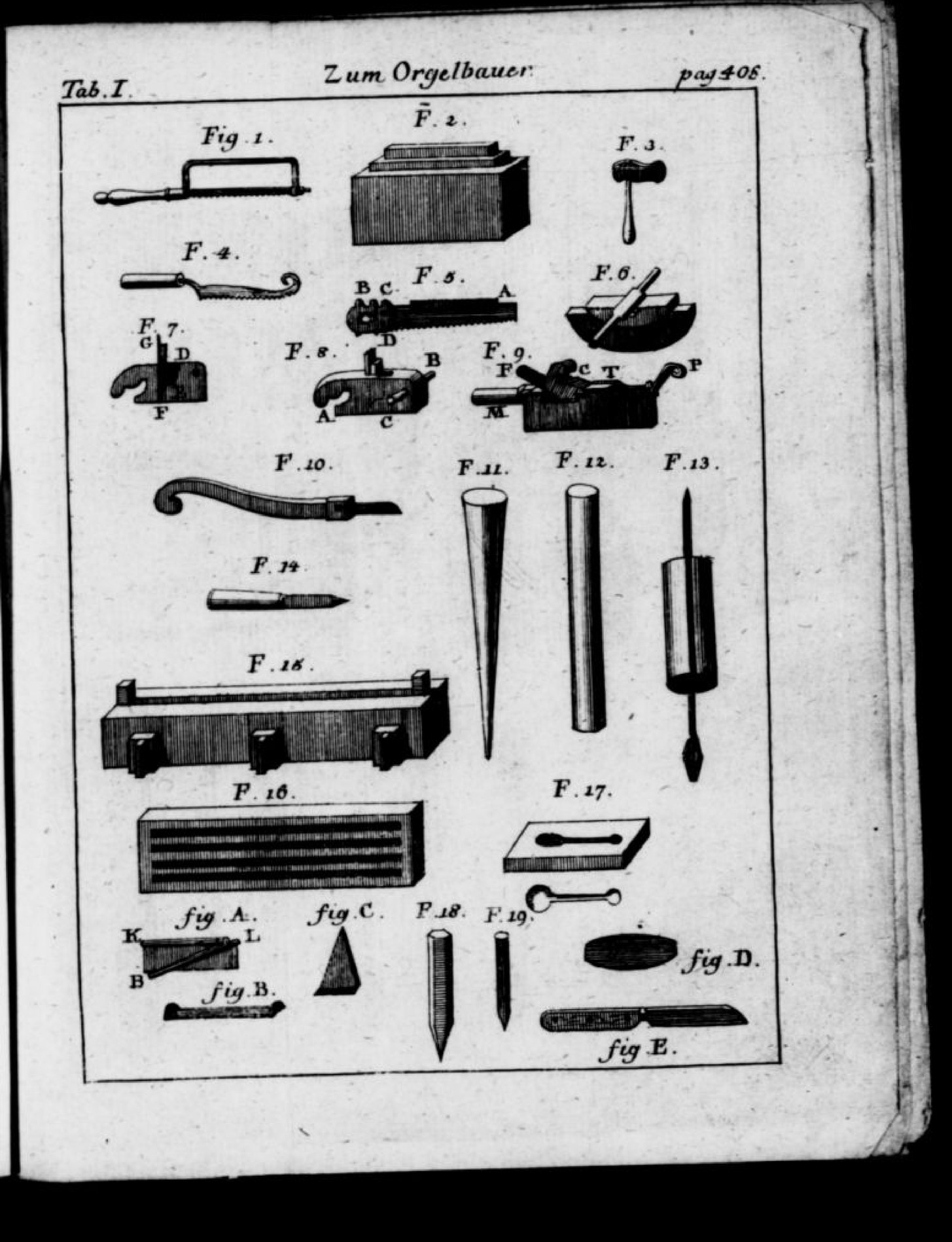
Fig. 1. Small hand saw, entirely of iron.498
2. The anvil.
3. The large hammer.
4. The keyhole saw.
5. The large hand saw for cutting up cast tin sheets.
6. The burnisher.
9. An iron plane for the mouldings, for the pipe feet, for making the lip straight, for planing the languid of lead, etc.
10. Carving knife.
11. Wooden pipe mandrel for the Trompete.
12. The like for cylindrical pipes.
13. The soldering iron is in its case, so that one does not burn oneself.
14. Scraping knife or scraper.
15. Languid mould, wedged like a clamp, for casting the lead thick.
16. Solder mould, for casting the solder in it in strips like window lead, so that in soldering one may take off a little of it with the iron.
17. Test mould for tin.
18. A flat and angular piece of wood for stroking the lips.
19. A foot mandrel for small pipes. The largest are of wood and the smallest of iron.
A. Foot gauge.
B. Mouth rule.
C. Mouth calibre499 for the Principal pipes.
D. Scraper for the Principal pipes.
E. Voicing knife.
Tab. II.
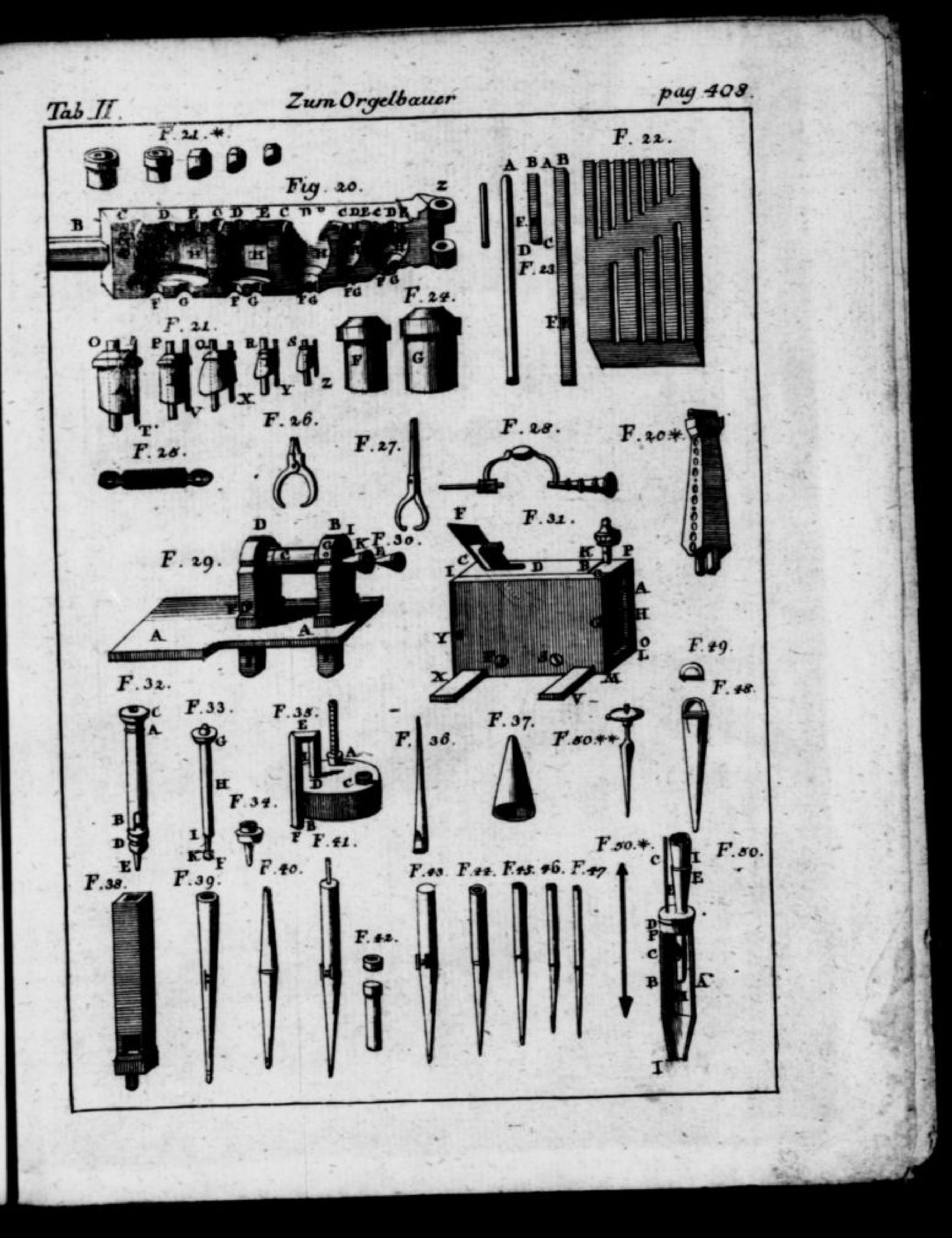
Fig. 20. Half of a block mould for the reedwork, on which B is the handle, H the 5 hollow places for the blocks, Z the hinge.
20.* Represents this whole mould as it looks, with its casting holes and Spieß holes at the top.
21. Are the 5 blocks that are cast in the preceding mould, with their double Spiesse. They serve for the reedwork. The largest block A is 1 Zoll, 6 Linien high in the body, and 1 Zoll, 5 Lin. broad at the top in the cap; the two Spiesse [403]are each 2 Zoll long. Block B is 1 Zoll, 3 Lin. long in the body, just as broad in the cap, and 2 Lin. less broad in the body; the rods are 2 Zoll long, and the middle one 4 Lin. broad. The third block C is cut off obliquely from below; its body is 1 Zoll long on the longest side up to the cap, the cap 3 Lin. high, the short side of the body 7 Lin. long, the thick middle Spieß 1 Zoll, 11 Lin. high, 4 Lin. broad. The fourth block D is 10 Lin. long on the longest side, and 6 on the shortest, up to the cap, which is 2 Lin. high; the middle rod is 1 Zoll, 8 Lin. long, 2 Lin. thick, the cap 10 Lin. broad, the small Spieß 1 Zoll, 6 Lin. long. The smallest block, or E, is 8 Lin. long on the longest side up to the cap, and over 5 Lin. on the shortest side; the cap is 8 Lin. broad, the middle Spieß 1 Zoll, 6 Lin. long, 2 Lin. thick, the small Spieß 1 Zoll, 4 Lin. long.
Fig. 21.* The 5 blocks without Spiesse, so that their holes may be seen. The first 2 are called square blocks, the other 3 round blocks.
22. The shallot mould of iron for 10 shallots. In it the shallots for the reedwork are stamped.
23. F E B and B A D C E are the stamps belonging to it, for stamping the shallots in the channels.
24. The Spiesse for the reedwork (les broches des anches).
25. Large file for truing the shallots.
26. Pointed pliers.
27. Flat-nose pliers for bending the wire.
28. The brace and bit (villebrequin), of iron or steel, for inserting various bits into it.
29. A lathe for boring out the pipe feet.
30. The cone for it.
31. The fine thicknessing plane, for making wooden rules of equal thickness.
32. The tuning flute.
33 Its piston.
34. The Kopfansazz500, to be screwed onto the pipe.
35. The wind gauge (anemometre).
36. Lip steel, for curving the lips.
37. Tuning horn.
38. A wooden pipe, open.
39. A conical pipe.
40. A spindle pipe (à fuseau), narrower at the top, wider at the lip than a cone.
41. A Rohrflöte.
42. A pipe stopped with a box.
43. A pipe closed at the top, with a beard at the lip.
44. An open pipe of wide cut for the Nasards, Terzen and Cornets.
45. Narrow cut for the Positiv.
46. Common narrow cut for the Mixturen.
47. Pipe of quite narrow cut.
48. The pipe foot with its languid soldered on, and a languid indicated above it, 49.
50. A completely finished reedwork with its block, which is soldered onto the box. At the top of this box one fits the lower end I of a large Trompete pipe. A is the shallot; C the tuning wire, going upwards; D the block, soldered to the box E E. The shallot A with the tongue B sits snugly in [404]the block D by means of the wooden wedge F. Everything is enclosed in the foot H, whose lower end is conical.
Fig. 50.* The large bit for the pipe-board holes, hollow, with a cutting edge. One needs three or four of different sizes. The thickest is 2 Zoll in A and 1 Zoll in B, and is 15 Zoll long. The smallest is 9 Lin. in A and 4 Lin. in B thick, and 1 Fuß long. Bradawl (Tariere pointue).
50.** Burning iron, 18 Zoll long, with conical heads. One head is 15 Lin. broad, and the other, small one 7 to 8 Lin. thick.
Tab. III.
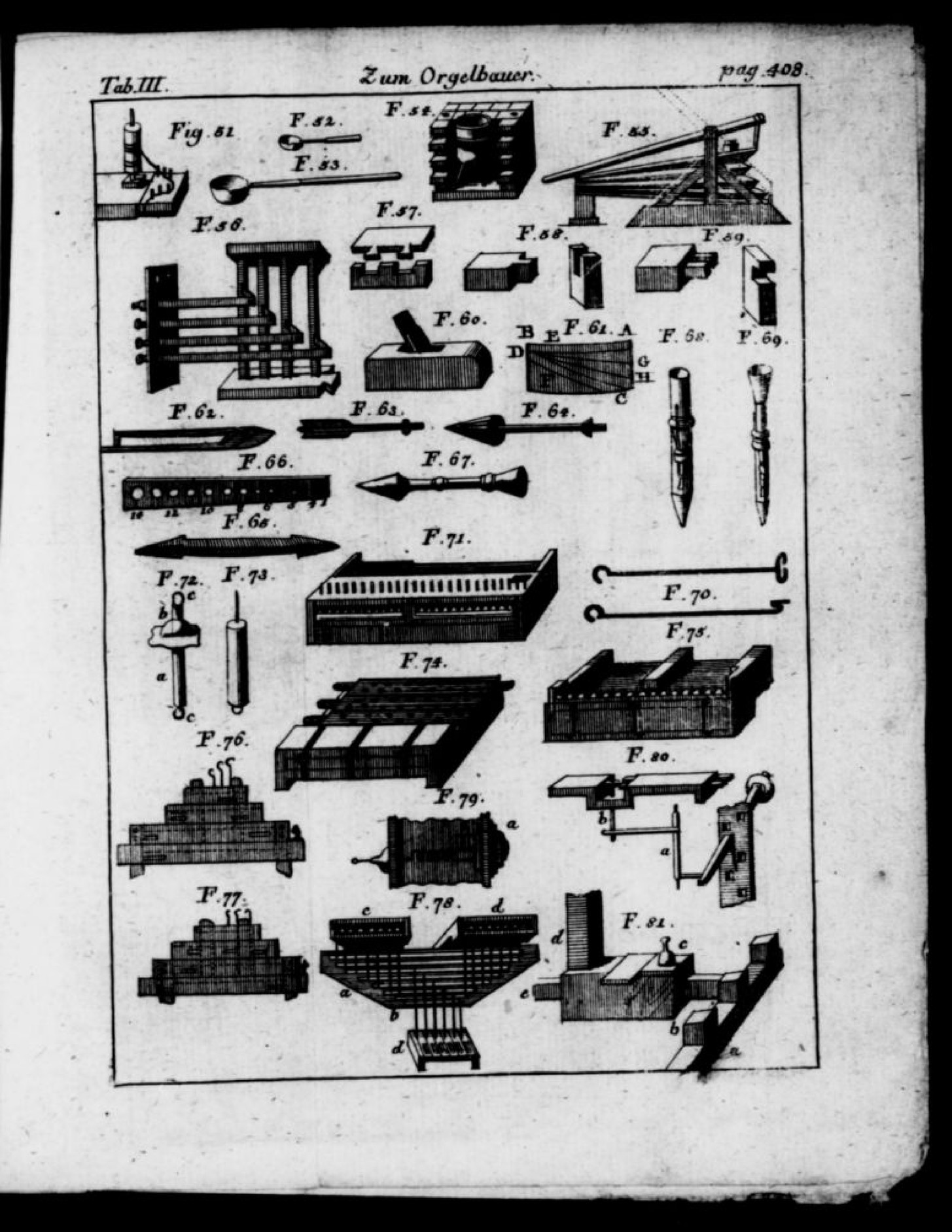
Fig. 51. A coil of wire, for stretching out the wire for the springs between the pins.
52. Melting ladle.
53. Casting ladle.
54. Melting kettle, built into masonry, for tin and Probezinn.
55. A bellows raised by hand by means of the pressing bar.
56. Upright stop rollers with stop rods, little arms, etc., to make the draw of the stop rods comprehensible.
57. Dovetail joint of the channel frame.
58. Slotted tenons with the saw.
59. Double-slotted tenon.
60. Tin plane without a nose.
61. Mouth gauge (Trace-bouche501).
62. Plate shears.
63. Screw tap.
64. The reamer of iron, for boring holes wider, by the brace and bit.
65. Scraper, for drawing straight, on the pipes to be soldered, the seam edge, that is, the line at the cut beside the bole.
66. The boring plates given in the text from No. 14 to 1, for boring the holes in the Windlade, table board and toeboard with the appropriate bits.
67. Tuning horn, for pressing pipes narrower or wider at the top.
68. The usual Menschenstimme, constituted like the Cromorne, but half-stopped at the top so that it does not shriek so. Its pipes are not large, and the first commonly only 6 Zoll high, and very often shorter still.
69. A pipe with the round block without a ring, as in the 2 last octaves of the Trompete and in the 3 last of the Clairon.502 It is the general rule to fit a ring to conical pipes only when, without one, they would sink too deep down into the foot.
70. Spring hook, for conveniently taking out and repairing the pallet springs.
71. An inverted Windlade with its wind chamber; at the front one sees, through the open doors, in part the pallets. The two doors are stopped up with 2 bungs, which are leathered, to close the wind chamber. Above this lies a board with the rows of wires that are intended for the Pulpeten.
72. A Pulpete, through whose middle the Weidenruthe a passes, through whose middle likewise a wire passes, which makes a loop above and below at c c; b is the Pulpete or the purse itself.
73. Is this same Weidenruthe (Osier), through which the wire passes.
[405]Fig. 74. Windlade in which the wind chamber lies above the Cancellen.
75. An inverted Positiv windchest with the sliders and toeboards taken away. On the 3 crosspieces at the top lies the Windlade, and one sees the row of purses or Pulpeten with the iron wires.
76. Four keyboards one above another.
77. The very same.
78. The c and d Lade with the roller rails a, on which the rollers of wood or of thick wire turn somewhat at the two ends. The trackers b are fixed below to the keyboard and above to the rollers.
79. The strong Tremulant with the flap a from outside; inside one sees the spring, wound like a corkscrew.
80. The stop draw, in which a is the upright spindle or roller (pilote tournant), b the outer Balancier.
81. The wind trunks, a the large wind trunk, b its throats (Schnauzen), c the gentle Tremulant, d the large trunk which brings the wind into the organ, e the one that brings it into the Positiv.
Tab. IIII.
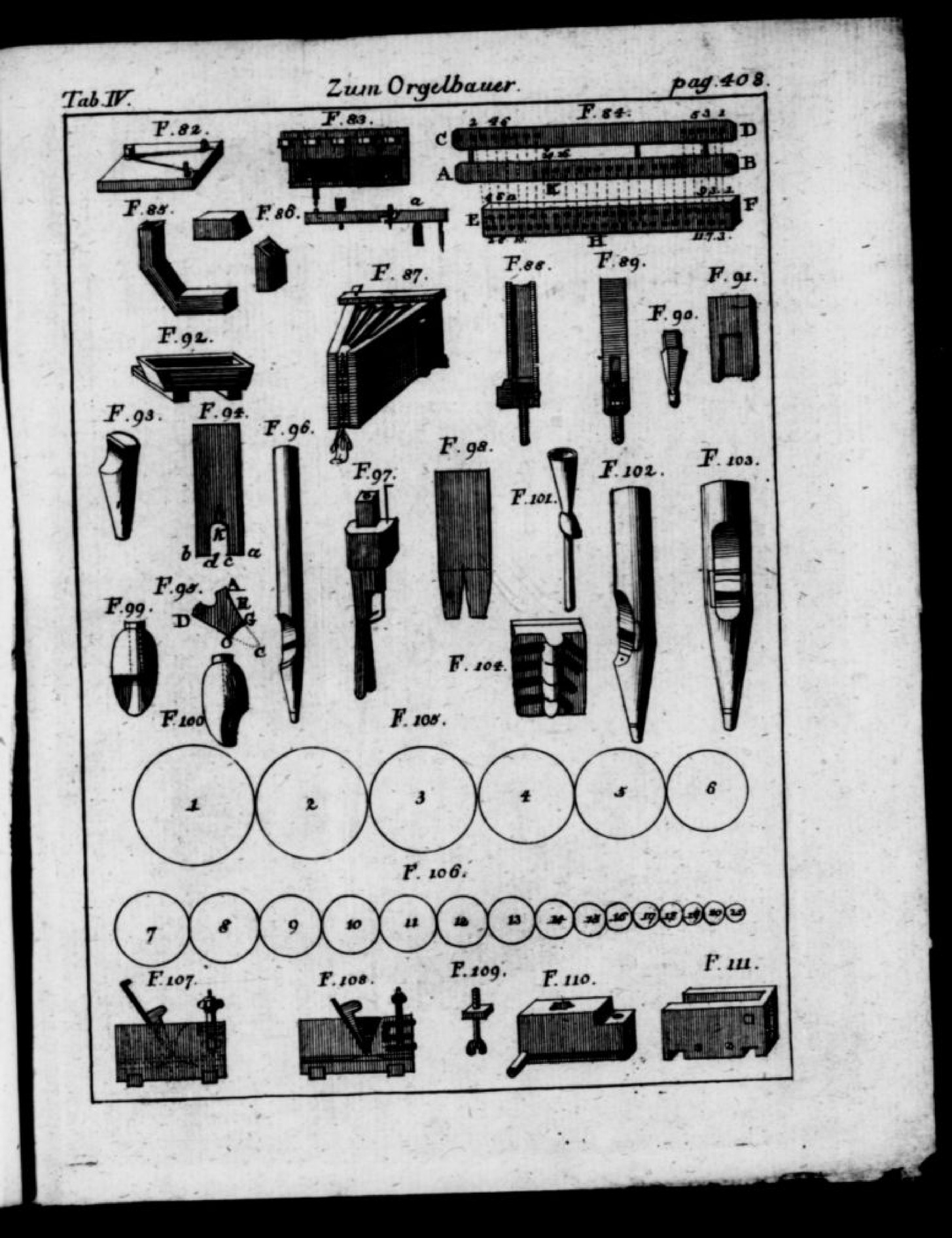
Fig. 82. The spring-bending board, for bending springs for the pallets in the Laden around some pins.
83. Open Windlade together with the action of the Wippe a with the pin joint.
84. To represent gebrochne Register. The toeboard E F begins at the top with the largest hole 1; its following hole stands below, namely No. 2. 3 is again at the top, under 1, 4 is below, above 2, and so always alternated up to No. 50. The second slider begins below with No. 24, at the top stands 25, below beside 24 is 26, and at the top under 25 is 27, alternated in the same way, so that here too the middle of the bar makes 50. On the third slider, below is the hole 2, and the uppermost hole 1, at the top under the hole 1 is 8, below above the hole 2 is 4. etc.
85. 86. Wind trunks and their pieces.
87. Bellows from the side. Along the back run horse sinews, that is, beaten sinews from horses’ feet.
88. A wooden pipe in section.
89. A wooden pipe with the cap taken away.
90. A pipe foot.
91. Cut-up of the wooden pipe.
92. Zinnlade503 for tin casting.
93. Foot of the tin pipes with the lower lip and the languid.
94. 95. Pipe cutting-out, how one cuts out a pipe foot of tin.
96. Principal with raised mouth.
97. Posaune shallot.
98. The foot cutting-out of the reedwork from one piece, slit at the bottom in the form of a bishop’s hat.
99. 100. Two blocks for the reedwork.
101. A Trompete with the tenon in the block.
102. 103. Pipes with mouldings on the lips.
104. Square for the stop draws.
[406]Fig. 105. 106. The thicknesses of the Spieße in the reedwork from No. 1 to 21.
107. The thicknessing plane (filière504), for drawing the sliders, rules, etc. equally thick throughout, two persons drawing the slider through this plane, each at one end.
108. 109. 110. 111. are the parts of the same.
Tab. V.
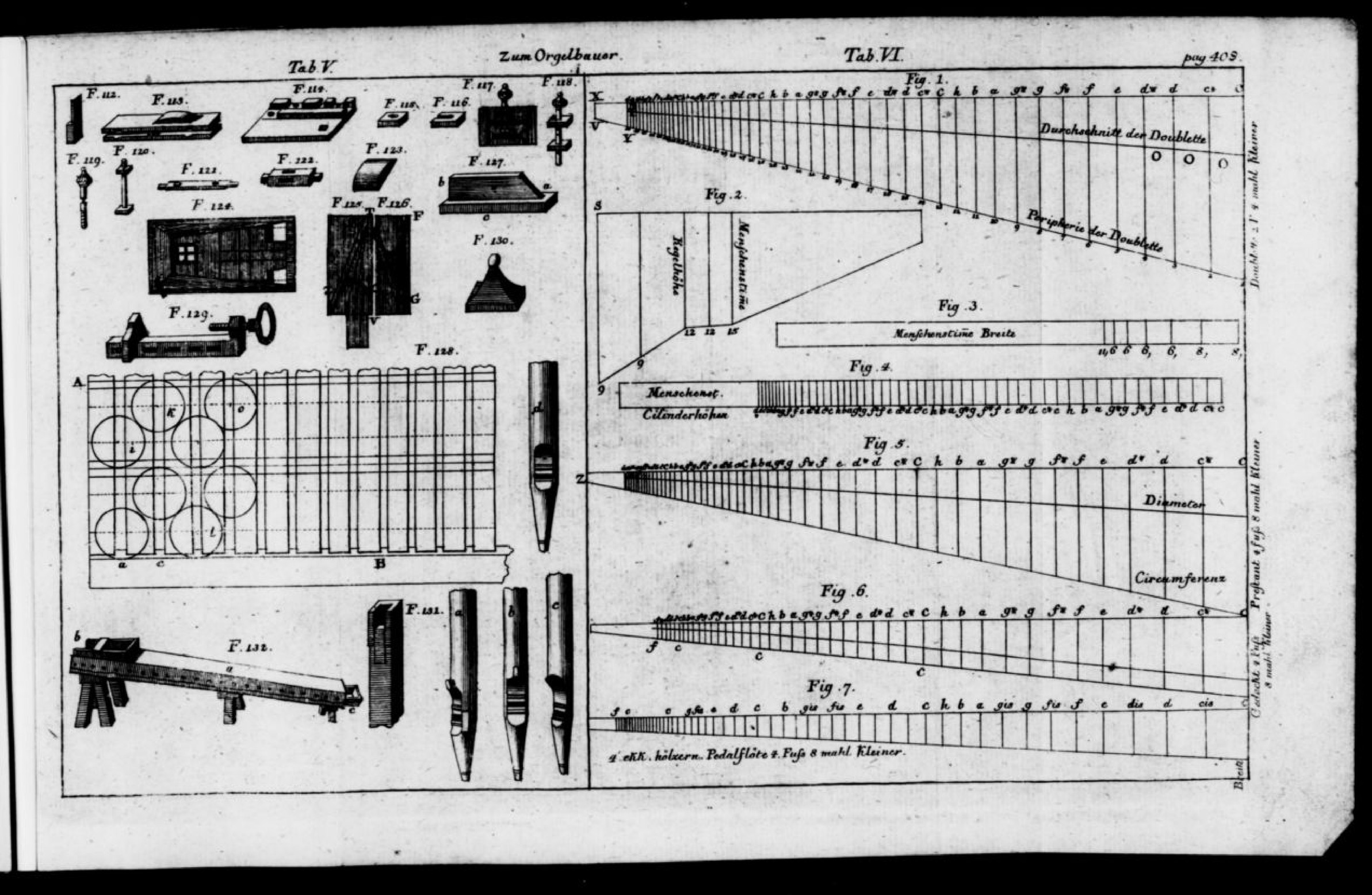
Fig. 112 to 123. are likewise parts of the same plane, taken apart individually.
124. A board of the bellows.
125. Gauge for the pipe cut-up (trace-bouche). One pushes between the two rules T V, X Z the circumference of the pipe cutting-out, up to the corner. From both sides let one set back the line P and Q; thus the cut-up i t arises.
126. Foot gauge. Push the pipe foot, which one has already cut out, between the two rules F G and F H, set the compass leg in G, and strike the upper arc N M, and the lower arc for the lower section of the foot F.
127. Wooden pattern, after which to cut all the windchest pallets, reversed. The line c actually closes the Cancellen. b Head of the pallet, at the front in the wind chamber. a Pallet tail, glued on with leather and fixed.
128. The Cancellen division of the Windlade.
129. Iron glue clamp.
130. Stoppers for the said pipes.
131. Wooden pipe to be tuned by the slide.
132. Sloping casting bench. At b is the casting box, into which one pours the tin, as it runs off through the slit of the box onto the bench and falls into the trough c.
a b c d Four pipes with decorated raised mouths, which give the tone 16 Fuß as distinctly as one of 8 Fuß.
Tab. VI.
Tab. VI: plate shown above, with Tab. V
Fig. 1. Mensur of the Doublette505, that is, of 2-foot, is here four times smaller, and must therefore be taken four times larger by the organ builder. The length of the lowest C pipe goes from C to X; its diameter is from C to O; and its circumference from C to 1 is here exactly half a Pariser Fuß, etc.; namely the lowest Cis is long from Cis to X; its diameter from Cis to O; its circumference from Cis to 2. and so on.
2. The Mensur of the Menschenstimme, namely the height of its cones; full size.
3. Width of the Menschenstimme; full size.
4. The Menschenstimme‘s cylinder height; full size.
5. Mensur of the 4-foot Prestant; is here eight times smaller, is therefore taken eight times larger.
6. Mensur for Gedakt (Bourdon) 4-foot; eight times smaller, is therefore taken eight times larger.
7. Square wooden Pedalflöte 4-foot; eight times smaller, is therefore made eight times larger. Fig. 5. 6. 7. make up exactly half a Pariser Fuß.
Tab. VII.
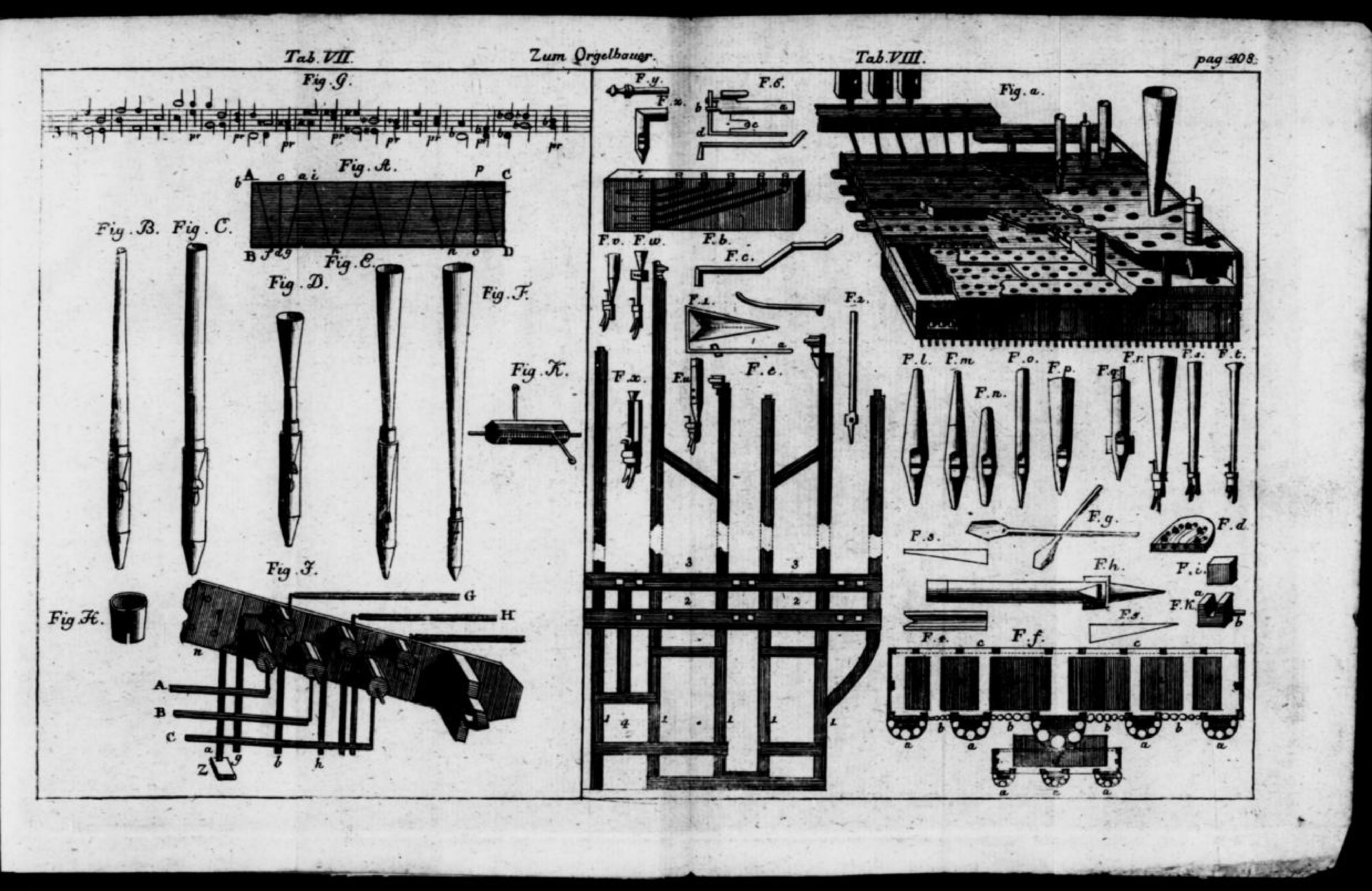
Fig. A. Foot gauge. Set from A to C half the circumference of the pipe body, and from c to a the other half. Draw a perpendicular from c to d; the [407]lower end of the foot is set half towards f and half towards g. Finally one joins A and f, as also g and a; thus A a and f g is the foot of the pipe.
Fig. B. Is the pipe for the Musette, or Polish Bokk506, namely a spindle pipe, which at the top is smaller by half than at the bottom; otherwise it resembles the Cromorne.
C. A Cromorne, whose pipes are all cylindrical, and in their lower part end in a cone, which one solders on there, and at whose point one solders on the round block.
D. A pipe with round block, without ring, for the last octave of the Posaune, for the two last octaves of the Trompete, and for the three last octaves of the Clairon. The ring is not necessary here, because the pipe cannot sink too deep into the foot: for the ring serves merely for that.
E. A Posaune, Trompete or Clairon, with round block and ring, which is one or two Linien thick and a little conical.
F. A large pipe with square block and box for Posaunen and Trompeten, 16 or 12, or 8, or 6 Fuß high.
G. How one tunes an organ. At the front one sees the German and French C or descant clef side by side. The lowest C is white; all white notes are to be tuned after the black ones that stand above or below them. Thus the fourth C of the keyboard is the fundamental, by which one seeks the third or white C. Further, the third C gives its fifth, G, which is shown in white. This G black gives D white, etc.
H. A lead ring in the reed pipes.
I. A piece of the pedal action with double squares (double échelle) and the Ruthen. Let one imagine that at the ends of the pedal keys Z the Ruthen or trackers a g b h etc. are hung. If one therefore presses a key, the Ruthe a is drawn down, which is hung on the horizontal arm of the square n. This draws its corresponding Ruthe, which is fixed to the vertical arm of the same square at n, from the left to the right. Likewise, as Ruthe b, hung from the horizontal arm of square q, moves down, it draws its corresponding Ruthe B, fixed to the vertical arm of the same square, from left to right. In short, when all the remaining Ruthen, one after the other, are pressed down, their correspondents move on from the left to the right. In such or a similar manner one lets the tracker actions continue up to the Windlade, which often lies far from there. Commonly one sets half the pedal stops on the one side of the organ on one Lade, and the other half on the other Lade on the other side of the organ; whereupon the Ruthen a b c d e f at the left pedal windchest, and the others g h i k etc. draw the chest pallets of the pedal windchest laid on the right hand.
K. A single roller with its two roller arms, for hooking in the trackers. The roller sits with its pivots between two boards, either tightly or with some play.
Tab. VIII.
Tab. VIII: plate shown above, with Tab. VII
Fig. a. A completely clad Windlade, so as to see on it some Cancellen, pallets, table, toeboards, pipes, and pipes offset by conveyances; in which the boards are, as it were, half broken away.
[408]Fig. b. The conducting off of pipes through conveyances in the Vorschlagebrett507, and channels carved into the Conductenbrett.
c. Some lead conveyances, for conducting off pipes, soldered piecewise.
d. How through the thickness of the Plintenbrett508, under the Principal, hollow invisible passages are bored to the place of the pipes or Mixturen, so that e.g. 5 pipes stand on one Cancelle.
e. Geometrical drawing of half the organ case. 1 1 1 1 The principal columns of the foot or lower case of the organ case. 2 2 The strong crossbeam on which the architrave comes. 3 3 Beam for the cyma. 4 Keyboard window, 3 Fuß high and 3 Fuß wide.
f. The ground plan for a large and a small organ case. a a a a etc. are the towers. b b b The flats. c c Back of the organ case. d d The pedal windchest. e e e The main windchest, divided into four parts. f Positiv windchest.
g. Voicing spatula of brass, somewhat turned up.
h. The Quintaton with the hat and the Rohrpfeife, and threefold beard.
i. The block in the large wooden pipes; at the top it has a smaller, straight-lined and longer sloping shoulder; from above and from below one sees, at the dotted lines of the edges, the ridge for setting in.
k. The block for middling and small wooden pipes, sawn from one piece with the bottom board. At a arises the straight line for the future slit; beside this one saws obliquely into, e.g., a piece of white- or red-beech, or oak, and thereupon the line c for the block straight down; whereupon one bores in the bottom board the hole for the foot b.
l. After Prätorius some stops, as l. Gemsenhorn; m. Spizz-509 or Koppelflöte510; n. Blokflöte511; o. open Queerflöte; p. Dulcian; q. Hohlflöte with the tube; r. Trompete; s. Krummhorn; t. Schallmei; u. Sordun; v. Zinkkornetdiskant512; w. Krummhorn; x. Bärpfeife.
y. Stop knob.
z. A mitred pipe.
1. A raised wedge bellows, set in contrast to the multifold bellows; a is the bellows treadle on the wedge bellows.
2. Schweizerpfeife.
3. 5. A bellows rib, or small board, of which 2 at the sides of the top board and 2 at the bottom board are joined with horse sinews and leather, for an inward-going fold.
4. A wedge bellows, fallen shut.
6. An upper pedal key a, with the tenon in the guide slot b. The spring c raises the trodden-down key up again, and is set in the spring board d.
Notes
- 1. Dom Bédos has brasé, brazed (hard-soldered), both for this bed iron and for the whole body of the plane; Halle’s gelötet does not specify the kind of soldering.
- 2. Dom Bédos has a strong iron spike (pointe de fer) riveted to the back of the plane, onto which the wooden handle is fitted.
- 3. Principal: the principal open flue stop of the organ, whose pipes stand in the organ front (façade).
- 4. Trompete: a loud reed stop, like the Posaune in body and foot but brighter, because its shallot is of brass rather than tin. Elsewhere the word can also mean the actual wind instrument, the trumpet.
- 5. Posaune: a reed stop of 32 to 8 Fuß pitch, named after the trombone, with a conical resonator of wood or tin. Elsewhere the word can also mean the actual instrument, the trombone.
- 6. Krükkenkeile: literally ‘crutch wedges’, pieces whose various sizes the mandrels just described are made to match; the passage does not make clear what these wedges are or what apparatus they belong to.
- 7. Dom Bédos joins the two pieces with a strip of white leather glued on the outside (une bande de cuir blanc qu’on cole en dehors), not a sheet-metal band.
- 8. Dom Bédos gives the boards as 3 pieds long (de 3 pieds de longueur), and about 15 to 16 lignes thick.
- 9. Dom Bédos has one more notch (entaille) at each end, that is, for a further wedge; Halle has Zapfen.
- 10. Zoll: the inch, a linear measure equal to one twelfth of a Fuß, used here for the dimensions of tools.
- 11. Linie: the line, a small linear measure, one twelfth of a Zoll (see [245]).
- 12. Dom Bédos says only that the edges are ground quite square on an oilstone without giving them any bevel (sans lui donner aucune pente); the rule about direction is Halle’s.
- 13. Halle writes Zungenformen. Since they match the channels of the shallot die just described, these are the formers on which the shallots (Mundstükke) are beaten, not the tongues.
- 14. Dom Bédos has three quarters of a ligne (“trois quarts de lignes moins épais”).
- 15. Dom Bédos gives this iron 9 to 10 lignes in width and 3 or 4 lignes in thickness; Halle’s 10 Linien is the French width.
- 16. Dom Bédos: the piece that forms the foot of the pipe is screwed on (“rapportée en vis”).
- 17. Fuß: the foot, a linear measure of 12 Zoll, used here for the length of a tool. Elsewhere the word also means the conical foot of a pipe and, in compounds such as 8-füssig, the nominal pitch of a stop.
- 18. Krükke: a crutch, whose head stands across the end of its shaft; the turned-up end of the pallet scraper stands across the wire in the same way.
- 19. Pfund: the pound, the unit of weight used for tools, metal and pipes; here, the weight of the larger vices.
- 20. Dom Bédos has one iron ladle holding 4 to 5 livres of tin and a second, smaller one. Halle makes the second ladle the larger and gives it the 5 Pfund.
- 21. Windmaaß: literally ‘wind measure’, the correct size of an opening that admits wind to a pipe, here the pipe’s foot hole and the opening named with it; it is not clear whether a gauge or simply the dimension itself is meant.
- 22. Oktavstimmen: the flue stops that sound in unison with the fundamental pitch of the organ or at its octaves, as distinct from the Veränderungsstimmen, which sound the fifth or third.
- 23. Veränderungsstimmen: literally ‘stops of variation’, the flue stops that do not sound in unison or at the octave with the organ’s fundamental pitch but give its fifth or third; they include the compound stops and are also called Hülfsstimmen.
- 24. Prestant: the French name for a stop of 4-foot pitch.
- 25. Doublette: the French name for a stop of 2-foot pitch.
- 26. Dom Bédos says the stop is in unison with harpsichord, violoncello, violin, serpent, bassoon, oboe and flute. Halle writes akkordirt for ‘in unison’, gives Baßgeige for the violin and Posaune for the serpent, and omits the bassoon.
- 27. gedakkt: stopped, i.e. closed entirely at the top, by a cap on tin pipes or a lid on wooden ones. As a noun (Gedakkt), the term also names a stop made of such pipes.
- 28. Rohrflöten: the second kind of closed pipe, which is not entirely stopped because its cap is pierced by a narrow tube (Rohr).
- 29. Bourdons: the French name, used here for all stopped stops belonging to the foundation of the organ, including those of Rohrpfeifen. Elsewhere the term (German Bardun) names a particular narrow-scale stopped stop.
- 30. Rohrpfeifen: here, pipes of the Rohrflöte kind, closed pipes whose cap carries a narrow tube. Although Rohr can also mean ‘reed’, reed pipes are not meant.
- 31. The first letters are damaged in the print. Halle writes ausgekehlt in the same sense at [353].
- 32. Windlade: the windchest, a slider chest on which the pipes stand and from which wind is distributed to them, the sliders governing which pipes receive it.
- 33. Hülfsstimmen: auxiliary stops. This is another name for the Veränderungsstimmen, the stops that sound the fifth or third rather than the unison or octave of the organ’s fundamental pitch.
- 34. Mixturen: compound stops in which several ranks of pipes stand on one slider, so that a single key sounds several pipes at once.
- 35. fourniture: the French name for the Mixtur, here a compound stop of three to seven ranks running through the whole keyboard.
- 36. Cornets: compound stops, defined here as always having five ranks of pipes.
- 37. Positive: the Positiv, either a small organ or the smaller division of a larger one; the passage does not make clear which is meant.
- 38. Mensur: the scale, i.e. the proportion of a pipe’s width to its length, set out by the builder as narrow, medium or wide according to the tone required. Elsewhere the word can also mean the drawing or table from which scales are taken.
- 39. Spillpfeifen: spindle pipes, conical pipes that are narrow at the top and widen towards the mouth, named after their spindle-like shape.
- 40. Nasard: a flue stop sounding the fifth, one of the Veränderungsstimmen; here, built with Rohrpfeifen in the bass and conical pipes in the treble.
- 41. Flöten: flute stops, flue stops of flute tone; here, the stops with which the trumpet-shaped conical treble pipes are combined. Elsewhere the word can also mean the actual instrument, the flute.
- 42. jeu à bouche: French for a flue stop, a stop whose pipes speak at a mouth. It stands for all the flue stops in the French list that follows.
- 43. Grobnasard: the large Nasard (French gros Nasard), a flue stop sounding at the fifth, an octave below the Nasard. Halle uses the same form again on p. 322.
- 44. grosse Terz: the large Tierce, a named flue stop that sounds at a third, an octave below the Terz. Here it means the stop, not the interval of a major third.
- 45. Larigot: a small French flue stop sounding at the fifth (1⅓-foot pitch). Here it is glossed as a wide Flöte, meaning its pipes are made to a wide, flute-like scale.
- 46. Quarte von Nasard: the French Quarte de Nasard, a flue stop of 2-foot pitch. It sounds a fourth above the Nasard, which is where its name comes from.
- 47. Terz: the Tierce, a flue stop of 1⅗-foot pitch that sounds a third above the octave pitches. Here it is the small partner of the grosse Terz in the French list.
- 48. Cimbel: a high, sharp-toned mixture stop with several ranks. As the next page explains, it is always drawn together with the Mixtur, and the two together make up the plein jeu.
- 49. Basse de Viole: ‘bass viol’, a flue stop in the French list. On p. 228 it is described under its German name Baßgeige as an 8-foot tin stop made to the width scale of the Prestant.
- 50. étoffe: French name for a cheap pipe metal, here an alloy rich in lead that builders sell simply as ‘metal’.
- 51. Zuschnitt, Schnitt: ‘cut’, used by Halle in this list, alongside Mensur, for the scale (the width of the pipe relative to its length), not for the cut-up of the mouth. Dom Bédos has taille.
- 52. plein jeu: French for ‘full chorus’. Here it means the multi-rank stops Mixtur and Cimbel taken together, which have to be drawn with the Grundstimmen (the stops at the fundamental pitches) because on their own they sound shrill and confused.
- 53. Baßgeige: ‘bass fiddle’, the German name for the Basse de Viole. It is a flue stop of tin with the length of an 8-foot stop but the width of the Prestant.
- 54. jeux d’anche: French for reed stops, the stops whose pipes sound by a vibrating tongue against a shallot. German calls them Schnarrwerke.
- 55. Clairon: the clarion, a reed stop of the trumpet family sounding an octave above the Trompete. Elsewhere it appears in the German spelling Kleron.
- 56. Cromorne: a French reed stop. As the text says, German organ builders turned its name into Krummhorn (‘curved horn’).
- 57. Menschenstimme: ‘human voice’ (Vox humana), a reed stop that imitates the singing voice. Its construction is described in detail later.
- 58. Hautbois: the oboe stop, a reed stop named after the oboe and counted here among the newer reed stops. Elsewhere it is traced back to a refinement of the Schalmei (shawm).
- 59. Sakkpfeife: ‘bagpipe’, one of the newer reed stops, made to imitate the bagpipe. Its French name is musette.
- 60. musette: the French name for the Sakkpfeife stop, taken from the small French bagpipe it imitates.
- 61. Regal: a reed stop with very small pipes. It was no longer used in church organs but was still found in small portable instruments, which its small size suited.
- 62. Leiern: literally ‘lyres’ or hurdy-gurdies. Here it means small portable instruments (translated ‘portable cases’) in which the Regal is still used. The text does not say exactly what kind of instrument is meant.
- 63. Dom Bédos says that the feet of the reed stops are almost always of étoffe (tin-lead alloy) and have the same shape, differing only in size. He does not say they are of brass.
- 64. boite: French ‘box’. In a large Trompete pipe this is the boot, the outer tube in which the lower part of the pipe sits.
- 65. Dudelsakk: German ‘bagpipe’; the same stop as the musette, also called Sakkpfeife (notes 46–47).
- 66. Diapason: used here as another word for Mensur, the scale that sets how pipe dimensions progress through the tones of the octave. The word is explained as Greek for a succession of tones.
- 67. la gamme: French ‘the scale’, the ordered series of tones in the octave (ut, re, mi, fa, sol, la). Here it is given as another name for the measure of the octave tones.
- 68. Hauptmaaß: ‘principal measure’. It means the two governing dimensions of a pipe body, length and width, which are set by the length and breadth of the tin sheet before it is rolled on the mandrel.
- 69. gammes: French ‘scales’, used here to mean octaves. A keyboard of four gammes has a compass of four octaves.
- 70. feintes: French name for the short half-keys (sharps and flats) that lie between the natural keys. Their names end in -is or -es. Here they are described as white.
- 71. B: here the fifth above E, that is B natural (German h); the next line marks B flat as B b. In the series B, Fes, Ces above, B stands for B flat.
- 72. Fuß: the foot, the unit of length, divided into Zoll. Here it gives the actual dimensions of a pipe; elsewhere it also gives the nominal pitch of a stop (e.g. 8 Fuß).
- 73. Dom Bédos gives 14 pouces 4 lignes inside for the first C of the 32-foot (a stopped Bourdon), and adds 2 pouces so that each board is an inch thick. Halle’s 16 Zoll 4 Linien is the outside figure.
- 74. Probezinn: a grade of pipe metal fixed by local assay standard. It is rich in lead (the Berlin grade is the lowest one listed). Reed blocks are cast from it, but they wear because the soft lead gives, so the shallot works loose.
- 75. montre: French ‘display’, the polished front pipes standing in the façade of the organ case.
- 76. sommier: French for the Windlade, the windchest. The pipes stand on it, and it distributes the wind to them.
- 77. la laye: the French term for the wind box, the airtight compartment of the Windlade that receives wind from the bellows and contains the pallets with their springs.
- 78. Cancellen: the note channels of the Windlade (singular Cancelle). They are the compartments of the windchest frame, separated by bars, one for each key. A pallet admits wind into its channel, and from there the wind passes through the slider and toeboard holes to the pipes.
- 79. gravures: the French term for the Cancellen, the note channels of the windchest.
- 80. soupappes: the French term for the pallets, the valves in the wind box that open when a key is played to admit wind into a note channel.
- 81. Hauptventile: the key pallets (singular Hauptventil). They form the row of note valves in the wind box, each opened by a wire from the key action, and each admits wind into its own Cancelle.
- 82. Lade (plural Laden): the windchest, the wooden chest on which the pipes stand and from which they get their wind. ‘Low’ windchests leave too little room underneath to reach into the wind chamber by hand.
- 83. pilotes tournants: the French term for the trundles, upright rotating rods turned by the drawstops. They pass the motion through the balanciers to the sliders.
- 84. balanciers: the French term for the pivoted levers that take the motion from the trundles and move the sliders they are attached to.
- 85. abrégé: the French term for the rollerboard, the set of rollers and arms that carries the motion of each key across to its pallet in the Windlade.
- 86. Rükkpositiv: the chair organ, a positive division placed behind the organist’s back with its own windchest, pipes and keyboard.
- 87. le massif: the French term for the panelled lower case, the decorated lower wall of the organ case that holds the window for the keyboards.
- 88. le buffet: the French term for the organ case as a whole.
- 89. Tourelles: the French term for the towers of the façade, rows of the tallest pipes that project in the form of semicircular columns.
- 90. Platesfaces: the French term for the flat rows of façade pipes that stand between the towers.
- 91. Clairs-voirs: the French term for the carved pieces, either pierced or solid, set among the façade pipes to support them. It is unclear why the text refers only to the left side of the front pipes.
- 92. chassis: the French term for the four-sided frame of the main Windlade. Bars fill the frame and divide it into the note channels.
- 93. battants: the French term for the wings, the two opposite sides of the windchest frame. They are cut with mortises to take the bars.
- 94. denticules: the French term for the mortises cut in the wings of the windchest frame, into which the bars are tightly fitted and glued.
- 95. barres: the French term for the bars glued into the mortises of the windchest frame. The spaces between them form the note channels.
- 96. gravure: the French term for a single Cancelle, the space between two bars of the windchest frame.
- 97. Dom Bédos gives the thickness of this board as about 4 lignes, not 4 Zoll.
- 98. emprunt: the French term for the fault in which wind leaks from one Cancelle into the next, so that the neighbouring pipe sounds without being played.
- 99. Halle: “mit einem Meisselchen des Trillbohrers”; Dom Bédos: “une petite mèche de vilebrequin”, a small brace bit.
- 100. la chape: the French term for the toeboard, the board laid over the sliders on which the pipes stand. It is bored with holes that lead the wind up to the pipes.
- 101. Dom Bédos says that the bearers can no longer be seen at all, and that only the sliders show, by ends projecting a few pouces beyond the length of the chest.
- 102. clous à chape: the French term for toeboard nails, ordinary nails with round leather washers under their heads. They fasten the toeboards down and are driven one Fuß apart.
- 103. flipot: the French term for the two rows of ledges glued and notched into the Cancellen. They carry the bars and the tails of the pallets and belong to the wind box.
- 104. Dom Bédos says the leather is about one pouce longer than the pallet on the tail side, so that it projects about that much beyond it.
- 105. les guides: the French term for the pallet guides, headless pins of hard brass wire set between the pallets. They keep each pallet from shifting sideways but do not hinder it in opening and closing.
- 106. boursettes: French for the purses (Pulpeten).
- 107. Pulpeten: the purses (singular Pulpete), small leather pouches around each pulldown. They seal its passage out of the wind box while still letting it move. Here they are made of white leather and end in small brass-wire rings.
- 108. Osier: a French term (literally ‘willow rod’) for the small cylinder or rod that passes through the purse. A wire with a ring runs through it and holds it fast in the purse. Its exact construction is not clear from the description.
- 109. Dom Bédos specifies annealed brass wire (fil de laiton recuit). Halle’s geschlagnem means hammered.
- 110. Ruthenhaube: literally ‘rod cap’, a fitting on the pulldown rod whose ring takes the lower end of the brass S-hook connecting the rod to the pallet. Its form is not described further.
- 111. Pallet: Halle’s Klappe. Elsewhere the word also means a bellows flap or a woodwind key.
- 112. Rod: Halle’s Ruthe, the pulldown rod that passes through the purse (Pulpete); the key pulls it down to open the pallet. As a unit of length the word is retained as Ruthe.
- 113. Solo: the third keyboard and the division of stops it plays, used for solo melodies. The French name récit is given beside it.
- 114. Dom Bédos gives the smallest iron rollers as 2 to 3 or 4 lignes in diameter and 6 to 8 pouces long. Halle’s figure of 6 Linien probably comes from the length, which he omits.
- 115. Zugwerk: the tracker action, the linkage of trackers and rollers through which a key pulls open its pallet in the windchest. Here it is treated as the same thing as the rollerboard, and its layout depends on how the pipes are arranged on the Lade.
- 116. double échelle: the French term given beside the ‘double squares’, the paired angle levers in the pedal action that turn the pull from the pedals toward the chest. The French literally means ‘double ladder’, and the passage does not show exactly how it matches the German term.
- 117. Register: here the drawstop, the handle the player pulls to move a slider. Elsewhere the word also means a stop or the slider itself, and in the passage on the harpsichord ([392]) a register of jacks.
- 118. Recit: the same division as the Solo (French récit), with its own keyboard and windchest for solo stops.
- 119. In Dom Bédos the upper end of the balancier is formed as a pivot that enters a fork attached to the two sliders. Halle instead has it end in a stud (Pfanne) and does not mention the fork.
- 120. Dom Bédos lines the inside of the bellows only with new parchment glued with strong glue; the frieze is Halle’s addition. Dom Bédos also gives the top and bottom boards a thickness of two pouces, which Halle omits.
- 121. Kröpfe: the short upright trunks under each bellows, standing on the main wind trunk, each with a flap that stops the wind running back into the bellows. The word literally means ‘crops’ or ‘gullets’; the French equivalent given, gosiers, means ‘throats’.
- 122. strong tremulant: German starker Tremulant, a device fitted in a wind trunk that interrupts the wind so the sound pulses noticeably. It is contrasted with the gentler Schluchser.
- 123. Schluchser: the gentle tremulant (literally ‘sobber’), fitted in the horizontal wind trunk. It makes a softer pulse than the strong tremulant.
- 124. So Halle. Dom Bédos has the middle between X and 27, which the series (X 26, X 28) requires.
- 125. So Halle. At [232] and in the table at [246] the last C of the Doublette is 3¾ Linien.
- 126. The widths 6 Zoll, 8 Linien and 11½ Linien are circumferences, that is, the breadth of the sheet. The Doublette row of the table at [246] gives them under circumference.
- 127. Königsfuß: the king’s foot (French pied du roi), the standard foot used for the measurements that follow. It is divided into 12 Zoll, each Zoll into 12 Linien, and each Linie into 12 Punkte.
- 128. Punkte: points, the smallest unit in this system of measures. One Punkt is one-twelfth of a Linie, so 1/1728 of the Königsfuß.
- 129. le diapason: the French term for the pipe scale (Mensur), meaning the proportions of pipe diameter and length set out in the table that follows.
- 130. jeux à bouche: French for flue stops, whose pipes sound through a mouth, as distinct from reed stops.
- 131. Bourd.: short for Bourdon, a stopped flue stop. This line gives the measurements of its treble pipes.
- 132. Quarte: ‘fourth’, here the name of a flue stop in the scale table, made to a wide measure and sounding a fourth above the Nasard. Elsewhere the word also means the interval of a fourth.
- 133. Cornet du Recit: the cornet of the Recit division, a solo stop of several ranks played from the Recit keyboard.
- 134. Vollstimmig: ‘full-voiced’, the rendering of French plein jeu. In this scale table it names the principal-chorus pipes of the full organ, whose measurements follow; elsewhere it means the full registration.
- 135. Flötenpedal: pedal flute, a flue stop of the pedal division, given here in its open form.
- 136. ravalement: the French term for extending the compass below the lowest C. The row marked with it gives a pipe for one of these added low notes.
- 137. Contratöne: contra notes, the extra low notes below the first or lowest C of a stop, here of the Posaune.
- 138. Halle has round pipes (runde Pfeifen) of number 2; Dom Bédos has round blocks (noyaux ronds) of the first number.
- 139. Dom Bédos: the length of the line T, as with S above.
- 140. Kugelspizzen: literally ‘ball points’: the small cone points soldered onto the round blocks (Nüsse, which Halle also calls Kugeln), as the following sentences show.
- 141. Dom Bédos counts the same 12, 12 and 15 but prints the total as 29 (“ce qui fait 29 … Ces 29 cônes”). Halle’s 39 is the correct sum.
- 142. Spiesse: the iron core pins set into the mould, not perfectly cylindrical, around which the metal is cast. Elsewhere the same word means the mandrel on which shallots are formed.
- 143. trace-bouche: French, ‘mouth tracer’, Dom Bédos’s name for this gauge. Halle gives the one French tool two German names: Labienmensur here and Mundmesser at [334] (Fig. 125). Both are the mouth gauge.
- 144. Rhineland working measure divided by twelves: 12 Linien to the Zoll, 12 Zoll to the Fuß.
- 145. Klavis: a key of the keyboard.
- 146. groß Posaunencornet: the large cornet of the Posaune (bombarde) division, a solo stop of several ranks.
- 147. groß Cornet: the great cornet, a solo stop of several ranks belonging to the great organ.
- 148. Posaunenbourdon: the Bourdon of the Posaune (bombarde) division, a stopped flue stop, listed here in 16-foot and 8-foot sizes.
- 149. Schnüffler: Halle’s German name for the Nasard; literally ‘sniffler’.
- 150. Posaunenprestant: the Prestant of the Posaune (bombarde) division, an open principal stop.
- 151. grosse Mixtur: large mixture, a stop of several ranks of principal pipes sounding octaves and fifths together.
- 152. grosse Cimbel: large cymbal, a high-pitched mixture stop of several ranks.
- 153. Posaunentrompete: the trumpet of the Posaune (bombarde) division, a reed stop.
- 154. Posaunenclairon: the clairon of the Posaune (bombarde) division, a trumpet-type reed stop pitched an octave above the trumpet.
- 155. Posaunencornet: the cornet of the Posaune (bombarde) division, a compound solo stop.
- 156. Baßladen: the two windchest sections that carry the lowest twenty keys of the manual, ten each; those for the upper keys are called the treble chests. Elsewhere the word means the pedal windchest.
- 157. Posaunenstimmen: the stops of the Posaune (Bombarde) division. On these chests they take wind from their own channel on each key, together with the other stops set over that channel.
- 158. Geleise: literally tracks or grooves. Dom Bédos here has la profondeur de la Laye, the depth of the pallet box; on p. 257 Halle renders the same Laye as Windkasten.
- 159. Dom Bédos reserves the firmest wood for the bars, frames and sliders (les Barres, les Chassis & les Registres). Halle has pallets in place of bars, although below he requires pallets of wood ‘not too hard’ and on p. 257 assigns the soft whitish oak to them.
- 160. mortaises: French for mortises. Here it names the dovetail sockets cut in the cross side of the chest frame to receive the long sides (wings) of the frame.
- 161. Tafel: the table of the windchest, the board glued over the trued tops of the channels and the frame. The sliders run on it, and its holes let wind up from each channel to the stops.
- 162. Dom Bédos makes this board longer than the whole width of the windchest (“plus longue que toute la largeur du Sommier”). The French fits the rule being a little shorter than the Cancellen, which run across the width.
- 163. bohrt: ‘bores’. One does not bore a wind chamber, so the word is probably a misprint or a slip for a verb such as ‘fits’ or ‘places’. Halle’s oder here means ‘that is’.
- 164. On these chests the Cornets are given only two octaves, starting at middle C, so the table board is bored for them only over that range.
- 165. Skrupel: a small unit of length in the Rhineland measure, one twelfth of a Linie and so one hundred and forty-fourth of a Zoll.
- 166. The German gives two values for No. 14: ‘sieben Linien‘ and ‘8 Linien, 2 Skrupel’. Only the second fits the next size, No. 13, at 7 Lin. 6 Skr.
- 167. Dom Bédos uses a small plane (petit rabot) here, not the large smoothing plane. He attributes the burrs to the countersink (fraise), not the bit. He also directs that all the holes be countersunk slightly on the other face of the board, a step Halle omits.
- 168. So Halle. Dom Bédos fixes the plane (filière) to the bench with two hold-downs and pulls the slider through it by its end.
- 169. la montre: the French name for the Principal, the open flue stop whose pipes stand in the façade; here the 32-Fuß Principal.
- 170. große Terz: the larger of the two Tierce stops in this specification, sounding a third (in a higher octave) above the fundamental. The smaller one, Terz, is stop 20.
- 171. Oktav: here the stop name: the 2-Fuß octave stop, given as the German equivalent of the French Doublette. Elsewhere Oktave also means the interval.
- 172. bombarde: the French name for the Posaune, the large trumpet-type reed stop that gives the Bombarde division its name; here it is stop 25.
- 173. Holzgedakkt: a stopped flue stop of wooden pipes, given here as the German equivalent of the French Bourdon at 16 Fuß.
- 174. Halle’s list for the treble chest passes from stop 3 to stop 5 and from stop 9 to stop 11. In the list of square holes at [269], stop 9 is the Posaunengedakkt 16 Fuß and stop 10 the Posaunengedakkt 8 Fuß. The stop numbered 9 here corresponds to that stop 10, which stop 12 follows in both lists.
- 175. Posaunengedakkt: a stopped (gedakkt) flue stop belonging to the Posaune (Bombarde) division, found here at 16 and at 8 Fuß. The passage gives only the sizes of its toeboard holes, not how it is built.
- 176. Suite: French, ‘continuation’: the part of the 32-Fuß Principal whose pipes stand on the treble chests, continuing the stop begun on the Baßladen.
- 177. Halle’s earlier list for the treble chests ([267]) passes from stop 3 to stop 5 and gives no holes for stop 4.
- 178. Halle has aus dem ersten und zweiten Loche, first and second. His previous sentence puts the pegs in the first and last holes, and Dom Bédos has les premier & dernier trous, the first and last.
- 179. la fraise: French for a reamer: a conical bit with lengthwise cutting edges like a file, used to open toeboard holes into a cone. Many builders used red-hot burning irons instead.
- 180. porte-vents: French for wind conduits, the tubes that carry wind from a toeboard hole to a pipe that does not stand directly over it. Here their ends are set into the toeboard holes.
- 181. Zimbeln: Cymbals, high-pitched compound stops of the mixture family. Their many ranks need their own specially chiselled toeboards.
- 182. Dom Bédos has appliquer le dessus de son Registre, contre le dessous de sa Chape: the upper face of the slider against the underside of the toeboard. Halle’s Diskant takes dessus in its musical sense.
- 183. Reprise: in a Mixtur or Zimbel, the point in the compass where the ranks drop back to a lower pitch and the pattern of pipes starts again; here the second such break falls at the fifteenth key.
- 184. Schleifen: the sliders proper, thin perforated strips that move between the table board and the toeboards to let wind into a stop or cut it off. Here they are named as the moving part that must be given its play.
- 185. Zuglinie: the marked limit of a slider’s travel (French repères). It ensures that when the stop is drawn the slider’s holes line up exactly with those of the table and toeboard, and when it is pushed in they do not.
- 186. Dom Bédos calls the single check for the four sliders a method that “is not good”, one that would not stay long in good order, “as I have seen by experience”. Halle leaves out the rejection, so his clause reads as an instruction. His next sentence, like Dom Bédos, gives a check to each of the four sliders.
- 187. Halle has bald erweitert und bald verlängert (now widens and now lengthens); Dom Bédos has tantôt s’élargit, & tantôt se rétrecit (now widens and now narrows).
- 188. Durchstechen (also sticht durch; Durchstiche, the places where it occurs): wind escaping from one channel into a neighbouring one, or past a slider, so that pipes sound that are not being played.
- 189. Dom Bédos has une petite feuillure de deux lignes, a small rebate cut along the edge of the channel, into which the strip is then fitted and glued.
- 190. Dom Bédos specifies the shape: the two ends are raised roughly square and rounded, as shown in his plate.
- 191. Dom Bédos has the second board glued on edge (‘on colle de champ’).
- 192. Dom Bédos has the pointed tail of the small eye-pin (petit piton) clinched like a common nail, with the clinch sunk entirely in the wood; Halle’s Oese (loop) stands for this clinched end.
- 193. Dom Bédos prefers the second mark: ‘or better still at 13 pouces from the head of the pallets’.
- 194. Dom Bédos says the opposite: this placement is to be avoided (‘il faut éviter de coller les Soupapes de façon que le dos de la peau… se trouve vers le milieu’). That is what Halle’s own reason requires; a nicht has probably dropped out of his sentence.
- 195. Pulpetenbrett: the board that closes the wind chamber below the pallets. The pull-down rods pass through it via small leather pouches (Pulpeten) that keep the wind from escaping.
- 196. German Pappen (pasteboards), evidently a misprint for Klappen (pallets): the whole passage concerns gluing the pallets.
- 197. Dom Bédos gives 3 pouces only as a length sometimes allowed when there is a single manual (“quelquefois jusqu’à 3 pouces de longueur, lorsqu’il n’y a qu’un Clavier”). Halle makes it a general maximum.
- 198. Dom Bédos says that at full tension the spring should make the key slightly too hard to press (‘tant soit peu trop dure à baisser’), so that slackening it very slightly makes the key soft and lively. Halle asks instead that at full tension the key be as little hard as possible.
- 199. So Halle (schwächere Klappen). The sense requires springs (Federn), as in Dom Bédos: ‘il faut y en mettre qui soient un peu plus foibles’, said of the springs.
- 200. Schlußleisten: the closing strips that frame and close the pieces of the wind chamber. Leather is glued into the angles they form at the corners to make the joints windtight.
- 201. Angel: the tang or shank of the iron hook or ring, the part fixed into the bung. It is covered with leather on the side that lies against the bung.
- 202. Dom Bédos prefers leather, parchment or heavy paper (la peau, ou le parchemin, ou le gros papier) to the inserted wood. Halle leaves leather out of the recommendation, though he goes on to describe its use, and adds the two or three layers.
- 203. Ruthen: the pull-down rods (Abstraktenruthen) that run from the pallets down through the Pulpetenbrett to the key action; here a grooved bar keeps them apart and free to move.
- 204. Groß Cornet der Posaune: the Grand Cornet of the Posaune (Bombarde) division, a compound solo stop.
- 205. Gros. Posaun. Mixt.: abbreviation of grosse Posaunenmixtur (see [254]), the large mixture of the Posaune division, with four pipes to each key.
- 206. Groß Mixt.: short for Groß Mixtur, the large mixture. It is a compound stop with several pipes sounding on each key (three here).
- 207. Zweite Achtfuß: ‘second eight-foot’, a second stop at 8-foot pitch; the list does not name its kind.
- 208. Groß Cimbal: the large Cymbel, a compound stop of high-pitched pipes listed here with four pipes to each key.
- 209. Erste Trompete: ‘first trumpet’, the first of two trumpet-type reed stops listed in this disposition.
- 210. Zwote Trompete: ‘second trumpet’ (zwote is an older form of zweite), the second trumpet-type reed stop in this disposition.
- 211. Dom Bédos has ‘une Basse sonnant 4 pieds’, a bass sounding at 4-foot pitch; Halle’s lauten (‘loud’) appears to render sonnant.
- 212. Flötenbaß: ‘flute bass’, a flue stop of flute type for the bass, here at 4-foot pitch. It is given as the model for a louder 4-foot bass in unison with the Prestant.
- 213. The specification on [291] has Flöte 4 Fuß, not 8 Fuß. Dom Bédos says the new bass should be set away from the 4-foot Flute (‘éloigner ce Jeu de la Flûte de quatre pieds’); entfernen can mean either ‘remove’ or ‘set at a distance’.
- 214. relocated channels: verlegte Ausschnitte, channels set out of their regular order on the chest (Dom Bédos: ‘gravures … qui sont transposées’).
- 215. Minengänge: ‘mine galleries’, hollow channels bored in from the edge of the toeboard to carry wind sideways to pipes standing off their holes. Their openings at the edge of the board are then sealed with cork.
- 216. Untersteg: the lower rail of the keyboard frame, on which the keys rest and pivot. Here it is the fulcrum of the key, which acts as a lever.
- 217. Schwebepunkt: ‘balance point’, the place along a key where it pivots on its support. Its position sets the proportion between the front and back parts of the key. In the next paragraph Halle also uses the word, equated with Einhängepunkt, for the point where the tracker hangs, which moves with the key.
- 218. Dom Bédos prescribes two such rules, of well-seasoned walnut or at least of oak (deux tringles ou regles de bois uni, comme de noyer bien sec, ou au moins de chêne). Halle has one rule, of walnut or pear wood.
- 219. Dom Bédos next carries one of these parts, ‘which will be the quarter or the fifth’, from a to c. Halle omits this step, so point c, used in the next sentence, is not defined in his text.
- 220. Halle’s schnurgleichen Flächen der Schlußzapfen render Dom Bédos’s arrasements des tenons, the shoulders of the tenons.
- 221. Dom Bédos labels the width C B. Halle’s C D does not agree with his own front edge B C on the next page.
- 222. Klavierbrett: the glued-up board, usually of limewood, from which the keys are later sawn. Halle also calls it simply Brett (board), and on p. 299 Griffbrett.
- 223. Dom Bédos gives 2 or 3 pouces (Zoll), not Linien.
- 224. Dom Bédos recommends these needles only where the wood is not at risk of splitting (dans les cas où le bois ne risque pas de fendre).
- 225. Dom Bédos compares bone with ivory: bone keeps its whiteness much better and is much harder than ivory.
- 226. French petites mortaises: small slots cut in the bone covering.
- 227. Knie: ‘knees’ (French talons), small blocks glued to the top or underside of the key board before the keys are sawn apart. Which side depends on whether the action is to engage above or below the keys.
- 228. Palmul: from Latin palmula, a key of the keyboard. It is one of three synonyms given here for the organ key.
- 229. Tangente: here simply a synonym for an organ key, given alongside Klavis and Palmul. Later in the book the word means the harpsichord jack and the brass tangent of the clavichord.
- 230. blindes Klavier: ‘blind keyboard’, a set of keys that is not played directly but serves as an intermediate mechanism for coupling. This passage does not describe how it is connected.
- 231. Schneiden, ‘edges’; probably a misprint for Scheiden, the guide slots of the preceding sentence.
- 232. Weidenruthen: thin willow rods hanging down from the windchest pallets, which carry the motion of the action. Dom Bédos lays the bar over the backfalls (bascules) and marks the middle of each backfall; Halle sets the straightedge beneath the rods and marks a point opposite each.
- 233. Dom Bédos instead calls it more convenient to make a coulisse with two coulisseaux. The two single studs set 6 Linien apart are Halle’s own arrangement.
- 234. Dom Bédos gives about three quarters of a ligne.
- 235. Späne: the thin wooden boards (ribs) that form the folds of the bellows, hinged so that they bend at the folds as the bellows opens.
- 236. So Halle (ein einziger Wind). The demonstration that follows, with one bellows going, suggests that a single bellows (Balg) is meant.
- 237. Schuh: another name for the Fuß. Halle uses both names for the same unit in this calculation.
- 238. Windschnauzen: ‘wind snouts’ (French gosiers), the outlet throats near the head of the bellows through which the wind passes into the wind trunk.
- 239. Dom Bédos gives the fold boards a width of 7 to 8 pouces; Halle has 11 Zoll.
- 240. Ribs: Halle’s Späne, kept in German on pp. 304–307 (see note 166).
- 241. Dom Bédos gives the reasons differently: stretching across the width does widen the pores, but it is needed because otherwise the skin would stretch when the bellows is working and the folds would not be firmly bound.
- 242. Ellen: ells. Five of them equal 18 Fuß, so the Elle here is the French aune (about 3 pieds 7 pouces), not the shorter German ell.
- 243. Zügel: ‘bridles’ (French brides), strips of tape glued across the bellows folds that limit how far each fold can open when the bellows is raised.
- 244. Kanalschnauzen: the trunk throats (French gosiers), short four-sided ducts that carry the wind on from the bellows. They are the same part as the Windschnauzen of [306] (note 238): Halle renders Dom Bédos’s gosiers with two German names.
- 245. Tremulant: a device set in the wind trunk between bellows and windchest, with a small valve and a wire spring, that makes the wind supply pulse and so gives the tone a beat. Here it is the gentle tremulant.
- 246. Terzstimme: here not a single tierce rank but the combination of stops given in the table above (French jeu de tierce); the ‘complete’ Terzstimme is that whole combination.
- 247. So Halle (weil man z. E. 2½ Balg sagen kann). Dom Bedos has the negative: one cannot install, for example, two and a half bellows.
- 248. Schnauzen: the bellows throats; see note 238.
- 249. Schnauzenkopf: ‘snout head’, the end of the bellows throat that sits inside the bellows. The height of the throat opening determines its size.
- 250. pariser Zoll: the Paris inch, a unit of the French royal foot divided into 12 Linien (lines). It is used here for the measurements taken from Dom Bedos.
- 251. Quadratholz: literally ‘square wood’: the square marked out on the front board, which is cut away to open the mouth.
- 252. Dom Bédos gives up to one pouce or even more for the largest pipes, if very large, and 3 or 4 lignes for pipes of 2 or 3 Fuß.
- 253. Dom Bédos describes a different sign and verdict: if the whole surface is matt and damask-like but smooth, the tin is fine but not soft and new (fin, mais non pas doux & neuf).
- 254. Dom Bédos has ‘irregular’ for ‘large’ and calls such tin brittle (aigre), the more so the larger the rough, matt part.
- 255. In Dom Bédos the mixture runs the other way: pure lead is useless for pipes, so 15 to 20 livres of common tin are mixed into each hundred of lead.
- 256. Dom Bédos has the keys pinned with pegs (on les chevillera), not nailed.
- 257. In Dom Bédos these bars are 2½ or 3 pouces thick and 7 to 8 pouces wide, and they are nearly as long as the table’s width, so they run across it. He does not mention planing.
- 258. Dom Bédos makes fir a concession: the beam may be merely of fir (peut n’être que de sapin), though oak is better.
- 259. Molleton: a soft, thick woollen cloth with a raised nap, similar to flannel, named here as a lining material.
- 260. rable: the French name for the casting box, a bottomless frame made of four boards that is used in casting the metal sheets for pipes.
- 261. Dom Bédos names service-tree, pear or walnut (cormier, poirier, noyer). Apple, cherry and plum are Halle’s additions, and he omits walnut.
- 262. Dom Bédos lifts only the two ends from the cloth as soon as the sheets are cast and begin to cool, so that they can shrink freely. Halle waits until the sheet is cold.
- 263. Orgelprincipale: the Principal stops of an organ generally, of whatever pitch and whether in the organ or the Positiv.
- 264. Pedalflötenwerke: the flute stops of the pedal. The basses of the open ones may be taken into the façade Principal.
- 265. Dom Bédos planes them with an ordinary iron plane (“le rabot de fer dessous & dessus”, his Pl. 4, fig. 20); the toothed iron is Halle’s.
- 266. Dom Bédos has the single sheet straightened on a hard, even board by rubbing hard with the back of the knife blade, on each side, until it is straight and true. Halle substitutes the rocker-shaped Ausstreicher.
- 267. Schild: the shield, a separate piece of metal fitted at the mouth of a façade pipe. The raised upper lip is soldered to it.
- 268. Lefzenschilde: lip shields, the applied shields at the pipe mouth (see Schild). They are often omitted on flat rows of front pipes that have a triangular upper lip and a semicircular lower lip.
- 269. Gesimse: a moulding, an ornamental profiled edge. Here the small tin sheets soldered beside the mouth are given a moulding with four edges.
- 270. Unterschild: the lower shield, the shield at the lower lip of the mouth. In this passage it is made in the usual way, while the upper shield projects further.
- 271. Gliederstreif: a moulded strip, a narrow strip bearing moulding members (Glieder). Here it is set along the edge of the lower lip, together with the two side pieces.
- 272. Dom Bédos requires the flask to be at least twice as large as needed (deux fois au moins plus grand qu’il ne faut); Halle has three times.
- 273. Loth: a unit of weight equal to one thirty-second of a Pfund.
- 274. Quentchen: a small unit of weight equal to a quarter of a Loth.
- 275. Rocourt: roucou (annatto), a red-orange dyestuff. Here it is one of the colouring ingredients of the gold varnish.
- 276. Lot: the same unit as Loth (note 185). The figure after the two dots gives Lot added to the Pfunde: 8.. 16 Lot is 8 Pfund 16 Lot.
- 277. Durchschnitt: the diameter, the width of the pipe measured across. Here it is taken from the drawn scale of the first C.
- 278. Pedalflöte: a flute stop belonging to the pedal, here at 4-foot pitch. Its scale is laid out like those of the Prestant and Gedakkt and then copied eight times larger.
- 279. Medium cut (Mittelschnitt): the middle of the three cuts named at [226], set against the large cut of the next sentence. Schnitt here is the scale width of the pipe, not the cut-up of the mouth. Dom Bédos has taille.
- 280. intonirt: brought to its right pitch and speech; the cover is soldered fast only after this. At p. 346 the word also covers regulating a pipe’s strength.
- 281. Positivstimme: the full chorus of the Positiv. As with the full-voiced stop of 14 pipes just before, the number counts the pipes to each key, not the pipes of the whole stop.
- 282. So Halle (’10 Fuß‘). Every other figure in this list is a weight, and the Doublette is a 2-foot stop, so 10 Pf. is probably meant.
- 283. Positivnasard: the Nasard stop of the Positiv. In this weight list it is kept distinct from the open Nasard of the main organ.
- 284. Kegelstimmen: reed stops with conical (Kegel, ‘cone’) resonators. Here they are named as the principal class of reed stops.
- 285. Posaunenbässe: the bass pipes of the Posaune, the large trombone-type reed stop. Because full-size mandrels are costly, their resonators are made from three pieces.
- 286. Pfunde Markgewicht: pounds by mark weight, meaning the Pfund reckoned as two marks.
- 287. Grosse Trompete: the large trumpet, a trumpet reed stop of bigger size than the Gemeine Trompete.
- 288. Gemeine Trompete: the ordinary trumpet, the standard trumpet reed stop.
- 289. Groß Cromorne: the large Cromorne, a reed stop.
- 290. Gemeine Cromorne: the ordinary Cromorne, a reed stop.
- 291. polnische Bokk: ‘Polish bagpipe’, a reed stop that Halle glosses as musette.
- 292. Posaunenpedal: the Posaune (trombone) reed stop of the pedal.
- 293. Trompetenpedal: the trumpet reed stop of the pedal.
- 294. Randnuß: a block with a rim, as distinct from the round blocks C, D and E; the table gives separate heights and widths for the rim and for the cylindrical body.
- 295. Pariser: short for Pariser Maaß, Paris measure. It indicates that the dimensions in this passage are given in Paris units (Fuß, Zoll, Linien).
- 296. Claironpedal: the Clairon stop placed in the pedal. The Clairon is a reed stop of the trumpet kind, named here alongside the Trompetenpedal.
- 297. Dom Bédos has the tongue rubbed with the back of the knife on each side until it is quite straight and untwisted (bien droite & bien dégauchie); the slight bellying (etwas bauchig) is Halle’s addition.
- 298. Gemeine Posaune: the ‘ordinary’ Posaune, the regular form of the trombone reed stop, as distinct from its larger forms. Here it heads the figures given for that stop.
- 299. Groß: a small unit of weight below the Loth, from the French gros. The passage does not state its value relative to the Loth.
- 300. Dom Bédos gives about 4 to 5 pieds between the bellows heads and the back of the organ or the separating wall; Halle gives 4 Fuß and names only the wall.
- 301. Bälgeboden: the bellows loft, the floor or chamber where the bellows stand. Here it is the side of the organ toward which the openings of the main wind trunk may be turned.
- 302. Sperrzapfen: literally ‘stop-peg’. Here it is named in apposition to the hinge joining two corresponding sliders, a peg that connects or limits the sliders; its exact form is not described.
- 303. Echobourdon: the Bourdon rank of the Echo, one of the five ranks of pipes that make up the Echo. Its holes are bored like those of the small Bourdon of the great windchest.
- 304. Echoprestant: the Prestant rank of the Echo. Its holes are bored like those of the Prestant of the great windchest.
- 305. Echonasard: the Nasard rank of the Echo. Its holes are bored like those of the small Nasard of the great windchest.
- 306. Windabtheilungen: the separate divisions of the wind supply below the bellows, each serving its own part of the organ. One tremulant of each kind is needed for every division.
- 307. Dom Bédos has ‘the first three or four pipes’ (les trois ou quatre premiers Tuyaux).
- 308. On the plates the lower-case figures are on Tab. VIII, not Tab. VII. There Fig. b shows conveyances led through the Vorschlagebrett (as the explanation of the plates at [408] says), and the two bent conveyance tubes are drawn beside it as Fig. c.
- 309. Gleichstimmigkeit: literally ‘sameness of voice’ or unison. It is given, alongside size, as a reason why certain wooden pipes are offset rather than standing on their wind; the passage does not explain how it has this effect.
- 310. Conductenbrett: the conveyance board, which carries the conveyances (Conducten) taking wind from the Lade to offset pipes. Its end is closed by a board bored with holes for the conveyances.
- 311. ausgekehlt: cut up, said of a pipe mouth, meaning the opening cut out between the lips. If the mouth is cut up too small, the pipe lacks tone.
- 312. frisirt: (of a tone) quivers or trembles. Here the cause is a pipe set loosely in its hole or touching another pipe.
- 313. pioller: a French workshop term for a fault of stopped pipes, rendered here as ‘rattling’. The passage gives no further description.
- 314. nasardiren: a verb formed from the stop name Nasard, meaning to sound like a Nasard. It is a fault of stopped pipes, listed separately from overblowing to the fifth and not further described.
- 315. Partition: the organ builders’ word for temperament, the deliberate alteration of intervals in tuning that this passage describes.
- 316. Kapellenton: ensemble pitch, the pitch of a band of musicians (Kapelle); here the pitch fixed in France, to which pipes are cut. In Germany pipes are cut to Chorton instead.
- 317. Chorton: choir pitch, the pitch standard to which organ pipes are cut in Germany, as against the Kapellenton used in France.
- 318. So printed. The sequence (sol re, then its lower octave) points to d (re).
- 319. Dom Bédos has the pipe cut with shears (cisaille); Halle has a knife.
- 320. bedane: a joiner’s mortise chisel (French bédane). Here it is set on the edge of the languid and struck with a hammer to drive the languid lower.
- 321. Plinthe: a part of the ‘pipe board’ on which pipes are tried in voicing. The passage does not make clear what its ‘key’ is, only that deepening it lessens the wind reaching the pipe.
- 322. Wendeloth: the turning solder, the third of the four kinds of soldering described at [327].
- 323. Contrabässe: the lowest bass notes added below the ordinary compass, the French ravalement.
- 324. C sol ut: the note C, by its old solmization name. Here it is the low C of a 16-Fuß stop.
- 325. ut: the solmization syllable for C. Here it means the true fundamental of the pipe, as opposed to the third that sounds with it.
- 326. Blattgelenke: literally ‘board joints’, the cord hinges joining the two boards of the bellows (see pp. 306–307). They are renewed below, when the hinge holes are bored open again and new cords drawn in.
- 327. Registerleder: slider leather, the leather lining the underside of the sliders (see p. 263).
- 328. sticht durch: (of wind) ‘runs through’, meaning it leaks within the Lade from its proper channel into a neighbouring one, so that a neighbouring pipe also sounds (ciphering).
- 329. Durchstiche: run-throughs, the places in the Lade where wind leaks from one channel into a neighbouring one.
- 330. Anhängsel: the attached parts of the stop action, meaning the trundles, irons and pins that link each drawstop to its slider.
- 331. Ansazzcancelle: literally ‘attached channel’. Here it is a bar fixed against the frame of the chest and bored with holes matching those in the frame, so that wind passes into it; it carries bearers and a slider of its own. How deep the holes run and how the bar is sealed is not fully clear from the passage.
- 332. Zwischenregister: an intermediate slider, mounted between two bearers on top of the attached bar (Ansazzcancelle) just described.
- 333. falsche Lade: literally ‘false chest’. Here it is a supplementary chest built over the attached bar and its slider, so that additional pipes can stand on it without a windchest of their own.
- 334. Dom Bédos: “des 32 pieds, Bombarde, &c”, the 32-foot stops and the Bombarde. Halle runs the two together.
- 335. Livres: French livres tournois (abbreviated Liv.). These are Dom Bédos’s French prices; Halle copies them without converting them into German money.
- 336. Contratasten: the keys of the contra octave, the lowest part of the compass below great C. The prices that follow are for carrying the compass down to F, F♯ (Fis), G or B (H) of that octave.
- 337. Dom Bédos has ‘from 300 livres and even less, up to 60000 livres’; Halle moves the open end of the range from the lower figure to the upper.
- 338. Viol de Gambe: the viola da gamba stop, an open flue stop of string-like tone named after the bowed viol. The book also uses other spellings, such as Violdigambe.
- 339. Violonchell: violoncello, given here as an alternative name for the Viol de Gambe stop.
- 340. Quintaden: a narrow-scaled stopped flue stop of wood or tin. It sounds a deep, flute-like fundamental together with a distinct fifth above it.
- 341. Quinte a ton: another name, in French form, for the Quintaden.
- 342. Flageolet: a small flue stop of high pitch, named after the flageolet, a small duct flute. Its pitch and construction are not given here.
- 343. Schallmei: the shawm; a reed stop named after it (described at [389]).
- 344. Queerflöte: the transverse-flute stop, an overblowing flue stop. Its narrow pipes are twice the ordinary length for their pitch, stopped in the bass and open in the treble. As the name of the actual instrument, the word is translated ‘transverse flute’.
- 345. Flute douce: literally ‘soft flute’, the French name for the recorder; here a soft flute stop. The list names it separately from the Blokkflöte on the next page, so the two are treated there as different stops.
- 346. Pissaro: probably Piffaro (long s and f are easily confused in the print). At [389] Halle gives piffaro as another name for the Schallmei, which this list also names separately.
- 347. Hohlflöte: literally ‘hollow flute’, an open flute stop of wide scale with a hollow, rather dull tone.
- 348. Sollicional: the Salicional, a narrow flue stop of soft, string-like tone. Elsewhere it is spelled Salicinal and grouped with the conical stops.
- 349. Unda maris: literally ‘wave of the sea’, a soft flue stop tuned slightly away from another stop so that the two together produce a slow wavering.
- 350. Sesquialtera: a compound stop of two ranks. Halle describes it at [381] as a Mixtur of two pipes, the fundamental and the sixth; in its usual form the ranks sound the twelfth and the seventeenth.
- 351. Rohrflöte: the chimney flute, a stopped flute stop whose cap carries a small open tube (the chimney). Its tone is likened to a large flute.
- 352. Glokkenspiel: here a bell register in the organ, a set of small tuned bells of bell metal at 2-foot pitch played from the keys. Elsewhere the word means the tower carillon.
- 353. Subbaß: a wide stopped stop of 16-foot pitch, counted among the stopped stops (Gedakkten). Tiefflöte is given here as another name for it.
- 354. Tiefflöte: literally ‘deep flute’, given here as an alternative name for the Subbaß.
- 355. Fagot: the bassoon stop, a reed stop with conical pipes, each set on a separate conical foot. In the book’s model large organ it stands at 16 Fuß; here it is likened to the Cromorne. As the name of the actual instrument, the word is translated ‘bassoon’.
- 356. Nachtigall: literally ‘nightingale’, a toy stop imitating birdsong. Its construction is not described in the book.
- 357. Gemsenhorn: the Gemshorn, an open conical flue stop, wider at the mouth and narrowing toward the top. The book calls it a sharper-sounding kind of Violdigambe, made from 8 Fuß down to 6 Zoll.
- 358. Superoktave: the open flue stop pitched two octaves above the foundation; 2 Fuß in Halle’s examples, which assume an 8-Fuß manual.
- 359. Nachthorn: a wide-scaled flute stop, found at 4 Fuß in the book’s examples, whose tone is compared to a broad horn.
- 360. Spizzflöte: the spire flute, an open conical flue stop, wide at the mouth and tapering upward like a truncated cone.
- 361. Tertian: a compound stop sounding a third and a fifth above the octaves of the fundamental (the seventeenth and the nineteenth); ‘twofold’ refers to its two ranks.
- 362. Fugara: a cylindrical open flue stop of narrow, string-like tone. Elsewhere in the book its sound is compared to a small pocket fiddle.
- 363. Waldflöte: literally ‘forest flute’, an open conical flue stop made like the Spizzflöte but slightly wider at the top, so less sharply tapered.
- 364. Vogelgesang: literally ‘birdsong’, a toy stop of small pipes set upside down in water, so that the wind makes them warble like birds.
- 365. Sifflöte: a small, high-pitched flute stop, named here only in a list; no pitch or construction is given for it.
- 366. Blokkflöte: ‘recorder’; a flue stop named after the instrument. Halle describes it inconsistently: at [388] as tibia vulgaris, open and long, of 16, 8, 4, 3 or 2 Fuß, or stopped; in his summary of Prätorius among the conical stops, open, wide below and narrow above (Blokkflöte 4 F.). Stop names were not standardised in his time.
- 367. Sedecime: a stop named here only in a list, without pitch or description. The name (Latin for ‘sixteenth’) suggests a small, high-pitched stop, but its exact pitch is not stated.
- 368. Dulcian: a reed stop, here at 16-foot pitch, named after the dulcian, a bassoon-like wind instrument.
- 369. Echo: an echo stop whose pipes stand enclosed and covered in a box, giving a muffled, distant sound. Here it is an echo version of the five-rank Cornet.
- 370. Flute traversiere: a flue stop imitating the transverse flute, made of tin with long, narrow-scaled pipes.
- 371. Stillgedakkt: a soft-toned stopped flue stop. Gedakkt means a stopped (capped) pipe; still means quiet.
- 372. Violon: a stop named after the violone, ordinarily a 16-foot pedal stop that is quieter than the Principal but has a penetrating, string-like tone.
- 373. Violonbaß: a bass stop of the Violon type. It is listed here beside the Violon, and the passage does not say how the two differ.
- 374. Schwebung: here an accessory stop, not a sounding rank. It is a gently beating tremulant that gives the Menschenstimme (vox humana) its wavering, voice-like quality. Elsewhere the word means the beating heard when tuning.
- 375. Sperrventile: shut-off valves in the wind trunks. Each valve lets the wind to the chest or chests that its trunk feeds be cut off.
- 376. Quinte: a mutation stop sounding a fifth above the pitch of the foundation stops. At 3 Fuß it sounds a twelfth above the 8-foot stops.
- 377. Scharf: a bright, high-pitched mixture, in which several pipes per key sound together. Here it has five ranks, at 1½ Fuß.
- 378. Salicinal: a very soft, open, narrow-scaled flue stop of tin or metal, bearded and narrower than the Viol di gamba. Here it is at 8-foot pitch.
- 379. Trompetendiskant: the treble portion of a Trompete reed stop, drawn and played on its own. Here it is at 8-foot pitch.
- 380. Quint a ton: a narrow-scaled stopped flue stop whose tone sounds the twelfth prominently along with the fundamental. Here it is at 8-foot pitch.
- 381. Grade: degrees of wind pressure as read on the wind gauge. At [387] the gauge’s scale is given in Rhineland Zoll, each divided into 10 Grade.
- 382. Strebefedern: springs that bear on the bellows to produce the wind pressure, doing the work of counterweights. Their exact form is not described here.
- 383. Gedakkt: stopped. The Bourdon sounds at 16-foot pitch from stopped pipes about 8 Fuß long, because stopping a pipe lowers its pitch by an octave.
- 384. Dom Bédos gives material, not placement: the basses of wood and the rest all of tin.
- 385. Fuß Ton: ‘foot tone’, the pitch at which a stop sounds, stated as the length of an open pipe of that pitch. 8 Fuß Ton is the pitch of an open 8-foot pipe, whatever the actual length of the reed resonators.
- 386. Abstraktur mit Wiederholungen renders Dom Bédos’ grand Abrégé à reprises, a large roller board made in several sections. Wiederholungen is the word translated ‘breaks’ in the mixtures above.
- 387. Schnarrstükke: the sound-producing reed parts of the stop, that is, the shallots and tongues. These are distinct from the block and foot named just before.
- 388. Blindläden: a wooden component of the action, named here in a list of action parts. The word means literally ‘blind chests’. The passage does not describe the part, and its exact form is unclear.
- 389. Dom Bédos asks only that the tin be new and soft (neuf & doux). He permits (‘on pourra’) alloying with one livre of copper to 100 livres of tin, to make the work more solid. ‘Unmixed’, the stated intention and ‘harmonious’ are Halle’s.
- 390. gebrochne Register, literally ‘broken sliders’: each slider is split at middle C so that the treble and bass halves can be drawn separately; cf. [292].
- 391. Thaler: the principal silver coin of account in these prices (abbreviated Thlr.).
- 392. Laternenbalg: literally ‘lantern bellows’, a small bellows; its construction is described at [385].
- 393. Dom Bédos names here the pilote (sticker) in its guide beneath the keyboard; Halle writes Abstraktendrat.
- 394. Halle writes Schwengel, rendered backfall as at [239]–[240]; in bellows contexts the word means the pumping lever.
- 395. Dom Bédos specifies the strong tremulant (Tremblant-fort).
- 396. Dom Bédos: if the tongue is not firmly fixed (n’est pas bien affermie) or projects beyond the shallot, push it in until it is level with the shallot and secure everything by driving in the wedge. The remark on the size of the wedge is Halle’s.
- 397. Dom Bédos: since the tongue is usually too open after this operation, stroke it with the back of the blade, pressing only on the side where it is too open.
- 398. Pedaltrompeten: Trompete reed stops in the pedal.
- 399. Pedalclairons: Clairon reed stops in the pedal. The Clairon is a trumpet-type reed sounding an octave above the Trompete.
- 400. Dom Bédos: interlaced with syncopations, dissonant chords, suspensions and striking harmonic surprises (entrelassés de syncopes, d’accords dissonants, de suspensions & surprises d’harmonie frappantes).
- 401. Positivterz: the tierce combination of the Positiv, in which its foundation and mutation stops, including the Terz, are drawn together as one registration.
- 402. Dom Bédos gives the upper limit as the fourth G (le quatrieme G re sol).
- 403. Dom Bédos: all the 8-foot stops on the great organ (tous les 8 pieds).
- 404. Hauptwerk: the main manual division of the organ. Elsewhere the word also means simply the builder’s chief work.
- 405. Gemshorn: a flue stop with conical pipes that narrow toward the top, giving a soft, horn-like tone.
- 406. Viol di gambe: a narrow-scaled open flue stop with a string-like tone, imitating the viola da gamba.
- 407. Gedakt: a stopped flue stop, its pipes closed at the top so that they sound an octave lower than open pipes of the same length.
- 408. Brustwerk: the manual division placed in the lower front of the case, at the organ’s ‘breast’; called simply the Brust on p. 377.
- 409. Kleingedakt: literally ‘small stopped’; a stopped flue stop (see note 295).
- 410. Rauschpfeife: a compound flue stop of the mixture type, sounding two or three ranks on each key, usually a quint and an octave.
- 411. Siffflöte: a small open flute stop of very high pitch.
- 412. Chalumeau: a reed stop named after the single-reed wind instrument whose tone it imitates.
- 413. Oberwerk: the upper manual division, placed above the main division in the case. Elsewhere in the book the name can denote the main manual itself.
- 414. Spizflöte: an open flue stop whose pipes taper toward the top (see p. 383, where it is listed among the stops ‘narrower at the top’).
- 415. Rohrquinte: a chimney-flute stop (pipes capped, with a narrow tube through the cap) sounding at the interval of a fifth.
- 416. Valve (Ventil): a valve, drawn as an accessory stop, that admits wind to or shuts it off from an entire division. The same German word also denotes the pallet beneath a single channel.
- 417. Cimbelstern: an accessory stop in which a visible decorative star rotates on a wooden shaft, and pegs on the shaft strike springs carrying small bells; the bells are to be tuned to the organ, sounding c, g, e, c and so on, the notes of a major chord.
- 418. devis: French for a builder’s itemised estimate; here the written estimates for the organ case and the organ-building work, with all costs specified.
- 419. verificadeur: French for the examiner who inspects and approves a completed organ; here attached to the heading on how an organ is to be examined.
- 420. Verbalprocess: Halle’s Germanised form of French procès-verbal, a formal written report; here the report the examiner draws up on the examination of the organ.
- 421. tribune: French for the organ gallery; here the gallery together with the foundation that carries the instrument, which must be rigid and strong enough for its weight.
- 422. Dresdner Maaß: the Dresden (Saxon) measure. The Fuß and Zoll in the preceding dimensions are Dresden units, named because the standard of length varied between German territories.
- 423. Skrup.: abbreviation of Skrupel (scruple), the smallest subdivision of length in these measurements, here further divided into 100 parts; on p. 384 twelve Skrupel make one Linie.
- 424. Fundamentbrett: the table, the board glued over the tops of the windchest’s channels beneath the sliders, through which the holes are bored that lead wind from each channel to its pipe; “plugging” reflects its sealing of the channels (cf. gespündete Laden, p. 384).
- 425. körperlicher Inhalt: literally “solid content”. In the worked example the quantity is the product of the lip measurement and the metal thickness, i.e. the area of the narrow opening at the lip, which Sorge converts into a square of equal area. 477.40 × 6.07 gives 2897.818, whose square root is 53.83, as printed; the printed product 289781.80 takes the thickness as 607 hundredths of a Skrupel. 53.83 enlarged by a fifth gives 64.59.
- 426. Flach-: short for Flachflöte, an open flute stop whose pipes narrow toward the top; here named together with the Queerflöte as one stop.
- 427. Orgelfuß: the organ foot, the nominal unit for pipe lengths and pitch designations; here fixed by the length of the two-line c at choir pitch, given as 10 Zoll, 3 Linien, 3 Skrupel of the Paris foot.
- 428. Pariser Fuß: the Paris foot, used here as a fixed reference standard of length; in this passage it is divided into 12 Zoll, each Zoll into 12 Linien, and each Linie into 12 Skrupel.
- 429. Springladen: spring chests, an older type of windchest in which each pipe has its own spring-loaded valve beneath the toeboard; drawing a stop opens that stop’s row of valves.
- 430. gebohrte Cancellen: “bored channels”, a windchest without bars, in which the channels are holes bored into a single plank; this construction was used for Positive.
- 431. gespündete Laden: “plugged chests”, the windchests of Halle’s own day, so called because the tops of the channels are sealed by the table; the same chests are also called Schleifladen.
- 432. Schleifladen: slider chests, windchests in which each stop is brought on or off by a slider, a perforated strip moving between the table and the toeboard; here the same chests as the gespündete Laden.
- 433. Parallelen: the sliders, the leathered strips in the windchest that are drawn to open or close the channels of a stop. The German name means ‘parallels’; Halle gives it as an alternative to Schleifen.
- 434. Glokkenzug: ‘bell draw’, a draw-stop that brings bells into play, listed here among the accessory devices. The passage does not say which bell device it works; a Glokkenspiel stop is described on p. 388.
- 435. Sternzug: ‘star draw’, the draw that sets turning the star (Stern) hung with small bells. The device itself is not described here.
- 436. Pauke: ‘kettledrum’; here an accessory draw that imitates the kettledrum, listed with the other accessory devices.
- 437. Vorschläge: metal fastenings on the wind box, preferred here to wooden or iron screws for holding its parts closed. Their exact form is not described in this passage.
- 438. Schuh: the foot as a unit of length; the bellows here measure 12 by 6 Schuh.
- 439. Karrenhölzer: stout timbers sized to the length and breadth of the bellows boards and screwed to the top board, serving as stiffeners or framing. Their exact shape is not described.
- 440. Calcant: the bellows-treader, the man who works the bellows. Here the word marks the place where he stands, near which the trunk valve is set.
- 441. rheinl. Zoll: the Rhineland inch. In the wind gauge described here, each inch on the measuring rod is divided into 10 Linien, which serve as the Grade of wind pressure.
- 442. Schwacher Wind: ‘weak wind’, low wind pressure that raises the water in the gauge to 25 Grade, that is 2½ Rhineland inches on the scale just described.
- 443. scharfer Wind: ‘sharp wind’, high wind pressure that raises the water in the gauge to between 30 and 40 Grade, that is 3 to 4 Rhineland inches.
- 444. tibia vulgaris: Latin, ‘common pipe’, the learned name Halle gives for the Blokkflöte stop.
- 445. clarino: Italian name for the high, bright trumpet, given as the equivalent of the Clairon stop.
- 446. cornu: Latin, ‘horn’, given as the equivalent of the Cornet, which this passage classes as a kind of Mixtur.
- 447. fagotto basson: the Italian (fagotto) and French (basson) words for the bassoon, joined as a name for the Dulcian reed stop.
- 448. Feldflöte: ‘field flute’, a narrow-scaled flute stop of 1, 2 or 4 Fuß. Halle also calls it Bauerflöte.
- 449. Bauerflöte: ‘peasant’s flute’, another name for the Feldflöte.
- 450. fistula rurestris: Latin, ‘rustic pipe’, a learned name for the Feldflöte. rurestris is an irregular form of the Latin for ‘rural’.
- 451. Vogelpfeifchen: ‘little bird pipe’, a German name for the Flageolet stop.
- 452. carillon: French, a set of bells, given as the equivalent of the Glokkenspiel: bells struck by hammers in the two upper octaves of the manual.
- 453. campanetta: Italian, ‘little bell’, a further name for the Glokkenspiel stop.
- 454. buccina: Latin name of an ancient horn or trumpet, given as the equivalent of the Posaune, a pedal reed stop.
- 455. deutsche Flöte: ‘German flute’, the transverse flute, given as a name for the Flute traversiere stop of 16 to 2 Fuß.
- 456. the natural one: the real transverse flute, as distinct from the organ stop.
- 457. Rauschflöte: ‘rushing flute’, a two-rank mixture of Principal scale made up of a Quinte 3 Fuß and an Oktave 2 Fuß.
- 458. Weidenpfeife: ‘willow pipe’, an alternative name for the Salicinal, an open metal stop narrower than the Viol di gambe and bearded.
- 459. Schäferflöte: ‘shepherd’s flute’, a further name for the Salicinal, an open, narrow, bearded metal stop.
- 460. piffaro: Italian name for a rustic reed pipe or shawm, given as another name for the stop just described.
- 461. Schweizerflöte: ‘Swiss flute’, a narrow flute stop of 8, 4, 2 or 1 Fuß with a sharp, viol-like tone. Its side beards and Unterleisten make it slow to speak. It is distinct from the Feldflöte.
- 462. Feldpfeife: ‘field pipe’ or fife, an alternative name for the Schweizerflöte.
- 463. Unterleisten: ‘under-strips’, strips fitted at the pipe mouth together with the side beards on narrow pipes, contributing to their slow speech. Their exact form and placement are not described here.
- 464. Neberpfeife: here the second rank of the Sesquialtera, a pipe sounding a major sixth above the Quinte and therefore a third above the fundamental. The word’s form is unclear; it may be a misprint.
- 465. Sordun: a quiet, stopped reed stop of 16 or 8 Fuß pitch. It has bent tubes inside a short outer body about 2 Fuß high and about as wide as a 4-foot Nachthorn.
- 466. Spillflöte: an open flue stop of 4 and 2 Fuß pitch, also called Spindelflöte or Spizzflöte. Its body is shaped like a spinner’s spindle, narrowing toward the top like the Gemsenhorn but more pointed, and it has a wider mouth.
- 467. Untersazz: here another name for the Subbaß, the lowest pedal stop, of 32 or 16 Fuß pitch and either stopped or open. Elsewhere the ‘grosser Untersazz‘ denotes a pedal stop of 32 Fuß pitch specifically.
- 468. Nachtigallenschlag: ‘nightingale’s song’, another name for the Vogelgesang. This is an old accessory stop of three small pipes sounding into a small water-filled metal box, which makes them imitate birdsong.
- 469. Leierorgel: the barrel organ, a small mechanical organ whose pinned barrel (Wellen), pipes and little double bellows are all worked by an endless screw.
- 470. Kammerton: chamber pitch. Halle names it beside choir pitch (Chorton) as a pitch to be matched when tuning organs and string instruments.
- 471. Principalbässe: the Principal stops of the pedal. The lips and blocks of their pipes are sometimes lined with tin.
- 472. Trompetenbaß: the trumpet reed stop of the pedal. Here it is made of sheet metal, with a shallot of wild-service wood boiled in linseed oil.
- 473. Sexten: stops sounding at the interval of a sixth above the fundamental. Together with the Mixturen, Quinten and Terzen, they are auxiliary stops that are never to be drawn alone because of the temperament.
- 474. Nebenstimmen: secondary stops such as mixtures and the fifth-, third- and sixth-sounding ranks. They serve only as Hülfsstimmen (supporting stops) to the principal stops and are never drawn alone.
- 475. Oktavenregister: octave-sounding stops, whose lowest C key actually sounds a C. They range from 32 to ½ Fuß.
- 476. Quintenregister: fifth-sounding stops, whose lowest C key sounds the G a fifth higher. They range from 24 to 1½ Fuß.
- 477. Terzenregister: third-sounding (tierce) stops, given here as 1⅗ or 1⅓ Fuß. The second figure is unclear, since 1⅓ Fuß elsewhere belongs to the fifth series.
- 478. 14löthig: ’14-loth’, a fineness designation for the pipe metal that indicates its alloy proportion. The passage does not state the denominator or which metal is counted.
- 479. Groschen: a small coin, a subdivision of the Thaler (abbreviated Gr.). These prices are reckoned in it.
- 480. Decher: a trade count for hides. It is defined here as a lot of 10 skins.
- 481. Stein: a trade weight. Joiner’s glue is sold by it, here reckoned at 21 Pfund.
- 482. Schokk: a trade count of sixty pieces. Pine boards are priced by it here.
- 483. Rükkenpositiv: the Rückpositiv, a separate division of the organ in its own case at the front of the gallery, behind the player’s back. It is counted a fault here because it gets in the way of reaching the main organ.
- 484. Subsemitonia: split keys, extra keys on older keyboards that gave separate pitches for notes such as D♯ and E♭. The tempered tuning makes them unnecessary.
- 485. spanische Reiter: literally ‘Spanish riders’ (chevaux-de-frise). This is a makeshift on the Cancellen to conceal Durchstechen (running, that is, wind leaking into a neighbouring channel). Halle describes it and the schwedische Stiche as chiselled-out trenches that lead the wind away.
- 486. schwedische Stiche: literally ‘Swedish stitches’. This is a second makeshift on the Cancellen to conceal Durchstechen; see note 378.
- 487. Schleifwege: the leakage paths by which wind escapes, here at the pallets, channels and sliders. Through them the bellows lose their wind and sink quickly.
- 488. Gemsenhörner: plural of Gemsenhorn (Gemshorn), an open flue stop with tapering pipes named after the chamois horn. It is listed here among the open single stops.
- 489. Ladenabtheilung: the laying-out of the windchest, that is, how its channels and pipe positions are apportioned. It appears here as one topic in a summary of a treatise’s contents.
- 490. Rauschquinte: a compound stop of two ranks, a fifth and an octave, here at 3 ft and 2 ft pitch.
- 491. Cornetbaß: a reed stop of cornett (Zink) character, normally in the pedal. It is listed here among the open reeds.
- 492. Bärpfeife: literally ‘bear pipe’, a reed stop with a short, covered resonator that gives a dark, growling tone. It is listed here among the stopped reeds.
- 493. Mixturcimbeln: mixture or cymbal stops, compound registers sounding several high ranks on each key. The word is used here as a synonym of Mixturen.
- 494. Chor: the sense here is not certain. It most probably means the set of pipes sounding together on one key, so that the old mixtures had up to 40 pipes per note. The word also means the organ gallery.
- 495. Gemsenhornquinte: a fifth-sounding stop with the tapering pipes of the Gemsenhorn, here at 1½ ft pitch.
- 496. Nasat: a flute stop sounding at the fifth, usually at 3 ft or 1½ Fuß Its mouth proportions are given here.
- 497. Nachthern: the Nachthorn (‘night horn’). As the sentence itself states, it is a wider-scaled Quintade, a stopped flue stop, with a horn-like tone in the bass.
- 498. Dom Bédos: the frame is of iron except the handle, which is of wood.
- 499. Labirkaliber: a gauge for setting out the mouths (width and cut-up) of pipes, here those of the Principal.
- 500. Kopfansazz: a head-piece screwed onto the top of a pipe. The plate caption does not state its purpose further.
- 501. Trace-bouche: French for ‘mouth-marker’, the term for the mouth gauge used to mark out pipe mouths.
- 502. Dom Bédos also names the last octave of the Bombarde: ‘à la derniere octave de la Bombarde, aux deux dernieres octaves de la Trompette & aux trois dernieres du Clairon’.
- 503. Zinnlade: the casting box or bench in which molten tin is run out into sheets for making pipes.
- 504. filière: French for ‘draw-plate’. Here it is a plane-like tool through which sliders, rules and similar strips are drawn to a uniform thickness.
- 505. Doublette: the 2-foot principal stop.
- 506. Bokk: (Bock) the ‘Polish goat’, a bagpipe. Here it is the name of a reed stop imitating that instrument, the same stop as the Musette. The same word in the unrelated sense of ‘trestle’ occurs elsewhere.
- 507. Vorschlagebrett: literally ‘fore-board’, a board through which conveyances (wind tubes) carry wind from the chest to pipes standing away from their channels. The passage does not make clear exactly where this board sits in relation to the Conductenbrett.
- 508. Plintenbrett: literally ‘plinth board’, a thick board lying under the Principal pipes. Concealed channels are bored through its thickness to carry wind to pipes or Mixturen that stand elsewhere.
- 509. Spizz-: short for Spizzflöte (Spitzflöte), the ‘pointed flute’, a flue stop whose pipes taper toward the top. It is named here as an alternative to the Koppelflöte.
- 510. Koppelflöte: ‘coupling flute’, a flute stop whose name refers to its use in combination with other stops. Here it is given as the same pipe form as the Spizzflöte, with a body tapering toward the top.
- 511. Blokflöte: (Blockflöte) ‘recorder’, a wide-scaled flute stop named after that instrument.
- 512. Zinkkornetdiskant: a reed stop named after the Zink (cornett). Diskant indicates that it runs only through the treble half of the keyboard.