The Organ Builder
Der Orgelbauer
The Twenty-Seventh Treatise
from Werkstäte der heutigen Künste
1764
Translated by
Jeremy Cox
With philological consultation by
Dr. Kira Petersen
Published by
Craftsman Technical Companies
2026
English translation, notes and glossary copyright 2026 Craftsman Technical Companies, licensed under Creative Commons Attribution-NonCommercial 4.0 International (CC BY-NC 4.0). The original text and plates (1764) are in the public domain.
Foreword
The author and his work
Johann Samuel Halle (1727–1810) was professor of history at the Royal Prussian Cadet Corps in Berlin. He sought to describe the working trades of his day through their materials, tools and methods. In the preface to his survey, he describes visiting workshops, questioning artisans and recording what he observed.
His Werkstäte der heutigen Künste, oder die neue Kunsthistorie (“Workshops of the Present-Day Arts, or the New History of the Arts”) appeared in six volumes, published at Brandenburg and Leipzig between 1761 and 1779.
The treatise translated here, Der Orgelbauer u. s. f. (“The Organ Builder, etc.”), appeared in the third volume in 1764, on pages 313–378. It follows the chapter on the tinsmith and treats organ building as one craft among many.
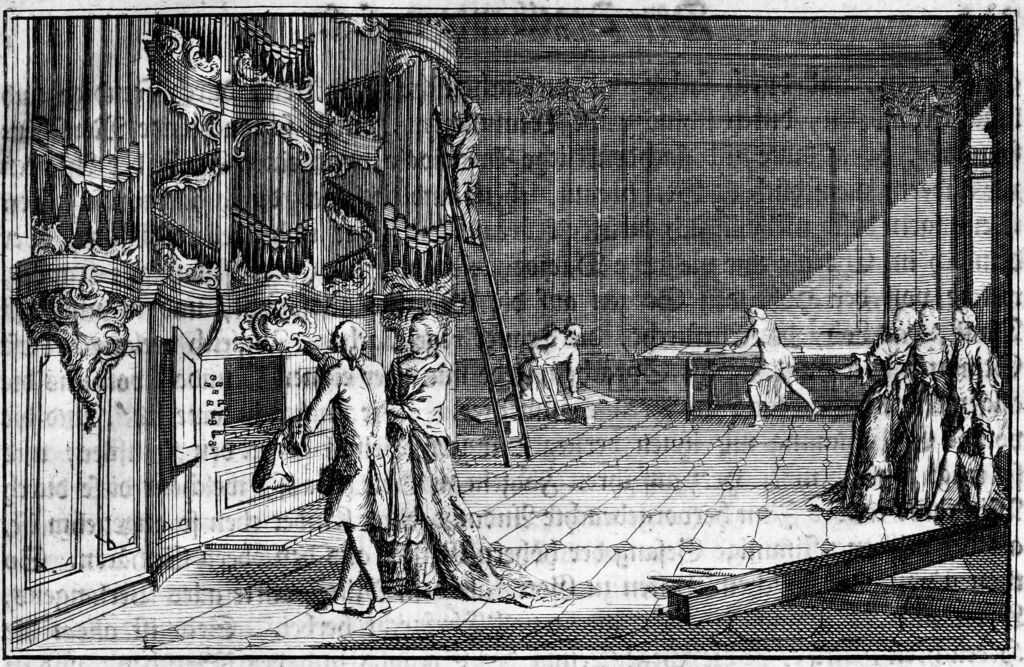
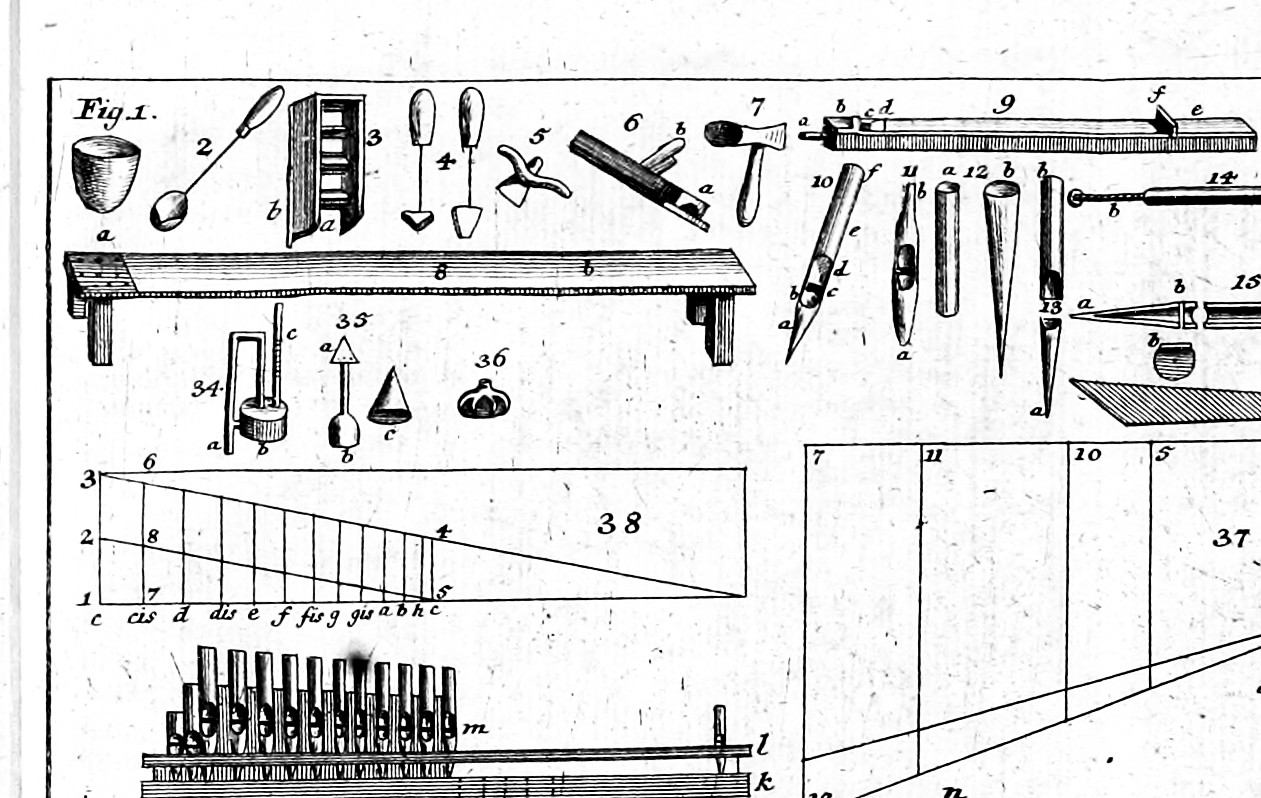
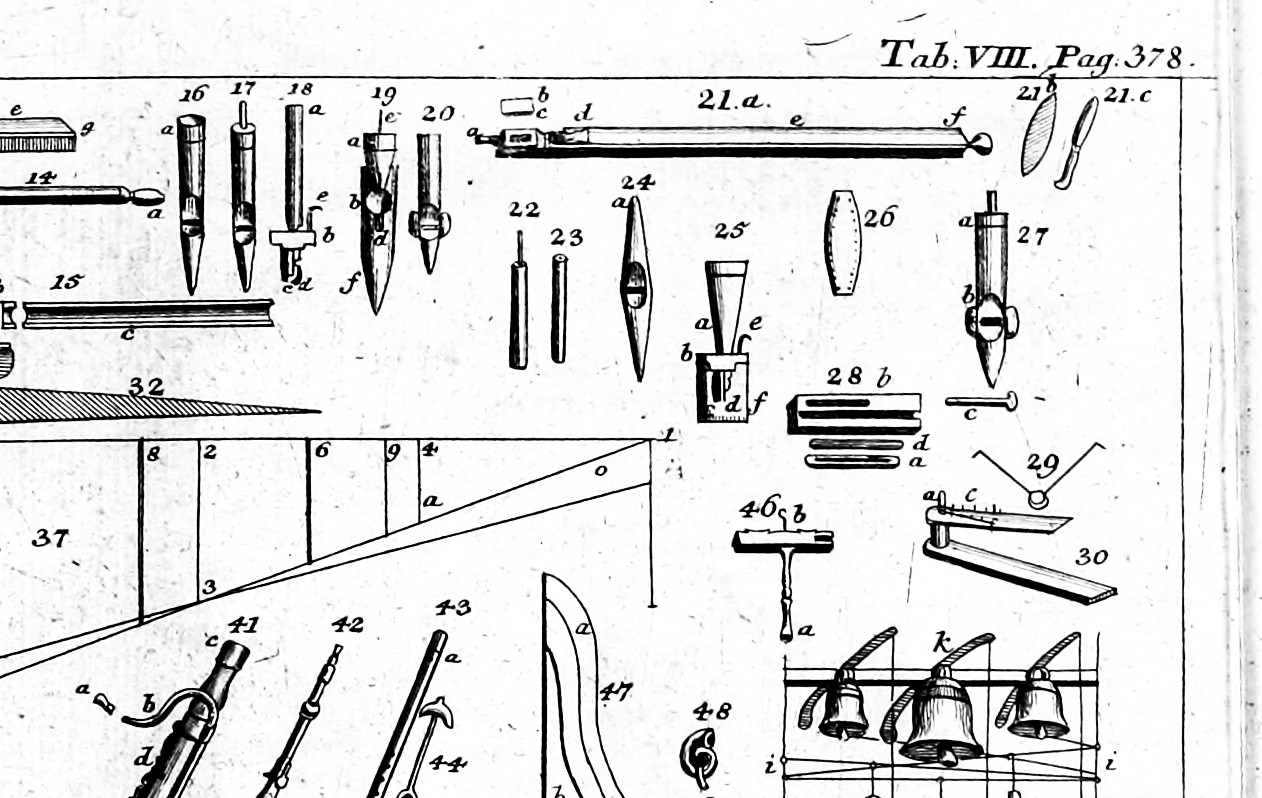
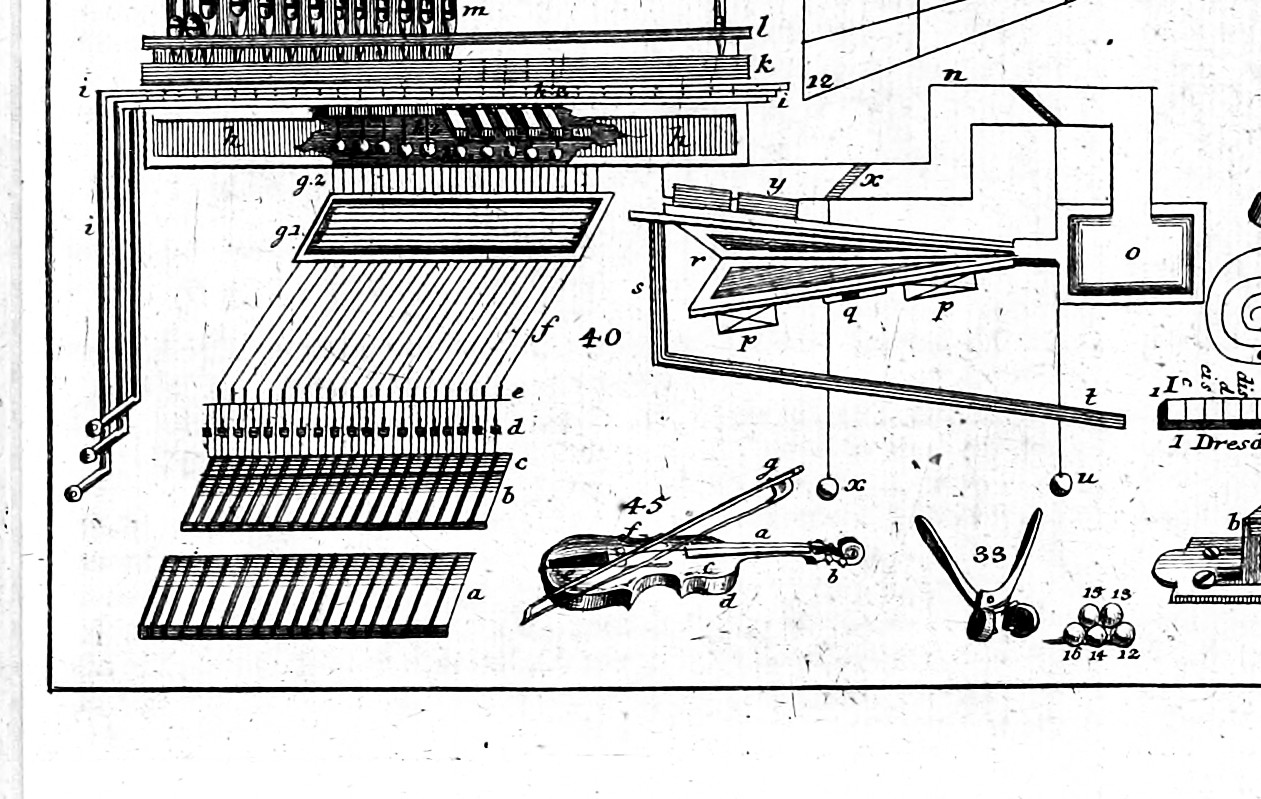
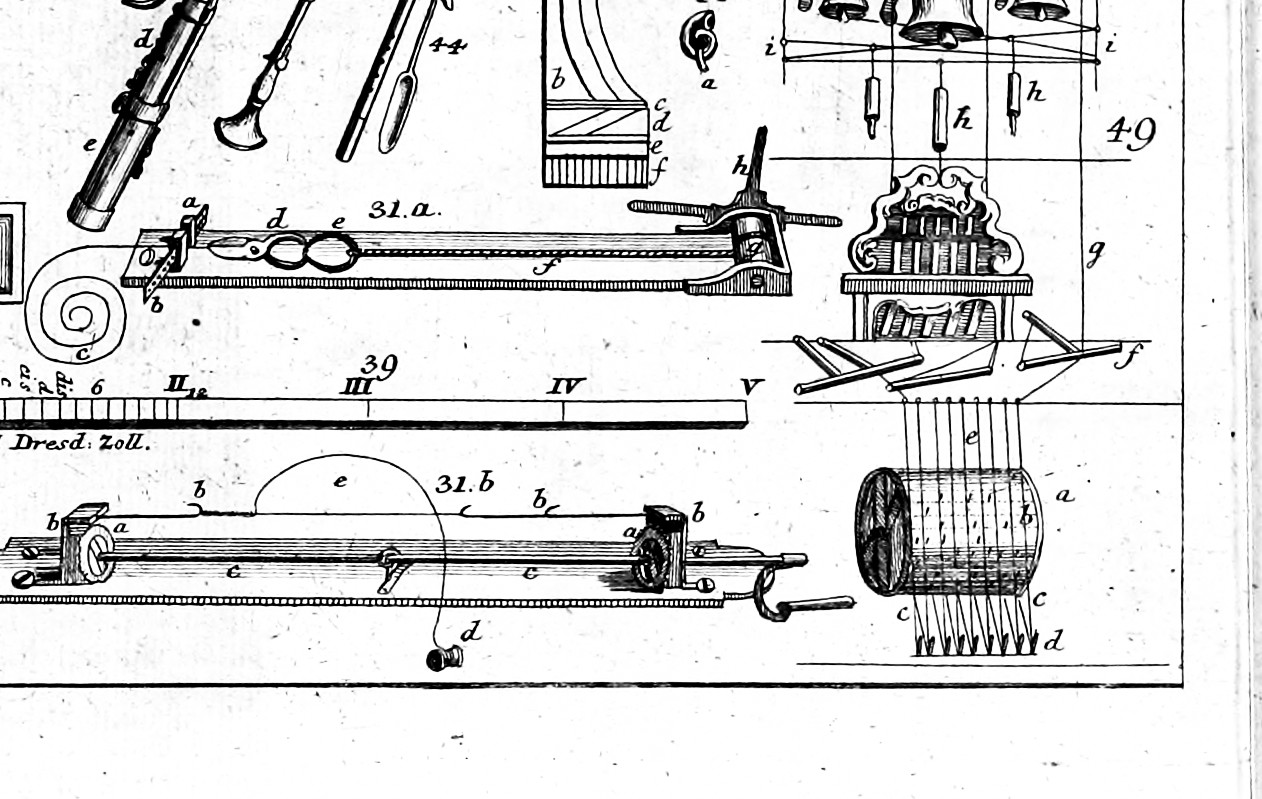
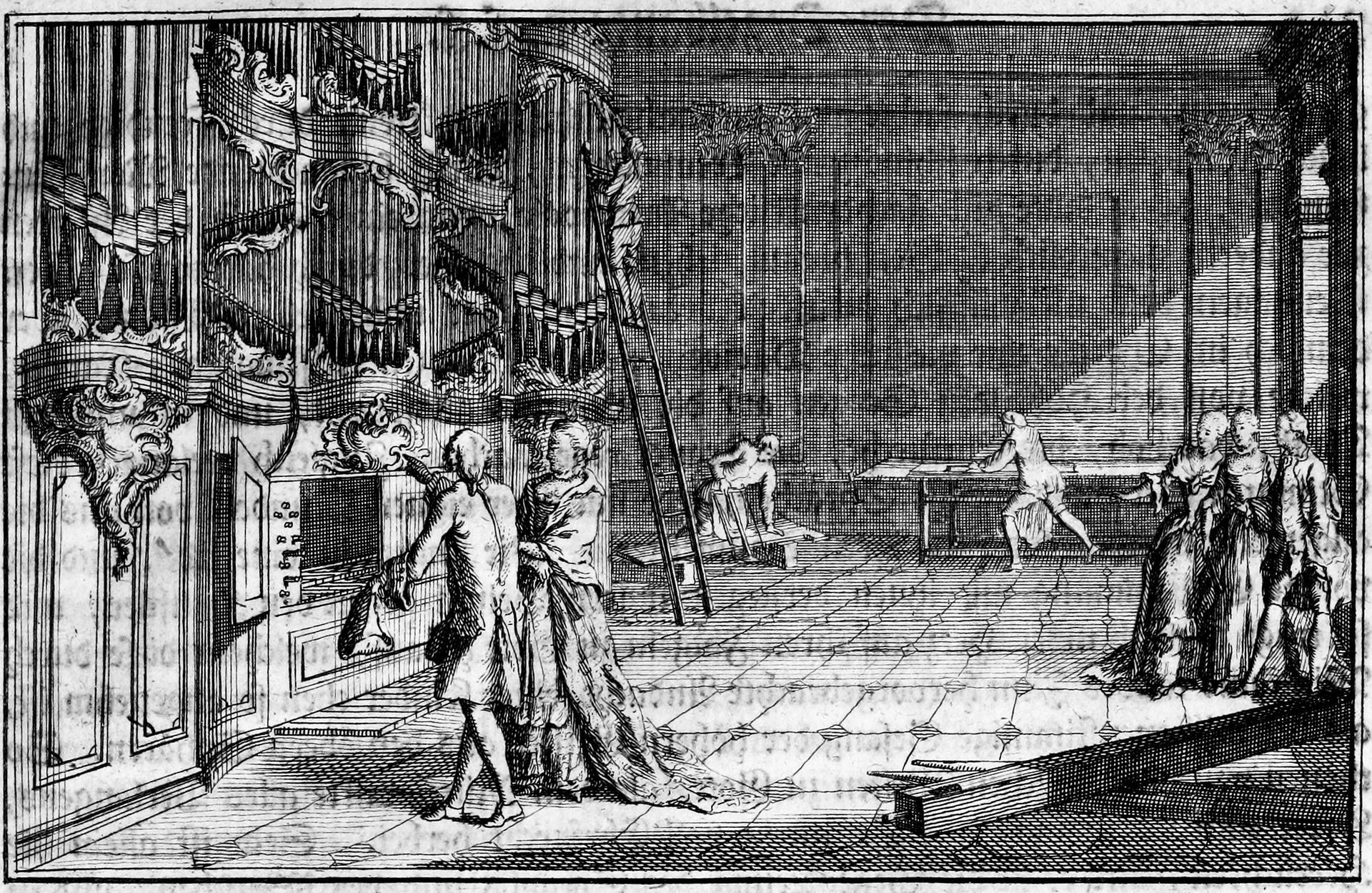
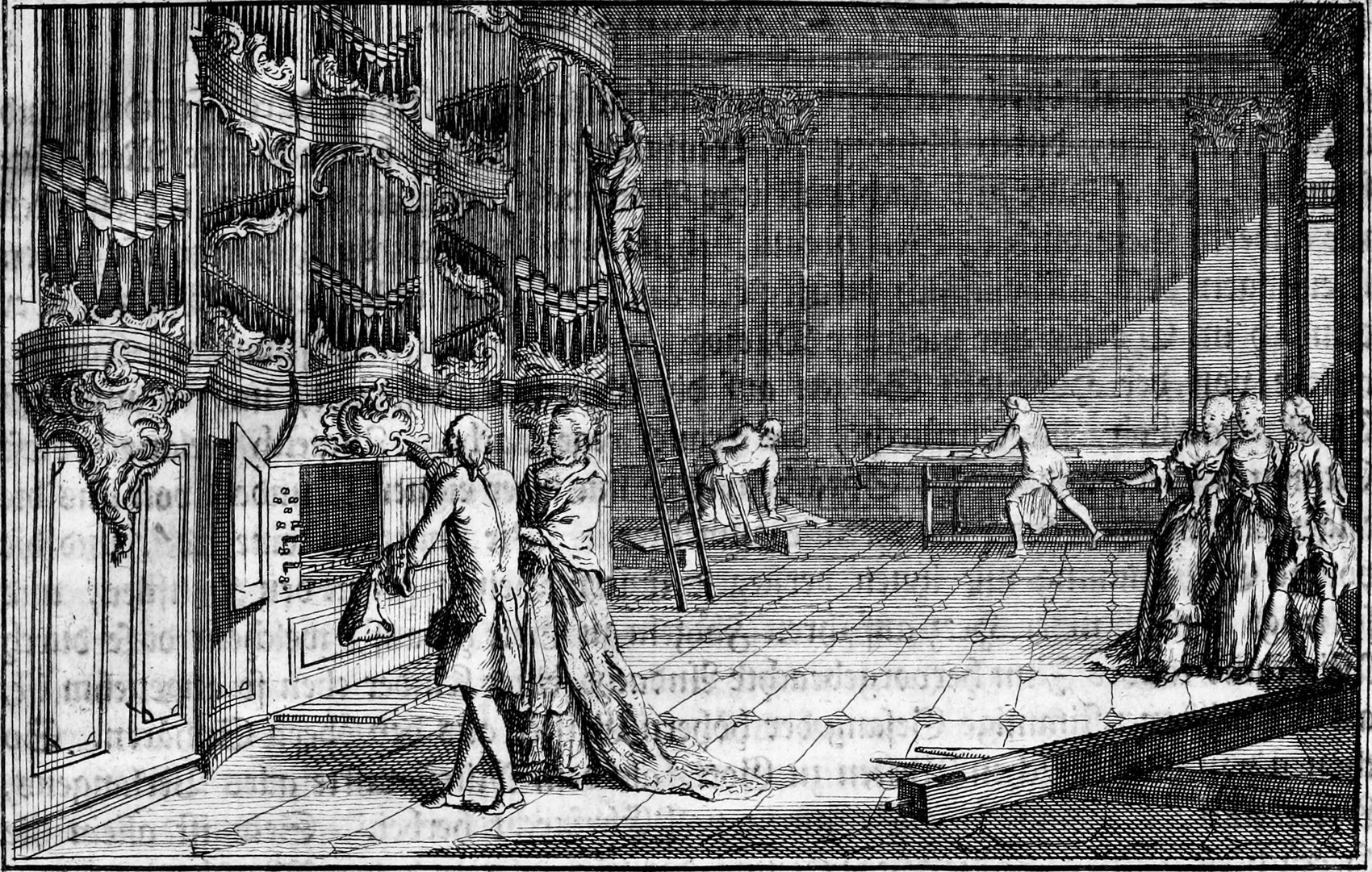
Halle describes casting and planing pipe metal, making and voicing pipes, laying out scales by geometry, temperament and tuning, windchests, bellows, action and stops. The treatise also includes sections on the Glokkenspiel (carillon) and on the makers of harpsichords, violins and wind instruments. Its 49 numbered figures appear on a single folding copperplate, Tab. VIII, reproduced in this edition. The engraved organ scene at the opening and the decorative tailpiece are also reproduced.
Fifteen years later, in 1779, Halle published a much fuller treatment in the sixth volume as Nachtrag zum Orgelbauer (“Supplement to The Organ Builder”). It also appeared separately that year as Die Kunst des Orgelbaues, theoretisch und praktisch beschrieben (“The Art of Organ Building, Described in Theory and Practice”).
This translation
Despite an extensive search, no English translation of this treatise has been found.
This edition presents the complete twenty-seventh treatise in English. It is intended to preserve Halle’s account rather than modernise his methods or substitute present-day explanations for his own. Where the original meaning remains uncertain, we say so rather than silently resolve it; those passages are listed under Open Readings at the end of the book.
Historical technical language requires particular care. Some of Halle’s terms have no exact modern English equivalent; others were used differently in his time. German terms are retained where an English substitute would obscure their meaning, with explanatory notes where needed. Ordinary tools and materials are translated directly.
I am grateful to Dr. Kira Petersen for her help interpreting difficult passages and eighteenth-century German terminology that consultation of contemporary dictionaries and lexicons had left unresolved. Her judgments informed the translation and its explanatory notes.
The translation was made from the copy of the third volume in the Getty Research Institute, Los Angeles, as digitized by the Internet Archive. The original printed page numbers are given in the margin so that passages can be located in the source.
The original dedication is also retained. Halle addressed it to Heinrich IX Reuß of Köstritz, a minister of the Prussian state, and signed it in Berlin on 1 May 1764.
Why we published this translation
I am Jeremy Cox, president of Craftsman Technical Companies and owner of Craftsman Pipe Organs. Our work includes preserving skilled trades and developing curricula and training programmes to help pass their knowledge to another generation.
That work extends to the books these trades have left behind. A historical text may survive in a library or a digital scan and still be inaccessible to the people who could use it. Language, old typography and unfamiliar terminology can keep practical knowledge out of reach.
We translate historical works in the public domain and make the translations freely available to technicians, apprentices, organists, historians and the people responsible for caring for these instruments.
Halle’s account belongs to that effort. We hope this edition will be read in workshops as well as libraries, and that it will help people understand, maintain and preserve the instruments in their care.
Los Angeles, November 2026
Jeremy Cox
President, Craftsman Technical Companies
Owner, Craftsman Pipe Organs
Translation of the Title Page
Johann Samuel Halle’s,
First Professor of History at the Royal Prussian Cadet Corps
(königl. preußisches Kadettenchor) in Berlin,
Workshops of the Present-Day Arts
(Werkstäte der heutigen Künste),
or
The New History of the Arts
(die neue Kunsthistorie).
With Copperplates and Vignettes.
Third Volume.
Brandenburg and Leipzig,
published by Johann Wendelin Halle and Johann Samuel Halle, 1764.
Translation of the Dedication
To His Excellency,
Lord Heinrich,
the IXth Reuß,
Count and Lord of Plauen, Actual Privy Councillor
of State and War (würklicher geheimer Staats- und Kriegesrath),
Vice-President and Directing Minister of the General Supreme
Directory of Finance, War and Domains
(General-Ober-Finanz-Kriegs- und Domainen-Directorium),
Knight of the Royal Prussian Order of the Black Eagle,
Director of the Estates of the Kurmark (kurmärkische Landschaft),
President of the Supreme Court of Appeal (Oberappellationsgericht), etc.
To my most gracious Lord.
High-born Imperial Count (Hochgeborner Reichsgraf),
Gracious Lord,
May Your Excellency, Count of the Empire (Ewer Hochreichsgräflichen Excellenz), graciously receive from me this third volume of my Workshops of the Present-Day Arts (Werkstäte der heutigen Künste) with the same gracious regard that Your Excellency always bestows on factories and manufactories. I shall count myself especially fortunate if Your Excellency, Count of the Empire, regards my researches in the dusty workshops at least as an outline of a mechanical history of Berlin, from which one may compare the present state of our arts with that of the future. France’s Academy is working, as I am, on the same materials: it on the French trades, I on the trades (Professionen) of Berlin. I have good hope that in time this newly ploughed field will be worked better, piece by piece, by a thousand skilled scholars from both the French and the Berlin side. I know it shall bear its fruits. More than that, it will bear its flowers too.
Meanwhile I pray God that He may take Your High Imperial-Comital Excellency (Ewer Hochreichsgräflichen Excellenz), together with Your exalted House, into His holy protection. I remain unto death in all humility, as
Your Excellency’s,
my High-born Imperial Count (Reichsgraf) and
gracious Lord’s
Berlin, the 1st of May (Maimon).
1764.
most obedient servant
Halle.
The Twenty-Seventh Treatise
The Organ Builder
etc.
In an attentive organ builder, who wants to understand and arrange every part of his work with broad thoroughness, there must come together a musician of taste who has more than a musical ear, a metal caster, a joiner, a sculptor, an architect, a geometer for the division of the Mensur1 and for the Verjüngung2, enlargement, calculation and transformation of geometric figures, a draughtsman, and above all the honest man. And since he has to be regarded from so many points of view, each of which presupposes certain outstanding talents, a skilful and conscientious organ builder also deserves particular esteem from the public, ahead of many other single-skilled artists. The multitude of organ stops, which set a devout congregation in motion,[314] and which – through soft and melancholy Gedakkt stops3, through joyful and loud Trompete stops4, through sobbing Tremulanten5, through languishing Menschenstimme stops6, through loud and emphatic Principal stops7 – draw it humanly upward to God from one level of the affections to another, and turn the heart all the more back into itself through harmonious diversions, are indeed unarticulated tones, yet in the chorale they are a manifold David’s harp of an entire many-voiced band of musicians, which from on high pronounces the blessing upon the congregation and stirs in us thanks, praise, reverence and mourning. At the same time these stops, or hundredfold languages, each with its own dialect, demand of us general esteem for their builder. We sing into each one; our complete unison with them seals our approval of the artist and at the same time carries our heart on its wings up to God, to whom this devotion of his children, produced by wind and dead tin, is just as pleasing as the million-voiced song of the higher spirits from the upper spheres. Thus songs with harmony and voices full of reverence sound forth from immeasurable worlds to God, the centre of all longing. His alone is the glory, and he is the inspiration of the seraph and of man, and, in dim tones, also of the demanding worm.
I begin the work of an organ builder with casting. For this he needs the following equipment. The melting pot is of iron, two and a half Fus8 long, one and a half Fus wide, one Fus deep, walled into the kitchen hearth, narrower at the bottom, and, as one can easily gather from the measurements I have given, oval at the mouth. In it the tin and lead are melted, usually half a Zentner9 in weight. The casting ladle, with which this tin is ladled out again, has a long stem in a wooden handle. With both of these goes the casting bench, sixteen Fus Dresdnermaas10 long, two and a half Fus wide, oblong, smooth, and full of little holes, so that the air from the tin poured on it may find an outlet downward through the top of the casting bench. Smooth, close-woven, fine linen, coated with bole, chalk and water, is nailed over the bench so that the hot tin stays on the linen and does not soak through. On the linen white paper is laid, section by section, and it is actually onto the paper that the tin is poured.
The casting box is an oblong wooden box, open at the top and bottom, but across it run several sliding boards, which can be slid up and down in their rebates. At its base, the casting box has a small nailed-on strip, which must fit exactly and closely against the outer edge of the casting bench and yet let no tin pass between them. The last sliding boards in the box have two plates with springs, so that they can be slid up and down more easily,[315] in order, as it were, to flatten out the running tin behind them, or to roll it out thin.
As soon as it has cooled, the finished cast tin sheet is planed straight away on the casting table with the tin plane, which is guided with both hands; and the tin shaving throws itself out of its own accord at the front through the mouth of the plane. The almost upright plane iron is set back at the bottom by a quarter of a Zoll11, whereas joiners set their plane iron sloping backwards. Meanwhile the cast tin sheet lies on the bench clamped with the screw clamp, held immovably fast under the plane.
The soldering irons here are of two kinds, one like a wedge, the other almost square, both of copper and with handles of the usual length. The square one is three Zoll12 long and one Zoll square.
The burnisher for polishing the cast pipes with soap and water looks almost like a short, broad chisel set in a wooden handle.
The planishing hammer has a large, polished, almost square face with bevelled corners; with it the blowholes of the cast tin sheets are hammered tighter, so that the tin may acquire a brighter sound.
These are the tools needed for casting; and so I now take up the casting itself. They obtain English tin in oblong blocks, each block three to four Zentner in weight. The best kind is stamped with an ear of corn, a pelican, and the lamb with the banner of victory, since in England there are five tin mines, each with its own stamp. The best English tin, however, is indicated by the triple ear of corn and the lamb. Organ builders call the purest sechzehnlötig13, as goldsmiths do the finest silver. Depending on whether they alloy it with more or less lead, as the church can afford, it becomes funfzehnlötig, i.e. 15 Pfund14 English tin and 1 Pfund lead, down to eilflötig, i.e. 11 Pf. tin 1 Pf. lead. The Leipzigerprobe15 is 10 Pf. tin 1 Pf. lead, i.e. zehnlötig, down to the sechslötig Berlin Probezinn16. When a pipe is to give a dull, wood-like tone, they often mix 3 Pf. lead to 1 Pf. tin for cheap pipes. The purer the tin, the brighter the sound a pipe gives out. All tin pipes are hollow throughout, cylindrical in the body, and pointed and conical as regards the foot; but more will be said of this below.
Now, in order to learn at once the amount of admixture in an alloyed tin, one melts a little of it and pours it into an iron ball mould, in which the organ builder has already cast sixteen balls (the size of musket balls) in reserve; he has marked each with its number 16, 15, 14, 13, 12, etc., and keeps them in a little box beside a scale pan. Ball 16 is entirely pure English tin; 15 has one part lead with it, which continues through all[316] the numbers in this way. As soon as he now places a new tin ball, cast in this same ball mould, on the scale pan against one of the sixteen, he learns at once how much tin and lead are present together in the mixture in question. The white colour of the tin alone is no sufficient test of the purity of the tin. Malacca tin is too brittle here; it breaks during hammering, and for this reason it is not used for the pipes, but it is used for the solder, because it flows more easily. English pig tin already contains a good deal of iron, just as the two English mines already carry it. It therefore gives the plane unpleasant jolts and does not take a fine polish. Saxon tin tends too much towards blue, is cast in plates, and bears the Saxon stamp at the corners; the Hungarian is better than that from Saxony, but still also bluish in colour, and in plates. Commonly one tests whether something is a piece of tin by seeing whether it crunches like sand between the teeth; but this test for tin is deceptive. A tin is certainly burnt if it crunches, and it crunches when, freshly cast, it is held to the ear.
Among the leads, the best and softest is the English, in pigs over an Elle17 long with the English stamp. That from Goslar holds more silver and is harder, but also, because of its hardness, better for the organ builder to melt together than the English itself. In the large iron melting pot, tin and lead are now alloyed according to the nature of the stops and the expense. The Principal requires English tin, sechzehnlötig to zwölflötig,18 so that, as the chief work of the organ, it may also provide the organ’s outward display; for the remaining stops hide inside the organ behind the handsome Principalwerk, which alone strikes everyone’s eye and commands all the other stops. The manual and pedal belong to the Principal; the manual has 48 to 52 keys, and the pedal, which is the actual organ bass and is trodden with the feet, has 26 keys, namely somewhat over two octaves, whereas the manual, i.e. the hand keyboard, carries somewhat over four octaves. Indeed, on many an organ one sees two to three manuals, each of at least 48 keys. The other tin stops stand behind the Principal and are made of Probezinn, from 8 Fus to ¾ Zoll long. Each key has its own pipe, but in Mixtur stops19 3, 5, 6 pipes often belong to a single key, so that such a stop, if the Mixtur is sixfold, contains six times 48 pipes; commonly, however, each stop in the organ has 48 pipes throughout the whole compass, and consequently an organ of 50 stops has 2400 pipes.
When the tin and lead have melted in the melting pot, though without too great a heat, and everything flows, it is ladled out with iron ladles and must cool a little of its own accord in the air, as each alloy requires.
Meanwhile the casting bench stands level, by means of the level applied to it; it is tightly covered with linen six Ellen long, by means of the flat-nose pliers, and nailed with quite flat-headed little nails, such as shoemakers’ tacks are. Then a doubled sheet of white paper is fastened at the top, at the head end, with a small strip. On the sheet of paper one sets the hollow casting box, onto the paper; with the casting ladle one pours the tin into the casting box, onto the paper: then the hot tin runs from the head end along the whole casting bench on the paper, which is there only so that the linen may not be burnt by the hot tin. The air draws off from the tin, under the linen, through the perforated bench, whereby the sheet is cooled at the same time. Meanwhile one ran along the bench with the casting box, and behind the organ builder the tin likewise knew how to find its way out of the casting box, and ran after him at his heels. According to the width and length of each pipe, a large or small casting box is used. The large one is 3 Fus wide for a sixteen-foot pipe, the middle one 22 Zoll wide for 8 Fus, the third 14 Zoll wide for 4 Fus; for a really large pipe, namely one 32 Fus long, if indeed such a pipe is cast at all, since it is usually made of wood, and of tin would be far too heavy and costly, the casting box is 5 Fus wide.
The longer the casting bench, the more economical the cutting-out. Moreover, the long cast tin sheet becomes cold in a few minutes. In the melting pot the tin was cleansed of its impurities with lime, bones and rosin. Now follows the cutting according to length and width, and according to the pitch. For this the Mensur is necessary, of which I shall speak further below. For the present I must say that for a Principal that is to be 8 Fus long, a width of 19 Zoll is taken. That is, 8 Fus measured for the length of the cylindrical body of an organ pipe, from the top down to the lip (labium); for below the lip one solders onto all pipes a conical, pointed foot, which may be long or short and which neither adds anything to the tone itself nor takes anything from it. For the rest, with the pipe foot one is guided by the height of the organ’s position, by beauty, and by the size of the pipe that the foot has to carry.
The cutting of the tin is carried out along the rule with the knife, which is like the joiners’ knife, as the Mensur of the pipe requires. Then the pipe-metal sheet is planed in proportion to the thickness; i.e. in our assumed Principal of 8 Fus (for pipes are always reckoned only by their length, and up to the lip), the diameter at the top of the body, and likewise at the lip, remains 6 Zoll.
So that, in casting, the first cast tin sheets may not get blisters before the casting bench has become properly warm, some take a doubled casting box, as wide as the casting bench, which however does not reach right down onto the bench[318] but rests straight only on the side strip of the bench, standing off from it only by the thickness of a knife-back, and can easily be slid along on it, so that the sand which some use may not be strewn into the casting at the two sides, between the cheeks of the bench and the casting box, as the latter is drawn along. While the tin is being melted in the melting pot, they at the same time make a pot of fine sieved sand quite hot. When it is now time to cast, they strew the hot sand in front of the bar or wood on which the metal is poured out, and indeed so high that the front part of the casting box comes to stand properly on it and no tin can run away under the casting box. Then they pour the rest of the sand into the doubled casting box, and when the tin has been poured in, one draws the casting box along, and the metal then runs behind it on the hot sand without penetrating or throwing up blisters. The bench must be exactly square, and the sand fine. In drawing the casting box one must not falter and cause the stream to back up.
It is necessary that the cast tin sheet receive its appropriate thickness if it is to last and have a good sound. The wind shakes a pipe that is too thin, and the sound roars confusedly in it. One must also adjust the thicknesses according to the admixture of lead. Let a sixteen-foot body have 13 to 15 Skrupel20 in thickness, an eight-foot one 10 to 12, a four-foot one 8, a two-foot one 5 to 6, a one-foot one 4 Skrupel, in order to stand firm and sound well. But the foot must always be thicker and richer in tin than its pipe body. The stated Skrupel sizes are taken from the figure of the Mensur.
This scaling, i.e. the calculating of pipes, does not depend on any stereometric or solid calculation of content by the geometers, since the art of measurement merely measures the solid space without touching the tone itself, and in pipes it is chiefly the length that raises or lowers the tone; and it is certain that two pipes can agree in stereometric content and yet differ in length and tone. The stereometric law, however, is: to multiply half the circumference of the pipe on the inside (the metal thickness excluded) by half the diameter, and to multiply the pipe length by the product. In this way the solid content of the pipe is obtained.
Here the musical proportions reckon far more unerringly. Consequently one must also cut the lengths and widths of the pipes according to them. Yet if in actual practice the high tones turn out too weak and soft, the blame lies not with the proportions but rather with the reference pipe by which one cut the pipe, and this was too narrow and deviated from the Chorweite21. Sometimes, too, with the small pipes, one has granted the knife[319] too much freedom. Nevertheless the musical proportions still remain the most correct guide for scaling and for the tuning of both reed and flue pipes, whether the flue pipes are open or stopped, conical or cylindrical, and whether the reedwork is large or small. The process of scaling consists in first setting down the proportional number of the known pipe, then its length, and finally the proportional number of the unknown pipe, on the footing of the rule of three. For example, I want to find the descending octave to the pipe 1, 2, 3 (see the Mensurtriangel22). Since its length by the measuring rod comes to 206 Skrupel, the statement runs: 1 has a length of 206 Skrupel; what length does 2 get? It is 412. But to find the width as well, one sets: 1 has a width of 70 Skrupel; what does 2 have? It is 140.
However, not everyone has become well enough acquainted with the musical proportions, and I will therefore set down here an easy method of scaling and the design of a monochord, the invention of a Pythagoras.
Divide the given pipe, tuned at choir pitch (Chorthon), or the whole length of a metal string stretched on a board, which is then a monochord, along its length into two equal parts. In this way I have the ascending octave. If I take the octave length three times, the descending fifth appears. I divide the pipe further along its length into two parts; then the octave arises again, and its length taken three times gives anew the descending fifth, and so on. And in this way one finally brings all the keys together. A test: I want to find the remaining keys for the pipe 1, 2, 3 (see the figure of the Mensurdreiekk), and let its key be c. To achieve this purpose I extend the line 1, 2 at will, draw an extended line from 1 through 3, and divide the length 2, 1 into two equal halves at 4; 4, 1 is now the length of the ascending octave, and the stroke or base running from 4 towards a is then its pipe width. The length 4, 1 taken three times gives 5, that is, the length for the descending fifth f, while the parallel base gives its width. Divide the key f anew into two parts at 6; then 6, 1 gives the octave f. The length 6, 1 carried three times to 7 produces the descending fifth of f, namely b. Proceeding with b just as with f gives dis; doing with dis as with b gives gis, and so forth.
Now when I have f at my command, h is a third of a comma too high against fis according to the temperament; consequently I divide the length of the h into nine equal parts. One such part again into nine parts, and then one of these last nine parts is the so-called temperament comma, the third part of which I afterwards subtract at the bottom from the length of the h. Now in order to find the comma and the third part of the comma by the rule of three, I proceed as follows: one sets the[320] larger proportional number of the comma, namely 81, in the middle the length of the pipe, at the end the smaller proportional number of the comma, 80; what 80 has received less than 81, that is the comma, which is divided by 3. I then subtract the result from the length of the f. Proceeding with h just as with all the previous ones, I get the key e, and so on. But one must play the same game with the key g as with h, because g likewise beats upward by a third of a comma against d.
When I have marked out all the keys of a whole octave on the board in this way, then for the octaves still missing I need only halve all the previous lengths; this gives their keys of the same name in the ascending octave. Taken double, they fill out the whole descending octave. This is the method of scaling. But the fastidious and delicate ear is not yet entirely satisfied with this. One must therefore add to the width of a pipe found by the foregoing method as much as one has taken from its length after trial; even so, the geometer and the musician remain dissatisfied. Further, one must likewise calculate exactly the flow of wind to the scaled pipes; and since the organ builders have always made secrets of their Mensur, a learned geometer and musician finds material here with which to oblige the world by accurate, easy rules, and to make the true cutting of pipes easier and more perfect. In the same way one must get the shallots and tongues of the reed pipes, that is, the reedwork, right in proportion; every pipe must have its full measure of wind, and the reedworks demand this more than the flue pipes do. The best tuning wires are bent from wire, and must slide on the tongues closely but gently. And by as much as the metal of my pipe is thicker than that of the reference pipe, by so much must I bring this greater thickness into the reckoning. The wind supply, or flow of the wind into the pipes, must be sought at the lip of the pipe and in the metal thickness. When the languid has its proper setting in the pipe, the empty space between the languid and the lower lip must be as high as the metal is thick. Now in order to discover this too, take the breadth of the lip with the dividers and make a straight line of it; attach the metal thickness straight on to this line, divide the line thus extended into two halves, and strike a semicircle from the middle; erect a perpendicular where the metal thickness was attached, and one obtains one side of the square of the wind supply, to whose sides one may still add a little. The height of the cut-up at the lips of the pipe is governed solely by the strength of the wind.
After the cast tin sheet has been planed straight, it is scraped clean with the joiners’ cabinet scraper, and rubbed to a shine with the burnisher and soapy water.
To remove the soap again, one finally rubs the tin smooth with chalk. After burnishing follows the rounding, on the conical wooden foot mandrel, and of the cylindrical pipe body, with a straight wooden beater†. This mandrel may be of oak, resinous pine, alder or other wood, and is not hollow.
For soldering the seam together, the tin at the seam is painted with bole and water, scraped thin with the knife as far as the solder seam is to go, and tallow is rubbed on at the seam. Finally, with the grain of solder hanging from it, one draws the hot soldering iron lengthwise all around this seam, no longer on the mandrel but only in the hollow of the hand. The bole holds back the burning of the tin. The two edges of the seam lie only close against each other and not over each other. After soldering follows the rounding on the wooden mandrel and the forming of the lips. The conical foot is likewise of tin, and is soldered separately onto the cylindrical pipe body. Forming the lips means slightly beating down a large arched surface above the cut-up, that is, above the long, four-sided, large transverse slit of the pipe, and a similar but smaller one below this transverse slit. The dividers mark out both beforehand. Inside, a metal languid is inserted crosswise into the widest beginning of the conical foot, that is, its base, and soldered fast; in small pipes this languid is only as thick as a knife-back and almost fully round, losing only a small straight segment of its circular roundness towards the cut-up, so that the wind can pass through this slit, as in wooden flutes. Finally the body and foot are soldered together by means of the bole. The languid, this almost fully round transverse disc, which closes the whole base of the foot cone like a soldered-in cover except for a straight-lined slit, is half a Zoll thick in large pipes; it is fitted horizontally into the foot. Consequently the wind that blows into the tip of the conical foot cannot come out of the foot again anywhere except at the narrow flue. Now when it has forced its way through this, this wind divides or splits; half of it is lost through the large cut-up, and its other half winds its way up along the slanting bevelled edge of the upper lip into the pipe body, which with its cylindrical sides produces a harmonious vibration that makes the tone. This wind, split at the upper and lower lip – which for that very reason must look straight at each other (when one looks down and through a pipe from above) – and the inclined surfaces of both lips are the actual causes of the pipe’s tone. What is more, both lip edges must tremble freely, for if one blows a pipe with the mouth and merely holds a finger gently against the upper lip, the pipe still gives no tone, although languid and slit, upper and lower lip, are all correct. The languid, moreover, is not cut off straight towards the cut-up, but somewhat slanting. If one blows gently into a[322] tin pipe, it gives a tone an octave higher; if one gives it the full wind, only then does its proper, strong tone arise, but an octave lower than the first, and then the first double-octave tone suddenly stops and turns into a single, emphatic and natural one.
The longer the pipe body itself is (for the length of the foot has no influence at all on the height or depth of the tones, because the conical foot is only the wind feeder and the pipe support), I say, the longer the pipe body is, the deeper the tone becomes. The reason is that more metal is set vibrating here, and the air is therefore compelled to beat waves, like a stream, for a longer time. The shorter the pipe, as with the clavichord string, the higher the tone one obtains. The more I close, i.e. narrow, the upper opening of the pipe with my finger, the deeper the tone immediately becomes. The thickness of a knife-back cut off the top of a pipe already alters the first tone to a noticeable degree.
It is curious, and one experiences it every day, that when one sounds a pipe on the organ, its neighbouring pipe of the same calibre announces itself at the same time. For example, strike the key c, open the organ case, and one will see, far from this sounding c, in another stop, often several Ruten23 apart, the c of another stop, if it is of the same size as the former, begin to move. The urge is there to be the echo of the first; the body trembles with longing that it may occur to the organist to play it; nothing but the full wind is still lacking, the tongue lisps the tone, only the breath is for the time being still absent. One also has examples of this in violins, which on the wall try to join in concert with the one being bowed. More still: if in the Cimbelspiel24 of organs I want to find out the true, predominant sound of these small round bells, I stand directly beneath them and sound all the tones on the tuning flute, one after another; the bell remains insensible to all of them; but as soon as I sound the true tone of the bell, the bell immediately and contentedly hums its approval down upon me, as if it were struck with the finger. In bells the circles are many-toned: one way below at the rim, another way above, and according to whether the striking hammer is a few Pfund heavier or lighter; hence in Glokkenspiele25 a single bell can be used for several tones at once.
A pipe’s length must bear a suitable proportion to its diameter. Very narrow long pipes sound disgusting; very short and too wide ones hum to the point of annoyance.
After the soldering follows the Intonirung26, i.e. the tuning by ear and by the semitones and whole tones of the entirely wooden square reference pipe, which is made like an ordinary flute but without finger holes, in which[323] a closely fitting graduated stick27 can be drawn out and pushed in, in order to sound all the keys and tune by them. One therefore cuts one little strip of tin after another from the top of the body of the tin pipe with the knife, until the higher flute tone in unison results. A shaving of the thickness of a horsehair already alters the tone noticeably. Further, if one takes a pipe in the hand, and the warmed metal makes quicker vibrations, it sounds higher; if one puts it down out of the hand again, the pipe becomes lower in tone in proportion as its parts contract again and grow cold. At the top they must be exactly round; but if one has cut too much off, one need only scrape them a little thinner.
The widths of the pipes are not arranged according to the proportional numbers, but in deep large stops one takes away somewhat of the width, and on the other hand adds something to the small pipes, whereby at the same time, according to circumstances, one now gives a little to the length, now takes it away again. Yet in this every organ builder follows his own measure and his own head. Further, the temperament makes a new alteration in the proportions. Meanwhile a pipework is beautiful if it is of a wide Mensur in the deep tones and stops, and in the high-pitched bright pipes of a narrower Mensur than the usual proportional numbers entail. The advantage then consists in this, that the high keys become sharp, bright and pleasant, whereas the low ones become solemnly magnificent, according to the nature of each kind of stop, since otherwise the roaring basses easily outshout and suppress the twittering treble.
All tin pipes are divided into reeds, into reedwork, because they blow through a reedwork, and into flue pipes†. Flue pipes are made of wood or tin. Now the purer the tin is in itself, the purer the flue pipe sounds, and the more durable it is, partly because lead overloads the pipe in the organ and makes the tone dull, and partly because the lead in the pipe consumes itself through the sugar of lead, by virtue of the Luftsäure28, and with it also the admixed tin, which otherwise holds back this sugar of lead in the viellötig pipes. In large pipes the body requires at least a fourth part of tin, but the foot half tin; for the smaller ones are content with an inferior mixture. Lead damps the tone because it is soft and not very elastic, so that the wind, when it crosses or cuts at the lips, is little thrown back by the lead and is struck only sluggishly.
On a tin pipe the whole length of the pipe from the top down to the cut-up is called the body; the large visible transverse slit through which half the wind escapes, the cut-up; the pressed-down, slanting and largest flat above the cut-up, the upper lip; inside, the transverse plate just below the cut-up, the languid;[324] the flattened smaller flat, the lower lip; and the cone is called the foot. So much for the tin flue pipes. The edge of the upper labium must always look exactly at the edge of the lower labium. At the front of organs it is customary, in order to bring out a proportional Verjüngung, to give the small rows of pipes often very long feet, or even to add dummy pipes, merely so that the files may parade in full number. Commonly, inside the organ, one makes the feet 7 Zoll long, and with them the body, on which alone the tone depends, up to 6 Fus long. All kinds of pipes, wooden or tin, stand vertically in their toeboard. Why could one not let the monstrous Cyclopes howl lying down, like a Ulysses!
Reedwork is of a somewhat altered construction, namely not cylindrical, but wholly conical, both as regards the body and as regards the foot. One such cone sits in the other, and the foot in turn in a square piece of wood. In this wood, in line with the pipe, is a hollow brass channel, closely covered by a thin brass blade. The blade is called the tongue, and the channel the shallot. The wind can push the tongue open a little, pass between it and the shallot, set the tongue vibrating (which causes the rattling), and make the ever-widening conical pipe sound like a trumpet and fill it. Otherwise neither foot nor body has a cut-up. Now, so that the tongue (the little blade, as on the Basson29) may not at times leave the mouth standing open, there is a bent wire which goes through the wood and clamps the tongue onto the mouth, so that the mouth may, as it were, remain open only by a small slit, for the barest drawing of breath. This wire is called the tuning wire, and with it one can easily tune all reedwork. If one wants the Trompete tone higher, one knocks the tuning wire down or downward with a small stick; the tongue then closes the mouth still more narrowly, so that the crack for letting the air through becomes narrower and the wind is therefore compelled to use force to move only a small part of the tongue, though all the more quickly, and that causes a rising tone. If the pipe is to trumpet at a lower pitch, one knocks the tuning wire up; the whole tongue is now unbound, the mouth slit wide, and the wind can now play with the whole tongue, which accordingly also causes slower vibrations, i.e. a lower sound.
Reedwork must be long and large enough; for if the low ones are too wide, they outshout the small ones, which is commonly a fault that clings to the nature of reed pipes. Either the length is not well scaled, or the wind supply is to blame, or the tongues and shallots are not quite straight, or are too wide or too narrow. And in short: a reedwork must indeed be made exactly and attentively if it is to last.[325] The pipes must not be set too close together, so as not to hinder ease of tuning. They must not be perforated at the bottom, and must stand firmly. The boots or feet must be wide. The tongues must be able to move freely back and forth on the shallot, like the lid of a sliding box, and must not catch anywhere, because otherwise they are inconvenient for tuning. Strong tongues last longer but do not take the wind well. One must make the tuning wires strong enough and bore [the holes for them] straight, so that they can be shifted on the tongue precisely and easily. But they must also not fall down off the shallot of their own accord, or shift on the shallot only through the swelling of the wood, because the pitch is immediately put out of tune by this. Elegance further requires that the lengths of the tuning wires be made to decrease in proportion. Their most durable material is brass wire, because iron wire rusts more easily. It is also customary to coat the brass shallots with tin by soldering, so that the tongues do not rattle too much.
So that my readers may also form some idea of the mechanics and of the variety of the stops in an organ, I will analyse the chief of these stops for them. Everyone can see the Principal, as the main stop, standing large and small together in the façade of the organ. The lowest c, or the largest pipe, is often on one side of the organ and the next, cis, on the other, with the d again beside the preceding c, the dis beside the cis, and so on through the whole compass, so that the rows are made to decrease step by step next to one another, in order to give a proportionate appearance. The body is richer in tin in the Principal than in any other stop; it is cylindrical, but conical below in the foot, where it stands in the toeboard. At the bottom, at the slit of the lip, the wind is split into the calculated pitch. The Principal is the main stop among all the others.
After the Principal come the tin Gedakkt stops, that is, pipes closed at the top with a cap, from which the corrupted name Gedakkt has arisen. To these belong the Subbaß30, sixteen-foot, and the Qvinte31, twelve-foot (down to 3 Zoll). For organ builders always count only the largest pipe, the flank man (Flügelmann), in each stop, and so it goes without saying that if the lowest c is 16 Fus long, or, which is the same thing, has 16 Fus Thon32, the ascending d, dis and so on must become ever shorter and narrower. Now the tone of all Gedakkt pipes, that is, covered pipes, whether of tin or of wood, is always muffled, as if a person tried to sing with the mouth closed; for the tone cannot get out again at the end of the body but must run back toward the lip, whereby the returning stream of the air waves receives the vibrations for longer and gives them back. Some stopped pipes are even fitted with a Schieberöhrchen33 in their caps, so that the pitch can be set high or low. The further I push the Schieber down into the pipe, the higher the pitch becomes, because the pipe, as it were,[326] seems to have become smaller by it; the further the Schieber is drawn out, the longer the cavity of the pipe becomes, and the lower the pitch. The Gedakkt stops are placed in the manual or pedal, and their pipes are made either of tin or as long, four-sided wooden boxes. Commonly, however, the largest Gedakkt stops and basses are made of wood, because in tin they turn out very heavy and costly.
The Posaune stops34 likewise commonly consist of wood, from 32 to 8 Fus long, or else of tin. Their conical body is set in a piece of wood through which the shallot, the tongue (Blat) and the tuning wire pass, and so make a reedwork. The same applies to the Trompete stops, which sound brighter than the Posaune stops, because in the Trompete the shallot is of brass, whereas in the Posaune it is of tin. Otherwise body, foot and everything else are the same, and there are 32-, 16- and 8-foot Posaune stops just as there are Trompete stops, proportionally diminished through all the keys.
The Menschenstimme is of tin, from 8 Fus down to 6 Zoll long, because no human bass can go lower than 8 Fus, and no throat treble can sing higher than 6 Zoll. It likewise has 48 keys, and Probezinn as its material. I will show its parts a little more closely. The body of the Menschenstimme is a narrow cylinder which runs down on the inside into a narrow foot; this foot is set in a small but thick ball of tin, through which run a brass shallot, a tongue, and a very long tuning wire that comes out at the top of the pipe for the sake of tuning. From the foot of the body just mentioned, a new, proper foot now goes down on the outside, coming to a point; this is called the boot (Hose), and this boot therefore hides within itself the Trompete shallot, the ball and the tuning wire. The ball is there only so that the shallot may sit firmly in it, and this reedwork must in general be made precisely. The ball is soldered to the invisible foot, and is here called the head. The tuning wire comes out freely at the top of the pipe. In the low octaves the pipes of this Menschenstimme are half covered at the top; the two higher octaves are made only a quarter stopped and mostly open; the highest, or fourth, octave, on the other hand, is entirely open at the top.
Among the open stops there is the Violdigambe35 of 8 Fus, the smallest pipe of 6 Zoll, running continuously through all 48 keys. It sounds like the bowing of a knee fiddle. It is cut from tin; it is wide at the lip, narrower and open at the top, and often also of wood.
The Salicinalstimme36 is wide and open at the top, narrow at the cut-up, with an ordinary pointed foot, of tin, from eight-foot down to six-inch, carried through all 48 keys. The main thing in the stops comes down to the setting of the languid, the cut-up, the forming of the lips, and the shape of the bodies and shallots;[327] and I would not rule out that a great many entirely new stops will yet be produced in future by mixing these.
The Gemsenhorn37 is narrow at the top and wider at the bottom, at the cut-up. The tone, thus already fully pushed out, narrows, or as it were draws itself back into the throat. Consequently it is a kind of Violdigambe; but it sounds sharper, and is customary from 8 Fus to 6 Zoll. It is merely more open at the top than the Violdigambe.
Mixtur stops have three, four or more pipes on a single hole, or key; they therefore fill out the weak stops better. The Gedakkt, Mixtur, Trompete, Posaune, Menschenstimme stops and so on, whatever is of tin, stand behind the curtain of the Principal, inside the case; but the heavy wooden bass pipework stands below and behind the organ on account of its weight.
If the Subbaß (deep bass) is sixteen-foot, then it is made stopped at eight-foot, or the eight-foot one is made into a four-foot. Its stopped nature makes the tone run back toward the lip, melancholy and hollowly rushing. It is called the Unterbaß38 because it sings lower than the human bass; since otherwise the throat can produce only 8 Fus in the bass, 4 in the tenor, 2 Fus in the alto, and 1 Fus up to 6 Zoll in the treble. The Unterbaß is made of tin and conical, or of wood, in which case the wind blows into it through a little tube.
The Qvintadema39 is stopped, of wood or tin, narrower than the Unterbaß, and at the same time it sounds two tones at once: the deep, flute-like fundamental and, together with it, a distinct fifth, for example c and g together. The reason for this lies solely in the narrow body and the cut of the lip, together with the double beard.
The Bardun40 stands midway between the Unterbaß and the Gedakkt; it is narrow in its cutting-out, stopped, and howls out a sharper emphasis than the Subbaß.
In forming the lips and the cut-up, one is guided by the length and width of the pipes, and by the nature of the stop that is to be produced.
The Qveerflöte41 is given a body twice as long as another open pipe. This wind, rolled slowly and from far off, splits at the lower lip into two overblown tones, as on overblown transverse flutes. Such a Qveerflöte 8 Fus long nevertheless gives only a four-foot pitch. Its body is narrow and long, stopped in the bass and open for the treble.
The Waldflöte42 is somewhat wider at the top than the Spizzflöte43, and in all other respects entirely the same as it.
The tone that a Spizzflöte gives is only soft, but cutting all the same. Its pipe is open at the top, and narrower there than at the lip; that is,[328] its body consists of a truncated cone, whose base is soldered onto the base of the inverted cone.
The Fagot has a conical body and is also fitted with a separate conical foot.
The Orgelecho44 stands with its pipes concealed in a box, and to one tone belong 5 to 6 pipes of tin. The first tone receives one or two keys stopped (†Gedakkt); the other four pipes, on the other hand, are open. The box damps the sound, which sounds as if it stayed somewhat outside and came from far off like a forest echo.
If a tin pipe is closed completely at the top with a cylindrical box, so that only from the middle of this covered box does a narrow, hollow little cylindrical tube rise up, this is called a chimney pipe. It then sounds sharper than a full Gedakkt.
Too strong a wind overblows a pipe, that is, makes it sound higher than it naturally should; too weak a wind gives a soft, low tone; and to that end the holes in the sliders must be bored in proportion to the pipes, because these stops must distribute the actual supply of wind from the Windlade45 to the pipes.
The stopped tin pipes are given a vertical side beard on both sides of the cut-up, i.e. two plates which drive back again the wind escaping through the cut-up, because the cut-up is wide and could let far too much wind escape, depriving the body of it.
As for the weight of each pipe in the organ through all the stops, setting it down would only tire the reader. I will therefore touch on only a little of it, so that the overloading of an organ may be surveyed from a distance. In Hamburg the Nikolaikirche contains, in the 32-foot Principal, two pipes, namely the lowest c and dis, which together weigh 1600 Pfund, and there are in the pedal of the Principal 26 pipes, from the largest to the smallest, together 42 Zentner in weight. Although, then, the lead alloys make a very great difference in the weight of pipes, as do also the different kinds of pipe cutting-out, according to how some organ builders have proceeded, I will nevertheless weigh out here some of the most usual stops for the reader, for further reflection.
Approximately, a Principal of 8 Fus with all its pipes c d e f fis g gis a b h c weighs about 165, or 200 to 220 Pfund.
A Principal of 4 Fus, 60 to 85 Pfund.
Zinngedakkt46 of 8 Fus, 120 to 140 Pfund.
Qvintathon of 16 Fus, 260 or 270 Pfund.
Qvintathon, eight-foot, 116 to over 120 Pfund.
Oktave, four-foot, 49 to over 50 Pfund.
Qvinte, three-foot, 22 to 25 Pfund.
Superoktave47, two-foot, 15 to 18 Pfund.
Gedakkt, four-foot, 72 Pfund.
Mixtur, five ranks (i.e. 5 pipes on each hole), the largest pipe one-foot, 60 Pfund.
Superoktave, one-foot, 10 Pfund.
Mixtur, three ranks, one-foot, 32 Pfund.
Mixtur, four ranks, largest pipe two-foot, altogether 90 Pfund.
But, as said, the wide and narrow scales, the longer or shorter feet, the admixture of lead and the different thicknesses make a difference if one wishes to have the weights of the pipes very exact. Quite pure tin turns out too brittle in casting, and for this reason the tin is softened by admixed lead; too much lead attracts the Luftsäure too strongly to itself, and overloads the tones with matter, so that they sound dull. A good alloy is made by 2 Pfund of lead to 1 Pfund of tin, and that even for village Principal stops. Better principal metal requires 2 parts tin to one part lead. But in descending one must not venture to go lower than the tenth part of tin; for then no whitening by regulus of antimony or by marcasite helps; and even if the elasticity and the tone resulted from it, both nevertheless cause loss of metal, and always add expense.
As for the wooden pipes, these can be glued together from resinous pine, maple, fir and oak wood as long four-sided boxes, or bodies, and the tone can be set lower or higher, and made into a Gedakkt, by a cap at the top on which there is a knob. Resinous pine boards are good for the Unterbaß and for the Posaune; maple wood, on the other hand, for pure Gedakkt pipes, instead of boxwood, oak wood for Gedakkt pipes; they are made 32, 16, 8 Fus and shorter, down to ¾ Zoll, if one wishes to save the boxes of the tin stops†, whose bright tone, however, they never attain. The small spigot with which they receive the wind from the Windlade is properly a small hollow tube or pipe of wood, which projects in front of the body. When the wind has entered through this tube, it falls into a square covered cavity (wind chamber); from this it presses against the somewhat obliquely cut tongue, a small transverse board which takes the place of the languid of metal pipes and which, at the top, conducts the air by a narrow path up to the obliquely lying lip (labium) and from there onward into the pipe body, out of which this air cannot come again if the pipe is stopped at the top with a cap. If the inflow of wind into the pipe is too great,[330] it is customary to insert a little chip into the small wooden pipe, which here as it were represents the pipe foot, because the body stands on it and has no other foot, before it is set up on the Windlade. To keep the heavy wooden pipes from falling over, they are usually provided with a strip running up from the outside toward the top, and fastened by it to the wall with a pin. The pipe passes almost up to the lip through the wind chamber. An open wooden pipe of 4 Fus Thon, which has no cap at the top, gives, when stopped, because of the long path in rebounding, yet no more than 2 Fus Thon, and this tone is muffled. The finest wood for pure-toned pipes is that of the maple. In general, the harder, drier and smoother the wood is, the brighter and sharper it makes the tone, oak wood excepted, since its nature carries with it a tough, pith-like matter, which prevents the wind from being thrown back equally strongly from all places. Fir wood must be completely free of resin and dry if it is to produce deep basses and Gedakkt stops, since the lightly tensioned and delicate wood fibres then vibrate easily, lengthen and shorten themselves, throw the air back and draw the tone out long, and consequently make it low and soft. Whoever coats oak or fir pipes on the inside with glue in order to make the working surfaces smooth commits the very same error as when one plasters string instruments all over with resinous or gummy lacquer varnishes and binds these vibrations of the wood fibres. Perhaps, however, thoroughly scouring the inner surfaces of wooden pipes and rubbing them smooth would do more than mere planing. In the same way the differing thickness of the pipe walls makes a difference in the purity of the tones, and these walls are, as it were, four soundboards joined together at right angles, in which the lengths of the veins should be equal to the length of the tone.
In former times tinplate organ pipes of tinned iron were in part made for the Trompete register; nowadays, however, the Posaune pipes are made of wood, and are 32-, 16-, 8-foot; Trompete pipes and Fagot (Basson), however, of tin, 16-, 8-foot, and so on. A Fagot has a narrow body and a rattling tone, softer than that of a Trompete. For the rest, one finds at Aachen and at S. Loretto a four-foot Principal of silver and of very pleasant tone, just as English tin already stands out noticeably above Probezinn. In the English church at Hamburg stands a Principal of 8 Fus of brass. But the Intonirung of brass pipes is exceedingly difficult; they speak only with difficulty, and yet do not sound much better than those cut from English tin, although they look well to the eye.
The largest wooden bass pipes and pedals are separated from the other stops by special wind conduits down below in the organ, because they are too heavy up above; whereas the small ones are arranged behind the Principal on the[331] Windladen side by side, each stop separately, on its own line, which line, however, is broken off into two halves or joined together by a Koppelholz48.
The church of St. Peter in Rome boasts the largest organ. It contains a hundred stops. But perhaps Berlin would have outdone it, had the tower of our Petrikirche not collapsed, since in the plan 110 stops and over 3000 pipes had been intended for it. The Nikolaikirche in Hamburg has 71 stops, with a 32-Fus Principal of English tin in the façade. The largest organ in Dresden was built by Silbermann in the Catholic church, 32-Fus in the Principal and pedal. The Hamburg organ in the Nikolauskirche is likewise 32-Fus, and in the Jakobskirche the f is 32-Fus; all of fewer stops than the one in Dresden.
The old builders characterised organs as ganze Orgel49, halbe Orgel, Vierteilorgel. But, properly speaking, either a ganze Orgel is nowhere to be found, because it is always still short of stops, or every organ is whole, because it must have its necessary stops according to the size of the congregation. But here too one must understand the old builders rightly. For a ganze Orgel, namely, they required that it must show a 16-Fus Principal in the manual keyboard; for no 32-Fus pipe is suitable for the manual. A Principal of 8 Fus made a halbe Orgel. The Principal of 4 Fus received the name of a Vierteilorgel, and the two-Fus one had to count as a Halbvierteilorgel; even though in the instrument itself one had much larger Gedakkt stops and Qvintaden stops to show.
Among the Berlin organs, that of the Garrison Church, built by Wagner, stands out above the others with its fifty stops; as does the one in the Petrikirche, likewise of fifty stops and erected by the skilful Migend, with the two largest Posaune stops, of 32 Fus in the Principal, and 16 Fus in the manual and pedal keyboards. The height of the Garrison organ here is 27 Fus to the organ gallery, that in the Petrikirche 40 Fus; the first has six, the other eight bellows, three manuals and the pedal.
The organ which I have set as the vignette before this treatise on the organ builder is the one, likewise built by Migend, which Her Royal Highness Princess Amalia uses for her princely devotions. It has two manuals, the pedal, 28 stops, and it is tuned to Kammerthon50. The manuals run from c, cis up to three-line f; the pedal from c, cis up to one-line d, thus somewhat over two octaves. The two manuals can be coupled in the midst of playing, without one having to break off in the fingering. The height is 23 Fus, the manual 16-Fus, the pedal twice 16-Fus, the Subbaß 16, the Posaune 16-Fus.
The Potsdam Garrison organ possesses 48 stops, and a height of 27 Fus rheinländisch Maas51, the same breadth, three manuals, a pedal, and the 16-Fus Principal stands in the middle of the façade. Of this organ, the organ builder Wagner’s report has come into my hands, which had to be drawn up when His Majesty the late King Frederick William, of most blessed memory, was graciously pleased to learn the character of all the stops of this Potsdam organ. This report reads as follows:
Principal of 16 Fus in the first manual. To it belong all the large and small rows of pipes in the middle of the façade and round about below. They sound out magnificently above all the pipe stops with a pleasing sharpness.
Principal of 16 Fus in the pedal keyboard, of greater gravity and emphasis, stands on both wings of the organ front.
Principal of 8 Fus in the second manual, set into the façade at the top, to the side.
Principal of 4 Fus for the third manual, right at the top above the façade; compared with the foregoing 16-Fus stops, both this and the 8-Fus Principal speak with distinct sweetness.
The Oktave of 8 Fus in the first manual, and
The Oktave of 8 Fus for the pedal, of equal tone, for reinforcing the Principal stops from octave to octave, as also
The Oktave of 4 Fus in the first manual.
The Oktave of 4 Fus in the second manual.
The Oktave of 4 Fus in the pedal.
The Oktave of 2 Fus for the first manual.
The Oktave of 2 Fus in the second manual.
The Oktave of 2 Fus in the third manual; each of the manuals of a different sound from the other. The remaining octave pipes that are needed, up to the highest pitch, occur in the Mixtur stops, which are mixed from octaves, fifths, fourths and thirds, only sharp-toned, and which must all together reinforce the treble at full throat against the deafening bass. These are, namely,
The Mixtur in the first manual.
The Mixtur in the second manual.
The Cimbel52 in the second manual.
The Cimbel in the third manual.
The Mixtur in the pedal. Here the Mixtur stops and the Cimbel stops have been separated from one another in order to be able to decrease and increase the sharpness of tone.
The Qvinte of 6 Fus in the first manual.
The Qvinte of 6 Fus in the pedal; in sound both are like the Oktaven, but against the fundamental c they sound its fifth, or fifth ascending tone, g. Consequently they also serve for the full chord and for the intermediate voices of the instrument, and therefore Qvinte stops follow between each octave, as follows:
The Qvinte of 3 Fus in the first manual.
The Qvinte of 3 Fus in the second manual.
The Qvinte of 3 Fus in the pedal.
The Qvinte of one and a half Fus, for the third manual. The remaining Qvinte stops are already lodged in the company of the Mixtur stops mentioned above.
The Qvintaden of 16 Fus, placed in the first manual, sounds softly, with two tones at once; namely, its fifth sings along harmoniously with the proper tone that is struck.
The Qvintaden of 8 Fus in the third manual sounds somewhat sweeter.
The Violdigambe of 8 Fus in the first manual, with the sound of a string stroked with the bow.
The Rohrflöte53 of 8 Fus in the first manual, like a large kind of flute.
The Rohrflöte of 4 Fus in the third manual, like a smaller flute.
The Flautetravers.54 of 4 Fus in the first manual, like that very wind instrument.
The Qveerflöte of 2 Fus in the second manual has been put in instead of the Sifflöte55.
The Kornet56, fivefold, in the first manual sounds like a charming reedwork, or French horn.
The Echo in the third manual is directed to the preceding Kornet, and is to be heard as an echo of it.
Fagot or Basson of 16 Fus in the first manual.
Fagot of 16 Fus in the pedal, both with the sound of the Basson.
The Hautbois57 of 8 Fus in the first manual.
The Hautbois of 8 Fus in the second manual; both imitate the wind instrument of the same name.
The Bardun of 16 Fus in the second manual sounds soft, ponderous, full of gravity, yet in the manner of a flute.
Gedakkt 8 Fus in the second manual.
Gedakkt 8 Fus in the third manual, both soft like a flute.
Salicinal58 4 Fus in the second manual, like the smaller kind of Violdigambe stops.
Vugara59 of 4 Fus in the second manual, similar to a stick fiddle.
Spizzflöte of 4 Fus, together with
The Waldflöte of 2 Fus, both registered for the second manual, sound flute-like, yet somewhat more cutting.
Flaschenettchen60 (Vogelflötchen) of 2 Fus on the third manual, as a delicate kind of flute.
The Trompete of 8 Fus on the second manual.
The Trompete of 8 Fus in the pedal; both sound, as it were, like a brass trumpet.
Kleron61 of 4 Fus in the pedal, bright-sounding in the manner of the shawm.
Nasat62 of 3 Fus on the third manual, of flute tone, and sluggish withal.
The Terz63 of 1⅗ Fus on the second manual, of the tone of a wide flute.
The Menschenstimme of 8 Fus on the third manual sings up a gentle human voice†.
Violon64 of 16 Fus in the pedal, less loud than the Principal, but nevertheless penetrating.
The Gemsenhorn of 8 Fus, like a string on the bass fiddle stroked with the bow.
The Nachthorn65 of 4 Fus sounds like a wide horn.
The Posaune of 32 Fus roars the deepest tone in the whole organ, and, together with the
Posaune of 16 Fus, maintains the gravity of the whole organ through the thunder-like bass.
All the stops of the pipework must stand straight, each in its row, and must not be placed too close together; otherwise the hand meets with many difficulties in tuning an organ cleanly. No pipe must be planed too thin, or overcharged with lead; one that is too thin gets dents when it is taken out, and never sounds as clean as one of proportionate thickness, since the wind, instead of merely setting its parts trembling among one another, shakes the whole body throughout, from which the pipe rattles. The gently flowing air waves rage against such a pipe like a small storm wind. The air broken at the lip of the pipe must, as it were, cut the tone to shape, and the tin must merely tremble against this tone in proportion to it, and sustain the waves in a gentle swaying. The thin pipes, which are moreover very leaden, also waste away in the air in a shorter time. No pipe must be dented or pressed into corners, because its tone at once suffers and is thrown back only weakly from these misshapen surfaces; dust and spiders, too, find comfortable nests there. Even the fingers that touch a pipe raise its pitch, and it falls again of itself in proportion as it grows cold in the toeboard. For this reason one does not like to blow warm breath into the pipes, since lead corrosion arises from it much sooner; and one has a tuning cone with which to narrow the pipes and also, as one sees fit, to press them apart while sparing the solder seam. The[335] tuning cone consists of a straight handle, one end of which has a brass cone nailed to it; the other end is fixed on a cylindrical horn turned hollow, whose inner cavity tapers conically to a point and is lined with brass. With the upper cone of brass, which one inserts into the top of a tin pipe, one presses or widens the upper rounding of a pipe; and into the conical cavity of the horn one inserts the upper edge of a pipe, which is thereby made somewhat narrower, because the inner cavity of the horn, as a hollow cone, keeps growing narrower. One has these widening cones (caps) and narrowers in large and small sizes, for large and small pipes. Commonly a single short, wide, hollow brass cone does both: its whole outer surface widens the pipe, while its inner cavity narrows it when struck firmly over the pipe’s head like a hat.
All pipes which are open at the top must be truly round at the top and, at all their points, arcs of a circle, or sound vaults (Sprachgewölbe), in order to reflect the sound. The chimneys that are narrow at the top must be sized according to the Mensur. The hat must cover the Gedakkt pipes exactly; otherwise dust would just work its way in. Some reject such Röhrengedakkt stops66, because the little tubes could already supply material for a whole stop. In the open pipes the languid must be set so that beneath it one can see through only a hair-breadth gap; nor must the languid come up too high toward the lip, and its segment must be neither too large nor too small, but a circular segment looking somewhat obliquely upward. If a pipe is to give the true pitch for which it has been prepared by the Mensur, it must have wind enough, yet also not too much; it must have no solder hole and no sand hole, because otherwise its tone beats, sounds hoarse, and, as it were, wheezes. Such hoarseness also follows when the languid is not soldered into the pipe at right angles, and lies too high or too low. In tin pipes the languid can be bent a little, in order to assist the speaking. The metal over the languid (lower lip) must be flat and straight, or be straightened with the voicing tool. One must make the feet in the large tin pipes strong enough that they do not bend under the load of the heavy pipe bodies, and for this reason large pipes also have a strip at the top, through which a pin is put, so that they stand securely and perpendicular. The mixtures should be made strong in body, and their lips must not be pressed together for the sake of the Intonirung, a faulty practice by which some organ builders try to help themselves.
Wood fitted into wood shrinks less, and at the same time swells, especially when both wooden bodies are of the same wood† and quite dry at the start. Large shallots are usually also lined with bark-tanned[336] leather, so that they do not overpower the pipe with rattle, because the alum-tawed (salty) leather draws much moisture to itself, from which the glue becomes soft and tends to let go. All large bodies, e.g. of 32 and 16 Fus Posaune pipes, are more suitably made of wood, because sheet metal, being stiff and elastic, rattles; and so it darkens the tone, which as it is already does violence to the ear. Wood carries these Posaune vibrations on more slowly and gently, and the hearing thereby gets time to reflect, and to grasp the thunder-tone.
In the stop of the Cimbelstern67 the Cimbelstern bells must harmonise with the c, g, e, c, etc. of the organ, sound bright and clean, and neither clatter nor rustle. One obtains the little Cimbel bells from Nuremberg already cast, round, with their ribs inclined toward the middle at the bottom, hollow, of yellowish metal, and with the iron clapper hanging inside them. One has them stretched out thinner: the thinner, the lower, and the thicker, the higher in tone. The star that revolves as an ornament is mounted on a wooden shaft fitted with as many pins as there are Cimbeln, of which sometimes only 6 are hung in. The shank of each bell hangs from a brass spring. Now, when the windwheel is turned by the wind, the spring-loaded pins on the shaft strike the spring, and the bell rings.
To carry out the tuning of the pipes and to tune an octave, the organ builders first cut themselves a tin pipe by the rule, of as many Fus Thon as this c pipe must have according to the width and length of the Mensur, and by this pipe they sound the octave piece by piece, all according to the Chorthon68.
The Chorthon is always used in church music, and by it one tunes not only the organ, but also the other string and wind instruments that attend with it. The Kammerthon in musical ensembles is a tone and a half lower than the Chorthon; the Kapellenthon69 roughly a whole tone lower than the Kammerthon; and the Franzthon70, unusual in this country, lower still than the Kapellenthon, or the lowest of all.
From the pipes, as the last and rearmost parts of an organ, I now turn piece by piece toward the front, or gradually nearer to the manual and pedal keyboards. All the pipes of a stop stand fixed vertically with their feet in their bored rackboard, and when the pipes are large, one further secures them against falling over by stays or strips. In this way large and small pipes that belong together also stand next to one another in straight lines on their rackboard.
Under the rackboard lies the toeboard, full of round holes which take in the actual foot of the pipes. Its lower part, or bottom, is leathered, and the wind passes into its holes and up into the pipes, sometimes obliquely, sometimes through passages.
Under the toeboard lie several rows of narrow, thin strips of wood, which can be pushed back and forth, are in turn full of round holes, and are called sliders. The purpose of the shifting is that an organ does not always play all its stops, but only those one chooses, or wishes to draw. If, then, one draws a slider so that all its holes come to lie directly under the holes of the toeboard, one can make this stop (voice, draw) sound as soon as one moves the keyboard. To silence the stop again, one pushes its slider back, so that its holes move aside and no longer lie directly under those of the toeboard; so long as it remains in that position, the wind’s path into the stop and its pipes is shifted aside, or blocked. The toeboards are screwed down onto the Windlade from above with screws. They are pieces of wood or boards one and a half Zoll thick, whose holes are bored so exactly that they must stand directly over the holes of the sliders, so that the wind can rise and pass through from one stop pipe to another. Under the sliders, whose advantage thus consists in the shifting and in the exact holes, it is customary to lay a table pierced with holes in the same way, or else, nowadays, to leave it out and fit rebated plugging in its place instead.
Under the sliders there follows (everything in horizontal layers one above another) an oblong, wooden, tightly closed Windlade, as the last stage, in which the wind blown in finds no outlet anywhere, but must simply await the moment when the organist strikes a key on the keyboard, so that it can pass out through a Cancelle71 and, right through all the small holes of the sliders and of the toeboard, which stand exactly one above another like storeys, reach its pipe and blow it. The sliders must draw, i.e. slide, neither too easily nor with too much effort, and just as little must it be possible to overdraw them. Further, in the Rükkpositive72 (behind the organist’s back), such as are no longer made nowadays, the stop-action irons must be strong enough and not bend too much, so that one can draw and release them cleanly without discord.
The Windlade itself is an oblong box of oak, 3 to 4 finger-breadths high; in its upper part sits an oak frame, or bottom board, which is divided across its width into a number of channels, each separated from the next by a wooden ledge, or bar, like a window grille shut by closely set iron bars that stand side by side lengthwise only. These grille-like channels are called Cancellen. There are as many of them as an organ has keys, and they are proportioned according to the number of stops. Our forefathers used bored Cancellen in their organs,[338] that is, they first bored all the Cancellen, chiselled them out, and plugged their sides again. Others chiselled the bottom board of the Windlade out of oak and plugged the channels again. These are called the Spundladen73. The Cancellen of the said frame or Windlade are, as a rule, all firmly plugged together over more than half of their lower part, and under the opening left one lays the wind chamber, which contains the row of Hauptventile74, which completely close the lower part of the Cancellen that was left open, and which the keyboard opens again in playing. Onto the upper part of this channel frame, or body of the Windlade, the table, which is half a Zoll thick, is fitted, after it has been lined with leather.
The Cancellen are thus tight and hollow grilles, and each of these grille spaces has lying beneath it a piece of wood like a key, which is leathered and fits exactly onto its grille channel; and so the whole row of Cancellen is pressed shut from below by equally large wooden flaps, so that no wind can come out of the Windlade into the Cancellen and pipes as long as the organ is not being played. The whole long row of these wooden flaps is called, in short, the Hauptventile, and each has lying beneath it a brass spring which, as soon as the organist’s finger is taken off the key, at once presses it back up tight against the Cancelle slit, and closes this Cancelle anew against the entry of the wind. Each of these pallets in the wind chamber has beneath it a wire descending vertically through a small leather bag (Pulpete). These hollow, windtight bags prevent air from escaping around the wires as they pass down through the Windlade, yet leave each wire free to move up and down through the chest’s lower board. All these rows of Cancellen, springs, pallets, wires and Pulpeten are entirely invisible in the Windlade, right in the midst of the wind, and cannot be seen until one removes a board from the Windlade.
The sizes of the pipes give the Windlade its size. Each Cancelle must be split so wide, or be so far apart from the next, that it can let through into the pipe as great a quantity of wind as the pipe requires. In these and other organ measurements one must know how to apply, at every moment, the advantages of the rule of three and the geometrical problems, e.g. turning straight lines into curved ones and vice versa, dividing surfaces, and so on. The Cancellen are made as high as they are wide, square, and the great length of these channels corresponds to the width of the Windlade, and is equal in all Cancellen. Each Cancelle receives a width proportional to the pipe. In the Baßlade75 the largest Cancelle may be 4 Zoll. Before I leave the Windlade for a short while in its connection with the organ parts still lacking, my readers must still[339] firmly impress on their minds the Pulpeten just mentioned, with their wires coming out of the lower board of the Windlade and hanging vertically down; they must not lose sight of these guiding threads, because from them I shall finally proceed to the keyboard.
Beside the Windlade, of which there are several in an organ, depending on whether one has room here or there to place the stops, one leads to the Windlade four-sided, windtight wooden tubes or trunks, which carry the wind over from the bellows into the Windlade. The placing of these wind trunks must likewise accommodate itself to the size of the space, and they have a Sperrventil76. The actual wind, however, comes from the large bellows, which the bellows-treader (calcant) treads down. A sixteen-foot organ of 30 to 40 stops ought properly to be provided with 6 bellows, each 9 Fus long and half as wide, and with 2 bellows for the pedal, because this swallows a great deal of wind. And in general too few bellows can indeed harm an organ, but not too many. All bellows must lie as close as possible to the works, and the arms that push the bellows up must be well fastened, both above in the top board of the bellows and below at the bellows treadle, so that they do not wobble; for otherwise, in rapid treading, the bellows, the wind and the whole organ fall into a vexatious vibration. All bellows should go at the same time, and none lag behind; at the same time the pallets of the Windlade must not be allowed to be drawn down too far from their Cancellen.
Nowadays the oblong bellows are commonly made 10 Fus long and 5 Fus wide, not wider at one end than at the other. They are given a top board and a bottom board of resinous pine or oak. Inside they are leathered, and the white sheepskin is firmly glued on. The folds of the leather and all the joints are strengthened along their length and breadth with horse sinews, i.e. with the tendons of horses’ feet, which are torn apart by beating into threads, as of white flax or hemp, and which are glued in as binding joints. The bottom board of the bellows is firmly nailed to the bellows bearer on which the bellows lies. Only the top board goes up and down with the leather and is weighted with one and a half Zentner of bricks. On the top board of the bellows there lies lengthwise a piece of wood 6 Zoll thick, whose end projects beyond the top board. Under this stands vertically another piece of wood, called the push-rod, and under this, parallel with the bellows itself, lies the bellows treadle. Now as this treadle is trodden down, the push-rod rises upward and pushes up the top board of the bellows, which the leather itself consequently follows. At the top the bellows draws the wind into itself through a flap. Each bellows has its own valve, so that one may not withdraw and steal the wind from another.
The bellows are weighted with weights, which compress the air drawn in and produce from it a wind that is able to set all the wind conduits in motion and to blow the pipes. It is not enough that it is wind, or air driven onward from the wide bellows hose into narrower trunks; it must also bring with it its exact measure of force, and this is what the so-called wind gauge decides. If here too, as in other matters of human knowledge, one misses the true magnitude, then a pipe gets a different tone as soon as the bellows has run down, i.e. has sunk, than when the bellows is first being trodden, because in the latter case the weight of a person is added to the pressure of the bellows wind. All the bellows treadles must rise equally high and sink equally low, and run on equally slowly, none getting ahead of another; and consequently the bellows valves must also open equally quickly and close again equally promptly.
If the folds of a bellows wrinkle too far apart, and the ribs stand too steeply on one another, the bellows is noticeably held back by this. In summertime, besides, the bellows always run down more strongly (just as with full chords) than they do in winter; consequently one must keep treading and repeat the shaking more often. Yet here too one can help oneself to some extent if one beds the bellows somewhat lower at the end where its wide folds are, which, however, is not possible with bellows of two or more folds.
As for the valves in an organ taken all together, these comprise: the bellows valve, which swallows the wind into the bellows; the trunk valve, which prevents one bellows from robbing another; the Hauptventil, which lies enclosed in the Windlade, is opened from the keyboard, and helps to produce the tone; the Springventil77 in the Springlade78, i.e. Windlade, which is opened by the stop, and of which there are as many as there are pipes, except for the compound stops, where 4 and more pipes are served by a single valve; and the Sperrventil, to shut off the wind in the trunk. In the bellows, nowadays, the folds and weights are left out.
The bellows chamber must be well protected against wet, sun and wind, so that the bellows may suffer no damage from the violent action of the weather, since otherwise they easily burst open and develop cracks. They must hold the wind perfectly and open wide enough, because only thereby does the pressure of the air gain its full force to drive the wind far enough from them; their motion must be uniformly slow, without shaking or rumbling; they must draw in air quickly and not give it off again sideways at any point, to which a good glue sizing on the inside contributes much. The horse sinews must be bored in and made fast with wooden pegs and glue.
The[341] bellows must be exactly leathered, carry a proportionate weight, and be capable of being trodden down easily; one must give it a secure bed, so that it cannot be shifted from its place, or project too far beyond the bed, since otherwise it easily shakes itself loose from the trunk. Meanwhile, when the bellows run down quickly, other causes may sometimes intervene, if, for example, the wind has found an unusual course in the trunks, or wanders astray in the Windlade.
Meanwhile the wind gauge is the most infallible measure of the strength of the organ wind. A wind gauge consists of a small sheet-metal box, 2 to 3 Zoll long, and half as wide and deep. On this box a hollow sheet-metal tube is soldered, standing vertically, half a Zoll in diameter, into which one inserts vertically a hollow glass tube open at both ends, likewise half a Zoll wide in diameter. Against the glass one holds a small rule, 6 Zoll long and divided into 60 equal parts. If one sets this box, which is provided with a hole at the bottom, on the wind trunk, for example, and treads the bellows, one sees how high the wind lifts the water out of the box up into the glass tube, which in some organs happens up to 15, 40, 45 Grad (for so the organ builder calls the above 60 parts). Wind of 35 to 40 Grad is considered sufficient, provided only that it finds enough room ahead of it to reach the pipe.
The actual shape of a wind gauge can be made clear from the copperplate; and because it is customary to make changes in it, I will here extend the scope of its description somewhat further. Imagine, then, a hollow cylindrical box of tinned sheet metal, closed completely and firmly with a cap. In the middle of the cap, or approximately in the middle, set up a thin soldered-on tube, 6 Zoll high and bent down at a right angle, and beside it on the same cap a short one which, as a foot tube, can receive a small glass tube, open at the bottom and top, into which some water has been poured. The diameter of the box is nine times greater than the diameter of the glass or the other wind tubes; and the remaining necessary measurements I gave the reader a moment ago. For the whole glass tube, which is only about a handbreadth long, just as the whole wind gauge may be a span high, divide a Dresdnerzoll79 into ten Grad, and paste the paper marked with the graduations up along the whole glass tube. As soon as one now inserts the wind gauge, with the narrow sheet-metal tube that is open at the bottom, into a hole in the wind trunk and has the bellows trodden, the wind must make the water rise from the wide sheet-metal box into the glass tube and raise it, for all stops drawn at once, 36 to 40 Grad high,[342] and that in the largest organs. Here the experiment is a pretty one: when a person blows into the wind gauge with the mouth, our breath is able to blow the water over 2 Fus high and right out of the glass tube, which the strongest organ wind, loaded with 3 Zentner, can scarcely do to a height of 5 Zoll; whereas otherwise a person can scarcely make an 8-Fus organ pipe sound by blowing with the mouth, and yet one and the same bellows can command so many stops and 32-Fus pipes. The more a bellows is loaded with weights, the more force the wind applies to stream into the trunks and to take up a wide space, and the sooner the bellows run down, especially when many bass keys and frequent chords that consume much wind are played on the organ. Commonly one loads a bellows with one and a half Zentner of bricks laid in rows. Now if a bellows has 40 Grad of wind, i.e. lifts water in a tube 4 Dresdnerzoll high, and one gives an organ ten such bellows, all equally large, all ten bellows nevertheless do not lift the water in the tube by ten times 40 Grad, but only, as if it were a single bellows, by its old 40 Grad. Further, a four-year-old child can blow the water out of the glass tube, which all ten large bellows, loaded with so many Zentner, nevertheless cannot do (what an enormous pressure from a small slack child’s lung against such great wind-makers!); whereas a person, by blowing into the bellows (if it has been made windtight with glue, so that no air whistles through at the sides), can make all its Zentner rise. Does not physics here see in miniature a resemblance to the shocks of the air in an earthquake! and what the straining human lung makes possible through the warmed and rarefied breath, which gives the wind double wings, should that then not be possible for the vapours enclosed in the earth and heated by fermentations? When old bellows are repaired, the wind in the new ones must drive just as high as before; otherwise all the pipes would have to be voiced anew.
Above I stopped at the completion of the Windlade, from whose bottom the pulldown wires came down vertically. At a slant to these wires a frame is fastened; it lies at a slant and is filled crosswise with cylindrical, parallel rollers of equal size, which turn a little about their axes at both ends and lie in their frame almost horizontally relative to the pulldown wires. Each of the organ keyboards has its own roller frame with the rollers. The above wires are hooked onto these rollers. From the rollers long pieces of wood, cut thin like a strap, run gradually and almost horizontally toward the keyboard; these are called the trackers, and their front end is joined at right angles to an iron square made movable by a rivet.
From this, brass wires with small wooden screws and a leather nut hang vertically downward, and each takes hold of its key of the keyboard at the rear end. Directly across the keyboard lies the manual rail (Manualsteg)80, or a small sliding board, in front of which the organist sits and plays the organ.
In order to survey everything in the organ at a single glance, I will also retrace the path already taken, and what I shall say of one key applies at the same time to all the others. Accordingly, when I press down a key, after the stop that opens the trunk valve has been drawn so that the wind of the bellows can enter as far as the Windlade, and the bellows are meanwhile being trodden (there are, however, three such wind drawstops, for the manual, the pedal and the coupler) – I say: as soon as I then strike a key, i.e. press it down, this key pulls its wire, its square and its tracker, and the tracker its roller, which turns a little about its own axis; the roller pulls its Pulpete in the Windlade, and the Pulpete pulls the pallet down, so that the wind already lodged in the closed Windlade can now rise into the one open Cancelle, and through this, by way of its hole, into the table (Cancellenbret), from there through a hole of the drawn slider, from this into the hole of the toeboard, and so directly into its pipe, which stands right above the opened Cancelle, and divide itself between languid and lip into a tone. If, on the other hand, I take my finger off my key again, then the brass wire pallet spring lying in the Windlade beneath the pulled-down pallet, a spring wound like a fork at the head and with straight legs, at once strikes the pallet back up against the open Cancelle, and the wind must be content to linger in the Windlade until one presses a new key and consequently opens a new Cancelle again.
The Windlade in particular must be made of good, clean-grained wood, strong and exact, well bored, and burnt clean where the pulldown wire passes through it, so that not the slightest wind may creep through beside it. In rainy weather the sliders are hard to draw, so that they are even in danger of tearing loose from their fastening; this is a case that often occurs especially with oak sliders and fir bars, since the soft and loose fir wood swells more in damp weather, and shrinks more in dry air, than oak does.
The springs under the Hauptventile must not be unequal in number, not two or three springs under one and only one spring under another; for if one key or keyboard is hard to press and the other easy, the playing is thereby made uneven. Some force the pallets with push springs, which, however, easily bend, stick and cause ciphering in the organ. And in general one must always have free access to the Windlade,[344] because the greatest faults occur here. Sometimes too the mere swelling of the wood of the Windlade in damp weather is to blame for the organ ciphering here or there. Namely, if one makes the Windlade of fir and this wood absorbs the damp air, the bottom of the chest swells and draws the little Pulpeten down with it; these likewise draw their pallet a little way down from the Cancelle, so that the wind can howl into it, especially if the tracker wire is a little short. Or the pallets themselves also swell up and cover the Cancelle only imperfectly, and then the pallets alone are to blame for the ciphering.
These pallets or wind valves must be strong and of good wood, so that they may not easily warp; they must be well leathered on top, where they close against the Cancelle, in order to shut it exactly against the air (for a Cancelle is, as it were, an airless tube, and its pallet is the lid to it, now holding the air back, now letting it in again). The leather must be warmed evenly with the glue if one wants to leather this pallet smoothly and windtight, so that no wind may be caught within the leather. The leather must not be over-limed, or salty, because salt draws moisture to itself. Organ builders call it Durchstechen when the wind passes from one Cancelle to another, or escapes beside the sliders, and either swarms about hissing, or sounds a neighbouring pipe at the same time.
Windlade, wind trunks and bellows must be flooded inside with glue throughout, on all their sides, because the wind widens the smallest pores of the leather; everything in them must be secured with screws, and nothing nailed.
The stop-action rollers must be well bedded, and the rollers must neither lie too close to one another nor border too closely on the board; since otherwise the organ ciphers when their wood swells, or dust gets in between them. With rollers in a frame a keyboard lies evenly, and with rollerboards, or, where these are lacking, with roller frames, one must always prefer wooden roller pegs to wire ones, because they rattle less in playing. Yet these pins must not play too freely either, but must be wound round with a little iron wire.
The keyboard must not be hard to press, nor sluggish, nor lie askew; it must not be too light under the hand, because otherwise it quickly ciphers; and no key must take another along with it, because otherwise in wet weather both readily go lame and stick. Neither manual nor pedal must rattle; both must lie with their middles directly above one another, and parallel to each other, the pedal c directly under the manual cis.
If one wants to examine an organ by ear, one draws out all the stops or registers at the side of the manual keyboard, opens the existing valves of the organ wind, each by its own stop, has the bellows worked, and steps on a board which presses down all the pedal keys at once and brings forth the many-voiced bass from all quarters. If one then hears a rushing and an anxious hissing, the fault usually lies in the sliders, since the united force of the wind lifts these sliders and runs between them. In the same way the manual too is examined with both arms at once; a world of voices cries out, each striving to outshout the others; one hears none of them all, because one attends only to the rushing of the wind, which in dry weather is to some extent excusable, provided only that the bellows do not shake too much in the process, which gives grounds to suspect perforated toeboards or hidden pipe feet.
Now one key after another is struck through the whole keyboard, and indeed singly, to see whether each sounds clean, and speaks quickly and fully. Large open pipes and pipes of narrow Mensur are not exactly inclined to speak promptly, although when they do speak, they speak sharply and cuttingly; consequently one must not, in one’s zeal, at once spoil them by cutting. The lips must not be bent up in voicing, even though this violence, as it were, loosens the pipes’ tongue, for they also very easily go out of tune again and lose their first sharp tone. When the Cancelle develops cracks, the neighbouring pipes often speak along with it, which also happens when the slider holes have not been fitted exactly onto the holes of the toeboards, etc. The ear must listen closely and be ready to judge whether the Intonirung is tuned at choir pitch.
After this trial one must turn to the correctness of a Principal of 4 Fus, or of an octave of 4 Fus, by which the organ builder has tuned all the others. Let one go through all the octaves of this four-Fus pipe, to see whether they are pure. Then let one draw one stop after another together with this Principal, and examine whether all the keys in it are in tune with one another and with the Principal laid down as the basis. Next let one draw 2, then 3, then 4 and more stops at once; perhaps one stop might rob another of wind; in that case the suffering stop must necessarily have too narrow Cancelle or short pallets. Let one observe whether the registers sounding together, if one all at once lets the organ stand still, lose something of their strength and, so to speak, let their effort sink, and whether, when a bellows is trodden anew, they come, as it were, to fresh breath; this arises from the trunk valves, from the bellows rising too high, and from the lack of bellows weights. One[346] can make the flow of the wind uniform if one first conducts the wind of all the bellows into a large trunk, as into a collecting place, and leads separate, narrower wind chambers from this common wind chamber to each Windlade; for otherwise a swaying, trembling and shaking, or a kind of “bellows fever”, must arise if one lets one wind tube branch directly off another, while often all of them together are scarcely sufficient for a single Windlade. Sometimes trunk valves that are too small are also to blame for these fluctuations, because the trunks cannot be properly filled through such a valve, and the pipes meanwhile consume more wind, and faster, than can follow through the trunk. For this purpose the valves must therefore be fairly large, and broader than they are long.
The Windlade pallets must be long, narrow, over a Zoll thick and bevelled, only not very broad, because otherwise the wind lies against their breadth and holds the keyboard back. What is otherwise called the wolf is a fault of Intonirung, when two concordant, pure pipes are sounded together and let a third, dissonant tone be heard between them. This third false tone or ill sound, however, does not arise from a third pipe; rather it is, so to speak, merely a misbegotten offspring of our ear and a product of the two pure pipes, in that these do harmonise in the tone itself, yet not in the cutting-out of their two widths, having instead different measures and unequal Intonirung. There is no other remedy here: one must cut up one of the two and make it either narrower or wider. Even the warmth of the hand puts thin pipes out of tune, though wooden ones less so. The wide and deep Subbaß uses a great deal of wind, just as the trill of a bass singer, though with fewer and slower vibrations in the sinking throat, costs ten times more breath than the trill in the high-drawn throat of the treble singer. Consequently the Subbaß cannot speak as quickly as the Gedakkt stops, and so the inflow of wind in the low keys of the Subbaß must be made considerable. As regards the strength of a pipe, however, one must also look to the place where it stands, what walls it strikes against, and at what angles its tone is thrown back; just as winter air in general is good bass weather, because it falls thickly upon the pipes and the whole organ sounds lower, whereas in summer all the pipes speak higher. With all this, however, the thin and sickly pipes still suffer most noticeably in their Intonirung from these two extremes.
Voicing (Intoniren) is what the organ builder calls giving pipes an equality in the strength or emphasis of the tone, so that the bass does not sound too loud and the treble not too hoarse. Tuning means prescribing to each pipe its height or depth of pitch according to its rank in the keyboard. Scaling (Mensuriren) means cutting out pipes[347] according to their kind of tone in width and length by the measuring rod; e.g. a 32 Fus long, wooden, four-sided pipe is made 18 Zoll wide. Tempering means letting some tones in the keyboard beat somewhat higher or lower than the common ranking of the keys appears to require.
I must therefore insert a couple of words on temperament into the text as well. When one tunes organs or harpsichords, etc., one must give something to the fifths and thirds, or take something from them, as the case requires. Let c g, d g, h fis beat ⅓ comma downward. Tune the remaining fifths pure. The major thirds beat ⅓ comma upward, namely c e, f a, b d. By a whole comma cis f, fis b, gis c; all the others by ⅔ comma. The minor thirds beat tolerably. Now one tunes c f, f b, b dis, dis gis, gis cis, cis fis pure with their octaves. Fis h at first pure, then h beating a little further upward; h e, e a, a d pure with their octaves; d g at first pure, then g beating somewhat further upward. If g then beats tolerably downward against c, it comes out right; if not, one repeats the matter from h e onward. The tuning itself must be undertaken, with an eight-foot stop, in the third and fourth octave, but with a four-foot stop in the second and third octave, counted from below. If one now goes back through the tuning once more, in the previous order, it is all the more exact. c c pure, c g so that g beats under; d beats downward against g; d a, a e, e h pure, fis beating under, fis cis, cis gis, gis dis, b, b f pure. If one now tries f against c, and the f sounds pure against c, then one has obtained what one sought.
The Tremulant, which in funeral music gives off, as it were, a melancholy palpitation of the heart, lies enclosed in the wind trunk. It consists of a wooden, square, leathered flap, which is provided with a brass wire spring, on the end of which a small lead weight rests. The spring is nailed onto the flap, and it pushes the flap back again. Now when I open the tremulant drawstop, the flap falls down and is set in motion in the midst of the stream of wind rushing through, which plays with it, now driving the flap before the trunk opening, now blowing it back again; and from this arises precisely the sobbing trembling which makes all the gentle stops that are drawn sob. Besides this, one also has in the trunk a long brass wire spring with a special small pallet, which is the Schwebung81 of the Menschenstimme, or a faintly beating Tremulant, in the manner in which a person draws breath in singing. A Tremulant must tremble quite gently and muffled, and sustain the affect of the deepest sadness with its measured sighing. It must not lose its beat, nor stun the other divisions, but must, so to speak, make a single swoon out of all their voices. A choleric[348] organ builder lets its pulse beat fast, after his own, and a phlegmatic one makes it sleepy to the point of yawning. In general one must enclose Tremulanten well, so that they may not, like rat traps that are constantly springing up, offend the eye and, by their clatter, the ear.
The principle in scaling must be this: one accommodates the sizes of the large pipes according to their width, and takes something away from the width, so that the low ones may not outshout the small keys. But how much is it that one takes from the large ones and gives to the smaller, and how must one give it to them? As much as the width is shortened, so much is added to the length; it is not the whole segment that is restored, but only the breadth of the segment that is added to the length. And as for the well-known rule that the third part of the breadth of the pipe’s lip shall be equal to the cut-up, this is correct with a restriction, since a wide pipe does not need so high a cut-up as a narrow one does. Above all, however, stops which must be drawn together must be scaled according to one and the same basic rule. E.g. the c under the ledger line in the 8 Fus Principal must have the same Mensur as the c in the Oktave 4 Fus, just as f in the three-foot Qvinte must be equal to the c in the two-foot Oktave; since in damp air a wide pipe very soon goes out of tune against another of narrow Mensur.
So that one may to some extent find one’s way among the number of stops that suit a certain size of organ, or make themselves indispensable to it, I will further say the following. In a Positiv of 4 to 6 stops one can include a Gedakkt or Qvintaden of 8 Fus Thon, for the sake of seriousness. With the Gedakkt of 8 Fus a stop of 4 Fus, open or stopped, and an Oktave of 2 Fus can be joined. All these open stops should have the same Mensur, so that they may be drawn together. If one wishes to fit in more than four stops, one can take a Qvinte of 3 Fus and a Terz of 1⅗ Fus, or a wooden stopped sixteen-foot Subbaß can be added as well.
In a large organ let there be in the Oberwerk82 a Principal of 8 Fus, a Qvintite83 16 F., a Spizzflöte 8 F., a Gedakkt of wide Mensur of 8 Fus Thon, a Violdigambe 8 F., Superoktav 4 F., Qvinte 3 F., kleine Oktave84 2 F., Terz 1⅖†, Mixtur sixfold 1 F., Fagot 16 F., Trompete 8 F.
In the Rükkpositiv, Principal 4 F., Qvintit. 8, Gedakkt 8, Qvinte 3, Nachthorn open 4, Superoktav 2, Terz 1⅗, gedakkt Qvinte 3, Mixtur fourfold 1, Spizzflöte 4, Fagot 8, Schallmei 4 Fus Thon.
For the third manual, Principal 4, Qvintaden 8, gentle and of narrow Mensur, Gedakkt 8, klein Gedakkt 4, Qvinte 3, Oktave 2, Spizzflöte 2, Qvintaden 4, Feldflöte85 1, Terz 1⅗, Mixtur threefold, lieblich Regal86 8 Fus.
In the Baßlade or pedal: gedakkter Baß87 32-foot, grosser Untersazz88 32, Subbaß 16, Oktave 8, Gedakkt 8, Superoktave 4, kleine Oktave 2, Waldflötenbaß89 1, Mixtur fourfold 1, Posaune 16, Trompete 8, Kornet 2 Fus. In all 50 stops.
For the fourth manual one could place at the back, on a separate Windlade: gelinde Gedakkt 8, klein Gedakkt 4, Nasat 3, Sifflöte 2, klein Gedakkt 2 F., Mixtur threefold, Menschenstimme 8 F. (for nowadays one leaves out the Rükkpositiv). One could add a further two extraordinary stops to such a large organ, such as two Tremulanten, one with a slow beat, the other with a quick one, a Cimbelstern, Pauken- und Trompetenengel90 (which are drawn by the drummer and blown by the organ’s Trompete stop). To this belong 5 to 7 bellows, each 10 Werkschue91 long and 6 wide, since 4 bellows supply the Manualladen92 with wind and 2 or 3 supply the Baßladen. In the Oberwerk belong pipes of wide Mensur, in the second manual those of medium width, and in the third pipes of narrow Mensur. Nowadays a short, i.e. defective, bottom octave is not tolerated in the manuals; rather all octaves are made alike, i.e. with at least 48 keys in each manual, from the lowest up to the highest or three-line c, through all 4 octaves.
Each roller frame contains 48 cylindrical wooden rollers running crosswise, which rest in the frame only at their ends, can be turned there on their pivot about a quarter of a turn round themselves, lie one lower than the other, and all slant towards the Windlade in the slanting frame. Every manual key finds its roller here, and each manual gets its own roller frame. These rollers are, properly speaking, the intermediate joints which allow the pull of the trackers and the pull of the pulldown purses to meet at a convenient angle. Where rollerboards are fitted, these boards reach from one Windlade to the other, are divided into 48 rollers, and rest at both ends on a pivot and wire, which describes a small arc for its play. Trackers are thin, narrow strips of resinous pine, but often more than an Elle long, looking like a ribbon or a strip of pasteboard. At the top, in the Windlade, they are glued over with parchment, and they have a wire at top and at bottom: one that hooks them to the rollerboard below, the other that hooks them to the Windlade above. Where, because of the space, organs must be played not directly in front of the façade but from the side, no rollerboards can be fitted, but only roller frames and squares. The squares likewise have a wire at top and bottom, and their lower arm is bent crooked in the pedal.
Organ builders’ solder must flow more easily than their tin; it is therefore composed, according to the alloy, of bismuth, tin and lead.
Among the pipes, all Oktaven, Qvinte pipes and Principal pipes are made cylindrical; but the Trompete pipes, Posaune pipes, Spizzflöte pipes and Waldflöte pipes conical. Thus a Hautboisstimme93 is cylindrical, but it has a shallot 4 Zoll long and one and a half wide, that being the largest; and so the higher keys, down to the smallest, keep diminishing in the shallot, just as in the Menschenstimme the shallot is often not much bigger than a poppy petal. Conical pipes with a lip cut-up are the Spizzflöte, Waldflöte, Salicinal. Of the wooden pipes, which are glued together from four smooth boards at right angles, the smallest wooden pipe is ¾ Zoll long when the largest by the Mensur measures one Fus. Of the Subbaß, Bardun and Gedakkt, one to two octaves are made of wood, the other two octaves of tin. Quite short and very wide pipes sound softly, without charm; look at the Blokkflöte94; very long and narrow ones give the Flaute traversiere95.
As regards the coupler, where two manuals are slid one under the other so that one strikes two keys at once with a single finger, nowadays one puts the Gabelkoppelung96 into the organ. Registerkoppelung97, on the other hand, means the continuation of the sliders from one Windlade to the other. Instead of Springladen, Schleifladen are now the fashion, which may well promise a life of a hundred years; for the Springladen are indeed ingenious, but very prone to faults.
Organ builders are in fact involved in a great number of trades, which increases the esteem in which they are held. They are, as has been said, joiners by trade, and their whole workshop is filled with planes, chisels, glue clamps, glue pots, boards, timber, log saws and other saws, etc., for the woodwork of the bellows, pallets, Windladen, trackers, wooden pipes, and for the keys; they are draughtsmen and architects in the plans and perspective drawings of organs that must be prepared, in the layout of the Principal pipes, in the architecture of the organ front; they are sculptors for the foliage carving and façade ornaments for gilding; they are turners, because they must turn the tin and brass shallots and tongues in the reedwork precisely; as tinsmiths they first beat these into shape with the hammer in hollow iron forms; they are wire-drawers, drawing on the draw bench the brass wire for tracker hooks and all harpsichord and clavichord strings; and since a sculptor or painter pleases through sight, and the musician charms through hearing, the two flow together in our mechanic; for he not only builds and voices elegantly, but also knows how to give long life to a host of organ parts which suffer even from the air, the vapours of the graves and church dust, so that nothing readily falls into disrepair. And how fair it would be if all the churches in large cities, instead of imposing this upkeep of the organ stops, extensive as it is, on an organist, who is very often not instructed in organ building, were jointly to set aside, for[351] one or several skilled and experienced organ builders, an annual salary, which would be regarded as a fixed part of their income! Certainly, they would preserve a church’s organs incomparably longer than the salary costs of several years amount to. It is not enough to knock the reedwork down when it is out of tune; the organ needs more tenderness. Meanwhile half the pipes of a stop cease to speak because they are full of dust, and the flue is so choked with cobwebs and dust that it can no longer wheeze; one plays twenty dumb keys, one calls on yet another stop for help; this too has dumb pipes here and there; one opens up and at last summons the whole wild clamour; and how do the music and the congregation fare with that! It is the same when churches have their organs built by people who have pulled apart a few old Positive in order to learn the pipe measurements from them. Meanwhile the talents of an experienced organ builder waste away in sorrowful care, and he has scruples about teaching his children a trade in which he and his family have the honour of starving, and the glory of having built honestly and durably.
Bellows were formerly given several folds, but nowadays only a single one for organs, and several for box Positive. The bellows is cut out at the front, towards the organ, like a Latin V. The length of each of these two ribs is 18 Zoll, and when both spread open, i.e. when the bellows has been trodden and pushed open, its whole extension (height) consequently comes to 2 Fus. A bellows consists of the wooden top board and bottom board, but its folded sides consist of wooden ribs 1 Zoll thick, which are called folds, and of which there are two on each side of the bellows, thus four in all. All their seams are glued over with white leather. Consequently the wooden folds incline their faces towards one another, and the four ribs are attached to one another and to the top and bottom boards solely by the strips of leather. It is the push-rod that thrusts the top board up at the front and spreads the two wooden folds apart; these sink back towards one another in the same proportion as the bellows runs down, until the top board almost touches the other board. In organs the folds are of resinous pine, and for Positive of beech, cut thin with the log saw like leather or pasteboard.
No conical pipe has a lip cut-up; rather, its shallot for buzzing is always turned underneath it. At the top the pipe is always open, and wide like a funnel, because the tone, which rises through a narrow foot into an ever wider body and can spread out in it, is transformed into a trumpet sound, i.e. into one which breaks forth softly and distinctly at first, but after a moment strengthened and blaring; the cut-up, on the other hand, would cancel all this.
Posaune pipes receive tin shallots, but of just the same kind as in the Trompete pipes. When one wants to cast these tin shallots for the Posaune pipes, one has large and small wooden cylindrical rods coated with bole, with a narrower neck (mandrels). Around this narrower neck one wraps a cone of paper and pours in the tin, which there becomes a cylinder, finger-thick and cylindrical, yet somewhat tapered at the bottom and somewhat hollow, just as the Mensur prescribes. Then this hollow of tin, thick in itself, wide at the large end but small at the thin, tapered end, is turned round on the lathe and planed until the tin opens under the plane. Over this narrow slit one glues leather (on brass shallots, parchment), and over the slit one lays a brass tongue, which is afterwards pressed onto the shallot by the tuning wire just so far that only a certain part of the air remains free to lift the tongue from the trough of the shallot, and thereby to keep the tongue rattling, i.e. trembling as a thin plate spring, while this trembling, buzzing tone rolls upward through the upper funnel like a trombone, and widens in bursts within the funnel. One must further note that the Posaune, from its wooden foot, in which the shallot is firmly fixed, stands firmly on the Windlade in a four-sided wooden box, which is called the boot. Tongue and tuning wire are of brass.
The Spizzflöte, Violdigamba, the Gemsenhorn, the Waldflöte are likewise conical pipes, but properly inverted cones, with the narrow and open point at the top, wide at the bottom at the cut-up. In general all reedworks of wood or tin stand with their shallots below and in a square boot on the Windlade, because otherwise the shallots would easily bend and go out of tune in the toeboard.
For the Trompete shallots one has iron moulds with large and small channels, and these channels are lined with brass. Now when one wants to beat the shallots out of brass, one anneals a piece of brass sheet, lays it in one of the brass channels of the mould, sets on the brass a cylindrical iron mandrel which fits the channel exactly, and with the hammer drives the brass in it into a roundish channel, i.e. into a split hollow cylinder with raised ends; after this come the planing and the gluing on of the parchment.
As concerns the wire-drawing of the organ builders, they draw the brass wire from a quarter of a Zoll thick down to the fineness of a horsehair, for the tuning wires, trackers, pallet springs, keyboard strings, etc. They receive the brass wire from the wire mill already a finger thick, drawn down beforehand from the coarse; they file its end to a point for the largest hole of their draw plates, which have ever narrower[353] holes, and are of just the same kind as the draw plates described in the first volume of this Werkstäte under the wire-drawer’s works.
The pallet springs consist of brass wire, the middle of which is coiled twice on the spring-bending board, and whose two long straight legs are bent at an angle at the end. The spring-bending board consists of two small boards laid one over the other, of which the upper can be turned round. On the upper stands an iron pin and a double row of short little brass pins, intermixed with hooks (see the Pin-maker), between which one straightens the wire and coils it around the pin by turning the upper board round.
The stop Vugara is cylindrical, open at the top, has a cut-up but no reedwork, and sounds like a little stick fiddle (kit) that one puts in one’s pocket. Open wooden stops are tuned by sawing a little off them to raise their pitch; in Gedakkt stops one pushes the stopper deeper into the body by means of the stopper handle,98 and the stopper is lined with leather. The deeper in, the higher the tone becomes.
The organ builder also forges the iron squares himself; nowhere would he need outside help; he draws everything from himself; he is even the strap-maker, in that he cuts up heavy leather, bark-tanned leather and sheepskin: the heavy leather for the screws for the nuts of the trackers, and for windchest nails, in order to leather these; bark-tanned leather, to soften the shallots in the Posaune pipes; parchment in the brass shallots of the Trompete pipes; alum-tawed sheepskin, to glue the wooden folds of the bellows to one another, and to paste over the Windladen at the joints; red morocco for the tracker leathering of the screws which are under the nuts.
If I blow an open wooden pipe, such as Violon 16 Fus, or Oktave of 8 Fus, with the bellows or the mouth, then as soon as I merely lay my hand over the upper open hole of the body and thus close it, this tone becomes not only dull and muffled but at once also a whole octave, i.e. seven whole tones, lower than it was at first with the pipe open, because the tone, owing to the hand or cap held over it, must now, as a Gedakkt, run back again the whole length of the pipe, whereby the wood fibres vibrate faster the one time and exactly twice as slowly the other, or are struck and reflect.
At the back, where it is fixed to the bottom board, the bellows opens into the main wind trunk; into this and all the trunks it pours out the wind it has taken in, and the Sperrventile are located in the trunks near the Windlade. The arms of the rollers of the rollerboard are squares, which are drawn a little about their fixed point by the straight trackers, and move the Hauptventile.
The Petri organ here was, before the tower collapsed, contracted for at 30000 Thlr. for 110 stops; the Nikolai organ in Hamburg cost 75000 Lübeck marks; the Görlitz organ by Casparini 25000 Thlr., since every pallet in the Windladen can be taken out; the Garrison organ here 4000, and the Nikolai organ at Stettin, built entirely new by Mitzend and Marx, 3000 Thlr.
The Glokkenspiel.
Sometimes one also installs in organs, at the front on both sides of the manuals, several tiers of musically tuned bells one above another, from which a Glokkenspiel arises, of about 26 bells, whose hammers are intended to be worked by treading the pedal. This reminds me of the Glokkenspiel on the tower of the Parochial Church here in Berlin; and I shall report as much about it as I have learned from the account of the skilful and obliging carillon player and organist at this church, Seidel, and from my own closer inspection.
There are five kinds of Glokkenspiele. The largest and finest kind weighs 36000 Pfund, all the musical carillon bells taken together; it goes through three octaves, contains 36 to 40 carillon bells, and runs through the compass from the lowest organ C, sometimes up to the three-line f. This is called a Glokkenspiel of a Chorthon99. The second kind, or b Chorthon, weighs 30000 Pfund, and is thus cast two keys lower than the organ C pitch. The Glokkenspiele of c Chorthon, of which kind the Potsdam one is, weigh 24000 Pfund. The one here sounds the d Chorthon, and weighs 20000 Pfund. The fifth kind, or of f Chorthon, is still higher in pitch, the smallest and cheapest among all the said kinds of Glokkenspiele, just as that of a Chorthon on the town hall at Amsterdam has the lowest tuning.
I keep solely to the Glokkenspiel of the Parochial Church here. Frederick the First, while still Elector, in the last century gave occasion for its origin. He destined it for the Münster tower, which was being erected in front of the corner of the palace side toward the Lustgarten. But when this building had been provided with the strong oak grillage and foundation, and stood almost finished, the whole work began, owing to the spring water, to crack and to sink; scaffolding and everything had to be pulled down again. Meanwhile in the year 1695 the foundation of the Parochial Church had been laid by Frederick the First, and it was intended to give its tower only a clock, and to hang a couple of ringing bells in it. It was finished in 20 years. The King finally presented the church with the good tower clock, which had been made at Harlem, and whose[355] durability, since everything in it is of iron and promises an eternal duration, makes it preferable to a thousand other tower clocks, since it had already been arranged for a Glokkenspiel. The famous caster Jakobi attempted to produce the Glokkenspiel for it; but his carillon bells did not pass the musical test, because their substance was for the most part only gun metal. This was discovered when one bell was heated and broken up; for heated bells fall to pieces under the blow of the hammer without much effort, and their composition was found to be contrary to the rule. Consequently the church, at its own expense, had the present Glokkenspiel, as it still is, cast in Amsterdam by the famous de Graave, who together with Emoni in Brabant was the greatest bell founder of his kind, and fitted to the Harlem clock. I do not wish to stir up this clock again here; one can seek further advice on clocks in general from my article on the clockmaker. This one has four weights: one, which drives the hour hand, of 5 Zentner of lead; the second, for the half hour, of 6 Zentner; the hour weight of 8 Zentner; the fourth, which is there to move the Glokkenspiel and drives it day and night, weighs 24 Zentner. One can readily imagine how strong the ropes must be; suffice it to say that the playing rope alone costs 15 thalers in old money, and must be drawn in anew every ¼, at most every one and a half years†. Once the rope had frayed, its weight smashed thick beams, and a tall box of tanbark is kept standing underneath in readiness against such a case, which is to be feared.
When the release takes place in the tower clock, the rope is drawn down by the heavy playing weight and the Glokkenspiel begins to play. When the playing is over, the half or full hour strikes. The rope is fastened to the winding shaft, lays itself around it like a watch chain, and must be wound up twice daily. By this at the same time the great iron pinned barrel, or pin drum (Notentrummel), turns about its axis.
The pinned barrel is of hardened and polished iron, lies horizontally and moves about its axis; it is hollow and has a cross inside which maintains its roundness. The diameter of the pinned barrel amounts to 5 Fus. On the outside this cylinder is cut lengthwise with close parallel lines on which there are holes, into which the barrel pins are screwed as a piece of music requires. Crosswise and around the middle of the pinned barrel stand the iron teeth which drive a clock pinion. Once a month, in order to change the everyday tune, the barrel pins are taken out of the holes in their lines (bars) and others are screwed into other lines, for which purpose a box of large and small iron barrel pins is at hand. The pinned barrel has eight divisions for the half-quarter, quarter, half and full hours, and if one counts all the barrel holes or pin holes through all the lines[356] one finds 4800 such holes for the musical barrel pins. These barrel pins are polished iron screws half a finger long, each with its nut around it, of hardened iron, which are screwed from outside into the appropriate holes on the surface of the barrel, in order to make the barrel rough in this way.
In front of the pinned barrel, i.e. to the side, close against it, lies a keyboard of iron keys, on which the pinned barrel, left to itself day and night, goes on playing its assigned little pieces by means of the iron barrel pins. Each barrel pin, according to where it stands on the barrel, lifts up a key assigned to it as the barrel revolves. If one wishes to have the pinned barrel play a new piece, one must screw the barrel pins on it into other lines and holes. The keyboard sets the bell hammers in motion by wire, and they strike the harmony of the music by means of the falling-off of the barrel pins.
From each key of the keyboard a wire rises vertically to the action chamber, and from there up to the bell hammer. If I climb one storey higher from the pinned barrel, I find myself in the action chamber, on whose floor are fixed a quantity of iron squares, which move a little, and through whose holes the wire coming up perpendicularly is made to run horizontally, in order to have the bells lying still higher conveniently struck. For the small bells there are also special helper springs of brass wire attached here to the squares, in order to draw back quickly after the stroke the long wire, which might be too heavy for the small hammer.
Another storey higher lies the playing cabin, and above this the tower, which is open at that point, is hung with carillon bells. Among these metal bells there are some which are provided with two hammers. On all of them the hammers, hung and attached on the outside, strike from outside below against the rim of the bells, and such a carillon bell gives only a single tone at all its circles.100 The Glokkenspiel here is distributed over three sides of the tower; and the largest bells hang in the middle of the tower above the playing cabin, the others around the sides of the tower, all under the covering, protected against the rain. In all this Glokkenspiel consists of 35 bells, and they hang on six different iron bolts (beams) in two rows one above the other. Each beam (bolt) that carries them weighs 4 Zentner in iron, and these iron bolts or carriers are fixed crosswise between six large main pillars, and parallel to one another. Since tuning would be extremely troublesome here, as a Glokkenspiel in any case already causes trouble and fuss every week, the bells have already been tuned exactly to their tone in the casting and turning, a tone which a bell does not lose again unless snow or frost should make it dull; and there is a danger, if it freezes immediately after rain, that the bell may be cracked by the hammer. The[357] tune barrel (drum) weighs 50 Zentner, and the whole clockwork weighs two hundred and fifty Zentner. Without question one can regard this Berlin Glokkenspiel as one of the best in the Prussian states. In Potsdam the Garrison Church has one from c Chorthon, over three octaves long up to the three-line f, and all its carillon bells hang on one side of the tower.
The Berlin one has a double action: one which the clock drives by itself, the other which is performed on the keyboard in the playing cabin, and which is carried out by the fingers of the carillonneur on the brass keyboard, merely by pulling the bell clappers, for 3 hours weekly in good weather, when there is no hard frost; and here one can improvise according to one’s fancy. For this purpose the clapper does not hang down in the middle of the bells, but is drawn aside by wire, three finger-breadths away from the rim of the bell, and kept so under tension: this clapper wire is bent like an acute angle and stretched fast to two walls standing opposite each other, and from the middle of the wire a ring with a wire is let run straight down, this wire being led through a hollow cylinder of sheet metal, a span long, which is fitted over a narrower cylinder and can move down upon it. These two cylinders fitted one into the other are called Dümper101, and the lower one is fixed in the floor. When the wire descends, always vertically, into the playing cabin, passing through the Dümper as its sheath, so that it may go through smoothly and not rub against the wood of the floor or stick in it, it passes through the middle of the wooden keys. Now when one plays the keys of this playing keyboard, which are of brass and are cylinders a finger long (the 13 sharps, however, lie in a separate row above the keyboard of the naturals, now 2, now 3 together, and there are 22 keys for the naturals), for which one must have a particular practice on the keys, then each key pressed down with a thrust of the finger, as also the pedal, pulls its own wire and bell clapper, and one makes music at pleasure in the middle region of the air, to delight the town, without hammers and merely by an imperceptible pulling of the clappers. On one iron bolt several bells hang side by side; the hammer of each, whose long iron hammer shank is pulled by the wire, is a couple of finger-breadths away from it for striking. The largest bells are played by the pedal (for here one can improvise manualiter102 and pedaliter103), and this pedal expresses the actual melody, since the large bells, because of the quantity of their material, overpower the small ones. Hence it now comes about that the pedal must perform the chorales and hymns, and that the small manual bells play along with the pedal. In this way the pinned barrel plays merely through the bell hammers, and the carillonneur merely through the clapper keyboard. The largest among the bells has the size of a middling ringing bell.
The Harpsichord Maker.
The single harpsichords are commonly given a length of 8 Fus, and the large ones a length of 16 Fus. Both are given a width of 3 Fus, 2 Zoll; but one never binds oneself exactly to these measures. The bottom board is made one Zoll thick. It is of resinous pine or fir, the drier the better. The back wall is made half a Zoll thick, of resinous pine; the bentside, on the other hand, of maple, elm or fir. The local maple trees which are raised in this country are coarse-grained and bluish, whereas the colour of maple wood must be white and the veins fine. Fir is supplied by Bohemia, Upper Lusatia and Silesia; it must be dry, fine in its veins, and a beautiful white. Elms have a very pliable wood, and for this reason the bridges on the soundboards of harpsichords are commonly made of elm, or of maple wood, which comes close to walnut in colour but differs from walnut in that the latter remains unbendable unless softened in water. Fir is also used for the soundboards, which are glued together from fir boards ⅛ Zoll thin, and often thinner, so that even in the glue clamp they give off a muffled sound when one taps them with a finger. The bodies of harpsichords are thus commonly made of maple, and the soundboard of fir, but with the distinction that the south side of a fir, because its fibres are burnt stiffer and harder by the sun, yields precedence to the north side, which best sustains the sound of the strings and whose fibres are most easily set vibrating.
The soundboard, which in harpsichords, as in all stringed instruments, must sustain and strengthen the sound, is given a narrow curve as its outline, which descends at a right angle to a straight line for the treble. This bentside is made about 6 Fus long, ⅛ Zoll thick and, with the case sides, 10 Zoll high, and is then bent, after its wood has been softened in water for 24 hours and clamped between the mandrel, i.e. upon a wooden bending form as wide as the bentside is to be, between iron clamps and pegs; it is thus bent to the curvature of this form and left to dry until it remains curved as desired.
When this has been brought thus far, the case sides, i.e. the whole frame, dovetailed together with triangular pegs, are let into the bottom board. The cheek is straight, two Fus long, of maple or elm wood, and dovetailed into the corners of the bentside where the treble is. In general the soundboard of harpsichords is given a curved outline in order to let the long bass strings,[359] as well as the short treble strings, diminish gradually or by steps, as the succession of tones requires. To the cheek a strip is attached which projects somewhat. Inside the hollow body, beneath the soundboard, 24 pieces of wood in the shape of carpenter’s squares are set as so many supports, so that the board may remain lying straight and horizontal without warping from the tensioned strings or from damp. Against the back wall 4 such knees are slid into the bottom board by means of a sliding dovetail, so that the whole board may remain straight and not be arched by the strings. All these knees are of equal size and 7 Zoll high. These pieces of wood are notched in at the back, and between the case sides and the knees comes a strip, on which the soundboard must rest. After this, at the front against the cheek, two wrestplank support blocks are slid in on the inside, both of equal length, one at the bass side and the other next to the treble region; and on these blocks, as bearers, rests the square oak wrestplank with its 122 iron tuning pins (Wirbel or Stifte), around which the beginning of the strings is wound.
The jacks pass through the stops; they stand quite free, or loose, and upright on the keys; they are of pear wood, hollowed out at the top like a gallows, and there [fitted] with a wooden flap (tongue), which can move on a small pin and, instead of a spring, has a hog bristle bored into it, which pushes the tongue back again into its first setting when the raven quill has plucked the string. At the top of the tongue a splinter of raven quill is fixed, which snaps against the string and springs back again. The jacks stand free so that they may be drawn out of their setting for quilling and be quilled anew. On each key stand two jacks, and in large harpsichords four; each jack strikes its string, all four being of one and the same tone, which then, however, sounds four times as strong. Meanwhile one jack has its quill turned to the left and the other its quill point to the right; each touches its own string, though the two strings sound the same note.
The two stops are of pear wood and lie between the soundboard and the wrestplank. They are of 8 Fus Thon, and sometimes further reinforced with a third Kornetregister104. Some harpsichords are given a double keyboard, with two stops of 8 and 4 Fus Thon, together with a Lautenzug105 or Kornetzug. If one moves such a slider, in which the jacks stand, by only the thickness of a knife-back, the jack draws back and the raven quill does not touch the string. Each stop has its own strings, two for each key, as in the clavichord, and consequently two stops require twice 48, 52, or, according to the newest fashion, in which harpsichords are made from g to g in the keyboard, twice 60 strings, because the keyboard then has 60 keys.
The jacks are covered with woollen cloth at the top so that they do not go on humming when one plays; for as the raven quill snaps back past the string, it makes an after-sound which confuses the following tones, and therefore a little scarlet cloth, which catches the buzzing tone and smothers it within itself, is clamped in beside the quill.
The soundboard is glued together from quite thin fir boards ⅛ Zoll thick and planed straight. It is laid horizontally on the edge of the knees, and its support, or ledge, is well secured, so that the board may come to no harm. Hard elm wood ¼ Zoll thick is glued all round the still missing rim of the bentside, so that a half-Zoll space still remains for the bentside, and now a small ogee moulding is glued on for decoration.
At the end of the stops two small blocks are set, with a rail laid over them; this is covered underneath with woollen cloth, so that the jacks, when they are pushed upwards by the keys, may not jump out of their compartment. Finally the soundboard is glued fast all round on its support; like the whole body of the harpsichord inside, it is hollow like a violin, in order to gather the sound within itself and let it out at the side, whereas formerly a round hole was left open on top of the soundboard for this same purpose.
On the straight wall of the soundboard a decorative moulding is laid as far as the stop. The curved rail, one Zoll high, of maple wood, is glued onto the soundboard, and this rail runs from half the length of the soundboard downwards towards the treble, diminished by ½ Zoll. In it are fixed the small hitch pins on which the strings are hung. Parallel with this strip, and of the same height as the preceding strip, the bridge runs on along the soundboard to the pins between which the strings are guided, so that they may move apart from one another and continue as far as the tuning pins, around which they are usually wound. This bridge thus keeps the course of the strings straight, since otherwise each string in the bass and treble is bent at an angle. For the Kornetregister there is a small bridge, and consequently only a short sounding length of string, which is why this stop sounds only muted compared with the other, large bridge of the two stops.
The keyboard is slid in with its frame, so that the keys can be withdrawn and repaired. In the keyboard there are 48 or 61 keys from g to g, through 5 octaves, the naturals of black ebony, the sharps covered with ivory. So much for the single harpsichords.
The double ones are given two stops, and besides these the Oktavkornetchen106, just as the largest harpsichords of 12 Fus have two keyboards one above the other, or[361] even three. The greater number of their strings also requires more bridges on the soundboard. Otherwise the construction, considered as a whole, is the same. The tuning is done according to the tones of the wooden tuning flute, or according to the monochord of about four strings and two bridges.
As regards the quilling of the harpsichord jacks: for the treble one takes, from a raven feather, the place where the vane begins at the quill, out of the spongy flesh of the feather, and cuts it to a point, because it is less elastic there; for the bass one cuts it from the quill of the feather, or also from turkeys, and from goose feathers. One sticks this pointed quill into the slot of the tongue, and fastens it therein with the flesh from the vane of the feather.
The strings are bought ready on small reels, by number (coarse and fine are equally dear) and by weight, so that the coarse ones come to a shorter length; and so that one can get a whole harpsichord string out, one has string reels twice as large as the single ones commonly are. The sound of these strings is carried off sideways beneath the hollow soundboard. The harpsichord lid receives two flaps, which are of resinous pine and, like the whole body together with the stand, are varnished. For hooking on the strings one has an iron tuning hammer, whose hook twists one end of the string, as it were, into a loop; and when one has broken the string off by twisting at the length it is to have, and wound it round the iron tuning pin, one puts the hollow socket of the tuning hammer onto the head of the tuning pin, and in this way the string is stretched until it takes on the required tone; and it snaps if it is still too thick for this tone.
Since I am not writing a systematic treatise on music here, it is enough for my purpose if I remark only the following about the mechanics of strings in general. Sound must make use of the air as a vehicle in order to travel on from place to place and be heard at some distance; for a bell falls silent in a space empty of air, and sound is stronger in compressed air. With sound, the air that is around it trembles; for how else could a bowed string set a violin on the wall in motion? Now the faster these tremblings occur in the air and in the moved body of the string or pipe, the higher the tone becomes; a stretched string vibrates faster than a slack one; a small organ pipe, with a narrow cut-up and narrow body, trembles faster than a large bass pipe, which opens its mouth wide, has much matter to be moved, and lets the breath into a wide body, all of which tends towards a more sluggish vibration. Meanwhile the deep, strong, high and weak tone nevertheless propagates itself in the air waves,[362] all in equal time, and equally far and equally fast. One hears how an organ that stops playing with full chords falls silent in all its tones at once. And consequently the air carries all tones from one place to another equally fast. Sound travels away from its place, all around itself, in straight lines, and must therefore be broken at all surfaces that it strikes, and be thrown back. All walls, mirrors, etc. in a room throw this sound back; one need only sneeze in a solitary room to hear this proof with one’s ears; these things must therefore be shaken by the sound, must tremble along like so many soundboards, and must drive the sound back and forth again and again until it becomes imperceptible to us. A whip can give only a mere sound, because its sound stops again at once, before we have time, as it were, to measure it in our hearing; and if sounds are to become tones, they must, as it were, be played to us several times and slowly by means of reverberations.
A string 96 Fus long, and stretched by a weight, trembles up and down once in a second. If one makes it, as it were, only half as long by means of a bridge pushed under it, it trembles twice in a second. Four times shorter, it trembles four times more slowly. If therefore two equally thick and equally taut strings are present, their vibrations or tones are in proportion to their lengths.
Long strings, especially if they are thick, have more air around them which they must drive from its place; consequently they vibrate only slowly and sound deep. The vibrating force, however, whether it makes a string tremble fast or not, derives mostly from the stretching force. And so with all kinds of Roman and metal strings one must pay attention to their thickness, to the length, and to the tension.
Each key in the harpsichord lies on its balance beam and, for the sake of balance, on an oak crosspiece on a pin, so that it can move up and down. The key contra F gives a sixteen-foot organ pitch, and is strung with the string of 3 noughts, just as the harpsichord is usually strung with brass wire from number 0 to number 9 or 10; the three-line treble c with number 10. The rounder a wire string is, the purer its tone; yet often a string simply will not yield a pure tone. But if one examines it with a magnifying glass, one will see that in the drawing it has splinters or twisted veins; and if one then draws it through a narrower die hole, one restores its tone at once.
The white strings are of iron, and rust easily. In clavichords it is customary to overspin strings for the bottom octave on the string-winding wheel as well. Their tone becomes fuller from this, because the rings of the winding contain air between them, and greater play is thus opened to the trembling, since the real string moves along its[363] length, and the false silvered one crosswise, through all its rings. The contra F string is 7 Fus long by Dresdnermaaß107, and the three-line c, by contrast, only 6 Zoll. Bridge and curved rail on the soundboard must therefore decrease proportionally for each string; thus the bridge with its bridge pins is curved for the treble and almost straight for the bass. The rustling spinets are an intermediate kind between harpsichords and clavichords.
Clavichords, in their internal construction, are small harpsichords with immovable short tangents of sheet brass, which is cut as a short triangle. The length for clavichords is 5 or 6 Fus, the height about four and a half Zoll, and the breadth two and a half Fus, or also perhaps 12 or 14 Zoll. Their soundboard, an Achtteilzoll108 thick, consists of strips of dry fir glued together and planed smooth, onto which the maple bridge is glued; the bridge, however, is cut from the solid, since here it is too short to be bent. The keys here likewise, as in the harpsichord, lie quite hollow, and merely with their middle on the balance beam and on the pin. Their end is furnished with a small piece of whalebone, which moves up and down in the guide slot on the back wall, so that the key cannot stray to the right or left in its setting, but always plays in its slot as in its track.
Here one wraps a narrow little strip of scarlet cloth round the beginning of all the strings, both for the bass and for the treble, up to where the brass tangent strikes each string, in order to take the rattle away from the strings and so that they may give out their single tone distinctly; just as, to the same end, one lines the jacks on harpsichords with cloth in the side slot of the tongue, so that when the quill leaves the plucked string, this swaying string may be damped by the cloth. The soundboard in clavichords is mostly four-sided in shape, and just as little pierced.109 One calls a clavichord unfretted where each tangent, as usual, pushes up or strikes its two strings; the opposite occurs where a single string serves two or three tangents. The body of clavichords is put together from maple, walnut, alder or oak. For inferior clavichords one also sometimes makes the soundboards from the light corners of resinous pine splinters. Here too the strings are of brass wire, growing finer and shorter by degrees, and one overspins the lowest octave because of the shortness of the Mensur, since clavichords are not long enough for the deep strings and one thus makes up for this length by the overspinning, because an overspun string sounds deeper than a plain one of the same thickness. Sometimes one also adds pedals to harpsichords and clavichords, for which the strings are mounted beneath the manual strings. The pedal receives[364] for a tone of 16 Fus, according as the space permits, gauge number 7 noughts for the string.
Positives are organs in miniature, with fewer stops, and the tin pipes are cut out to a narrower Mensur. The Principal is from 2 to 4 Fus long, since an eight-foot one, with a pedal of 16 Fus, already belongs in an organ. An organ begins with a Principal of 8 Fus, and goes on from 16 to at most 32 Fus (for the very largest pipe). In positives there are 3, 4 up to 12 stops; the bellows have several folds and are raised by hand, or drawn up by a strap. Usually the bellows are placed on the Windlade, to the side of the keys. Otherwise the trackers, pulldown purses, pallets, Cancellen and everything else are made as in organs, only closer together and smaller. Box positives, church positives, etc., are built.
The Violin Maker.
It has been found by experience that elastic bodies surrounding a sounding body up to a certain distance are a multitude of small echoes for it, and unite their sound with that of the sounding body into a single sound. But they strengthen it to the highest degree only when they are disposed to the same degree of tone as the sounding body, i.e. when their parts can take up such a position that, in vibrating, they form among themselves the very same tone as the parts of the sounding body make among themselves; and then the untouched foreign body, in sympathy with the struck one, trembles just as often, and throws back the direct sound several times, quite audibly and unchanged. The opposite holds if it has no proportionate length, thickness and tension with respect to it; it remains deaf to the tones of the sounding body, and does not move.
The wood fibres of a soundboard in a harpsichord must consequently be cut off in a curve, and its bridge is likewise curved, so that these fibres agree in length with the length of the strings, and can catch their tone and double it. And for this purpose all stringed instruments are hollow, so that the air can move within them, and the vibrations of the air waves and of the fibres may continue for a time. The lighter, thinner, older, and consequently drier and freer of resin the fir soundboard or the violin tops are, the more mobile and the more separated from the neighbouring fibres the veins of the wood then are; and therefore old instruments, partly through the repeated vibrations, partly through drying out, have the reputation of being the best, which extends even to trumpets and the like.[365] Now the fewer heterogeneous or dissonant wood fibres, so to speak, hum along beneath a bowed tone (and in instruments there are always such strings, with which some false fibres sound along), the more purely an instrument plays. The bridges on violins, harpsichords and clavichords do of course interrupt the middle of the longest and finest wood fibres, but where else should one put them?
If the first lyres were only open frames, without back and top, then in time this sound, which flew away into the open air, was shut up in panelled backs, which became suited to vibrating along with the strings, and in which the sound is let out at the top through the f-holes of the violins, whereby an unequal length is again imparted to the fibres. To know the different tones which the different wood fibres in a soundboard have, one need only tap here and there with the finger on such a board, once it has been glued together from thin fir boards and clamped in the glue clamp. These places will differ in sound. And consequently a stringed instrument would be brought nearest of all to its perfection if, for the tops and backs, one were to choose fibres which harmonised purely with every string tone. But how would one be able to tune instruments to Kammerthon if one had to tune them according to their fibres?
Among the stringed instruments which the violin maker makes, first place belongs to those which are indispensably required for musical concerts, and which for that reason are also usually called concert instruments. These, however, are the violins in the general sense, or the violin, the viola, a violoncello, and a contrabass violone. Without these four a concert loses its full harmony; they are, as it were, so many organ stops, which must multiply the Principal of the 4 human voices, namely the treble, alto, tenor and bass. Like the other three, the violin is cut away almost in a semicircle on both sides of the top, namely at its middle; it has a similar back, and the top is opened by two incisions, whose shape has given them the name of f-holes. This top is strung with 4 gut strings of unequal thickness, which serve all the tones of the treble, the strings being shortened at will by the fingers on the fingerboard. The strings are drawn up and tensioned at the top in the pegbox, under the scroll, by tuning pins; they run along the fingerboard over a bridge, and are fastened beneath the tailpiece. The bow with which the strings are bowed has at the bottom, at the frog, a screw by which the raw horsehair is tensioned, coming down from the head, where it is glued in. It is rubbed with rosin.
If the violin, as occasion requires, serves the treble or alto, the viola is arranged for the tenor; with the difference that it is a violin with a deeper back and coarser strings. The bass violin (violoncello) likewise has 4 strings, the coarsest of 8 Fus organ pitch, for the soft bass; a contrabass violone has 4 or 5 strings, sixteen-foot in tone, and this bows the contrabass.
All bowed and blown instruments are tuned to Kammerthon, to which the Berlin cathedral organ and the organ of Her Royal Highness Princess Amalia are also set; the other church organs usually observe Chorthon, for the sake of saving tin; and then the organist must always transpose in church music, to accommodate the violins.
All kinds of violins get maple wood for the body and neck, which Bohemia and Silesia produce of fairly good quality. The tops are often spruce, from the same regions, but yet not entirely free of all resin. The best spruce wood for this purpose grows near Viume on the borders of Italy, since the high mountains there best purify and consume the resin. But good firs nevertheless, if they have lain many years in the dry and are not very old and hard-grained, retain precedence over all woods in use for the tops.
For the amusement of individual persons, on the other hand, the viola da gamba, the lute, the harp, the viola d’amore, the guitar, the cittern and the baryton suffice. One either bows all the above instruments with the bow, or plucks their strings with the fingertips. The viola da gamba, the viola d’amore and the baryton are played with the bow, the others with the fingers. The bows are of pernambuco, which is the best for it, both on account of its weight and of its toughness. Snakewood or plum wood is also used for them. All their bodies are of maple, the tops of fir, and for lutes Indian woods are usually chosen.
For lutes, with an oblong-round top and bent neck, maple or spruce wood is taken for the back, fir for the top. Their back is not flat, but vaulted, and glued together from strips of different length. They are strung with some 8 or 12 strings. The tuning pins of the strings sit in the bent-back neck. Body, fingerboard, bridge, etc. differ in nothing from the others. They are made large or small, and their stringing is Roman strings (gut strings), because the finest gut strings are made in Italy.
Of[367] harps, one makes pointed harps and David’s harps. Their body is likewise of maple, the top of fir. They are strung with some thirty-odd strings, which span two and a half octaves. The pointed harp has brass strings, the David’s harp gut strings; hence it sounds softer and less noisy, although it too soon goes out of tune in damp air, like a violin carried across the street. It has no soundboard, and the strings all hang in the open air, receiving no echo from a top. What might represent the soundboard here is merely a small hollow in the body.
The viola da gamba has six strings and, as a fiddle, sounds somewhat sweeter than the small Oktavbaß110. The top of the guitar is given an outline like the violin, but without projecting corners, and the lute-shaped cittern has brass strings.
I have already said above that the north side of fir wood is the softest and most delicate for the tops of all stringed instruments, and better still than the south side, especially if it has lain for long years (even if it were a hundred years) in the dry and has sweated out its resin.
The tools of this kind of instrument maker consist of all sorts of gouges, small iron planes, saws, glue pots, clamps, flat chisels, cabinet scrapers, all after the manner of joiners and carvers. The finest violins are the old ones, and especially the Cremona violins.
The Flute Borer.
The bass pipe (Fagot, Basson) consists of two hollow tubes of thick wood lying side by side; the short one bears the name of the S tube, because the hollow brass tube fitted to it, which carries the reed, has the shape of this Latin letter. Behind this S piece lie three holes without keys; the long tube receives three holes and two brass keys, which by means of two springs immediately move away from the hole again as soon as one withdraws the finger from the pressed-down key. The lower Basson piece receives, on the rear side, five holes with keys, and on top one open hole.
All brass flap valves on Hautbois, Bassons and so on have a brass spring beneath one end, which lifts them again from the hole they covered shortly before; and so that this may happen exactly and without noise, the valves are padded with leather, so as to let no wind through between them.
Both tubes of the Fagot unite at the bottom into a single piece, which is held together and decorated by a broad ring, as are the head, i.e. the uppermost end of the[368] main tube, the middle joint, and the Fus or foot joint. These mounts are of brass, or silver.
In order to blow the wind into these two thick, bored wooden tubes, a reed is fitted onto the S piece, which ends in a bent and gradually narrower brass tube; this reed consists of two thin split reed blades, bound together with pitched thread at their thin lower end. Their sides must touch exactly, and right at the front, where one takes them between the lips, leave a narrow slit through which the wind is blown in and gradually spreads out further in the Basson. When the reed becomes dry in the air, this slit opens too far, and the lungs then cannot bring a tone out of the reed unless one first lets it swell in water for some hours. Brass shallots, such as the organ has, could not be mastered by human breath.
When, therefore, one blows the air into the bass pipe through the slit of the reed, this air is compressed; it thus moves down through the ever wider S piece into the wide Fus, and from this, through a cross hole which connects the two wide bores at the mount, up into the long main tube beneath the flap valves, and here it finally goes out through the head at the top. At the bottom each of the two bores in the Fus has a stopper on its underside, so that the air does not escape below but must turn back again and rise into the main tube. Since the wind in the Basson thus has to run a path twice as long as the whole Basson, and its wood is at the same time thick, it plays the bass; and perhaps this could be deepened still further by a wide bore, by inserted middle joints, by oblique holes, by stopping slides.
Sometimes a brass bell as wide as a funnel is fitted onto the Basson in place of its head, for the sake of a stronger, crackling sound. The best Bassons are bored and turned from boxwood, but the common ones from pear wood. The former are given an S tube, keys and mounts of silver.
Hautbois (Schallmei), a ensemble instrument like the preceding, consists of a straight tube of boxwood, assembled in pieces, somewhat wider at the bottom and bored straight, and, like all wooden wind instruments, is kept moistened inside with oil. The boxwood found here is not suitable for it. This Schallmei is played through a narrower and smaller reed. Its upper half has 2 holes one below the other, and two side by side; the middle joint two side by side, and one below these; the wide lower part has two holes and, in addition, two flap valves.
Fifes are entirely cylindrical, large and small, bored from the solid, and customary in the Prussian regiments. Not far from their lower end they have six holes; except for the embouchure hole, which is large, and has its stopper and mount near the head of the drum fife. Otherwise this pipe is a Qveerflöte in miniature, and a single tube.
The Qveerflöte is cylindrical like the preceding, but is assembled from parts which, because they are wrapped with thread, can be pushed tightly into one another so as to hold the air back. It often consists of three middle joints of unequal length, a head joint with the embouchure hole, and two lower parts, on which there is a single or double flap valve. In the middle of the head joint sits a stopper, which one places half a Zoll from the embouchure hole, in order to make the blown-in wind turn back towards the middle joints and run backwards. Each of the middle joints receives three holes, the Fus three, and the lower part one or two holes. Otherwise the Qveerflöte is hollow throughout, and gedakkt at the head. All finger holes on Bassons, Hautbois, pipes and kinds of flute receive their definite and gradually decreasing diameters; and when one blows with tightly closed lips into the wide embouchure hole, and the air cuts itself on the edge of this hole and runs half towards the stopper, half towards the rest of the body, then, when all holes are closed, it flows away down through the flute with a gedakkt and deep tone, because the whole length of its fibres vibrates along with it; but as soon as one opens a hole, the tone becomes ever higher the shorter the flute has thereby, as it were, been made in itself. A stronger breath overblows the flute to a higher octave, because one makes the air circulate twice as fast, and the waves of this small hurricane, trembling, beat out from the stopper through the holes in half the time and cut themselves anew on the edges of the holes.
In general the bore here must be very straight and exact, so that the bodies may be neither too thin nor too thick and the holes may be bored in according to proportions, since most depends on the diameters and edges of the holes. Oiling only assists the suppleness of the wood fibres against drying out, and gives the air a smooth bed; but too much eats away the fibres, as one sees an old oil dissolve steel and brass. All bits and reamers here are spoon bits of all sorts of sizes without a screw thread, and the small lathe is the other item of their tools. The Kammerthon applies to all stringed instruments and wind instruments.
On some Qveerflöten one even sees six middle joints, each somewhat shorter than the other, in order to tune the flute to the harpsichord; the longer the flute itself is thereby made, the deeper its tone becomes. Their beginnings are covered[370] at five places with rings of ivory or silver, and sometimes the stopper is also provided with a screw, which reaches as far as the mounts of the head, so that this stopper can thereby be moved nearer to the embouchure hole or further away from it; the nearer it is brought to the embouchure hole, the higher the tone becomes, and conversely. The best Qveerflöte are turned from boxwood, bored, stained with aqua fortis, and ground with damp Dutch rush, after which the staining and the polishing with tripoli and oil properly follow. All varnish, especially if it is very resinous or gummy, deadens the soundboards, and all musical instruments of wood lose a part of their vibrations through it, as they do from much glue.
On the flutes that are blown lengthwise one observes the hollow-cut languid; the air enters through its slit and, at the end of the languid, is divided at the cut-up and the obliquely cut lip, as in organ pipes. They are made of boxwood, pear wood or black ebony. They are given seven holes, and one underneath. On these, as on the Qveerflöte, the tenons are wound with thread so that they close all the better; screws would only swell and bind. If they fall to the ground and get cracks, they do not give the low tones at all, and one must have a new piece fitted to the flute.
The wooden English horns are bent in a curve and covered with leather; they are wide at the bottom but grow gradually narrower towards the reed end. The reed ends are taken wider or narrower so that an instrument can be blown at Chorthon.
Of the remaining metal instruments still commonly used in the performance of musical harmonies, I will also list the following. Kettledrum kettles are forged large or small, of copper, brass or silver; steel ones surpass all the others in sound, as we see here in the pair of steel kettledrums that the city of Nuremberg presented to Frederick the First. The parchment with which kettledrums are covered must be made by the parchment maker from good calfskins, and be strong; drums are content with a poorer calfskin. At the bottom the kettle of the drum has a round hole, and above this a funnel (bell, voice) of the width of a horn, i.e. the bell is one Fus wide at the top and ends at the bottom in a hole one and a half Zoll in diameter, and the parchment almost reaches the wide part. In every pair of kettledrums one is always smaller than the other; the one is called the g drum, 9 Zoll wide in diameter, the other, or small one, on the other hand, the c drum, of 8 Zoll in width, so that the large one is one Zoll wider than the small one. The[371] parchment is stretched at the screws with the drum key according to the Kammerthon or organ pitch, and only the middle of the skin, and not the sides, gives its simple leathery tone. Consequently the drummer has only two notes before him, and with these, by means of the two sticks, he performs his rolls and the four-, five- to sixfold tongues, i.e. beats, very often with more than sixfold grimaces in the air. The kettledrums are set up below on a three-legged foot where they are to be used, and in concerts they lie on a four-legged drum stand with four crossed legs. The funnel leads the sound straight out of the bottom of the drum, since otherwise it would only hum without tone.
The Trompete consists of three straight tubes (yards) and two bows. For the whole cavalry they give a low dis, and rise through two octaves. Their tone is forced out with the lips and the full lungs, for which the trill is struck with the tongue. The mouthpiece that is fitted on is round for the lips and has a very narrow hole, which gradually widens along the hollow Trompete, and finally the air rushes out with a thrust through the vibrating and wide bell of the Trompete. The infantry uses the shorter e or f Trompete of six pieces†, namely a large and a small bow, the large one making a whole tone, the small one a half tone; the seven small tuning bits hold 1/16 1/8 1/4 tone. The longer, therefore, trumpets and all instruments are, the lower their tones turn out. The notation of the trumpeters is like that of the †Hautbois players; one begins with the treble and rises through 3 octaves, whereas the organ blows 48 Trompete tones.
There are four Posaunen: treble, alto, tenor and Qvartposaune111 or Qvintposaune, the Qvartposaune of 4 Fus Orgelthon. Their mouthpiece is, as on the Trompete, merely a cup whose bottom has a narrow hole, which however is wider.112 They consist of a wide bell, two yards, two bows, two slide tubes, two bows, which are drawn†, i.e. moved further forward. The longer the slide extension, the lower the tone. On the large 16-foot ones a wire with a joint and handle is fixed, in order to draw out the yards with it, because the arm does not reach so far. They rise through three octaves, and are blown solely by the force of the breath and the lips, and this breath must have its definite measure of air for each tone.
There are nine kinds of horns. The f horns, or English horns, have added pieces and bows, and thus rise higher in tone than the others. The dis horns agree with the Trompete; the D major horns serve only for hunting pieces at par force hunts; c horns, and so on. The horns are[372] bent two and a half times, and play three octaves. The bell becomes wide all at once, and therefore makes the slowly thrusting horn tone.
The post horns of the Saxon and other imperial posts wind three and a half times; they blow in c or a through two octaves; the small Prussian ones give only one octave. One often sees such post horns on the whip handles of the couriers.
All these metal instruments have a mouthpiece with a round, wide hollow, which opens into a very narrow hole that already grows steadily larger within the mouthpiece. Here too, however, no measurement may be arbitrary; everything must have its exact proportion for the length, curvature and bore of the tube. For this one uses the eighth or ninth number of latten brass, whose sheets are 6 Fus long, one and a half Fus wide, and as thick as music paper. The cut is made, as for organ pipes, according to the Thonmaaß113. After this the sheets are curved over iron mandrels, soldered with hard solder, and driven fully round with iron hammers over the iron model. Through long use they are likewise blown purer. The ear trumpets of silver or brass look like a small post horn, or like a wound scroll which grows steadily narrower towards the middle, in order to take up little space. From the centre an almost straight narrow tube goes into the ear, and the speaker meanwhile speaks into the wide end. This is held to the ear only as long as the conversation lasts.
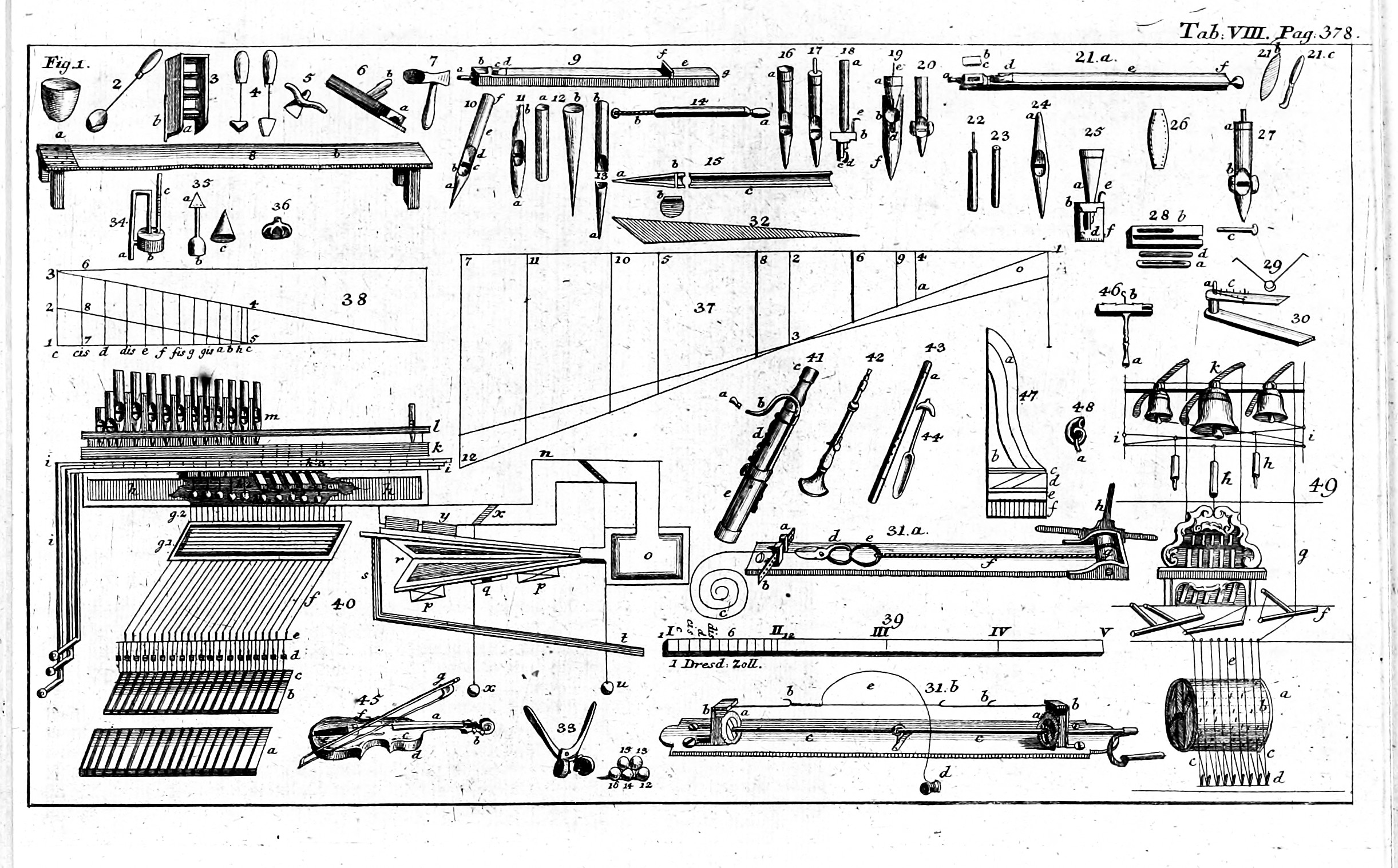
Enlarged quarters: upper left upper right lower left lower right.
Explanation of the Plate on the Organ Builder, etc.
Fig. 1. The iron melting pot, bricked in, narrower at the bottom, for melting tin. In it the alloy of tin and lead from which the organ pipes are to be cast is made fluid.
Fig. 2. The iron casting ladle, with which the molten tin is scooped from the melting pot in order to pour it out into long sheets.
Fig. 3. Is the casting box, or the sluice, with some movable cross-boards a, into which the tin is poured on the bench, and which, as it were, smooth out the congealing tin behind them. The casting box is always drawn ahead of the flowing tin; b is the strip, which must fit closely on the bench as it is drawn and let no tin through between. The wider the pipes are to be, the broader the casting boxes used in pouring out the tin.
Fig. 4. Are two copper soldering irons, one triangular, the other almost square, for soldering the languid into the pipe, or also the body onto the Fus of the pipe.
Fig. 5. Is the burnisher, for polishing the tin pipes.
Fig. 6. The tin plane, for planing the cast tin sheets smooth. On it, a is the hole through which the plane throws out the tin shavings; b the plane iron, set in almost upright.
Fig. 7. Is the planishing hammer, with a polished, steeled face. When the tin sheet has been cast, cut out for the pipe according to the Mensur, and planed, the tin is laid on an anvil, and its blowholes are hammered closer with this hammer, so that the tin may take on a better sound.
Fig. 8. Is the oak casting bench, its top board full of holes through which the air escapes downwards out of the poured tin, so that it does not form blisters. For on this bench the tin melted in the melting pot is poured out into a sheet, which is as long as the bench and as wide as the casting box (see Fig. 3.) that is drawn along ahead of the stream of tin. This bench is tightly nailed over on top with linen, which is painted with bole and covered with paper, onto which the tin is poured, and so runs along the bench. The tin thus takes the impression of the threads of the linen, so that the thin cast tin sheet looks like linen woven of tin; a is a piece of the uncovered bench with its air holes, b the rest of the bench, covered with linen.
Fig. 9. Is a pipe made entirely of wood, on which a is the entirely hollow wooden foot, or little tube, through which the wind enters the pipe. b is the glued-on cap of the wind chamber. c is the hole (cut-up); crosswise beneath this, invisible here, lies the wooden languid with a narrow air slit; d is the obliquely rising lip (labium), e the hollow pipe body, f the strip by which the standing pipe is hung against a wall. This pipe is open at the top at g.
Fig. 10. An ordinary tin pipe, on which a is the conical Fus, by which the pipe stands in the toeboard. b the small lower lip, pressed flat, beneath which the languid lies. c the cut-up, that is, the oblong rectangular hole through which half of the wind blown in through the Fus a escapes again and is lost, while the other half, at the bevelled edge of the upper lip d, which is longer, rises into the cylindrical pipe body e, which is soldered to the Fus at c and whose length is what actually makes the tone high or low; from this the pipe body e vibrates; the pipe is open at the top at f.
Fig. 11. Is a pipe for the Violdagambastimme114, wide at the bottom in the Fus a, open at the top, but narrower at b.
Fig. 12. Are two pipe mandrels turned from wood, a cylindrical for the pipe body, b conical for the Fus, or also for conical pipes, such as Trompete pipes, and so on. The cut-out tin pipe is bent round over these mandrels.
Fig. 13. a is the conical tin Fus with its small lower lip. This lip is not as large as the upper lip because otherwise it could easily be pressed in the toeboard and get dents; and the upper lip on the body b is longer because the wind rises into the pipe beneath its slanting surface. The lower lip is [374]also smaller because it need only be a short cap, to half cover the flue. b the cylindrical body, before it has been soldered to the Fus.
Fig. 14. Is the tuning flute, a regular wooden flute, with a hollowed-out languid, cut-up and slanting lip a, without any finger holes. Everything of wood. b is the Thonzug (graduated plunger), that is, a plunger marked with lines for all the whole and half tones, so as to tune an organ by it at a pinch; for practised organ builders cut themselves a pipe one Fus long out of tin, measuring its length with a rule, and tune all the others by it. In the temperament, however, since in an octave one has 12 pipes but 13 tones, one must distribute this thirteenth excess among all 12, whereby the whole crux lies115 between f and fis, because it simply is the fashion to give e and h no sharp.
Fig. 15. A tin pipe cut open lengthwise, a where the wind enters. b the languid, that is, an almost circular plate, as thick as a knife-back in small pipes, as is shown next to b, almost a whole circle, and cut off straight, sits crosswise in the Fus; and above its straight cut edge, which does not completely fill the Fus, there arises beneath the lower lip that narrow slit in which the wind begins to make the sound. c is the section of the cylindrical body, soldered to the conical Fus and just as tall. From this figure one can recognise the inner construction of a tin organ pipe.
Fig. 16. A tin pipe, gedakkt at the top at a with a closed box (hat), which is leathered inside; it gives a soft tone, an octave lower than it would otherwise give at its length if open, because the sound cannot get out at the top but must run back again.
Fig. 17. One gedakkt in the same way, through whose hat an open little tube nevertheless passes, is called a Rohrflöte.
Fig. 18. A pipe for the Fagotstimme116, open at the top at a. b a piece of wood, in which are the brass shallot c and its cap d, which a wire e (tuning wire) presses against the cap d (tongue)†. This is the structure of all reedwork.
Fig. 19. Depicts the figure of the Menschenstimme. On it are to be noted a the cylindrical pipe body, b a tin ball, soldered on, which is to carry the shallot. c is the brass hollow shallot, like a channel, d the blade (Blat) upon it, or tongue. e the tuning wire, which presses the tongue close onto the channel, so that only a little air can get into the channel. The tuning wire comes up out of the pipe at the top at e for adjusting. f is the boot, or the pipe Fus, by which it stands in the toeboard.
Fig. 20. A bearded pipe, in which the vertical beard soldered on at both sides of the wide cut-up prevents the wind from scattering too much.
Fig. 21. Once more a wooden organ pipe, oblong rectangular. None of them stand in the rackboard, but in the toeboard, with the strip against a wall, and one pipe leaning against the other; the toe stands in the toeboard. a is this wind-catching hollow toe of wood. b c the cap, which is glued onto the hollow of the wind chamber, [375]and is here lifted off. c the wooden crosswise languid, over which the wind passes. d the slanting surface or lip, at whose bevelled edge the wind is cut and runs along the hollow body e as far as f, where a stopper closes it, which can be pushed deeper into the body by the stopper handle (tuning stopper). And so arises a stopped pipe of wood, from little boards glued together at right angles and sized inside with poured glue. 21. a.
21. b Is the mouth-forming block, onto which a tin pipe is put when one wants to form its lips. First the lip arcs are struck on the tin with dividers, and, following this drawing, these arcs are beaten or stroked into flat surfaces, that is, lip flats, on the mouth-forming block with the lip iron 21. c. A finger that does not even touch the bevelled edge of the upper lip already drives all the wind back into the pipe; the splitting of the wind is checked, and the pipe is mute.
Fig. 22. Wooden former; it is wrapped round with paper, and the tin shallot for Posaune pipes is cast in it.
Fig. 23. Is this tin shallot, tapered at the bottom; it is hollow, but thick in tin.
Fig. 24. Spizzflöte, open at the top at a, wide at the lip, truncated-conical.
Fig. 25. The Posaune, a conical pipe a; b the wooden Fus, c the shallot of tin, d its cap or tongue of brass, e the tuning wire, f the square box of wood (boot).
Fig. 26. A draw plate for the wire-drawing of brass, with large and small holes. The brass heats up with each draw, is annealed, but gets no wax. Swedish brass, rich in copper, gives the best harpsichord or clavichord strings. The more often thick wire is drawn through, the more spring temper it acquires, as from hammering.
Fig. 27. A bearded stopped chimney pipe; it sounds soft and moderately bright. On it, a the hat (box), b the reflecting beard.
Fig. 28. Iron mould b and channels lined with brass, in which, by means of the iron mandrel c laid on top and the hammer, the brass is to be stamped into just such channels, that is, into the Trompete shallot a, which is covered with the straight flat tongue d; for reedwork, after the manner of the brass-girdlers or tinsmiths.
Fig. 29. A twice-bent pallet spring of brass wire; it pushes each pallet back up against its Cancelle hole.
Fig. 30. The spring-bending board, on which to straighten wire between the little pins and clamps, and to bend the preceding spring around the pin a. The upper board can be turned about its pivot. c is the spring as it arises between the little pins.
Fig. 31. a. The draw bench, for drawing wire; on it, a the posts, through whose middle the draw plate b is inserted. c the wire which is to be drawn through. d the tongs, [376]which grip it, e the heart-shaped ring of iron, f the rope, g the wooden drum, which takes up the rope, h the windlass.
31. b. The string-spinning wheel for the spun white clavichord strings of the bass. On it a a an iron wheel, together with gearing in an iron housing. b b the revolving gear hooks, to which both ends of the string e are fixed, which is to be overspun closely or loosely with the silvered wire from the little reel d by turning the crank quickly. c the round iron rod, whose middle is carried by the post, and which passes through the crank and both wheels.
Fig. 32. A wooden bellows fold; the two sides of an organ bellows each consist of one such fold, which is glued to the bellows with leather.
Fig. 33. Iron ball mould (as for rifles and muskets), in which to cast tin balls of No. 16, 15 and so on. Each shows its admixture of lead on the scale pan.
Fig. 34. The wind gauge of sheet metal; it is set with a onto the bellows or wind trunk, and wind is let in, which enters the box b and drives the water in the open glass tube c five Zoll high.
Fig. 35. A tuning cone, brass at a and hollow at b, tapering continuously; at a it is pushed into a pipe to widen it, whereas at b the pipe is pushed into the cone to narrow it. c is the hollow brass cap for both purposes, which, pushed into a pipe from outside, widens it, and the pipe, pushed into the hollow cap, is narrowed by it.
Fig. 36. A hollow Cimbel cast of metal, tuned to a certain pitch, for use with the organ; it has a clapper, like a bell.
Fig. 37. The Mensurdreiekk, by which to cut tin pipes. 1 2 3 is the base pipe, by which I find the others in the octave. 4 1 is the length of its ascending octave, 4 a its width. The length 4 1, taken three times, gives 5, i.e. the descending fifth together with its width; the text explains the remaining pipes by these same numbers.
Fig. 38. Separate gauge for the width of the pipes; it is scribed on a tin sheet. 1 3 is the width of the largest pipe, i.e. c, 6 7 for the next, cis, and so on, 4 5 for the ascending c; thus one has the whole octave. 4 5 carried from 1 to 2, then 2 5 gives the width of c, 7 8 the width of cis, and so forth for the whole ascending octave.
Fig. 39. Mensur for the length of the pipes. I. II, a natural Dresdnerzoll here counted as one Fus, is divided for the 12 tones of an octave into 12, but unequal, i.e. continually smaller, parts; thus III is the length of a one-foot pipe, I. III of a two-foot pipe†, and so forth on this scale rod; and II, III. III, IV. IV, V. are each divided again into 12 such unequal parts.
Fig. 40. The complete framework of an organ, in which all the parts stand in their connection with one another. a is the pedal; it is trodden with the foot. b the manual of the naturals, c of the sharps, d the leather nuts and brass screws, [377]e the iron squares riveted at the corner. f the wooden trackers, g 1 the rollers in the frame; they turn somewhat about their axes, g 2 wire, which goes up from the rollers to the Windlade. There are 48 of the rollers. h is the slider chest, or Windlade; its board is broken open so that something of the inside can be seen, namely: h 1 are little leather bags, which the wire g 2 pushes upward and lets sink together again; they are there so that no wind hisses out of the Windlade along with each wire, and are called Pulpeten. h 2 are the pallets; each key has one such pallet; five are at rest at h 2, five are pulled down at h 1, as when one plays the organ, so that the small Cancelle or grid holes can be seen at h 3, i i i are the sliders, bored through with holes, which are shifted over the Cancellen for each new stop, and at h 3 one can see how the wind rises through the Cancellen up to the pipes. k is the toeboard, in which the pipes stand, which the rackboard l must hold upright. m are tin organ pipes, from the largest down to the smaller, along the Windlade; they should properly be drawn down to l. n is the wind trunk. o the main wind trunk. p p two bearers, or beams, on which the organ bellows lies. q valve of the bellows, through which it, as it were, draws breath from the air. r the bellows itself with its single wooden fold. s the push-rod, a piece of wood that pushes the top board of the bellows r upward, so that the bellows opens. t the treadle of the bellows-treader, which he treads down. u the valve drawstop, which lets the wind into the Windlade. x the tremulant drawstop. y stones, which must weight the bellows. At y the wind enters the Windlade h, and since h 3, i.e. the Cancellen, stand open, because I have pulled down their pallets h 1, this organ as drawn would shriek at these places if I had fully drawn in the pipes belonging above them from m to l. I therefore spare the hearing of my quiet reader, who will in any case already be tired of organ building.
Fig. 41. The bass pipe (Basson, Fagot), on which a the mouthpiece of reed, b the S piece, c the head, d the two brass keys, e the foot.
Fig. 42. The Hautbois, with the two keys.
Fig. 43. The fife in one piece. a its embouchure hole, into which one blows.
Fig. 44. The reamer, or spoon bit, of the flute maker.
Fig. 45. The violin, on which a the fingerboard, b the pegs, c the top of fir, d the back, e an f-hole. f the bridge, over which the strings run. g the frog of the bow.
Fig. 46. The tuning hammer, on which a the hole into which the tuning pins of harpsichords and clavichords are inserted, and their strings thereby tightened. b the hook, for twisting a string into a loop.
Fig. 47. Soundboard of the harpsichord, a soundboard bridge, b Kornetsteg117, c two sliders with their jacks. d oblique Kornetregister, e wrestplank. f keyboard to be slid in.
Fig. 48. Ear trumpet; a is put into the ear, and one speaks into the wide opening.
Fig. 49. A piece of the Berlin Glokkenspiel on the Parochial Church here. a the large iron playing barrel; in its holes are set the iron barrel pins b; these lift the iron keys c; on the keys are set the pegs d; from the pegs the wire e goes up, which I have here tied off idly at e. f is one storey higher, the action chamber, where this wire is led round crosswise by iron squares until at the top it pulls a bell hammer. g one storey higher, the playing cabin, with the brass keyboard and pedal, on which one plays the drawn clappers at will. h the Dümper, through which the clapper wire passes. i the stretched wire. k the bell hammers.
Notes
- 1. Mensur: the scale of a pipe or stop, meaning the proportions of its dimensions (above all diameter relative to length) and their progression through the compass. Halle treats the laying out of Mensuren as a geometrical task.
- 2. Verjüngung: proportional reduction, the scaling down of a figure or dimension. Halle names it among the geometrical operations of organ-building, where it governs the decrease of pipe dimensions through the compass.
- 3. Gedakkt (modern spelling Gedackt or Gedeckt): a stopped flue pipe or stop, closed at the top by a cap or lid, sounding about an octave below an open pipe of the same length. Halle derives the name, as a corruption, from the covering lid (Dekkel).
- 4. Trompete: the Trumpet, a chorus reed stop with conical resonators. Halle notes that its brass shallot makes it brighter than the otherwise similar Posaune.
- 5. Tremulant: a device in the wind supply that makes the wind, and so the tone, pulsate. Halle also describes a gentler beating form associated with the Menschenstimme.
- 6. Menschenstimme: the Vox humana, a reed stop meant to imitate the human voice. In Halle’s description it has a narrow cylindrical body and very small shallots.
- 7. Principal: the open flue stop of normal (diapason) scale that forms the foundation of the organ. It typically stands in the façade, and its pitch names the size of a division.
- 8. Fus (Fuß): the German foot, used by Halle as a unit of length, as a pitch designation (achtfüssig = 8-foot), and for the conical foot of a pipe (Pfeifenfus, Fuskegel). This edition retains Fus for the historical measure, uses foot or feet for the pipe part, and -foot for pitch adjectives. The local foot differed from the English foot and varied from region to region.
- 9. Zentner: the German hundredweight, a unit of weight of roughly a hundred Pfund whose exact value varied from state to state; it is not identical with the English hundredweight of 112 lb.
- 10. Dresdnermaas: “Dresden measure”, meaning the dimensions are given in the Saxon (Dresden) foot rather than another local foot.
- 11. Vierteilzoll: a quarter of a Zoll (the German inch, one-twelfth of a Fus).
- 12. Zoll: the German inch, one twelfth of a Fus. Like the Fus, its length varied by region and is not identical with the English inch.
- 13. sechzehnlötig (“sixteen-lot”): the builders’ term for the purest tin, borrowed from the goldsmiths’ grading of fine silver. Lower numbers (funfzehnlötig, eilflötig, zehnlötig, sechslötig) are grades alloyed with progressively more lead.
- 14. Pfund: the German pound, a weight that varied from place to place and differs from the English avoirdupois pound. Halle gives metal charges and pipe weights in Pfund and Zentner.
- 15. Leipzigerprobe: the Leipzig standard grade of pipe tin, which Halle gives as 10 Pf. tin to 1 Pf. lead, i.e. zehnlötig.
- 16. Probezinn: tin alloyed with lead to an officially tested standard (“Probe”). Halle names the Berlin grade as sechslötig, the lowest in his scale.
- 17. Elle (pl. Ellen): the German ell, a linear measure that varied by territory. Adlung treats it as equal to 2 Fuß; it is not the English ell of 45 inches.
- 18. Halle’s lötig grades are given as printed. They need not follow the goldsmiths’ scale, on which sixteen-lot silver is pure.
- 19. Mixtur: a compound stop in which several pipes, three, five, six or more, sound on each key.
- 20. Skrupel: the smallest unit of length in Halle’s measurements, used both for metal thickness and for pipe lengths. Its exact size depends on which subdivision of the foot is meant.
- 21. Chorweite: apparently the standard width of a pipe appropriate to choir pitch. Halle blames weak trebles on a Stimmpfeife that was too narrow and departed from it.
- 22. Mensurtriangel (also Mensurdreiekk): a triangular scaling diagram to which Halle refers the reader, with numbered points, for finding pipe lengths and relations such as the lower octave.
- 23. Rute: a German unit of length, usually 12 (sometimes 16) feet, varying by region. Halle uses it loosely (“several rods apart”) for distance inside a large organ.
- 24. Cimbelspiel: an organ accessory of small round bells (Schellen) sounded mechanically. It is not the mixture stop Cimbel (Zimbel).
- 25. Glokkenspiel: in this passage a carillon, that is, a set of tuned bells played from a keyboard and pedal and also by a pinned barrel. It is not the organ stop of the same name.
- 26. Intonirung: Halle defines it as tuning by ear to the whole and half tones of a square wooden tuning pipe. At [346] Halle himself uses the verb in the sense of voicing.
- 27. Grad: here the graduations marked on the sliding stick of the wooden tuning pipe, by which it is set to sound each key. Halle uses the same word later ([341]–[342]) for the divisions of the wind gauge.
- 28. Luftsäure: literally “air acid”, an acid Halle believes is present in air and attacks lead. Later writers, such as Wolfram (1815), use the word for carbonic acid.
- 29. Basson: the bassoon, whose reed Halle compares with the tongue of the reed pipe. (The organ Fagot stop, with its separate conical foot, is described at [328].)
- 30. A stopped stop of 16-foot pitch, normally a pedal stop of wide scale.
- 31. Qvinte: here the Quint stop, a stopped rank sounding a fifth above the fundamental. The same word names the interval of a fifth.
- 32. Pitch designation by foot: a stop “has 16 Fus Thon” when its lowest C sounds the pitch of an open pipe 16 feet long.
- 33. A small sliding tube fitted to the cap of some stopped pipes so that the pitch can be raised or lowered.
- 34. A powerful reed stop of 32- to 8-foot pitch, usually in the pedal, named after the trombone.
- 35. An open flue stop of narrow scale imitating the viola da gamba, here at 8-foot pitch.
- 36. Halle’s spelling of Salicional, a soft, narrow open stop. In 1764 he describes it as wide at the top and narrow at the mouth.
- 37. Literally “chamois horn”. It is a flue stop whose pipes taper, narrow at the top and wider at the mouth.
- 38. A deep bass stop, named, Halle says, because it sounds lower than the human bass voice. It corresponds to the Subbaß.
- 39. A narrow stopped flue stop of wood or tin that sounds a flute-like fundamental together with a clearly audible fifth (twelfth) above it.
- 40. A narrow-scaled stopped flue stop which Halle places between the Unterbaß and the Gedakkt in character, sounding with sharper emphasis than the Subbaß.
- 41. A flute stop whose narrow pipes are made twice the normal length and overblown, so that a pipe 8 Fus long sounds 4-foot pitch, imitating the transverse flute.
- 42. A conical open flue stop which Halle describes as identical to the Spizzflöte except slightly wider at the top.
- 43. An open flue stop shaped as a truncated cone, wide at the mouth and tapering towards the top.
- 44. An echo effect produced by pipes standing covered inside a box (Kasten), so that they sound distant and soft.
- 45. The windchest: the chest that holds the wind supply beneath the pipes and distributes it to them through the stop mechanism.
- 46. A Gedakkt (stopped flue stop) made of tin; Halle gives 120 to 140 Pfund as the weight of metal for one at 8 Fus.
- 47. Superoktave (also Superoktav): an octave-sounding rank above the Principal. In the weight list here Halle gives it at 2′ and 1′; in his model organ at [348] it stands one octave above the division’s Principal (4′ over 8′, 2′ over 4′).
- 48. Koppelholz: a wooden block joining the two halves of a slider in a divided windchest, so that one stop action moves both halves together.
- 49. Vierteilorgel: “quarter organ”, in the older classification of organs by the pitch of the manual Principal (ganze 16’, halbe 8’, Vierteil 4’, Halbvierteil 2’).
- 50. Kammerthon: chamber pitch, the pitch to which (Halle says) all bowed and wind instruments are tuned. In Halle’s day it was lower than the Chorthon at which most organs stood.
- 51. Rhineland measure: dimensions given in Rhineland feet and inches, the standard reckoning in Prussia and widely used in German organ building. Halle uses it for the case dimensions (“a height of 27 feet, Rhineland measure”).
- 52. Cimbel: a compound flue stop of small, high-pitched pipes (cymbal mixture). Halle lists it without a pitch or rank count.
- 53. Rohrflöte: a stopped flute stop whose cap carries a small open tube (chimney), giving a brighter tone than an ordinary stopped pipe. Halle compares it to “a large kind of flute”.
- 54. Flautetravers. (abbreviation of Flaute traverse, i.e. flauto traverso): a flute stop imitating the transverse flute. Halle says it sounds “just like that blown instrument”.
- 55. Sifflöte: a small, high-pitched open flute stop, usually at 1-foot pitch. In the Potsdam report Halle mentions it only as the stop that the Qveerflöte 2’ replaced; he also lists a Sifflöte 2 for the fourth manual of his model organ.
- 56. Kornet: a compound flue stop of several wide-scaled ranks sounding together on each key. Halle says the five-rank Kornet “sounds like a pleasing reed, or Waldhorn”.
- 57. Hautbois: a reed stop imitating the oboe, here at 8-foot pitch in the first manual.
- 58. Salicinal: Halle’s spelling of the Salicional, a soft, narrow-scaled metal flue stop. In 1764 Halle classes it among conical pipes.
- 59. Vugara (Fugara): an open, narrow flue stop with a string-like tone. Halle likens it to a Stokkgeige, a small pocket fiddle.
- 60. Flaschenettchen, also called Vogelflötchen (“little bird-flute”): a small, fine flute stop at 2-foot pitch. The name appears to be a Germanised diminutive of flageolet.
- 61. Kleron (Clairon): a 4-foot reed stop, here in the pedal. Halle describes it as “bright-sounding, in the manner of a Schallmei”.
- 62. Nasat: a flute-toned mutation stop sounding the twelfth (a fifth above the octave). It is given here at the period nominal pitch of 3 feet, i.e. modern 2⅔’.
- 63. Terz: a mutation stop sounding the major third two octaves above the fundamental (e on the c key) at 1⅗-foot pitch. Halle says it has “the tone of a wide flute”.
- 64. Violon: an open 16-foot pedal flue stop imitating the double bass (violone). Halle says it is “less loud than the Principal, but nevertheless penetrating”.
- 65. Nachthorn (“night horn”): a wide-scaled flute stop with a horn-like tone. Halle says the 4-foot Nachthorn “sounds like a wide horn”.
- 66. Röhrengedakkt: a stopped flue stop whose caps carry small tubes (chimneys); the Rohrflöte or chimney flute.
- 67. Cimbelstern: a toy stop consisting of a revolving decorative star, driven by organ wind, which rings a set of small bells.
- 68. Chorthon (modern Chorton): “choir pitch”, the pitch to which most church organs of Halle’s day were tuned. Halle places it above Kammerthon, so that an organist playing church music with violins had to transpose.
- 69. Kapellenthon: “ensemble pitch”. Halle puts it about a whole tone below Kammerthon (chamber pitch).
- 70. Franzthon: “French pitch”. Halle calls it unusual in his region and the lowest of all the pitches he names, below even Kapellenthon.
- 71. Cancelle (pl. Cancellen): a channel of the windchest, one per key, into which wind is admitted when the key is played and from which it passes to the pipes of the drawn stops.
- 72. Rükkpositiv (Rückpositiv): a separate positive division placed behind the organist’s back, usually on the gallery front. Halle remarks that such divisions were no longer being built in his day.
- 73. Spundlade: in Halle, an older type of windchest whose channels were bored or chiselled out of solid oak and then closed again with plugs (verspündet).
- 74. Hauptventil: here the pallets in the wind box, one per note, that admit wind to the grooves when a key is pressed. This is not the general wind shut-off valve that Adlung calls by the same name.
- 75. The windchest carrying the pedal stops, as distinct from the manual chests.
- 76. Sperrventil: a valve in a wind trunk that cuts off the wind to one division. It is operated from a stop control.
- 77. In a spring chest, the small spring-closed valve under a pipe that is opened when its stop is drawn.
- 78. A windchest in which each pipe or stop is governed by small spring-loaded valves opened by the stop action, rather than by sliders.
- 79. The Zoll of the Dresden (Saxon) foot, which Halle takes as the basis of the ten-degree wind-gauge division.
- 80. A wooden sliding cover lying across the keyboard, in front of which the organist sits. See Glossary.
- 81. Schwebung (lit. “beating, undulation”): a gently beating tremulant, used chiefly with the Vox humana; Halle himself glosses it as “a weakly-knocking Tremulant”.
- 82. Oberwerk: the manual division housed in the upper part of the case. In Halle’s model large organ it is the principal manual, carrying the 8′ Principal and the fullest chorus.
- 83. Qvintite: Halle’s variant of Qvintaden (he also writes Qvintadema, Qvintathon, Qvintit.; modern Quintatön): a narrow-scaled stopped flue stop.
- 84. kleine Oktave (“small octave”): the next octave-sounding Principal rank above the Superoktav, at 2′ in both manual and pedal. Not to be confused with the pitch-register name “small octave” (c-b).
- 85. Feldflöte (“field flute”): a small, open, narrow-scaled flute stop imitating the military fife; Halle has it at 1′.
- 86. lieblich Regal: an 8′ Regal (a reed stop) with a soft, “lovely” voicing, the only reed on Halle’s third manual.
- 87. gedakkter Baß (“stopped bass”): a pedal stop of stopped pipes. Halle gives it at 32′ pitch.
- 88. Untersazz (Untersatz, lit. “under-set”): a deep pedal bass stop; “grosser” marks the 32′ size in Halle’s scheme.
- 89. Waldflötenbaß: a Waldflöte (“forest flute”) stop on the pedal, given by Halle at 1′.
- 90. Pauken- und Trompetenengel: carved angel figures on the organ case that appear to beat kettledrums and blow trumpets. Halle says they are worked by the Paukenschläger and sounded by the organ’s trumpet register.
- 91. Werkschue (Werkschuh): the craftsman’s foot, a linear measure normally of 12 Zoll whose exact length varied by territory. Halle uses it for physical dimensions, distinct from “Fus” as a pitch designation.
- 92. Manuallade: a windchest serving a manual division, as opposed to the Baßlade (pedal windchest).
- 93. Hautboisstimme: the Hautbois or oboe reed stop. Halle describes its resonator as cylindrical, with a Mundstükk 4 Zoll long and 1½ Zoll wide.
- 94. Blokkflöte (Blockflöte, in Halle’s kk spelling): a flute stop that Halle cites as an example of very short, very wide pipes, which he says sound soft but without charm.
- 95. Flaute traversiere: a flute stop imitating the transverse flute, made, according to Halle, with very long and narrow pipes.
- 96. Gabelkoppelung: a coupler joining two manuals so that one finger depresses keys on both. Halle reports it as the type in use “nowadays”.
- 97. Registerkoppelung: not a keyboard coupler but, in Halle’s definition, the continuation of the stop rods (Registerstangen) from one windchest to another.
- 98. Halle’s Dekkel (elsewhere “cap”) is here the leather-lined stopper pushed into the pipe; the Propf (“plug”) is the part by which it is pushed, its handle.
- 99. a Chorthon: a carillon “of a Chorthon” is named after the note (here a, at choir pitch) of its reference bell, presumably the lowest. The variants b, c, d, f Chorthon name other sets.
- 100. Compare [322]: “In bells the circles are many-toned, different below at the rim, different above.”
- 101. Dümper: Halle’s name for a pair of cylinders fitted one inside the other, the lower fixed in the floor. The clapper wire passes through it as through a sheath, so that it runs smoothly and does not rub against the wood of the floor ([357]).
- 102. manualiter: Latin adverb, “with the hands”: played on the manual keyboard alone. Halle uses it of the carillon keyboard.
- 103. pedaliter: Latin adverb, “with the feet”: played with the pedal keyboard. Here it shows that the carillon had a pedal keyboard.
- 104. A third harpsichord register that Halle groups with the lute stop (“Lauten- oder Kornetzug”). It has its own small bridge and so only a short string length. Despite the name, it is not the organ Kornet stop.
- 105. A harpsichord stop imitating the lute, which Halle names together with or as an alternative to the cornet register. Its construction in Halle is not fully specified.
- 106. Oktavkornetchen: literally “little octave cornet”. A harpsichord register additional to the two registers of a double-strung instrument; its exact nature is not explained here.
- 107. Dresdnermaaß: measurement in Dresden (Saxon) units. The Dresden foot is roughly 28.3 cm, so Halle’s Contra F string of 7 feet is about 2 m long.
- 108. Achtteilzoll: one eighth of a Zoll (inch). Halle gives this as the thickness of the soundboard.
- 109. That is, like the harpsichord soundboard, in which, Halle says at [360], a round hole is no longer left open.
- 110. Here a bowed string bass, not the organ stop of the same name. Halle says the six-string viola da gamba sounds sweeter than the “small Oktavbaß”.
- 111. Qvartposaune: the bass trombone pitched a fourth below the tenor (the Qvintposaune is pitched a fifth below). Halle gives its size as “4 Fus Orgelthon”.
- 112. Halle gives no comparison for “wider”; presumably wider than the very narrow hole of the trumpet mouthpiece described just before.
- 113. Thonmaaß: a standard of dimensions keyed to pitch. Halle says the brass sheet is cut out “as with organ pipes, according to the Thonmaaß”.
- 114. Violdagambastimme: the Viola da gamba stop. Halle’s pipe for it is wide at the foot (a), narrower at b, and open at the top.
- 115. crux: Halle writes Knoten (“knot”), as in the saying “da steckt der Knoten”, there lies the difficulty. The thirteenth excess, distributed among the twelve semitones, leaves its remainder between f and f-sharp.
- 116. Fagotstimme: the Fagott (bassoon) stop, a reed register; Halle illustrates one of its pipes, open at the top.
- 117. Kornetsteg: a second bridge on the harpsichord soundboard, named after a “Kornet” register. At [360] Halle explains that the Kornetregister has its own small bridge, and so only a short sounding length of string.
Open Readings
The passages below remain uncertain. In each, Halle’s German is either doubtful as printed or can reasonably be read more than one way. The translation gives the reading we think most likely; the alternatives are noted here rather than silently resolved. A further hundred or so places where the printed German itself is hard to read in the scan are listed in the online edition.
- † [321] “After burnishing follows the rounding, on the conical wooden foot mandrel, and of the cylindrical pipe body, with a straight wooden beater.”
- das Rundiren auf der kegelförmigen Fusform von Holze und des cilindrischen Pfeifenkörpers The genitive depends on ‘Rundiren’: the pipe body is rounded as well as the foot. Jacobsson (1781, s.v. Rundiren) describes rounding the plate on one wooden form, so ‘Diese Form’ is a single mandrel. Possible reading: the rounding of the foot on the mandrel, and of the cylindrical pipe body.
- † [323] “All tin pipes are divided into reeds, into reedwork, because they blow through a reedwork, and into flue pipes.”
- Alle Zinnpfeifen unterscheiden sich in Rohr- in Schnarrwerke Rohrwerk and Schnarrwerk are probably one class, the reeds, under two names, with ‘in’ repeated; Jacobsson (1781, s.v. Schnarrwerke) calls them ‘one of the main classes of organ pipes’. Halle’s division is twofold: reeds and flue pipes. Possible reading: a misprint for ‘Rohr- und’ or ‘Rohr- oder Schnarrwerke’.
- † [328] “The first tone receives one or two keys stopped (Gedakkt); the other four pipes, on the other hand, are open.”
- Der erstere Thon bekömmt einen oder zween Klaves gedakkt; hingegen sind die andern vier Pfeifen offen. ‘Klaves’ (keys) is then picked up by ‘die andern vier Pfeifen’ (the other four pipes). It is also unclear what ‘the first tone’ is contrasted with. Possible reading: Read ‘Klaves’ as a slip for ‘Pfeifen’: ‘of the 5 or 6 pipes to each note, one or two are stopped and the other four open’.
- † [329] “if one wishes to save the boxes of the tin stops”
- wenn man die Kasten der Zinnstimmen ersparen will ‘Kasten’ (boxes, cases) gives no organ sense here. Adelung (1793, s.v. ersparen) gives ‘Kosten’ as a usual object of ersparen, and Adlung (1768) says most stops ‘can be made of wood at little cost’. Possible reading: ‘Kosten’: ‘if one wishes to save the cost of the tin stops’.
- † [334] “sings up a gentle human voice.”
- singt eine sanfte Menschenstimme herauf The print reads ‘herauf’ (f, not long s). Possible reading: ‘heraus’ (‘sings out’), the more usual German, but an emendation against the print.
- † [335] “Wood fitted into wood shrinks less, and at the same time swells, especially when both wooden bodies are of the same wood”
- Holz in Holz gestekkt schwindet weniger, und qvillt zugleich besonders, wenn beide hölzerne Körper von einerlei Holz … sind There is no comma after ‘zugleich’. We read ‘zugleich’ with ‘qvillt’ (swells at the same time, in step with the surrounding wood) and ‘besonders’ with the wenn-clause. Possible reading: ‘swells, especially when…’ (a break before ‘besonders’).
- † [348] “Terz 1⅖”
- Terz 1⅖ The tierce is regularly 1⅗ (eight feet divided by five), as Halle prints it in the dispositions that follow; 1⅖ is not a tierce pitch. Possible reading: ‘Terz 1⅗’.
- † [355] “must be drawn in anew every ¼, at most every one and a half years.”
- alle ¼, höchstens anderthalb Jare The span, a quarter year to a year and a half, is wide; there is no independent evidence for another reading. Possible reading: ‘alle 1¼’ (every one and a quarter years) would narrow the span.
- † [371] “the shorter e or f Trompete of six pieces, namely a large and a small bow, … the seven small tuning bits”
- von sechs Stükken, nämlich einem grossen und kleinen Krummbogen … die sieben kleinen Sezzstükke Krummbogen are probably the detachable crooks used to change key; Koch (1802, s.v. Krummbogen) describes ‘a larger and a smaller’. If so, the crooks and the seven tuning bits are extras, and the six pieces are the body’s own parts. Possible reading: the two bows counted among the six pieces.
- † [371] “The notation of the trumpeters is like that of the Hautbois players; one begins with the treble”
- Das Notenzeichen der Trompeter ist wie das der Hautboisten; man fängt mit dem Diskante an ‘Notenzeichen’ probably means the clef rather than notation in general: the following words about beginning with the treble fit a clef, and Zedler (Universal-Lexicon, s.v. Musick-Schlüssel) calls clefs ‘gewisse Zeichen’. Possible reading: ‘The trumpeters’ clef is the same as the oboists’’.
- † [371] “a wide bell, two yards, two bows, two slide tubes, two bows, which are drawn”
- zwo Spillen, zween Krummbögen, zwo Stosspillen, zween Krummbögen, die gezogen … werden ‘Zween Krummbögen’ (two bows) is printed twice. Either the slide has its own pair of bows, or the phrase is doubled in the print. ‘Which are drawn’ may refer to the whole slide, tubes and bows together. Possible reading: a doubling in the print.
- † [374] “which a wire e (tuning wire) presses against the cap d (tongue)”
- den ein Drat e (Krükke) an den Dekkel d (Zunge) andrükkt As printed, the wire presses against ‘the cap d (tongue)’, so d is called both cap and tongue, and the tongue would be pressed against itself. In Fig. 19 the wire presses the tongue onto the shallot. Possible reading: ‘an das Mundstükke c’: the wire presses the tongue d against the shallot c.
- † [376] “thus III is the length of a one-foot pipe, I. III of a two-foot pipe”
- so ist III die Länge einer einfüssigen I. III einer zweifüssigen Pfeife Because I. II is the Zoll counted as one Fus, one expects ‘I. II’ for the one-foot pipe. The engraving of Fig. 39 does not decide between I–II and II–III. Possible reading: ‘so ist I. II die Länge einer einfüssigen’.
Works Cited
Works referred to in the notes and glossary.
- Adlung, Jakob. Musica mechanica organoedi. Edited by Johann Lorenz Albrecht. 2 vols. Berlin: Birnstiel, 1768.
- Audsley, George Ashdown. The Art of Organ-Building. 2 vols. New York: Dodd, Mead, 1905.
- Goodrich, Wallace. The Organ in France. Boston: Boston Music Company, 1917.
- Niedt, Friedrich Erhardt. Musicalische Handleitung, part 2. 2nd edition, edited by Johann Mattheson. Hamburg, 1721.
- Seidel, Johann Julius. Die Orgel und ihr Bau. Breslau: Leuckart, 1843. Revised edition by Bernhard Kothe, Leipzig: Leuckart, 1887 (cited as Seidel/Kothe).
- Sponsel, Johann Ulrich. Orgelhistorie. Nuremberg, 1771.
- Wedgwood, James Ingall. A Comprehensive Dictionary of Organ Stops. London: Vincent, 1905.
- Wolfram, Johann Christian. Anleitung zur Kenntniß, Beurtheilung und Erhaltung der Orgeln. Gotha, 1815.
The source of this translation
Johann Samuel Halle, Werkstäte der heutigen Künste, oder die neue Kunsthistorie, vol. 3 (Brandenburg and Leipzig: Johann Wendelin Halle and Johann Samuel Halle, 1764), pp. 313–378 and Tab. VIII. Translated from the copy in the Getty Research Institute, Los Angeles, as digitised by the Internet Archive (identifier johannsamuelhall03hall). Public domain.
Glossary
German terms kept in the English text, with the sense Halle gives them.
Stops and registers
Bardun: Bourdon ↑ text
A stopped flue stop of narrow scale, intermediate between the Unterbaß and the Gedakkt, with a sharper, more emphatic tone than the Subbaß. Modern equivalent: Bourdon.
Blokkflöte: wide, short flute stop (Blockflöte) ↑ text
A flue stop that Halle cites as the example of very short and very wide pipes, whose tone he calls soft (sachte) but without grace (ohne Anmut). Modern equivalent: Blockflöte (recorder-type flute stop).
Cimbel (Cimbeln): high mixture (Cymbal) ↑ text
A pipe stop in the second manual, almost certainly the high, sharp mixture (Cymbal): Halle keeps it separate from the Mixtur “in order to be able to decrease and increase the sharpness of tone” ([332]). Halle gives no pitch, rank count or description. Modern equivalent: Cymbal (mixture).
Cimbelspiel (Cimbelspiele): set of small tuned bells ↑ text
A set of small round bells attached to an organ. Halle finds the true pitch of each bell by standing beneath it and sounding notes on a tuning flute, and the bell hums when its own note is played. This implies bells with a definite pitch. Modern equivalent: Zimbelstern / cymbelstern, or bells (uncertain).
Cimbelstern (Cimbelsterns): Zimbelstern (rotating bell star) ↑ text
An accessory stop. A visible decorative star rotates on a wooden shaft, and spring-loaded pins on that shaft strike the springs carrying small bells. Halle requires the bells to be tuned to the organ, sounding its c, g, e, c and so on, i.e. the notes of a major chord. Modern equivalent: Zimbelstern.
Fagot (Basson, Bassons, Fagots): Bassoon (reed stop) ↑ text
A stop with conical pipes which also receives a separate conical foot (Kegelfus). In Halle’s model large organ a Fagot 16 stands in the Oberwerk alongside a Trompete 8, which suggests a reed stop. Modern equivalent: Bassoon (Fagott) reed stop.
Fagotstimme: Fagot stop (Bassoon reed stop) ↑ text
A reed stop named after the bassoon. Halle shows a single pipe of the stop whose resonator is open at the top. Modern equivalent: Bassoon (Fagotto).
Feldflöte: field flute (narrow fife-like flute) ↑ text
A high flute stop at 1′ on Halle’s third manual. Halle gives only its pitch; later authors describe it as open, narrow-scaled and sharply voiced in imitation of the soldiers’ fife. Modern equivalent: Fife (rare); otherwise none.
Flaschenettchen (Vogelflötchen): flageolet (small flute stop) ↑ text
A 2-foot flute stop in the third manual, described as “a fine kind of flute”. Halle gives Vogelflötchen as an alternative name. Modern equivalent: Flageolet 2’.
Flaute traversiere: transverse flute stop ↑ text
A flue stop imitating the transverse flute. Halle (1764) says it is made with very long and narrow pipes. In 1779 he describes it as tin, narrow-scaled and long, and names the greater length, scale, beard, cut-up and lips as what distinguish it from related stops. Modern equivalent: Traverse Flute (Flûte traversière).
Flautetravers.: transverse flute stop ↑ text
A 4-foot flute stop in the first manual, named after and imitating the orchestral transverse flute. Modern equivalent: Traverse Flute / Flauto traverso. The full stop marks an abbreviation. The same description separately lists a Qveerflöte 2’ (Querflöte, the German name for the same instrument) in the second manual, so two transverse-flute imitations stood in different manuals at different pitches.
Gedakkt (Gedakkte, Gedakkten, Gedäkkten, bedekkten, gedakkt, gedakkte, gedakkten, gedakkter, gelinde ↑ text
Gedakkt, klein Gedakkt, zugedekkt): stopped flue stop (Gedackt; Stopped Diapason) A pipe or stop closed at the top. Tin Gedakkt pipes have a cap (Hut) that must fit exactly so that no dust is drawn in. Wooden ones are closed by a lid with a knob, which also adjusts the pitch. Halle characterises them as gentle and melancholy (“sachte und melancholische Gedakkten”) and lists qualified forms such as “gelinde Gedakkt”, “klein Gedakkt” and “Gedakkt of wide scale”. Modern equivalent: Gedackt; stopped flute (British: Stopped Diapason).
gedakkter Baß: stopped pedal bass 32′ (Subbourdon) ↑ text
A stopped flue stop in the pedal (Baßlade) at 32-foot pitch, the first-named of two 32′ pedal stops in Halle’s model. Modern equivalent: Contra Bourdon 32′ (Subbourdon).
Gemsenhorn: Gemshorn (conical open flue stop) ↑ text
A conical open flue stop, narrow at the top and wider at the mouth (p. 327). Halle calls it a kind of Violdigambe that sounds sharper, made from 8 Fus down to 6 Zoll. Modern equivalent: Gemshorn.
Glokkenspiel (Glokkenspiele, Glokkenspiels): carillon (bell register) ↑ text
A carillon: a set of tuned Spielglokken with hammers, played from a clavier (manual) and pedal, and also automatically by a large iron pinned barrel (Walze, Notentrummel). Halle’s example is a set of about 26 bells whose hammers are worked by the pedal. Modern equivalent: carillon.
Hautbois (Schallmei, Schallmeien): oboe reed stop ↑ text
An 8-foot reed stop in the first manual, named after the oboe. Halle gives no further description at this point. Modern equivalent: Oboe. Elsewhere (1779), Halle says the Hautbois arose from the refinement of the Schalmei (Schallmei).
Hautboisstimme: Hautbois (oboe) stop ↑ text
A reed stop named for the oboe. Halle uses it as an example of a cylindrical reed and specifies a Mundstükk (“shallot”) 4 Zoll long and 1½ Zoll wide. Modern equivalent: Oboe (Hautboy).
kleine Oktave: Octave 2′ (Fifteenth) ↑ text
A Principal-family octave rank at 2′, the smallest of the octave series on its division. It appears in the Oberwerk above Superoktav 4′ and in the pedal above Oktave 8′ and Superoktave 4′. Modern equivalent: Fifteenth 2′ (manual); Octave 2′ / Choral Bass-range octave (pedal).
Kleron: Clarion 4′ (pedal reed) ↑ text
A 4-foot pedal reed with a bright tone. Halle likens it to the shawm (Schallmei) rather than to the trumpet. Modern equivalent: Clarion 4’. Kleron is a German spelling of French Clairon. In French and later usage the clarion is an octave trumpet. Halle’s shawm comparison may indicate a different tonal character or resonator form.
Kornet: Cornet V ↑ text
A five-rank (fünffach) cornet in the first manual. Its combined sound is compared to a reed or a hunting horn. A separate Echo stop in the third manual answers it as its echo. Modern equivalent: Cornet V.
Kornetregister (Kornett, Kornette, Kornetzug): cornet register (harpsichord) ↑ text
In Halle’s harpsichord description, an additional (third) register that sometimes reinforces the two 8’ registers. He equates it with, or offers it as an alternative to, a lute stop. He says it has a small bridge of its own and therefore only a short “Saitenanschlag”.
Lautenzug (Lauten-): lute stop ↑ text
A register or stop-pull (Zug) giving a lute-like tone, which Halle offers alongside the 8’ and 4’ registers on a two-manual harpsichord (“nebst einem Lauten- oder Kornetzuge”). Modern equivalent: lute stop.
lieblich Regal: gentle-voiced Regal ↑ text
A softly voiced Regal at 8′ on the third manual of Halle’s large model. “Lieblich” (“lovely, sweet”) appears to describe voicing rather than name a distinct construction. Modern equivalent: Regal.
Menschenstimme (Menschenstimmen): Vox humana ↑ text
A reed stop imitating the human voice (“schmachtende Menschenstimmen”). Halle describes it as of tin (Probezinn), from 8 Fus down to 6 Zoll, with 48 keys, a compass justified by the range of the human voice. Its parts are a cylindrical resonator, a soldered tin ball carrying the shallot, a hollow channel-shaped brass shallot sometimes no larger than a poppy petal, and a tuning wire pressing the tongue close so that little wind enters. Modern equivalent: Vox Humana.
Mixtur (Mixtnren, Mixturen): mixture (compound stop) ↑ text
A stop with several ranks, so that more than one pipe stands on a single key. Halle gives 3, 5 or 6 pipes per key as typical, in contrast to the single pipe per key of an ordinary stop. Modern equivalent: mixture.
Nachthorn: Nachthorn (wide horn-toned flute) ↑ text
A 4-foot wide-scaled flute stop whose tone Halle compares to a broad horn. Modern equivalent: Nachthorn / Night Horn (French cor de nuit). Seidel/Kothe describe it as usually stopped, sometimes open, scaled wider than the Quintatön for its horn-like tone. An open form resembles the Hohlflöte with a lower cut-up and narrower scale. Goodrich treats the French cor de nuit as a soft stopped 8’. Modern builders often make it open. Adlung uses the width of a 4’ Nachthorn pipe as a reference measure for Sordun bodies, implying a notably wide pipe.
Nasat: Nasat (nazard, fifth-sounding flute) ↑ text
A 3-foot stop in the third manual, of flute tone, which Halle calls “träge” (sluggish). Modern equivalent: Nazard 2⅔’. Period stoplists commonly round fifth-sounding pitches (3’ for 2⅔’, 6’ for 5⅓’). Adlung reasons that a Nasat of 3’ or 1½’ is a Quinte. Against Niedt, who defined it as a stopped Quint, he notes that the name is not always a fifth. Chimney variants are called Rohrnasat (Adlung, Seidel/Kothe).
Oktavkornetchen: Oktavkornetchen (small octave register of the harpsichord) ↑ text
An extra register on a double-strung harpsichord, beyond its two main registers. The name suggests a register at the octave, probably 4’ pitch, but Halle’s sentence does not specify its pitch, its stringing or its tonal character.
Orgelecho (Echo): organ echo (enclosed echo stop) ↑ text
A stop, or small group of stops, whose pipes stand enclosed and covered in a box, giving a muffled, distant echo effect. Modern equivalent: Echo (enclosed echo stop or division).
Pauken- und Trompetenengel (Paukenengel, Trompetenengel): drum- and trumpet-angels (mechanical ↑ text
figure registers) Halle lists them among “extraordinary registers” that may be added to a large organ. In his words, the angels are “drawn” (gezogen) by the Paukenschläger and “blown” by the organ’s Trompete register, so the trumpet angels mime what a real reed stop sounds.
Posaune (Posaunen): Posaune (trombone reed stop) ↑ text
A reed stop from 32 to 8 Fus. Halle says it is usually made of wood, or else of tin. In his figure, the Posaune pipe is a conical resonator with a tin shallot, a brass tongue, a tuning wire, and a four-cornered wooden boot (Stiefel). Modern equivalent: Posaune; Trombone (pedal chorus reed).
Principal (Dorfprincipalen, Principale, Principals, Principalwerk): Principal (open diapason) ↑ text
The principal open flue stop, described by Halle as loud and emphatic (“laute und nachdrükkliche Principale”). Halle describes the façade Principal as a “curtain” concealing the tin stops behind it. Principal stops appear at 8 Fus and other pitches in Halle’s model organ. Modern equivalent: Principal (British: Open Diapason).
Qveerflöte (Qveerflöten): Querflöte (overblowing transverse flute stop) ↑ text
An overblowing flue stop with narrow, long bodies twice the length of an ordinary open pipe of the same pitch. A Qveerflöte 8 Fus long therefore gives only a 4-foot tone. It is stopped in the bass and open in the treble. Modern equivalent: harmonic flute (Querflöte / transverse flute).
Qvintadema (Qvintaden, Qvintadenen, Qvintathon): Quintadena (stopped flue stop) ↑ text
A stopped flue stop of wood or tin, narrower in scale than the Unterbaß. It sounds two tones at once: a deep, flute-like Fundamentthon and a distinct Qvinte. Halle attributes this to the narrow body, the cut of the mouth (Lefzenschnitt) and the double Bart. Modern equivalent: Quintadena / Quintaton.
Qvintaden (Qvintit., Qvintite): Quintadena (stopped flue stop) ↑ text
A stopped flue stop that Halle treats as an alternative to the Gedackt at 8-foot pitch in a small organ. In his large model it appears at 16′ in the Oberwerk and at 8′ (“gentle, narrow scale”) and 4′ on the third manual. Modern equivalent: Quintadena / Quintaton.
Qvinte (Qvinten, absteigende Qvinte, gedakkt Qvinte): Quint (stop name); translated as “fifth” where it means ↑ text
the interval In the monochord passage, the interval of a fifth: the descending fifth found by tripling the octave length. Elsewhere Halle uses it as a stop name: Qvinte 3 in his model Oberwerk, and a stopped “Qvinte, zwölffüßig” among the tin Gedakkt stops. Modern equivalent: fifth (interval); Quint (stop).
Rohrflöte: chimney flute ↑ text
An 8-foot stopped flute with a chimney in the first manual. Halle characterises its tone as like a large sort of flute. Modern equivalent: Chimney Flute (Rohrflöte).
Röhrengedakkt: chimney stopped flute (Rohrflöte) ↑ text
A stopped flue stop with chimneys through the caps. Halle reports that some reject it because the chimneys alone would furnish enough material for a whole stop. Modern equivalent: chimney flute (Rohrflöte).
Salicinal: Salicional ↑ text
A narrow-scaled flue stop which Halle (1764) lists among conical pipes with a lip cut-up. In 1779 he describes it further as open, of tin or metal, narrower than the Viol di gamba, bearded, very soft, and made at 16, 8 or 4 Fuß. He also gives the names Weidenpfeife and Schäferflöte. Modern equivalent: Salicional.
Salicinalstimme (Salicinal): Salicional stop ↑ text
An open flue stop. On p. 326 Halle describes it as wide and open at the top, narrow at the mouth, with an ordinary pointed (conical) foot, i.e. an inverted-conical body. Modern equivalent: Salicional.
Schwebung: gentle tremulant (for the Vox humana) ↑ text
An accessory stop rather than a sounding rank: a soft, slow-beating tremulant intended to give the Vox humana its wavering, voice-like quality. Halle equates the “Schwebung der Menschenstimme” with “ein schwachklopfender Tremulante”. Modern equivalent: gentle tremulant (cf. French Tremblant doux).
Sifflöte: small high flute stop ↑ text
Named only as the stop in whose place (“anstatt”) the Querflöte 2’ was inserted in the second manual. Halle gives no description or pitch for the Sifflöte itself. Modern equivalent: Sifflöte (Sifflet).
Spizzflöte (Spizzflöten): Spitzflöte (spire flute) ↑ text
An open, conical flue stop, wide at the mouth and narrowing upward as a truncated cone. In Halle’s model large organ it appears in the Oberwerk at 8 Fus. Modern equivalent: Spitzflöte (spire flute).
Subbaß (Subbasse, Subbässe): stopped 16′ stop ↑ text
A 16-foot stopped stop. Halle lists it among the stopped stops (Gedakkten) that follow the Principal. Modern equivalent: Subbass; Bourdon 16’ (pedal). Halle’s context places the Subbaß under “die zinnernen Gedakkten”, but period practice made it of wood. Seidel calls it a wide-scaled covered 16’ found in almost every pedal. Halle’s grouping is therefore probably by construction type (stopped) rather than material. Synonyms in sources: Untersatz, Unterbaß (Adlung); at 32’, Untersatz or Majorbaß (Seidel). Adlung distinguishes the Bordun as narrower in scale.
Superoktav (Superoktave, Superoktave): octave above the Principal (4′) ↑ text
The rank sounding one octave above the foundation Principal. It is 4′ in the Oberwerk (Principal 8′) and 4′ in the pedal (above Oktave 8′). A further “kleine Oktave 2′” stands above it. Modern equivalent: Octave 4′ (Principal 4′).
Terz: Tierce 1⅗′ ↑ text
A 1⅗-foot tierce in the second manual, voiced with wide-flute tone. Modern equivalent: Tierce 1⅗’. Seidel/Kothe describe the Terz as an open stop of principal scale. Halle’s “wide flute” tone suggests a wider, flute-like scale in this organ. Adlung notes that mutation stops are tuned pure, unlike the tempered octave stops, and that the separate Terz derives from the Sesquialtera, where it was sometimes called Sexte. Unlike the Nasat (3’), Halle gives the exact fraction here.
Tremulant (Tremulante, Tremulanten): Tremulant ↑ text
A wind-modulating device counted among the organ’s expressive resources (“schluchzende Tremulanten”). Halle describes a mechanism placed in the wind channel, with a long brass wire spring and a small valve (Ventilchen), and calls it the beat of the Menschenstimme or a weakly beating tremulant. Modern equivalent: tremulant.
Trompete (Trompeten, Trompetenregister, Trompetenthon): Trumpet (reed stop) ↑ text
A reed stop which Halle calls joyful and loud (“freudige und laute Trompeten”). Halle describes it as like the Posaune in body and foot but brighter because its Mundstükk (shallot) is of brass rather than tin. Halle says Trompete stops exist in 32-, 16- and 8-füssig forms. Modern equivalent: Trumpet.
Unterbaß: Subbass 16′ ↑ text
A deep bass flue stop sounding below the range of the human bass voice. Halle equates it with the Subbaß and says it is made either of tin, in conical form, or of wood. He recommends Kien (pine) boards for the wooden form. Modern equivalent: Subbass (16’).
Untersazz (grosser Untersazz): Sub-bass / Contra Bourdon 32′ ↑ text
A pedal foundation stop at 32′ (“grosser Untersazz 32”) in Halle’s model large organ, standing beside the gedakkter Baß 32′ and Subbaß 16′. Modern equivalent: Sub-bass / Contra Bourdon 32′.
Violdagambastimme: Viola da gamba stop ↑ text
A flue stop imitating the viola da gamba. Halle describes and illustrates its pipe as wide in the foot, narrower at b, and open at the top. Modern equivalent: Viola da Gamba (Gamba) stop.
Violdigambe (Violdigamba, Violdigamben): Viola da Gamba 8′ (string stop) ↑ text
An open stop of 8 Fus running through all 48 keys, with its smallest pipe 6 Zoll long (p. 326). Modern equivalent: Viola da Gamba; Gamba (string stop).
Violon: Violone 16′ ↑ text
A 16-foot pedal stop that is quieter than the Principal but has a penetrating, string-like tone. Modern equivalent: Violone 16’. Adlung lists it among the open 16-foot stops suitable for the pedal and observes that the Violon and Violdigamba sometimes sound true at the attack but overblow when held. Some examples had adjustable screws on the lower lips (Zimmern). It could stand in the façade, which required enlarged feet (Adlung §320).
Vugara: Fugara (string-toned open flue stop) ↑ text
A 4-foot stop in the second manual. Elsewhere Halle describes it as cylindrical, open at the top, with a mouth and no reed, sounding like a small pocket fiddle (Stockgeigchen) of the kind carried in the pocket. Modern equivalent: Fugara.
Waldflöte (Waldflöten): Waldflöte (conical open flute stop) ↑ text
A conical, open flue stop with a cut-up mouth, made like the Spizzflöte but slightly wider at the top, and so less sharply tapered. Halle groups Spizzflöte, Waldflöte and Salicinal as conical pipes with a Lefzenaufschnitt. Adlung reports the Waldflöte at 8’, 6’, 4’, 3’, 2’, 1½’ and 1’ (the 6’, 3’ and 1½’ being quints), and a double-mouthed Waldflöte or Dolcan 4’ at Gera. In later English usage (Wedgwood) the Waldflöte is usually a wooden open flute with a stopped bass, often with an inverted mouth. This is a different construction from Halle’s conical stop, so the English “Waldflute” should not be substituted.
Waldflötenbaß: pedal Waldflöte (1′) ↑ text
A high flute stop at 1′ in the pedal of Halle’s model, apparently a solo or cantus-firmus voice above the pedal chorus. Wedgwood describes the Waldflöte (English usage, after Hill 1841) as a wide-scaled wooden flute at 8′ or 4′. That is a much later English source, and it conflates the Waldflöte with the Feldflöte.
Zinngedakkt: tin Gedakkt (metal stopped flute) ↑ text
A Gedakkt made of tin rather than wood. Halle cites it in a table of material weights: an 8-foot Zinngedakkt needs 120-140 Pfund. Modern equivalent: Stopped Diapason / Gedackt (metal).
Organ parts
Baßlade (Baßladen): pedal windchest ↑ text
The windchest for the pedal (Baß) division. Halle gives its largest groove a width of up to 4 Zoll. His model large organ lists its pedal stops under this heading. Modern equivalent: pedal chest (pedal windchest).
Cancelle (Cancellen, Cancellenloch, Gitterlöcher): note channel of the windchest ↑ text
One of the compartments of the windchest frame, separated by bars, one for each key of the division. Playing a key admits wind into its Cancelle, and the wind passes through the slider and toeboard holes into the pipe. Modern equivalent: channel (note channel).
Dümper: nested sheet-metal cylinders ↑ text
Halle’s term for the two nested sheet-metal cylinders that enclose the wire in the carillon mechanism, the lower one fixed in the floor ([357]). The word is left untranslated; its origin is unresolved.
Gabelkoppelung: fork coupler (a manual coupler) ↑ text
A mechanism for coupling two manuals so that depressing one key also depresses the corresponding key of the other manual. Halle reports it as the current practice of his day. Modern equivalent: manual coupler.
Hauptventil (Hauptventile): key pallet (= Spielventil) ↑ text
For Halle the Hauptventile are the row of note pallets in the Windkasten of the chest, each opened by a wire from the key action. This matches Seidel/Kothe’s use, where the Hauptventil, also called Spielventil, is the pallet that admits wind from the pallet box to a groove. Modern equivalent: pallet (key pallet, play pallet).
Koppelholz: slider coupling block ↑ text
On a windchest divided into two halves, each stop’s line of pipes, and its slider, is split. Halle says the halves are “broken off or joined together” by a Koppelholz.
Kornetsteg: cornet bridge (second soundboard bridge) ↑ text
A second bridge on the harpsichord soundboard, distinct from the Saitensteg, apparently serving a string choir or register Halle calls “Kornet”. The name suggests a register named by analogy with the organ Cornet, but this is not attested in this passage.
Manuallade (Manualladen): manual windchest ↑ text
The windchests that carry the manual stops. In Halle’s model four bellows wind the Manualladen and two or three wind the pedal chests (Baßladen). Modern equivalent: manual windchest.
Manualsteg (Schiebebretchen): manual rail (sliding cover over the keyboard) ↑ text
A narrow board, or “little sliding board” (Schiebebretchen), lying directly across the keyboard, in front of which the organist sits: a wooden sliding cover over the keys. The brass wires that hang down in the sentence before belong to the mechanism described there, not to this board.
Oberwerk (Oberwerke): Oberwerk (upper manual division; here the main manual) ↑ text
In Halle’s 50-stop model, the first-listed and largest manual division, built on Principal 8′ with Qvintite 16′, a six-rank Mixtur and Fagot 16′ / Trompete 8′. It therefore functions as the main manual. Modern equivalent: Great (in Halle’s scheme); otherwise “upper division” with no fixed English equivalent.
Registerkoppelung: stop-action linkage carrying one stop draw across several windchests ↑ text
Halle defines it explicitly, and in contrast to keyboard coupling, as the continuation of the stop rods (Registerstangen) from one windchest to another. One stop draw thus works across more than one chest.
Rükkpositiv (Rükkenpositive, Rükkpositive, Rükkpositiven): chair organ (positive behind the organist’s back) ↑ text
The positive division “hinter dem Rükken des Organisten”. Halle notes “dergleichen man heut zu Tage nicht mehr macht” and says its stop irons must be strong enough not to bend. Modern equivalent: Rückpositiv; chair organ.
Schieberöhrchen (Schieber): sliding tuning tube ↑ text
A little tube on the Dekkel of certain stopped pipes that can be slid to set the pitch higher or lower (p. 325). Modern equivalent (approximate): adjustable chimney or tuning slide on a stopped pipe; no exact standard term.
Sperrventil (Sperrventile): shut-off valve for a wind trunk ↑ text
In Halle, each wind trunk has a Sperrventil, which lets the wind to the chest(s) it feeds be shut off. Modern equivalent: Sperrventil (shut-off valve, stop valve); English-language historical organ literature often keeps the German word.
Springlade (Springladen): spring chest ↑ text
A type of note-channel windchest in which drawing a stop opens a row of spring-closed valves beneath the pipes. Halle glosses it loosely as “d. i. Windlade”, treating it as a kind of windchest. He uses the form “im Springladen”. Modern equivalent: spring chest.
Springventil: spring-chest valve (stop pallet) ↑ text
The small valve in a Springlade that admits wind to an individual pipe. It is opened by the stop, not the key. Halle says there is one per pipe, except in Doppelstimmen, where one valve serves four or more pipes. Modern equivalent: spring-chest valve (stop pallet).
Spundlade (Spundladen): bored-and-plugged chest ↑ text
An older construction attributed to earlier builders. The channels were bored and chiselled out and their sides plugged again, or the oak Windladenboden was chiselled out and re-plugged. Halle explains the name from this plugging (Spund = plug).
Windlade (Lade, Windladen, Windläden): windchest (slider chest) ↑ text
The chest on which the pipes stand and from which the wind supply is distributed to them, the stops (Register) governing which pipes receive it. In Halle’s period this is the slider chest. Lade is a short form. Modern equivalent: windchest (slider chest).
Period concepts
a Chorthon (b Chorthon, c Chorthon, d Chorthon, f Chorthon): a at Chorthon (choir pitch) ↑ text
A designation of a carillon by the pitch of a reference bell, apparently the largest or lowest, expressed at Chorthon (choir pitch, the pitch at which church organs stood).
Chorthon (Chorthone): choir pitch (higher than chamber pitch) ↑ text
The customary pitch of church organs. Halle says that church organs other than the Berlin cathedral organ and Princess Amalia’s organ usually keep Chorthon, and he gives the saving of tin as the reason. Because the organ stands at Chorthon, the organist must transpose in concerted church music “den Geigen zu Gefallen”. Both points imply that Chorthon is higher than the chamber pitch used by the strings. Modern equivalent: choir pitch (Chorton).
Chorweite: normal (standard) pipe width ↑ text
A standard or normal pipe width. A reference pipe that is too narrow “departs from” it, with the result that high notes cut by that pipe come out weak and soft.
Franzthon: French pitch ↑ text
A pitch standard associated with France. Halle describes it as lower than Kapellenthon, “unter allen der tiefste”, and uncommon “hier zu Lande”, i.e. in Halle’s own (Prussian/Berlin) region.
Intonirung (intoniren): tuning by ear (Halle’s sense) ↑ text
Halle uses the word in two senses. At [322] he defines it as bringing the newly made pipe to pitch by ear against the wooden tuning pipe, and it is rendered Intonirung there. At [330], [342], [345] and [346] it means evening out the strength of tone, i.e. voicing, as distinct from tuning; Adelung (1793, s.v. Intoniren) defines it so among organ builders, “im Gegensatze des Stimmens und Mensurirens”. At [335] and [345] (“ob die Intonirung chormäßig gestimmt sei”) either sense is possible.
Kammerthon: chamber pitch ↑ text
The pitch standard of ensemble and court music. Halle notes that the Berlin cathedral organ and Princess Amalia’s Migend organ are tuned to it, so that they agree with the orchestral instruments. Modern equivalent: chamber pitch.
Kapellenthon: ensemble pitch ↑ text
A named pitch standard which Halle says lies roughly a whole tone below Kammerthon and above the still lower Franzthon. Presumably this is the pitch of a court Kapelle (musical establishment), but Halle’s passage does not say so.
Knoten: “knot”, the crux
Halle’s figure of speech, as in “da steckt der Knoten” (there lies the difficulty): in his tuning, the remainder of the thirteenth excess sits between f and f-sharp. Translated “crux” at [374].
Luftsäure: “air acid” (18th-c. chemistry) ↑ text
An acidic agent in the air that Halle holds responsible for corroding lead in pipe metal and turning it into Bleizukker. He also says that too much lead “attracts” it. The term belongs to 18th-century chemistry rather than modern organ building.
manualiter: on the manuals ↑ text
Playing with the hands on the manual clavier. Halle notes that one can improvise (phantasiren) on the carillon both manualiter and pedaliter. Modern equivalent: manualiter (used as is in English organ literature); “manuals only”.
Mensur (Mensuren, enger Mensur, weiter Mensur): scale (pipe proportions) ↑ text
The dimensional proportions of organ pipes and the geometrically constructed tables or drawings by which a builder sets them out. Halle names it among the skills an organ builder needs from geometry (“ein Geometer zur Abteilung der Mensuren”), alongside reduction and enlargement of figures. Halle speaks of “enger” and “weiter Mensur” (narrow and wide scale). Modern equivalent: scale; scaling.
Mensurtriangel (Mensurdreiekk, Mensurdreiekks): scaling triangle (Halle’s geometrical scaling diagram) ↑ text
A triangular geometrical scaling diagram, apparently one of Halle’s figures, with pipes marked by numbered points (e.g. 1, 2, 3). It is used to find related pipes such as the descending octave.
Oktavbaß: Oktavbass (a bowed bass instrument) ↑ text
In this passage a bowed bass string instrument, of which Halle mentions a “small” size. The sentence means the viola da gamba sounds “etwas lieblicher” than the small Oktavbaß; “wie” has the period sense of “als”, i.e. “than”.
pedaliter: with pedal (paired with manualiter) ↑ text
Playing with the feet on a pedal clavier. Paired with manualiter, it indicates that the carillon could be played with hands and feet together. Modern equivalent: pedaliter (used as is); “with pedal”.
Probezinn (berlinschen Probezinn): standard (assay) tin, a locally regulated grade ↑ text
A regulated, assay-tested tin-lead alloy, its grade fixed by local standard. For Halle, Berlin Probezinn is a sechslötig metal at the bottom of the range of grades he lists.
Qvartposaune (Qvartposaunen, Qvintposaunen): Quartposaune (bass trombone a fourth below the tenor) ↑ text
The lowest member of Halle’s family of trombones (Diskant, Alt, Tenor, Qvart- or Qvintposaune). It is a bass trombone a fourth (or, as Qvintposaune, a fifth) below the tenor. Halle states its size by reference to organ pitch: “4 Fus Orgelthon”. Modern equivalent: bass trombone (in F or E♭).
Thonmaaß (Thonmaaße): pitch scale (measuring rule relating tube size to pitch) ↑ text
A set of dimensions or a measuring rule relating tube size to pitch, used to lay out the cut of the brass sheet. Halle explicitly compares it to the practice for organ pipes. Modern equivalent: scale (pipe/tube scale).
Verjüngung (proportionirliche Verjüngung, verjüngt): proportional diminution of scale ↑ text
In Halle’s p. 313 context, a geometrical operation, the reduction of a figure in proportion, paired with Vergrösserung (enlargement). Applied to organ-building, it is the proportional diminution of pipe dimensions from bass to treble (“proportionirliche Verjüngung”). Modern equivalent: scale progression; proportional diminution (for drawings: reduction to scale).
Vierteilorgel (Halbvierteilorgel, ganze Orgel, halbe Orgel): quarter organ (4′ Principal class) ↑ text
Halle reports an older classification, which he attributes to “the Alten”. A ganze Orgel has a 16’ Principal in the manual (32’ is unsuitable for the manual), a halbe Orgel an 8’, a Vierteilorgel a 4’ and a Halbvierteilorgel a 2’. Larger Gedackt stops or Quintadena stops do not raise the class.
Measures and units
Achtteilzoll (Achtteilzolles): an eighth of a Zoll ↑ text
A thickness of one eighth of a Zoll. Halle gives it for the soundboard of the instrument described. Modern equivalent: eighth of an inch. The German Zoll varied regionally and is not the English inch. If the Dresden foot of about 28.3 cm and 12 Zoll per foot are assumed, an Achtteilzoll is about 3 mm. Rendered as “an eighth of a Zoll”, retaining the historical unit.
Dresdnermaas (Dresdnermaaß): Dresden measure ↑ text
Halle specifies that the Fus in which he gives the casting bench length is the Dresden (Saxon) foot. The measurement standard varied between German territories, so he names it.
Dresdnerzoll: Dresden inch ↑ text
The Dresden inch, divided into ten Grade on the wind gauge. Modern equivalent: none exact. About 2.36 cm (1/12 of a Dresden foot of about 28.3 cm).
Elle (Ellen): ell (German linear measure) ↑ text
A customary linear measure used for lengths of materials such as lead pigs, linen and timber. In Adlung’s organ-building usage one Elle is reckoned as 2 Fuß, so that “halbellicht” means 1 Fuß.
Fus (F., Fuskegel, Fuskegels, Fusse, Füsse, Kegelfus, Pfeifenfus, Pfeifenfusse, achtfüssigen, dreifüssigen, ↑ text
füssig, füssige, füssigen, sechzehnfüssig, vierfüssigen, zweifüssigen): foot (period measure; pitch; pipe foot) Halle uses Fus in three senses. It is a linear measure (1 Fus = 12 Zoll), as in “Sie ist 1 Fus, 6 Zoll breit”. It is the nominal pitch designation of a stop (8-, 16-, 32-füssig), which Sponsel (1771) says is reckoned by the speaking length above the mouth, the foot not counted. It is also the lower, usually conical part of a pipe below the mouth (Pfeifenfus, Fuskegel, Kegelfus). Modern equivalent: foot (unit); foot (pitch designation, e.g. 8’); pipe foot / toe.
Fus Thon (Fus Orgelthon): foot pitch ↑ text
The pitch of a stop expressed as the length in feet of its lowest C. Halle states that a lowest c 16 Fus long and a stop having “16 Fus Thon” are “one and the same”. Modern equivalent: foot pitch (e.g. 16’ pitch).
Grad (Grade, Grades): degree, graduation mark ↑ text
A graduation mark. At S. 323, the marks on the sliding stick of the wooden tuning pipe, by which it is set to sound each key. At S. 341–342, Halle uses the word for the organ builder’s unit of wind pressure: one-tenth of a Dresden Zoll on the wind gauge’s scale, about 2.4 mm of water. Modern equivalent: none exact.
Leipzigerprobe: Leipzig standard (tin grade) ↑ text
A regional, named standard of tin-lead alloy current at Leipzig, ranked by Halle between the higher lötig grades and the sechslötig Berlin Probezinn. “Probe” here means an assay or standard grade, compare Probezinn. The same lötig discrepancy applies (see sechzehnlötig). By Halle’s stated ratio the grade is about 91% tin. By the later Lot reading, zehnlötig would be 62.5% tin.
Pfund (Pf., Pfunde): pound (period local weight) ↑ text
A unit of weight used for metal quantities and pipe weights. At p. 312 it gives proportions of an alloy (1 Pfund brass to ½ Pfund zinc). Elsewhere Halle uses it for pipe weights, e.g. a tin Gedakkt 8 Fus of 120-140 Pfund. Modern equivalent: pound.
rheinländisch Maas: Rhineland measure (Rhineland foot, c. 31.4 cm) ↑ text
The system of linear measurement based on the Rhineland foot (Fus, i.e. Fuß) of 12 Zoll. Halle gives it explicitly so that the case dimensions are not read in some other local foot. Modern equivalent: Rhineland foot (c. 31.4 cm).
Rute (Ruten): rod ↑ text
A unit of length used here only for a rough distance: pipes of the same pitch in different stops may stand “several Ruten” apart in the case. Modern equivalent: rod (approximate only).
sechzehnlötig (eilflötig, funfzehnlötig, sechslötigen, viellötigen, zehnlötig, zwölflötig): sixteen-lot (pure tin, ↑ text
on the Lot fineness scale) A fineness scale for organ tin in which sixteen means pure tin. Halle defines funfzehnlötig as 15 Pf. English tin with 1 Pf. lead, eilflötig as 11 Pf. tin with 1 Pf. lead, and zehnlötig (the Leipzig proof) as 10 Pf. tin with 1 Pf. lead, descending to sechslötig Berlin Probezinn. Halle’s own definitions give N Pfund of tin to 1 Pfund of lead. Later writers (Audsley, 1905) read N-lötig as N Lot of tin in 16 Lot of metal. The two readings agree only at 15-lötig; below that they diverge widely (6-lötig is about 86% tin by Halle’s ratio but 37.5% by the Lot reading). This edition gives Halle’s ratios as he states them.
Skrupel (Skrupelgrössen, Skrupelweite): scruple (small length unit) ↑ text
A small unit of length. Halle uses it for plate thickness (13 to 15 Skrupel for a 16-foot body) and for lengths read off the Maasstokk (e.g. 206 Skrupel).
Vierteilzoll: quarter Zoll
A quarter of a Zoll. Halle uses it for the set-back of the plane iron, and elsewhere for the thickest brass wire organ builders draw down to horsehair fineness.
Werkschue: working foot (local linear measure) ↑ text
A unit of length used for real dimensions of parts. Halle’s bellows for the 50-stop model are each 10 Werkschue long and 6 wide. Modern equivalent: foot (local; not the English foot).
Zentner (Bleizentnern, Zentnern): hundredweight (German) ↑ text
A commercial unit of weight used for bulk metals. Halle uses it to state the usual capacity of the melting vessel for tin and lead, “gemeiniglich zu einem halben Zentner schwer” (commonly half a Zentner in weight). Modern equivalent: hundredweight (approximate only).
Zoll (Zolle, halbzölliger): inch (German; 1/12 Fus) ↑ text
A linear measure, one twelfth of the Fus, which Halle uses for dimensions of pipes, tools and parts (e.g. “Sie ist 1 Fus, 6 Zoll breit”; a Hautbois shallot 4 Zoll long). “halbzölliger” means half an inch in size or thickness. Modern equivalent: inch.