Overview
Johann Samuel Halle’s The Organ Builder describes how an organ is made, from casting the pipe metal to building the windchests and setting the pipes in tune. It was published in 1764 as part of Halle’s survey of the working trades.
This German–English edition is translated by Jeremy Cox, with philological consultation by Dr. Kira Petersen, and published by Craftsman Technical Companies. Each English page faces the German page it translates. We also offer an English-only reading edition.
Download the German–English PDF · Download the English-only PDF
“The organ needs more tenderness”
Halle’s account reaches beyond the construction of an organ to the problem of paying for its care. On original pages 350–351, he proposes that churches in large cities jointly provide an annual salary for one or more skilled, experienced organbuilders. Their professional care, he argues, would preserve the instruments well enough to justify the expense.
He describes what happens when that care is missing: dust and cobwebs choke the pipes, notes fall silent, and the organist draws more stops to compensate. His response is direct:
“It is not enough to knock the reedwork down when it is out of tune; the organ needs more tenderness.”
Then he turns to the craftsman. An experienced organbuilder, poorly rewarded for durable work, hesitates to teach his children a trade that leaves his family with:
“the honour of starving, and the glory of having built honestly and durably.”
These passages appear on pages 44–45 of this edition. They connect the survival of the instruments with the ability of skilled people to make a living and pass on their knowledge.
Why we published this translation
Craftsman Pipe Organs combines regular maintenance, modern replacement-part manufacturing and paid training to make repairs more affordable for institutions and support lasting careers in the trade. Our in-house W-2 team brings organ technicians together with apprentices and technicians from related trades. We manufacture replacement parts in-house and are developing community-college degree pathways in pipe organ repair and a U.S. Department of Labor apprenticeship program.
Publishing Halle in English is part of that teaching work. His account gives future technicians both practical history and a remarkably direct argument for looking after the people who look after organs. Read more about how these translations fit Craftsman’s work.
What the treatise covers
Halle’s text runs without chapter breaks until the sections on other instruments. Our contents list marks where each subject begins, by original page number:
- Casting and planing the pipe metal (314)
- Scales and the proportions of pipes (319)
- Making and soldering the pipes (321)
- Voicing and tuning the pipes (323)
- The stops (325)
- Wooden pipes and materials (329)
- The windchest (338)
- Bellows and wind (339) and the wind gauge (341)
- Keyboards and action (342)
- Temperament and tuning, including the adjustment of fifths and thirds (346)
- The carillon, or Glokkenspiel (354)
- The harpsichord maker (358)
- The violin maker (364)
- The flute borer, who also makes bassoons and oboes (367)
- Explanation of the plate (372)
Inside the edition
The edition translates the complete twenty-seventh treatise from volume III of Halle’s Werkstäte der heutigen Künste, pages 313–378. It does not translate the rest of the volume.
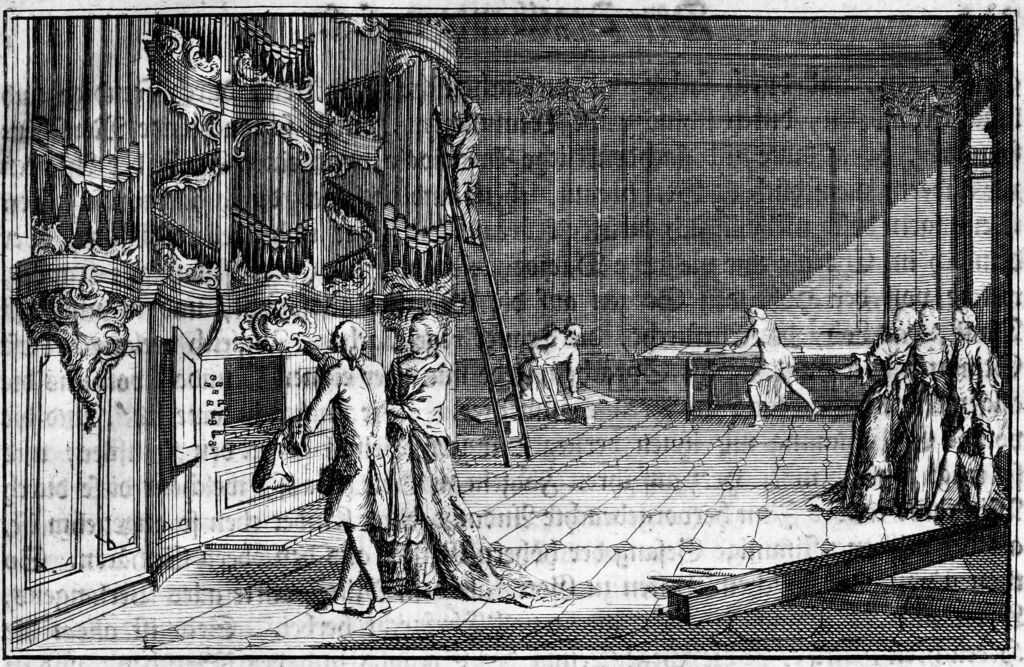
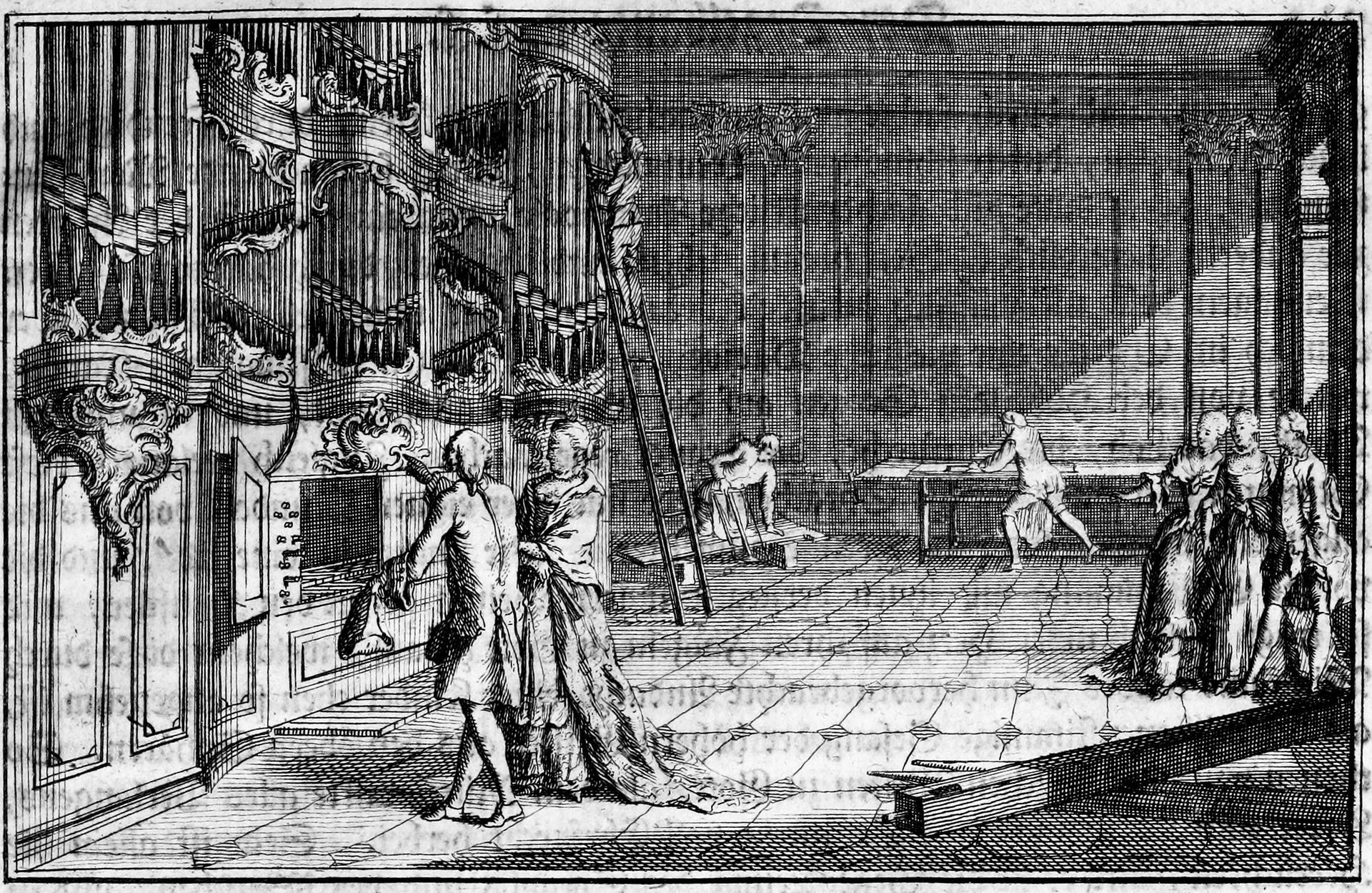
The German pages are reproduced in facsimile from the Getty Research Institute’s copy, digitized by the Internet Archive. The edition also reproduces the folding copperplate, Tab. VIII, with its 49 numbered figures, the engraved organ scene that opens the treatise and the tailpiece that closes it. The volume’s title page and its dedication to Count Heinrich IX Reuß of Köstritz are included in German and English.
Explanatory commentary is separated from Halle’s text in 117 notes and a glossary. Some historical terms remain in German, with explanations in the notes and glossary. Passages whose meaning remains uncertain are identified in Open Readings.
Where this treatise fits
Halle published The Organ Builder two years before Dom Bédos’s L’Art du facteur d’orgues began to appear in 1766. In 1779 he wrote about organ building again, at three times the length, working from Bédos. That treatise is The Art of Organ Building.
For Halle’s teaching post, his writing on other trades and why Craftsman translates these books, see Johann Samuel Halle and his organ-building treatises.
Edition and reuse
The original title, Der Orgelbauer u. s. f., means The Organ Builder, and so forth. The treatise also includes the shorter accounts of carillons, harpsichords, violins and wind instruments listed above.
Original: Johann Samuel Halle, Der Orgelbauer u. s. f., in Werkstäte der heutigen Künste, volume III, Brandenburg and Leipzig, 1764, pages 313–378 and Tab. VIII.
English edition: Translated by Jeremy Cox, with philological consultation by Dr. Kira Petersen. Published by Craftsman Technical Companies, 2026.
The original text and plates are in the public domain. The English translation, notes and glossary are licensed under Creative Commons Attribution–NonCommercial 4.0.
Download the German–English PDF · Download the English-only PDF